
- Release Year: 1994
- Platforms: Android, Genesis, iPad, iPhone, Linux, Macintosh, Wii, Windows
- Publisher: SEGA Enterprises Ltd., SEGA Europe Ltd., SEGA of America, Inc.
- Developer: Ancient Co. Ltd.
- Genre: Action, Role-playing
- Perspective: Top-down
- Game Mode: Single-player
- Gameplay: Arcade, Puzzle elements
- Setting: Fantasy, Middle East
- Average Score: 80/100
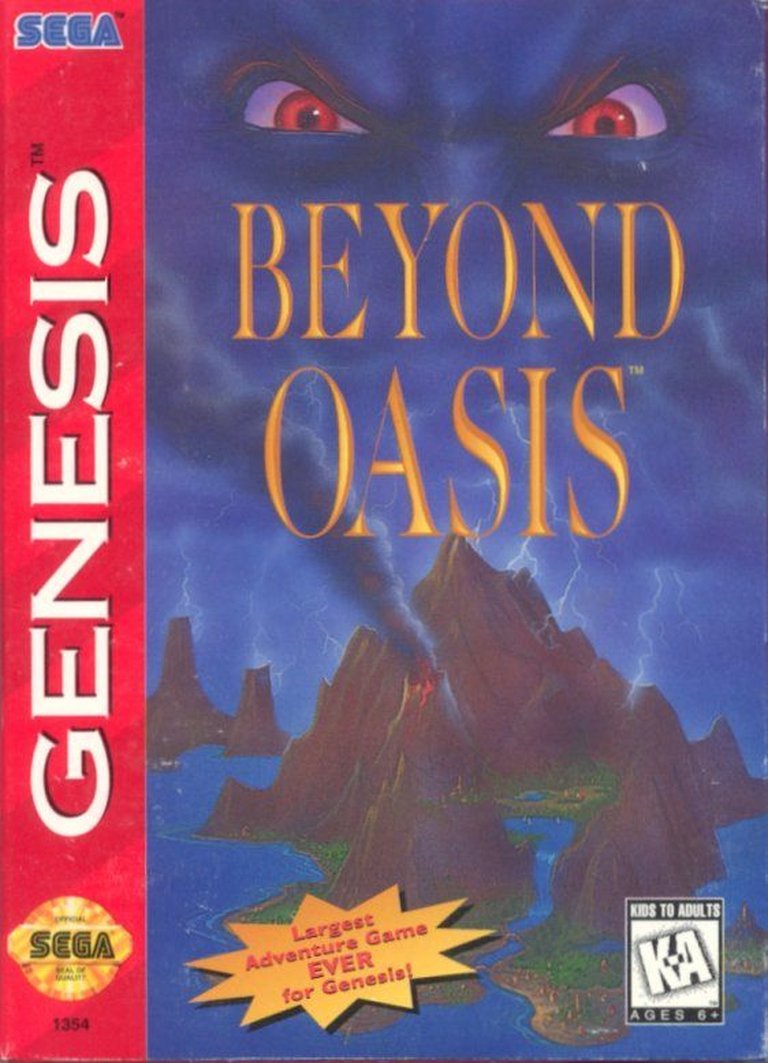
Description
Prince Ali must harness the power of the magical Golden Armlet and the four elemental Wild Spirits to confront an evil sorcerer and save the island of Oasis. This fast-paced action RPG for the Sega Genesis blends top-down dungeon crawling, puzzle-solving, and dynamic combat with a weapon deterioration system, all set against a vibrant fantasy world inspired by Middle Eastern aesthetics.
Gameplay Videos
Beyond Oasis Free Download
Genesis
Beyond Oasis Guides & Walkthroughs
Beyond Oasis Reviews & Reception
metacritic.com (80/100): one of the best action-RPGs currently available to mobile gamers.
Beyond Oasis Cheats & Codes
Sega Genesis
Game Genie codes must be entered via a Game Genie device or emulator. Button sequences are entered on the title screen or save screen as specified in the cheat effects.
| Code | Effect |
|---|---|
| AABT-AA7R | Master Code |
| ABWA-AA9T | Service Pack for Walking on Air codes |
| PBWA-CEXE | 1 Hit Kill Bosses |
| PC2T-CEXE | 1 Hit Kill Enemies |
| PAWA-EEWN | 1 Hit Kill Enemies |
| PCWT-CEZJ | 1 Hit Kill Enemies |
| H3KA-AAF8 | Always Can Use Health Restoring Items |
| FKKA-AAGW | Always Can Use SP Restoring Items |
| HW8T-BELL | Always Have Rank 999 Damage |
| HW8T-AGCN | Always Have Rank 999 Damage |
| 83NA-AA2G | Almost Invincible |
| ALFT-AA4W | Disable Active Zones |
| REPT-C6YA | Don’t lose SP on ‘Hold A’ Spirit moves |
| REPT-C6VR | Don’t lose SP on ‘Tap A’ Spirit moves |
| REPT-C6XL | Don’t lose SP with time |
| SH5T-BAX0 | Each Kill Worth 8 |
| FF1996:0001 | Game thinks It’s In Demo Mode |
| FF1A72:00DE | Health Bar stays full |
| ALCT-AA5L | Infinite Special Weapon |
| RFEA-A6W2 | Infinite All Items |
| RFEA-A61A | Infinite All Items |
| AKNA-AA6G | Infinite Energy |
| JCZT-CAG4 | Infinite Energy (part of code pair) |
| AWZT-CA88 | Infinite HP |
| AXGT-CA36 | Infinite HP |
| AKYT-AA5G | Infinite HP |
| AJFA-EA6N | Infinite HP |
| AJZA-AA2Y | Infinite HP for Japan Beta |
| FF1C90:00C8 | Infinite HP for Japan Beta (Story of Thor) |
| FF17A0:00FF | Infinite Health |
| FF17A2:00FF | Infinite Health |
| FF17A4:00FF | Infinite Magic |
| FF17A6:00FF | Infinite Magic |
| FF1A76:03E7 | Infinite Sp |
| FF0D80:00FF | Infinite weapon uses, Slot 1 |
| FF0D82:00FF | Infinite weapon uses, Slot 2 |
| ALCT-AA5E | Infinite weapons aren’t infinite |
| MXFT-AAF4 | Invincible |
| ABSA-AA6L | Jump mid-air |
| AGRA-BT3L | Float in air |
| ACXT-CA6T | Ogres can’t grab you |
| AADT-EA30 | Worms can’t grab you |
| ACRA-BY3N | Walk through walls |
| RGCT-A6XJ | Infinite weapons |
| 96KT-A0GT | Start with hyper bomb |
| 96KT-ATGT | Start with metal bow |
| 96KT-ALGT | Start with omega sword |
| 9JKT-AAH4 | Start with 250 HP (part of code pair) |
| 9JLA-AAAA | Start with 250 HP (part of code pair) |
| 8TKT-ACH4 | Start with 500 HP (part of code pair) |
| 8TLA-ACAA | Start with 500 HP (part of code pair) |
| NTLA-AAAR | Start with 100 attack (Rank) |
| 8TLA-ACAR | Start with 500 attack (Rank) |
| RFWA-A6TY | Don’t need key for blue door |
| RFWA-A6VE | Don’t need key for green door |
| RGWA-A6TE | Don’t need key for red door |
| RFWA-A6VY | Don’t need key for yellow door |
| NCFT-BNFT | Press MODE instead of A+B+C to cancel summon |
| BCFT-AAF0 | Press MODE instead of A+B+C to cancel summon |
| FF0DB8:000F | 15 black gems |
| FF0DB6:000F | 15 blue gems |
| FF1985:0000 | Ali Can Attack While in Meditation Mode |
| FF1AA9:000C | Ali in Meditation Mode |
| cabba:e | ITEMS DIGITS |
| FF0D90:00?? | Items, Slot 1 |
| FF0D92:00?? | Items, Slot 2 |
| B + Start | Best Players Screen (at title screen) |
| B + Start at save screen | Sound Test |
| Down + Right + Start | Demo |
| Down+Right, A, Z | Area select and dialog viewer |
| Up+Right, A, Y | Full inventory and upgraded stats |
| Down+Left, A, B, Z | View ending |
Beyond Oasis: A Chronicle of the Genesis’ Most Refined Action-RPG
Introduction: The Mirage in the Desert
In the vast, sun-scorched library of the Sega Genesis, few gems shimmer with the cohesive polish and stylish confidence of Beyond Oasis. Released in late 1994, as the 16-bit era waned and the industry’s gaze turned toward new 3D horizons, this action-adventure RPG from Ancient Co. Ltd. quietly infiltrated cartridge slots with a promise: a synthesis of The Legend of Zelda‘s exploratory heart with the visceral, combo-driven punch of Sega’s own Streets of Rage. It was a game that wore its inspirations on its sleeve while forging an identity so distinct that, decades later, it stands not as a mere clone, but as a masterclass in genre-blending that was, and perhaps still is, underappreciated. This review posits that Beyond Oasis is a seminal, if flawed, masterpiece of the late Genesis catalogue—a title whose technical artistry, innovative spirit-summoning system, and brisk pacing elevate it above its contemporaries, even as its truncated scope and occasionally clunky execution keep it from achieving the undisputed classic status it so clearly aspired to. It is the story of a prince, an armlet, and four elemental spirits, but more importantly, it is the story of a small studio’s audacious bid to redefine what an action-RPG could be on Sega’s flagship hardware.
Development History & Context: Ancient’s Genesis Gamble
The Studio and Its Vision
Beyond Oasis was developed by Ancient Co. Ltd., a studio born not from corporate mandate but from familial passion. Founded in April 1990 by composer Yuzo Koshiro, his mother Tomo, and his sister Ayano Koshiro, Ancient was initially a music production house. Yuzo Koshiro was already a legend in the industry, having composed the revolutionary, genre-blending soundtracks for Streets of Rage and ActRaiser. The studio’s first forays into development were support roles: they contributed character design and art direction to the landmark Streets of Rage 2 (1992) and handled audio for ActRaiser 2. This pedigree is crucial; it meant Beyond Oasis was crafted by a team whose understanding of dynamic,节奏感强的 action was innate. The shift to an original action-RPG was a natural, if ambitious, evolution. Kataru Uchimura served as game designer and main planner, while Ayano Koshiro provided the iconic anime-inspired art direction that would become the game’s visual calling card.
The “Mega RPG Project” and Technological Constraints
The game was produced under Sega of Japan’s “Mega RPG Project,” an initiative to bolster the Genesis/Mega Drive’s library of Japanese-style role-playing games—a genre where the console was perceived as weaker than the Super Nintendo. However, Beyond Oasis was not a turn-based epic. It was a conscious effort to create an “action-RPG for the West,” blending real-time combat and exploration with light RPG progression. This hybrid approach was a direct response to market sensibilities; Sega of America, overseeing the international release as Beyond Oasis, favored action-oriented titles that resonated with its audience’s love for beat-’em-ups.
Development occurred against the harsh reality of the Genesis’s hardware. The team, led by main programmer Yukio Takahashi, had to achieve scaling effects for large bosses (like the Red Dragon) and multi-layered parallax scrolling in diverse environments using the console’s limited sprite capabilities and VDP (Video Display Processor) tricks. The most significant constraint was audio. Yuzo Koshiro composed an ambitious, late-Romantic orchestral score using the Genesis’s Yamaha YM2612 FM synthesis chip and the PSG. His custom “Ancient Music Driver MD” squeezed over 30 tracks from the hardware, but the limitation meant the rich, layered sound of his vision sometimes manifested as gritty or compressed in-game—a trade-off for its emotional scope. This technical tug-of-war between artistic ambition and hardware limits defines the game’s aesthetic: a beautifully realized world viewed through a slightly hazy lens.
Late Release, Obscured Legacy
The timing was paradoxical. In Japan, it launched as The Story of Thor: Hikari o Tsugu Mono on December 9, 1994—the same day as the Sega Saturn’s debut. It was effectively an afterthought in its home market, overshadowed by the new generation. In North America, it arrived in March 1995, a month after the highly anticipated Phantasy Star IV, and at the very tail end of the Genesis’s lifecycle. Sega of America was already hedging its bets on ill-fated peripherals like the 32X and Sega CD, and the Saturn loomed. Consequently, Beyond Oasis arrived with minimal marketing, a victim of corporate transition. Yet, this late arrival meant it was among the last, most technically proficient titles on the platform, benefiting from years of iteration on the hardware’s strengths and weaknesses.
Narrative & Thematic Deep Dive: Light, Shadow, and Familial Ties
Plot Deconstruction: A Simple Frame, Complex Undertones
The narrative is straightforward: Prince Ali of the island kingdom of Oasis discovers the Golden Armlet, a relic once used by a wizard to combat an evil sorcerer wielding the Silver Armlet. Upon returning home, he finds his land invaded by monsters and his father, the King, wounded. Tasked with seeking out the four elemental Wild Spirits (Dytto, Efreet, Bow, and Shade) to counter the Silver Armlet’s power, Ali embarks on a journey across Oasis’s diverse biomes. The plot follows a classic hero’s journey structure—gather allies, overcome trials, confront the Big Bad—but its thematic core lies in the mythology of balance and the personal cost of wielding power.
The world of Oasis is built on a mythic duality. The ancient war was between Raharl (wielder of the Gold Armlet/Light) and Agito (wielder of the Silver Armlet/Chaos). This isn’t just good vs. evil; it’s a dialectic of order and entropy, creation and destruction. The four spirits are not mere tools but manifestations of natural law: Water (healing, fluidity), Fire (aggression, purification), Plant (growth, constraint), and Shadow (obscurity, protection). The player’s progression is literally the re-establishment of this primordial balance.
The story’s most potent twist is the identity of the Silver Armlet’s bearer: Ali’s older sister, Gwyne. Presumed dead after a past incident, she is revealed to be the mind-controlled vessel of Agito’s spirit. This “Samus Is a Girl” trope, subverted in the West, adds a profound layer of personal tragedy. The final victory is bittersweet; Gwyne, freed from the Silver Armlet’s influence, chooses to remain in the Spirit World as its guardian, a permanent exile to maintain the newly restored balance. The King survives but abdicates, passing the throne to Ali. The ending is not a triumphant coronation, but a quiet, somber transfer of responsibility, underscored by loss. This成熟 handling of consequence elevates the plot beyond generic “save the princess” fare, though its delivery is sparse, conveyed mostly through brief NPC dialogue and the intro/outro cutscenes—a common critique.
Character and Dialogue: Minimalist but Effective
Character development is minimal. Ali is the archetypal royal hero—brave, dutiful, and largely silent (though the player reviews note his “amorous” nature, implying some charm). The spirits are defined by their elemental roles and personalities: Efreet is hot-headed, Dytto is serene, Bow is gluttonous (per TV Tropes), Shade is enigmatic. The dialogue is functional, often cheesy by modern standards (“Oh my, the power!”). Yet, this minimalism serves the game’s pace. It is an adventure first, a drama second. The emotional weight falls on the twist and the ending, not on protracted conversations. Juri Ogawa’s script efficiently establishes lore and stakes, trusting the player to infer the mythology from environmental cues and item descriptions—a design choice that enhances immersion for those who seek it.
Gameplay Mechanics & Systems: The Alchemy of Action
Core Loop and Exploration
Beyond Oasis employs a top-down perspective with real-time exploration across an interconnected overworld map divided into distinct regions (Beach, Forest, Desert, Mountains, Castle, Shadowlands). The core loop is: arrive in a new area -> navigate environmental puzzles and combat encounters -> enter a dungeon -> defeat its guardian spirit -> gain a new spirit -> unlock new area. The map is always accessible and, in a notable quality-of-life feature, often automatically marks the next objective after key events, reducing aimless backtracking. However, as several player reviews note, this linearity can be stifling; missing a key or item can create genuine confusion, as the game offers few explicit hints.
Combat: A Beat-‘Em-Up’s Soul
This is where the game truly sings. Ali’s base knife is not a weak starter weapon but a versatile tool with a deep combo system. Tapping the attack button yields quick jabs; holding it performs a heavier, arcing slash. More importantly, directional inputs combined with the attack button unleash special moves: a forward-backward lunge, a spinning 360 attack, a backflip strike. Mastering the Alt. Knife’s moveset is a rewarding skill ceiling, making it a viable weapon throughout the game, even as breakable swords and bows enter the inventory.
The weapon durability system—a direct carryover from Streets of Rage 3—is divisive. Swords, crossbows, and bombs break after a set number of uses. While this encourages conservation and strategic switching, it can induce tension and inventory management stress. The game mitigates this by frequently spawning new weapons in chests and as enemy drops. True “Infinity +1 Swords” (like the fire-emitting Omega Sword) exist but are hidden in challenging bonus dungeons, serving as potent endgame rewards.
The Spirit System: Innovation and Interaction
The four summonable spirits are the game’s defining mechanic, seamlessly integrating combat, puzzle-solving, and exploration. They are not passive summons but active, AI-controlled companions with persistent Spirit Points (SP). Summoning requires using the Armlet’s orb on a resonant environmental object: a flame for Efreet, water for Dytto, a mirror for Shade, a Venus flytrap for Bow. Once summoned, they remain until their SP depletes or they are manually dismissed.
Their abilities are context-sensitive and tactically rich:
* Efreet (Fire): Aggressive melee support with flame breath and explosive projectiles. Can ignite enemies and certain environments.
* Dytto (Water): Ranged stun bubbles, a magic storm AoE, and, critically, healing on command. Also “Kills It with Water” against fire foes.
* Bow (Plant): Launches constricting vines that immobilize enemies and poison pollen clouds. Its “Extreme Omnivore” trait lets it crack open heavy gates—key for puzzles.
* Shade (Shadow): The utility spirit. Grants temporary invulnerability, deploys a doppelganger for multi-target attacks, and can fly Ali out of bottomless pits—a lifesaver.
Spirit synergy is rewarded; for example, using Shade’s lift can position Bow to block a boss’s charge. Boss fights often require elemental exploitation—Dytto’s water to douse a fire dragon. This system transforms Ali from a solo fighter into a commander, a significant innovation for its time. However, the reliance on environmental triggers for summoning can sometimes feel restrictive, and SP management is a constant concern in longer engagements.
Progression, Dungeons, and Flaws
Experience points from defeated enemies raise Ali’s max HP and power. Keys (color-coded) gated by spirits unlock new regions. Dungeon design evolves nicely: the first spirit’s shrine is a simple corridor; later ones maze with multi-floor puzzles, switch-block sequences, and platforming.
This platforming exposes the game’s most common criticism: control imprecision. Jumping and crouching share the same button (tap to jump, hold to crouch), leading to mistimed inputs and frustrating falls, especially in precision-platforming sections. This “Some Dexterity Required” issue, noted in multiple reviews, is the game’s primary mechanical flaw.
Other critiques include a relatively short main quest (5-8 hours), a lack of deep side-quests (though village mini-quests for better gear exist), and a linear path that discourages exploration. The “Pit of 100 Trials” bonus dungeon offers a randomly generated marathon for the Infinite Omega Sword—a nod to dedicated players—but its rewards often feel disproportionate to the effort.
World-Building, Art & Sound: A 16-Bit Masterpiece
Visual Direction: Anime Grandeur on a Genesis
Ayano Koshiro’s art direction is universally lauded as the Genesis’s pinnacle. The game achieves a vibrant, almost SNES-like color palette with rich textures, detailed sprites, and impressive animation. Ali’s running cycle, spirit summoning animations, and the massive, scaling boss models (a technical feat for the hardware) exhibit a fluidity rare on the console. The environments—from the sun-drenched beaches and lush, overgrown forests to the fiery depths of Volcano and the monochrome horror of the Shadow World—are distinct and atmospheric. The top-down perspective allows for clear visibility of hazards and enemy patterns, a practical boon for the action gameplay. The “American Kirby Is Hardcore” trope is in full effect; Western covers traded the anime artwork for more serious, dramatic pieces, yet the in-game aesthetic is undeniably that of a high-energy, Saturday morning cartoon come to life.
Sound Design: Koshiro’s Orchestral Ambition
Yuzo Koshiro’s soundtrack is a landmark achievement in FM synthesis. Eschewing the rock and techno of Streets of Rage, he composed a sweeping, late-Romantic score with leitmotifs for each region. The serene, woodwind-like “Aqua” for the Water Shrine, the percussive, driving “Burning Cave” for Fire Mountain, and the ominous, low brass of the Shadow World themes create an emotional soundscape that elevates the entire experience. The main theme, “The Story of Thor,” is a triumphant, memorable fanfare. While some reviews (notably GameFan) quipped that “Yuzo must be going deaf” if this was considered “just good,” the consensus across time is that it is a classic 16-bit OST, even receiving a 2024 vinyl reissue.
The sound effects, programmed by Hideki Koyama, are functional and impactful. Sword clashes, enemy screams (over a dozen types), and spell effects provide satisfying feedback. They are, however, “scratchy” by design due to FM synthesis limitations, and lack the crispness of sample-based audio—a consistent note in critiques that the sound effects are “forgettable” compared to the music.
Reception & Legacy: From Obscurity to Cult Veneration
Contemporary Reception: High Scores, Low Profile
Critical reception at launch was generally favorable to excellent, with an average score of 86% from critics on MobyGames and 78% on GameRankings. European magazines like Consoles Plus (96%) and Player One (96%) were effusive, calling it “a small jewel” and “brimming with original ideas.” GameFan awarded it 95% and named it Action RPG of the Year for 1995. Electronic Gaming Monthly praised the vast world and plot twists, while Mean Machines declared it “hell of a game.”
Common praise centered on:
* Graphics and animation (“best-looking Genesis game”).
* The innovative and deep spirit-summoning system.
* The fast-paced, satisfying combat.
* A user-friendly interface and always-available map.
Common criticisms echoed through nearly every review:
* Brevity: The main quest is short, with limited replay value.
* Sound: The music was divisive (though many loved it), the sound effects often deemed forgettable.
* Linearity and Guidance: The narrow critical path could leave players stuck.
* Difficulty Spikes: Certain platforming sections and boss fights (notably the final form of Agito) were punishing.
* Control Issues: The shared jump/crouch button was a persistent frustration.
A particularly scathing Next Generation review (2/5) argued it was “average on both fronts” (action and RPG), with a weak story and poor fighting—a outlier take that highlights how its hybrid nature was a double-edged sword. For traditional RPG fans, it lacked depth; for pure action fans, it had extraneous systems.
Re-evaluation and Cult Status
In the years following its release, Beyond Oasis slipped into relative obscurity, overshadowed by perennial Genesis classics. However, its inclusion in compilations like Sonic’s Ultimate Genesis Collection (2009) and, most significantly, the Wii Virtual Console re-release in 2007 sparked a major reappraisal. IGN’s 8/10 review called it “very stylish” and argued its unique mechanics “deserve to be mentioned alongside such classics as Secret of Mana.” GamesRadar later ranked it #38 on its “Best Sega Genesis/Mega Drive games” list.
The narrative shifted. It was no longer a mainstream title but a hidden gem—a “Zelda clone for the Genesis done right,” as one player review succinctly stated. Its strengths (art, combat innovation, pacing) were reevaluated as conscious choices rather than shortcomings. Its weaknesses (short length, linearity) were reframed as a “brisk, arcade-friendly adventure” perfect for a weekend playthrough.
Influence and the Oasis Legacy
The game’s direct legacy is a single prequel, The Legend of Oasis (1996) for the Sega Saturn. Developed by the same team, it shifted to 3D graphics, expanded the lore (introducing new spirits like Airl the Wind Spirit), and, per fan consensus, was more merciful with weapon durability. However, it sold poorly, ending the franchise.
The spirit-summoning mechanic—calling forth AI elementals from environmental triggers—is Beyond Oasis‘s most influential contribution. It predates and conceptually resonates with later systems like the “Partner” mechanics in Chrono Trigger or the summons in modern Final Fantasy titles, but with a unique tactical integration into real-time combat and physics-based puzzles. Its DNA can be faintly traced in games that blend action combat with strategic companion management.
Culturally, Yuzo Koshiro’s soundtrack became a beloved piece of chiptune history, frequently streamed and remixed. The game’s resurgence on modern platforms—Steam (2012), SEGA Forever mobile ports (2017), Sega Genesis Classics (2018), and Nintendo Switch Online + Expansion Pack (2022)—has cemented its status as a preserved classic of the 16-bit era, accessible to new generations who missed its original window.
Conclusion: An Imperfect Jewel in the Crown
Beyond Oasis is not a flawless game. Its narrative is thin, its sound effects unremarkable, its control scheme occasionally infuriating, and its campaign regrettably brief. Yet, to dismiss it for these reasons is to miss the forest for the oases. It is a game of extraordinary confidence and style. It takes the best parts of Zelda—exploration, puzzle-item integration, overworld connectivity—and fuses them with the immediate, kinetic joy of a Sega beat-’em-up. The four spirit system is a masterstroke of design, creating a legion of tactical possibilities from a simple premise. Visually and aurally, it is a towering achievement for the Genesis, representing the plateau of what the hardware could express.
Its late arrival meant it was a swan song for the Genesis’s original era—a final, polished statement from a studio that understood the console’s soul. It was overlooked then, but time has been kind. In an era where “action-RPG” often means repetitive grinding or bloated open worlds, Beyond Oasis remains a refreshingly focused, 5-8 hour adventure that respects the player’s time. It is a game that knows exactly what it wants to be—a stylish, spirited, arcade-drenched action-RPG—and executes that vision with a precision few of its contemporaries could match.
Final Verdict: Beyond Oasis is an essential, if niche, classic of the 16-bit era. It is not the Zelda rival it was sometimes touted as, but it is something more interesting: a unique hybrid that perfected its own blend of元素 magic and hack-and-slash. It belongs in the pantheon not as an “also-ran,” but as a brilliant, idiosyncratic outlier—a mirage that, upon closer inspection, reveals itself to be very, very real. For any scholar of the Genesis or the action-RPG genre, it is a mandatory study in how to stretch a console’s limits and leave a lasting, if subtle, impression on the DNA of game design.