
- Release Year: 2009
- Platforms: Windows
- Publisher: Ikarus Modellsport
- Developer: IPACS GbR
- Genre: Simulation
- Perspective: 1st-person, 3rd-person, Behind view
- Game Mode: Single-player
- Gameplay: Aircraft selection, Flight Simulation, RC control, Viewpoint customization, Weather effects
Description
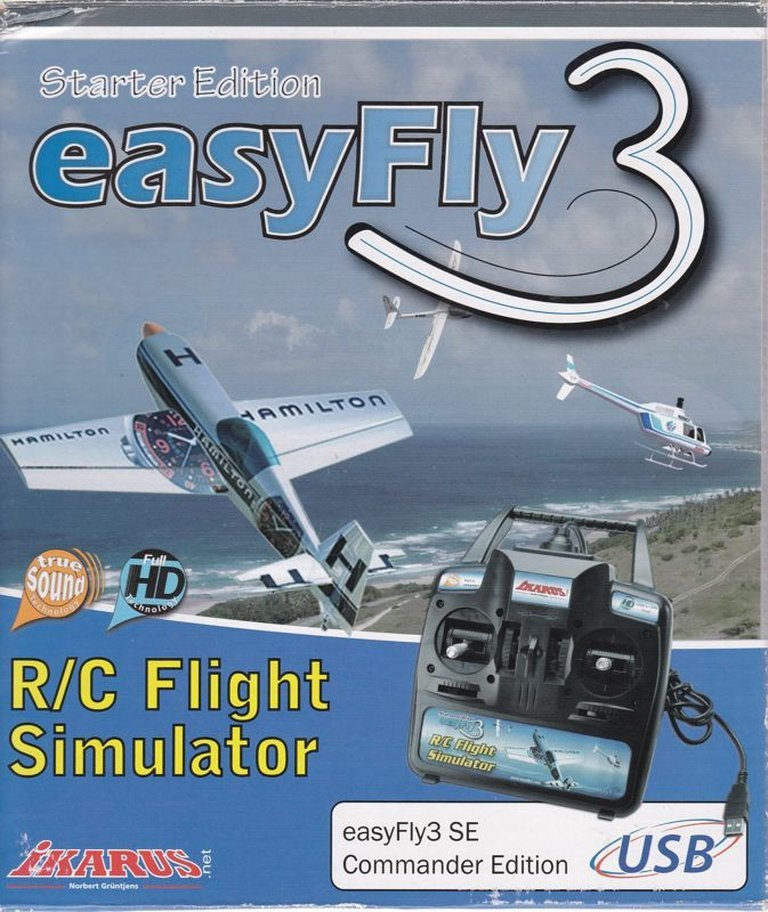
easyFly 3: Starter Edition is a flight simulation game focused on piloting remote-controlled aircraft, offering a realistic experience with a bundled USB controller that mimics a twin-stick radio control set. Players can fly various planes, helicopters, gliders, and jets in selectable locations, with customizable options like viewpoints, smoke effects, and weather conditions, though this Starter Edition restricts access to only a portion of the full game’s content.
easyFly 3: Starter Edition Cracks & Fixes
easyFly 3: Starter Edition: A Review
Introduction: The Sky’s the Limit (But Only Just)
In the vast and often overwhelming landscape of flight simulation, where complex study sims like Microsoft Flight Simulator and X-Plane dominate the discourse, a quieter, more specialized niche has always thrived: the radio-controlled (R/C) aircraft simulator. It is within this dedicated subgenre that easyFly 3: Starter Edition emerges—not as a revolutionary titan, but as a calculated, accessible gateway. Released in March 2009 by the German publishers Ikarus Modellsport and developed by IPACS GbR, this title represents a specific, almost artisanal, approach to flight simulation. Its thesis is not one of global conquest or hyper-realism, but of democratization: bringing the precise, skill-based joy of R/C flying to the desktop of any enthusiast with a modest PC, armed with a uniquely tangible peripheral. This review will dissect easyFly 3: Starter Edition not on the scale of its contemporaries, but on the merits of its own narrow, meticulously crafted ambitions, evaluating how successfully it translates the tactile, outdoor hobby into a constrained but compelling digital experience.
Development History & Context: The Aerofly Legacy and the Niche Engine
To understand easyFly 3: Starter Edition is to understand its progenitor, Aerofly Professional Deluxe. IPACS, a German development studio with a clear focus on R/C simulation, had already established its technical and design credibility with the award-winning Aerofly. The easyFly 3 engine, therefore, was not built from scratch but refined from a proven foundation. This context is crucial: the simulation’s core flight physics, 3D graphics pipeline, and scenery rendering technology were battle-tested in a more advanced product. The 2009 release date places the game firmly in the late-PC era, where DirectX 9 and OpenGL 2.0 were standard, and multi-core processors were becoming commonplace, yet still demanded optimization. The “Starter Edition” moniker reveals the market strategy: to create a low-cost, physical-retail entry point. The technological constraint was not just about system requirements (a Pentium 4 1.5GHz and 512MB RAM), but about content constraints. The full easyFly 3 was a substantial package (30 aircraft, 8 sceneries); this Starter Edition was deliberately hobbled—a “freemium” model before the term was ubiquitous in gaming—to encourage an eventual upgrade purchase. The gaming landscape of 2009 was seeing the rise of digital distribution (Steam was gaining traction), yet easyFly 3: Starter Edition relied on a traditional CD-ROM in a sturdy box, its most novel feature being the included USB controller. This physicality was its primary differentiator in a market moving toward digital keys and generic controllers.
Narrative & Thematic Deep Dive: The Absence of Story, The Presence of Place
easyFly 3: Starter Edition has no narrative in the conventional sense. There are no characters, no plot, no dialogue. Its “story” is the player’s own journey from clumsy novice to confident virtual pilot. The theme is pure, unadulterated simulation as practice. The game is a digital dojo. The underlying philosophy, inherited from the R/C hobby itself, is one of mastery, patience, and intimate understanding of a machine’s interaction with the elements. The only “plot” is the arc of a flight: takeoff, navigation, reaction to wind and thermals, and a (hopefully) perfect landing. The “characters” are the aircraft themselves—each with distinct personalities defined by their weight, power, and aerodynamics. The dialogue is written in the silent language of control inputs and physical feedback. This absence of authored narrative is not a flaw but a feature; it demands the player project their own goals and experiences onto the open sky. The true thematic resonance lies in the translation of a tactile, outdoor pastime into a safe, weather-independent, and infinitely repeatable indoor discipline. It’s about the process, not the product.
Gameplay Mechanics & Systems: The Physics of a PPM Stick
The core gameplay loop is deceptively simple: select an aircraft and a location, then fly. Its genius and its challenge are embedded entirely in its control scheme and physics model.
The Controller as Rosetta Stone: The included USB “Game Commander” is not an afterthought; it is the game. It is a twin-stick radio transmitter replica, complete with a fake battery compartment. This design does more than look cool—it enforces the correct muscle memory. The left stick controls throttle (up/down) and rudder (left/right); the right stick controls elevator (pitch) and ailerons (roll). This is the standard mode 2 configuration in R/C, and using a gamepad or keyboard would be a crippling abstraction. The manual explicitly warns that calibration is imperative on first use, a process involving centering the sticks and then moving them to their maximum deflection. This step is the sacred rite of passage that aligns the player’s physical intent with the digital aircraft.
Flight Physics & “Break-Apart” Technology: Built on the Aerofly pedigree, the flight model is reportedly sophisticated for its class. It accounts for terrain-induced wind, turbulence, and thermals—critical for glider flight. The inclusion of “break-apart” mechanics (wings, landing gear detaching under stress or crash forces) is a standout feature that adds visceral consequence and humor, directly translating the costly mistakes of real R/C into a dramatic, repeatable spectacle. Helicopter autorotation training is another deep-cut feature that signals a commitment to hobbyist authenticity.
Progression & Customization: Progression is horizontal, not vertical. There is no tech tree, no experience points. Progress is measured in skill acquisition. Customization is environmental and aesthetic: adjusting wind strength/direction, toggling thermals, choosing smoke color, and selecting from multiple camera viewpoints (ground, chase, cockpit). The cockpit view includes a “realistic instrument display,” adding another layer of immersion for those seeking it. The fundamental systems are robust but narrow, focused entirely on the fidelity of the flight model and the fidelity of the input-to-action response.
The Starter Edition Shackle: The gameplay is fundamentally intact but truncated. Six aircraft (Cularis trainer, ECO 7 helicopter, Extra aerobatic plane, F-84 jet, Lama bi-rotor helicopter, PT-40 trainer) and four locations (Barbados, Marxzell, US-Lincoln-Sky-Knights, Hawaii 3D) are locked. The full version’s additional 24 models and 4 more sceneries are gated behind an online-purchasable serial number. This creates a clear “ceiling” on exploration and variety, a tangible limit on the game’s replayability that defines the “Starter” experience.
World-Building, Art & Sound: Photorealism in a Miniature World
The visual and auditory presentation is where easyFly 3: Starter Edition punches above its weight class for a budget 2009 title.
Visuals & Scenery: The claim of “breath-taking 360 degree photographic sceneries” is not mere hyperbole for the era. The three photographic locations (Barbados, Marxzell, Lincoln-Sky-Knights) use actual ground-level panoramas stitched into expansive, flyable 3D volumes. This technique, while potentially repetitive, creates an unprecedented sense ofPlace for an R/C sim. Flying over the real Marxzell airfield in Germany or the beaches of Barbados feels distinct and geographically truthful. The Hawaii location is a fully modeled 3D environment with four landing areas, showcasing the engine’s capability for both photo-textured and polygon-modeled terrain. The aircraft models are “extremely detailed,” with reflective surfaces that accurately catch the environment—a subtle but crucial touch for simulating the gleam of a real model in sunlight. The “Full HD” (1920×1080) resolution support was a premium feature at the time.
Sound & Atmosphere: Sound design is functional and effective. The “True Sound” and “Glider sound”提及 indicate attention to different aircraft audio profiles. The “sizzle” of a jet, the whir of a glider, the distinct thwop of a helicopter rotor are all present. The inclusion of sunlight reflection effects and a customizable fog/smoke system completes the atmospheric picture, allowing for dramatic sunrise flights over mountains or mystery-flights through misty valleys. The overall atmosphere is one of serene, scale-playing beauty—you are not a giant god in a small world, but a tiny pilot in a real, vast one.
Reception & Legacy: A Quiet Cult Classic
Official critical reception data for the Starter Edition specifically is virtually non-existent on aggregate sites like MobyGames, a testament to its niche distribution. However, we can infer its position from the ecosystem it inhabited.
Commercial Context: As a physical retail product with a unique bundled controller, it likely targeted hobby shops and the R/C modeling community more than the general PC gaming aisle. Its business model—selling a functional-but-crippled product with a clear, convenient upgrade path—was common in simulation and creative software (e.g., early versions of Cinema 4D). It was a low-risk trial for the curious and a gift for newcomers.
Legacy and Influence: Its legacy is twofold. First, within the small constellation of dedicated R/C sims, easyFly 3 is remembered as a capable, accessible entry point, sitting between the ultra-accessible RealFlight (with its even more advanced hardware) and the more bare-bones options. Its use of real-world photographic scenery was a notable technical achievement. Second, and more broadly, it represents a specific early-2000s/early-2010s model of simulation: the premium physical peripheral bundled with a proprietary software suite. In an era of generic flight sticks and VR, that dedicated, purpose-built controller feels like a lost artifact. The series continued beyond easyFly 3, and the IPACS engine evolved, finding new life in mobile and VR applications, suggesting the core technology had lasting value. Its primary influence was on the player’s own skill set: for many, it was the first software that taught the genuine principles of R/C flight, making the jump to a real field less daunting.
Conclusion: A Niche Perfected, A Product Defined by Its Limits
easyFly 3: Starter Edition is a paradox. It is both a fantastic introduction to R/C flight simulation and a product irrevocably defined by its commercial constraints. Its strengths—the authentic twin-stick controller, the robust flight physics derived from Aerofly, the stunning photographic sceneries, and features like break-apart models and wind simulation—are all genuinely impressive for its price point and era. It succeeds utterly at its primary mission: to give a convincing, skill-transferable taste of the R/C hobby.
However, its weaknesses are the other side of that same coin. The limited aircraft and locations create a finite playground. The lack of any structured missions or tutorials beyond the manual (which is a PDF on the CD) means the learning curve is steep and self-directed. The requirement for an internet connection for activation and the separate purchase for the full content feel archaic even for 2009.
Final Verdict: easyFly 3: Starter Edition is not a classic in the pantheon of great games, nor was it meant to be. It is a superb tool. For the person in 2009 (or today, via the secondary market) curious about R/C flying, it remains a remarkably effective and charming gateway. Its place in history is not one of broad influence, but of perfect exemplification: it is the definitive artifact of the budget, hardware-bundled R/C simulator era. It proves that a game’s value is not solely in its scope, but in the integrity and authenticity of the micro-experience it offers. For those who wish to feel the sticks in their hands and think in four-channel corrections, the Starter Edition delivers. For those wanting a vast, ever-expanding sandbox, it offers only a beautifully rendered, but frustratingly gated, preview. Its legacy is that of a skilled, dedicated teacher who, for reasons of business, can only give you the first few chapters of the textbook.