
- Release Year: 2004
- Platforms: Windows
- Publisher: Sierra Entertainment, Inc.
- Game Mode: Online PVP, Single-player
- Average Score: 98/100
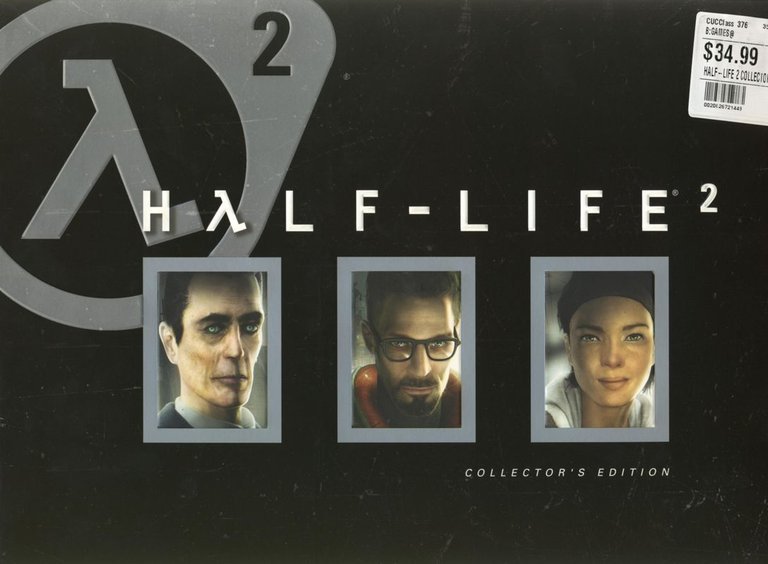
Description
Half-Life 2 is a groundbreaking first-person shooter set in a dystopian Earth occupied by the alien Combine empire. Players assume the role of Gordon Freeman, a physicist turned resistance fighter, who must navigate through urban and rural environments, solving physics-based puzzles and engaging in combat to liberate humanity, all while experiencing a deeply immersive narrative driven by advanced character animations and the Source engine’s realistic physics.
Gameplay Videos
Half-Life 2 (Collector’s Edition) Free Download
Half-Life 2 (Collector’s Edition) Guides & Walkthroughs
Half-Life 2 (Collector’s Edition) Reviews & Reception
ign.com : Half-Life 2 is, simply put, the best single-player shooter ever released for the PC.
metacritic.com (96/100): No other game has ever lived up to six years of hype and then left gamers so glued to their PCs that 24 hours later.
imdb.com (100/100): The most engrossing video game ever made.
Half-Life 2 (Collector’s Edition) Cheats & Codes
Half-Life 2 PC
Enable the developer console in game settings, press ~ during gameplay, type sv_cheats 1, then enter the desired cheat code.
| Code | Effect |
|---|---|
| god | Toggles invincibility (god mode) |
| noclip | Allows flying and walking through walls |
| impulse 101 | Grants all weapons and full ammo |
| impulse 82 | Spawns a jeep |
| notarget | NPCs ignore the player |
| map | Loads a specified map |
| give | Gives a weapon or item |
| buddha | Reduces health but prevents death |
| hurtme | Damages the player by a specified amount |
| developer | Toggles developer mode (0=off, 1=on, 2=verbose) |
| picker | Toggles picker mode |
| cl_drawhud | Toggles HUD display |
| cl_enablehud | Toggles HUD display |
| cl_showfps | Shows frames per second |
| +mlook | Enables mouse look |
| hud_quickhelp/text? 1 | Shows crosshairs |
| viewmodel_fov | Sets the size of the weapon viewmodel |
| exec | Executes a script file |
| npc_create | Creates an NPC at the player’s position |
| npc_create_aimed | Creates an NPC aiming away from the player |
| setpos | Moves the player to specified coordinates |
| setang | Sets player view to specified pitch and yaw |
| sv_gravity | Sets gravity value |
| sv_stopspeed | Sets minimum stopping speed on ground |
| sv_friction | Sets world friction |
| sv_bounce | Sets bounce multiplier for physically simulated objects |
| sv_maxvelocity | Sets maximum velocity of any moving object |
| sv_waterdist | Sets vertical view fixup when eyes are near water |
| air_density | Changes air density |
| dsp_explosion_effect_duration | Sets length of explosion confusion effect |
| prop_debug | Toggles bounding-boxes debug mode |
| sv_soundemitter_filecheck | Toggles reporting missing .wav files |
| mat_numtextureunits | Limits number of texture units |
| vcollide_wireframe 1 | Shows wireframe for physics-affected objects |
| mat_fastnobump | Toggles bump mapping |
| impulse 200 | Removes weapon model from screen |
| showtriggers_toggle | Shows game triggers |
| mat_normalmaps 1 | Shows normal maps |
| mat_normals 1 | Shows surface materials |
| mat_yuv 0 | Restores color |
| givecurrentammo | Refills ammo for current weapon |
| sv_unlockedchapters 16 | Unlocks all chapters |
| ent_fire | Fires an entity event (e.g., for NPC behavior) |
| npc_create_equipment | Equips spawned NPCs with a specified weapon |
| ai_disable | Disables all NPC AI |
| ai_resume | Resumes NPC AI |
| thirdperson | Enables third-person view |
| firstperson | Switches to first-person view |
| fov | Changes field of view |
| r_drawviewmodel | Hides or shows weapon model |
| sk_plr_dmg_crowbar | Sets crowbar damage value |
Half-Life 2 (Collector’s Edition): A Monument in Interactive Storytelling and Physics-Driven Gameplay
Introduction
To discuss Half-Life 2 is to discuss a pivotal moment where video games irrevocably altered their own trajectory. Released in 2004 after a tumultuous five-year development cycle, it was not merely a sequel but a seismic event that redefined expectations for narrative cohesion, environmental interactivity, and technical prowess in the first-person shooter genre. The Collector’s Edition, released concurrently, physically manifested the game’s cultural weight with its tangible extras—a T-shirt, strategy guide, and bundled classic Half-Life ports—acting as a curated time capsule for a landmark release. This review will argue that Half-Life 2, and by extension this premium packaging, stands as a masterclass in holistic game design. It successfully fused a gripping, player-centric dystopian narrative with a revolutionary physics-based gameplay system, all wrapped in a meticulously crafted world. Its influence is not just historical but pervasively felt in every modern immersive sim and narrative-driven FPS that followed.
Development History & Context
Valve’s Ambitious Vision and the “Unlimited” Budget
Development began in June 1999, just six months after the original Half-Life’s release. Valve President Gabe Newell instilled a culture of uncompromising innovation, famously telling his team: “Why spend four years of your life building something that isn’t innovative and is basically pointless? If Half-Life 2 isn’t viewed as the best PC game of all time, it’s going to completely bum out most of the guys on this team.” Newell provided a “virtually unlimited” budget and no fixed deadline, funding the project internally if necessary. This rare creative freedom allowed for a marathon development spanning roughly 82-100 developers (including voice actors) and costing an estimated $40 million, a staggering sum for the era.
The Source Engine and Havok Physics: A Dual Revolution
Central to Valve’s vision was the simultaneous creation of the Source engine. This was not merely a graphical upgrade but a foundational shift. The team integrated a heavily modified version of the Havok physics engine, moving physics from a novelty to a core gameplay pillar. Early experiments, such as the internal minigame “Zombie Basketball,” proved the potential for emergent, player-driven solutions. Newell’s initial feedback on a 2001 showreel was harsh; he felt physics demonstrations lacked gameplay context and a dialogue-heavy scene with Dr. Kleiner was overlong. This led writer Marc Laidlaw to a critical conclusion: character drama must support interactivity, not compete with it. The final product would become a benchmark in environmental storytelling.
The 2003 Leak, Backlash, and Final Push
The project’s darkest chapter came in September 2003. German hacker Axel Gembe infiltrated Valve’s network and obtained the source code. By early October, a playable but deeply unfinished build was leaked online. The public see the game’s rough edges—placeholder graphics, broken AI—and a wave of backlash crashed upon Valve, severely damaging team morale. The already-delayed project (having missed its announced September 30, 2003, date) faced a crisis of confidence. Development continued under immense pressure, with costs rumored to reach $1 million per month. A pivotal moment came in March 2004 when the team completed the first fully playable start-to-finish build.Key cuts were made, including the original “Borealis” icebreaker concept and the jet ski (replaced by the airboat). The gravity gun was repositioned to an earlier, more impactful introduction. After months of polishing and playtesting, Half-Life 2 was finally mastered on October 13, 2004.
The Steam Mandate and Retail Disputes
Half-Life 2’s release was inherently tied to Valve’s Steam digital distribution platform. It required an active Steam account and online verification, a decision that sparked immediate controversy over ownership rights, installation hurdles, and digital rights management (DRM). This tension spilled into the legal realm. Publisher Sierra Entertainment (under Vivendi Universal Games) disputed distribution rights to cyber cafés, leading to a lawsuit. In November 2004, a federal judge ruled in Valve’s favor, affirming their sole authority to license the game for public play—a landmark decision that strengthened digital-first distribution models. The Collector’s Edition, distributed by Sierra, included the game on a limited edition DVD-ROM alongside Counter-Strike: Source and Half-Life: Source, a men’s XL T-shirt, and a Prima strategy guide. This physical premium offering sought to balance the digital mandate with tangible collector’s value.
Narrative & Thematic Deep Dive
A Story Told Through the First-Person Lens
Half-Life 2 continues the story of Gordon Freeman, the theoretical physicist from Black Mesa, now a legendary figure in a oppressed Earth. The narrative is delivered with Valve’s signature “no cut-scene” philosophy. The story unfolds entirely from Gordon’s first-person perspective. Environmental cues—graffiti, propaganda broadcasts, the hushed conversations of citizens—and scripted in-game sequences build the world. The player learns of the Combine, an interdimensional empire that conquered Earth in the Seven Hour War, and their puppet ruler, Dr. Wallace Breen (the former Black Mesa administrator). The plot is a methodical journey from the grim, Orwellian urbanity of City 17 through the zombie hellscape of Ravenholm, to the coastal resistance outposts and the final assault on the Citadel.
Character and Performance: Pillars of Emotional Weight
Where the original Half-Life had archetypes, the sequel features fully realized characters, a deliberate design choice informed by observing player connections to minor NPCs in the first game. Animator Ken Birdwell studied psychologist Paul Ekman’s work on facial musculature to create nuanced expressions. Writer Marc Laidlaw established family units as the core emotional driver—most notably the Vance family (Eli, Alyx, and Dog, Alyx’s robot companion). The voice acting, featuring talents like Robert Guillaume (Eli Vance) and Robert Culp (Wallace Breen), is exceptional, with lip-syncing and animation so precise it invites the player to lean in and watch during dialogues. Alyx Vance emerges as a landmark character: a capable, witty, and compassionate partner who feels organically integrated into the gameplay (she assists in combat, puzzles, and navigation) rather than a relegated escort.
Themes: Resistance, Complicity, and the Nature of Control
The narrative is a dense exploration of dystopian control. The Combine’s rule is enforced not just by soldiers but by Civil Protection—collaborating humans motivated by privilege and fear. Themes of biological exploitation (the use of headcrabs as weapons, the transformation of humans into Stalkers) and resource depletion (the Combine draining Earth’s oceans and atmosphere) permeate the setting. Dr. Breen’s philosophical rationalizations for surrender present a chilling vision of intellectual complicity. The recurring motif of “the right man in the wrong place” (as Barney Calhoun puts it) questions the myth of the lone hero; Gordon is a catalyst, but the rebellion is a collective effort by citizens, scientists, and even erstwhile alien allies like the Vortigaunts. The enigmatic G-Man remains a puppet master, his final words—”My offer is for you alone… the right man in the wrong place”—hinting at a larger, manipulative cosmos beyond the Combine threat.
Gameplay Mechanics & Systems
The Core Loop: Seamless Interactivity
The gameplay loop is a masterclass in pacing and variety. Players navigate linear but sprawling levels, engaging in combat, solving physics-based puzzles, and participating in set-piece vehicle sequences. The HUD is minimalist: health, suit energy, and ammunition. There is no traditional inventory screen; weapons are accessed via a quick-select radial menu. The HEV Mark V suit provides audio feedback for damage and low health, maintaining immersion.
Combat: AI, Arsenal, and the Gravity Gun
Combat is defined by intelligent, tactical AI. Combine soldiers use cover, flanking maneuvers, and suppressive fire. They coordinate across squads and react dynamically to the player’s use of the environment. The arsenal is varied and satisfying: from the reliable 9mm pistol and shotgun to the long-range crossbow and powerful Combine pulse rifle. The star is the Zero Point Energy Field Manipulator, universally known as the Gravity Gun. Initially used for light object manipulation and fetching out-of-reach items, it is upgraded mid-game after exposure to Citadel dark energy. The upgraded gun can lift and propel heavier objects, instantly kill standard Combine soldiers, and disintegrate their weapons. It transforms from a tool into a weapon of war, perfectly symbolizing the player’s growing power against the regime.
Physics: The Central Gameplay Pillar
Physics are not an effect; they are the primary mechanic. Puzzles require stacking crates, balancing weights on levers, or using explosive barrels to clear obstacles. In combat, the Gravity Gun enables creative solutions: flinging saw blades, catching and returning grenades, using wrecked cars as shields, or collapsing structures on enemies. The environment is a sandbox of interactivity. This systemic approach makes encounters feel unique to each player’s choices.
Vehicles: Expanding the Scale
Vehicles provide crucial pacing shifts and a sense of scale. The airboat sequence through City 17’s canals is a thrilling chase against a relentless Hunter-Chopper. The later dune buggy ride along the coastal highway (Highway 17 and Sandtraps) introduces the terrifying Antlions—burrowing insects that attack from sand. The pheropod (or “bugbait”) allows the player to command Antlions, deploying them as a squad against Combine fortifications. These sections break up the on-foot pacing while reinforcing the game’s theme of using the environment and its creatures against a common foe.
Flaws: Teammate AI and Pacing
Not all systems are flawless. Friendly NPC AI, particularly during scripted sequences or in tight corridors, can be problematic. Allies like Barney or Resistance fighters often impede movement, crowding doorways or blocking progress, lacking a robust “hold position” command. Some players also found the long, vehicle-focused chapters (especially the dune buggy segment) to be slightly protracted, though they are punctuated by combat and discovery.
World-Building, Art & Sound
City 17: A Dystopian Eastern European Masterpiece
Art director Viktor Antonov championed an Eastern European aesthetic to create a sense of foreign occupation and decay. City 17 is a juxtaposition of crumbling pre-war architecture, brutalist Combine structures, and eerie, pristine propaganda. The Citadel, a towering, organic-technological spire, dominates the skyline—a constant, oppressive presence. The world tells a story of gradual descent: early levels feature muted, overcast skies and orderly oppression; later, the rebellion paints graffiti and scars the city with battle damage, culminating in the finale’s all-out urban warfare under a hellish, Citadel-lit sky.
Visual Design: Light, Shadow, and Detail
The Source engine delivers stunningly detailed textures, realistic lighting, and dynamic shadows. Light is used narratively: the passage of time is marked by the setting sun during the canal and coastal journeys, creating a melancholic, waning-day atmosphere. Character models are extraordinarily expressive for their time, with subtle facial animations and body language conveying emotion without dialogue. The visual design of enemies and technology is iconic: the sleek, menacing lines of Combine soldiers, the grotesque biomechanics of Stalkers, and the terrifying, tripodal Striders.
Sound Design and Score: An Auditory Landscape
Sound is integral to the experience. Kelly Bailey’s ambient soundtrack is sparse, eerie, and often diegetic—heard from in-world radios or speakers, reinforcing the setting’s lived-in reality. It swells only for key moments, making those peaks more impactful. Weapon sounds have weight and recoil; the thwump of the Gravity Gun, the crack of the crossbow, and the Combine soldiers’ clattering, synthesized voices are instantly iconic. Environmental audio—the dripping water of Ravenholm, the distant rumble of Citadel reactors, the screech of Antlions—builds palpable tension. The soundscape is one of palpable dread and industrial oppression.
Reception & Legacy
Critical Acclaim and Commercial Success
Half-Life 2 was met with universal critical acclaim. It holds a Metacritic score of 96 for PC—one of the highest ever. Publications like PC Gamer (US: 98%, UK: 96%), IGN (9.7/10), Edge (10/10), and Eurogamer (10/10) hailed it as a masterpiece. Maximum PC infamously awarded it an 11/10, calling it “the best game ever made.” It won 39 Game of the Year awards, including top honors from the AIAS (D.I.C.E. Awards), BAFTA, Game Developers Choice Awards, and Spike Video Game Awards. By 2011, it had sold 12 million copies worldwide.
The launch was not without controversy. The mandatory Steam installation and online verification drew fire for being intrusive and buggy, with some reviewers penalizing the game for it. The 2003 source code leak remained a stain on Valve’s public relations, though it ultimately fostered a massive modding community. The Collector’s Edition itself received a modest MobyGames score of 7.7 from 50 user ratings, likely reflecting its niche nature as a physical collector’s item rather than ajudgment on the base game.
Influence on the Industry and Medium
Half-Life 2’s legacy is profound and multifaceted:
* Physics as Core Gameplay: It mainstreamed the idea that physics simulations could drive puzzles, combat, and player expression, influencing titles from Portal to Bioshock to Red Faction: Guerrilla.
* Narrative Integration: Its seamless, first-person storytelling, devoid of cut-scenes, became a gold standard for immersive sims and narrative FPS games.
* The Source Engine and Modding: The release of the Source SDK birthed a modding renaissance. Total conversions like Garry’s Mod (a phenomenon in itself), Black Mesa, and Dystopia, along with countless maps and modes, extended the game’s life for decades. The 20th-anniversary update in 2024 added official Steam Workshop support, formalizing this legacy.
* Episodic Storytelling & The Orange Box: The follow-up Episode One and Episode Two pioneered the episodic model for AAA games (though the cancellation of Episode Three remains a famous industry “what if”). The game’s inclusion in The Orange Box (2007) bundled it with Portal and Team Fortress 2, demonstrating the value of a curated, multi-game package—a concept later emulated by Game Pass.
* Ongoing Cultural Resonance: The game’s 20th anniversary in 2024 triggered a massive surge in players (peaking at 64,085 concurrent users on Steam), a free play period, a comprehensive update with developer commentary, and the reveal of the Half-Life 2 RTX fan-led remaster project with Nvidia. Its influence is perennially rediscovered.
The Collector’s Edition in Context
The Collector’s Edition represents the physical, premium retail experience of the mid-2000s. Including the game on DVD-ROM (a step up from CD-ROMs), plus the full versions of Counter-Strike: Source and Half-Life: Source, a T-shirt, and a strategy guide, it catered to the devoted fan wanting a tangible artifact. Its value is twofold: historically, it captures the era’s transition to digital distribution (requiring Steam even for the physical disc), and materially, it offers a curated package of the game’s immediate ecosystem. Its German indexing due to the inclusion of Half-Life: Source is a curious footnote in the complex history of regional content regulation.
Conclusion
Half-Life 2 is more than a game; it is a foundational text in the history of interactive media. It achieved the rare feat of meeting impossible hype through a relentless focus on systemic gameplay, environmental storytelling, and technical ambition. Its physics-based design philosophy empowered player creativity in a way few games have matched. Its dystopian world, populated by some of gaming’s most memorable characters, feels ripped from a cerebral sci-fi novel. The Collector’s Edition does not alter the game’s essence but preserves a specific moment in its life—the debut of a title that demanded to be owned, studied, and celebrated. From the haunting silence of City 17’s streets to the explosive, strider-scarred summit of the Citadel, Half-Life 2 remains a towering benchmark. It is not just one of the greatest FPS games ever made, but a timeless masterpiece that proved video games could be as thoughtful, immersive, and artistically significant as any other medium. Its place in history is not merely secure; it is foundational.