
- Release Year: 2007
- Platforms: PlayStation 2, Windows
- Publisher: SEGA Europe Ltd., SEGA of America, Inc.
- Developer: Sonic Team
- Genre: RPG
- Perspective: 3rd-person
- Game Mode: Online Co-op, Single-player
- Gameplay: Character Creation, Co-op, Combat, Customization, Importable characters, Interior decorating, Mission-based, Social Interaction
- Setting: Futuristic, Sci-fi
- Average Score: 70/100
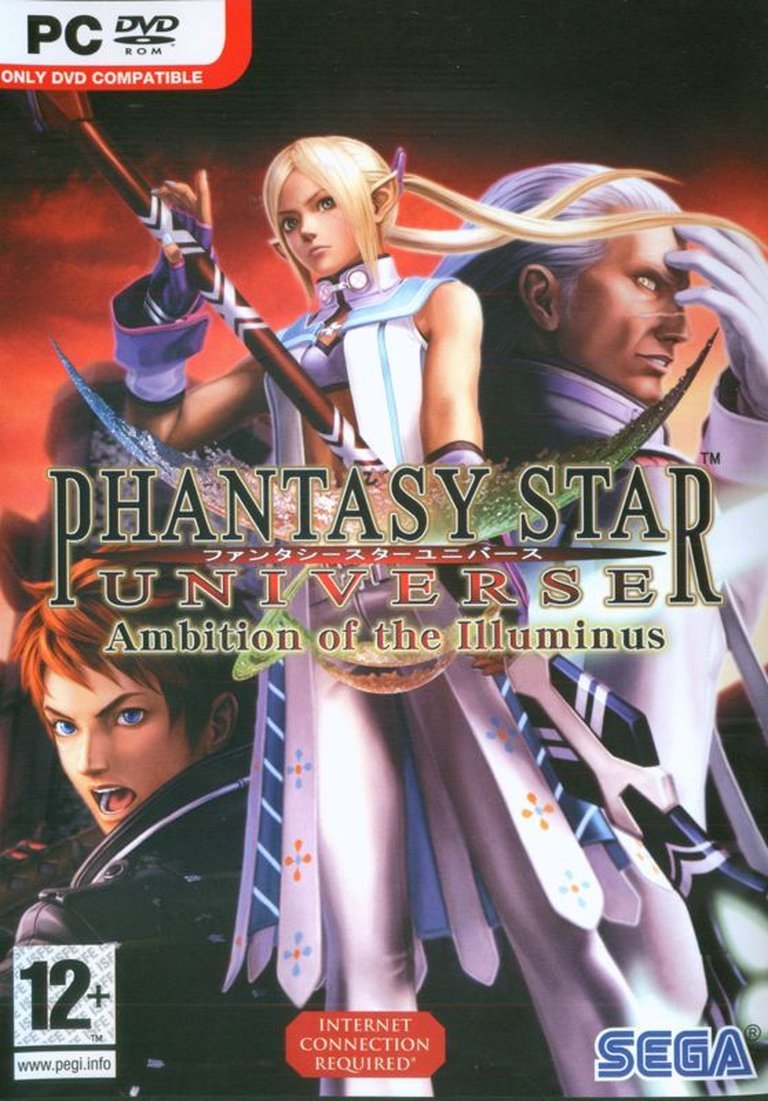
Description
Phantasy Star Universe: Ambition of the Illuminus is a standalone expansion to the sci-fi RPG Phantasy Star Universe, set in a futuristic universe where players embark on an offline story mode as a custom-created character to thwart the Illuminus, a secret organization aiming to destroy all non-human races. Building on its predecessor, it introduces extensive character customization, social interactions in hubs like casino lobbies, additional weapons and combat abilities, and supports both solo play and online multiplayer for up to six players.
Gameplay Videos
Phantasy Star Universe: Ambition of the Illuminus Free Download
Phantasy Star Universe: Ambition of the Illuminus Guides & Walkthroughs
Phantasy Star Universe: Ambition of the Illuminus Reviews & Reception
metacritic.com (70/100): The story’s as thin as air but the XP grind is super-addictive.
gamesradar.com : Phantasy Star Universe: Ambition of the Illuminus proves there’s room for a faster paced, action-RPG approach to the MMO.
Phantasy Star Universe: Ambition of the Illuminus: A Noble Failure in Perpetual Beta
Introduction: The Ghost of Phantasy Star Online
To understand Phantasy Star Universe: Ambition of the Illuminus (hereafter AotI), one must first understand the haunting specter of Phantasy Star Online. Released in 2000 on Sega’s Dreamcast, PSO was a revelation—a seamless, console-based MMORPG that felt like a sci-fi Gauntlet infused with the looting frenzy of Diablo. Its legacy was a double-edged sword for Sonic Team. When Phantasy Star Universe (PSU) launched in 2006 on the PlayStation 2, Xbox 360, and PC, it was an attempt to evolve that formula into a full-fledged, story-driven online RPG with a dedicated single-player campaign. The reception was tepid at best. Critics found it graphically dated, mechanically redundant, and narratively convoluted compared to its contemporaries like Final Fantasy XII or Rogue Galaxy. Enter Ambition of the Illuminus, a standalone expansion released in late 2007 that functioned as both an epilogue to PSU’s story and a substantial “1.5” update to its systems. My thesis is this: AotI is a fascinating, deeply conflicted artifact—a game passionately built by developers clearly committed to their community’s desires, yet one ultimately shackled by the technological and design constraints of its era, resulting in a product that feels less like a definitive sequel and more like a prolonged, valiant beta test for a vision that never could fully materialize on its chosen platforms.
Development History & Context: The Weight of Expectation
Sonic Team, under the direction of Satoshi Sakai and producer Takao Miyoshi, was at a crossroads. The original PSU was developed internally as the spiritual successor to PSO, aiming to capture its magic while adding a proper narrative and refined class system. However, by 2006, the action-RPG landscape had shifted. The PS2 was in its twilight, the Xbox 360 had raised expectations for online integration, and the PC was dominated by deeply intricate MMOs like World of Warcraft. PSU felt like a bridge between eras—its persistent lobby and instanced dungeons were concessions to console limitations, while its attempt at a grand, serialized online story (Episodes 1-2) felt clunky and disjointed.
AotI was conceived not as a mere DLC pack but as a “Director’s Cut” that could also be purchased standalone. This was a pragmatic response to the original game’s muted launch and the need to reinvigorate the player base. As detailed in the PSUPedia forum threads, a Japanese server merge was planned to combat community fragmentation, and a free network trial was held to test stress on the new features. The development team was listening, responding to fan requests for more customization, better loot, and quality-of-life improvements. Yet, they were fighting against the PS2’s DVD storage limits (a noted concern in forums regarding fitting the expanded content), the aging CRI middleware for audio, and the fundamental architectural differences between designing for a persistent MMO versus a console action-RPG with online elements. The game’s very existence is a testament to Sega’s lingering commitment to the “Phantasy Star Online” brand, but it was a commitment poured into a form factor that was rapidly being outpaced by both technology and player expectations.
Narrative & Thematic Deep Dive: From Defined Hero to Player Avatar
The narrative pivot in AotI is its most significant—and most telling—change. PSU’s original story was a linear, predefined saga centered on Ethan Waber, a reluctant GUARDIANS recruit with a personal grudge and a destined role. It was classic JRPG heroism, told through lengthy, unskippable anime cutscenes (a frequent critic complaint, especially from PC Gamer UK‘s scathing “personality-free void” assessment). The plot involved the S.E.E.D. monsters, the enigmatic CASTs, and the traitor Magashi, culminating in a confrontation with the Dark Force entity.
AotI’s offline story mode, Episode 2, directly continues this but executes a crucial shift: the player’s custom avatar becomes the protagonist. You are no longer Ethan; you are a new GUARDIANS instructor tasked with finding the now-wanted Ethan and unraveling the Illuminus conspiracy. This is more than a narrative gimmick; it’s a fundamental realignment of the game’s identity. The theme moves from “a chosen one’s destiny” to “your story in this universe.” The Illuminus, a human-supremacist group seeking to exterminate non-human races (CASTs, Newman, Beast), introduces a more politically charged conflict than the cosmic horror of S.E.E.D. It reflects a growing sophistication in the Phantasy Star mythos, touching on themes of racial purity, institutional distrust (the GUARDIANS are compromised), and personal agency.
However, the execution is mixed. The story is delivered through a similar torrent of low-budget cutscenes with stilted dialogue (noted by Jeuxvideo.com as “intrusively numerous”). The player avatar remains a silent protagonist, which feels increasingly dissonant when NPCs like Laia Martinez or Karen Erra have fully voiced, dramatic arcs surrounding you. The thematic potential of a player-driven narrative is undermined by a structure that still funnels you through scripted beats. It’s a step toward player agency but not a leap, leaving the narrative feeling like a slightly more personalized version of PSU’s Episode 1, rather than the groundbreaking evolution it could have been.
Gameplay Mechanics & Systems: Depth Beneath a Repetitive Surface
AotI’s greatest strength lies in its profound and intricate class and weapon system, which was considerably expanded from the base game.
1. The Type System & Acro-Revolution: The core of PSU’s gameplay is its “Type” system (Hunter, Ranger, Force, and advanced hybrids like Fighgunner, Wartecher, etc.), which dictates your statistical growth, weapon proficiency, and Photon Art (PA) caps. AotI added two new types: Acrofighter (Hunter/Ranger hybrid) and Acrotecher (Ranger/Force hybrid). These weren’t just new options; they represented a new design philosophy focused on agility and specific tool mastery. Acrofighters gained exceptionally fast movement and strike animations, while Acrotechers received boosted support TECHNIC casting speed. This added meaningful diversity, allowing players to craft highly specialized builds, such as an Acrofighter using the new Whip (A-Rank) for crowd control or an Acrotecher wielding the new Madoog (a left-handed TECHNIC weapon) for rapid healing and debuffs.
2. Weapon Proliferation & New Categories: The expansion famously added four entirely new weapon categories: Whips (multi-target striking), Slicers (homing energy blades), Madoogs (left-hand TECHNIC casters), and Shadoogs (auto-firing elemental ranged weapons). Combined with over 200 new individual weapons across all 27 categories, the arsenal felt immense. Furthermore, manufacturers began “crossing over” (e.g., Tenora Works making claws), breaking old exclusivity and encouraging experimentation. This addressed a major PSU complaint: weapon monotony.
3. Photon Arts & Grinding Overhaul: The PA cap was raised to Level 40 for all types. Crucially, a new PA Disk Conversion system was added. Once you learned a PA, you could convert it back to a disk, freeing a learned slot while retaining its level. This was a QOL godsend, allowing players to swap skills for different mission types without permanent loss. The weapon grinding system was also softened: failed grinds now reset stats but reduce the weapon’s maximum achievable grind level, making high-risk grinding less punishing.
4. Repetitive Core Loop & Flaws: For all this systemic depth, the moment-to-moment gameplay remained fundamentally unchanged and, for many, stale. The core loop was—and is—entering an instanced field, killing all monsters, fighting a boss, and returning to the lobby. This “hack-and-slash” repetition, while satisfying in short bursts (like Gauntlet, as GamesRadar noted), became mind-numbing over the 18-hour campaign. Enemy AI, despite tweaks, was still rudimentary. The camera was frequently obstructive, especially in tight spaces. The offline mode’s NPC partners were notoriously incompetent, often failing to attack or getting stuck—a point hammered home by PC Gamer UK‘s 21% review. The expansion added depth to character building but failed to inject substantive variety into mission design or enemy behavior.
5. Social & Quality-of-Life Additions: AotI wisely expanded the social fabric. Three new main lobbies were added (Paracabana Beach on Parum, Mt. Ohtoku Shrine on Neudaiz, Casino Voloyal on Moatoob), each with unique aesthetics and minigames. The Casino Voloyal in particular offered a break from combat. The room system received a major upgrade: a free-grid layout for decorations, a jukebox for custom music, and a bulletin board for visitor messages. The Player Shop search function was improved, and item transport to room storage was added. These were wins for the dedicated community but did little to attract new players.
World-Building, Art & Sound: A Charming, Dated Vision
The Gurhal Star System—Parum, Neudaiz, Moatoob—remained a neatly realized, if small, sci-fi tapestry. The new fields, as documented on the PSUPedia (Old Rozenom City, Granigs Mine, etc.), were often reskins of existing areas (a common cost-saving measure), but some, like the Habirao Forbidden District with its giant mushrooms and dense photon energy, offered memorable new vistas. The anime/manga aesthetic, directed by Kosei Kitamura, was bright and clean, with iconic character designs. However, on the PS2 and even PC, the graphics were undeniably dated by 2007 standards. Textures were blurry, character models were simple, and effects were modest. As spieletipps noted, the PS2’s graphical potential wasn’t fully utilized, but the “atmosphere” carried through.
The soundtrack, composed by Hideaki Kobayashi, Fumie Kumatani, and others, was a highlight. It maintained the series’ tradition of energetic, synth-heavy tracks that perfectly matched the fast-paced combat. The iconic “Guardians” theme became a cultural touchstone, later featured in the 2020 Tokyo Olympics. However, the voice acting was a major point of contention. While the Japanese cast was serviceable, the English dub was widely panned as wooden and poorly directed, contributing to the cutscene fatigue. The PC version’s reliance on keyboard-only control (a bizarre decision noted by Hry Sme) was another significant accessibility and comfort flaw.
Reception & Legacy: A Middling Pivot Point
AotI’s critical reception was mixed to average, mirroring but slightly improving upon the base game.
* PlayStation 2: Metacritic ~66/100. Reviews like spieletipps (81%) praised the added content and online fun, while Jeuxvideo.com (50%) found it a shallow rehash. The consensus: a solid update for existing fans, but not a must-buy for newcomers.
* PC: Metacritic ~53/100. This version suffered disproportionately. PC Gamer UK‘s catastrophic 21% review highlighted control issues (lack of mouse movement by default, playing in a window), poor optimization, and an unfriendly UI. Hry Sme and Sector echoed these sentiments, labeling it a “poor conversion.”
* Xbox 360: Better received as downloadable content, though it required the base game.
Commercially, it was a modest success, selling an estimated 260,000 units combined across regions (per VGChartz), but far from a blockbuster. Its true legacy is twofold:
1. The Bridge to Portable: AotI’s most significant impact was narrative and systemic. Its story and character creation focus were ported wholesale to the Phantasy Star Portable series on PSP. These games, which became the franchise’s mainstay for years, directly used AotI’s premise: you, as your avatar, are the central hero. In this sense, AotI was the crucial prototype for the series’ future.
2. The Community’s Last Stand: The servers for the NA/PAL PC/PS2 versions shut down in 2010, Japanese PS2 servers in 2011, and all remaining servers in 2012. Yet, the game’s dedicated fanbase kept it alive through private servers, a testament to the deep customization and loot-driven gameplay that hooked players despite all flaws. The PSO-World forums and PSUPedia are bustling archives of this enduring community.
Conclusion: The Definitive, Flawed Artifact
Phantasy Star Universe: Ambition of the Illuminus cannot be judged in a vacuum. It is the second act of a two-part experiment, the “Director’s Cut” of a game that already felt behind the curve. Its verdict is one of profound contradiction. It made meaningful strides in player expression—with Acrotypes, new weapons, PA disk conversion, and free-form room decorating—while failing to evolve the repetitive mission structure or the dated presentation. It gave the player’s custom avatar the narrative spotlight but couldn’t escape the cutscene-heavy, linear storytelling of its predecessor. It was a generous offering to its existing community but a confusing and technically shaky entry point for new players, especially on PC.
In the grand timeline of the Phantasy Star series, AotI is a pivotal but stumbling step. It preserved the core loot-and-loop addiction of PSO while trying, and often failing, to build a modern online RPG around it. It provided the essential template for the more successful Portable series but could not save its own platform versions from obscurity and server death. To play AotI today is to engage with a game of immense ambition perpetually in beta—a game whose heart was always in the right place, fostering creativity and community, but whose body was constrained by the hardware, design orthodoxy, and production values of its time. It is not a forgotten classic, but a fascinating, deeply flawed monument to a specific moment when console online RPGs were still trying to find their soul beyond the persistent world. For historians and nostalgic fans, it is an essential study; for everyone else, it remains a curious, charming, and ultimately frustrating relic.