
- Release Year: 2015
- Platforms: Linux, Macintosh, PlayStation 4, Windows, Xbox One
- Publisher: Focus Home Interactive SAS, H2 Interactive Co., Ltd., Larian Studios NV, Spike Chunsoft Co., Ltd.
- Developer: Larian Studios NV
- Genre: Role-playing (RPG)
- Perspective: Diagonal-down
- Game Mode: Co-op, Online Co-op, Single-player
- Gameplay: Auto-mapping, Character development, Crafting, Turn-based combat
- Setting: Fantasy
Description
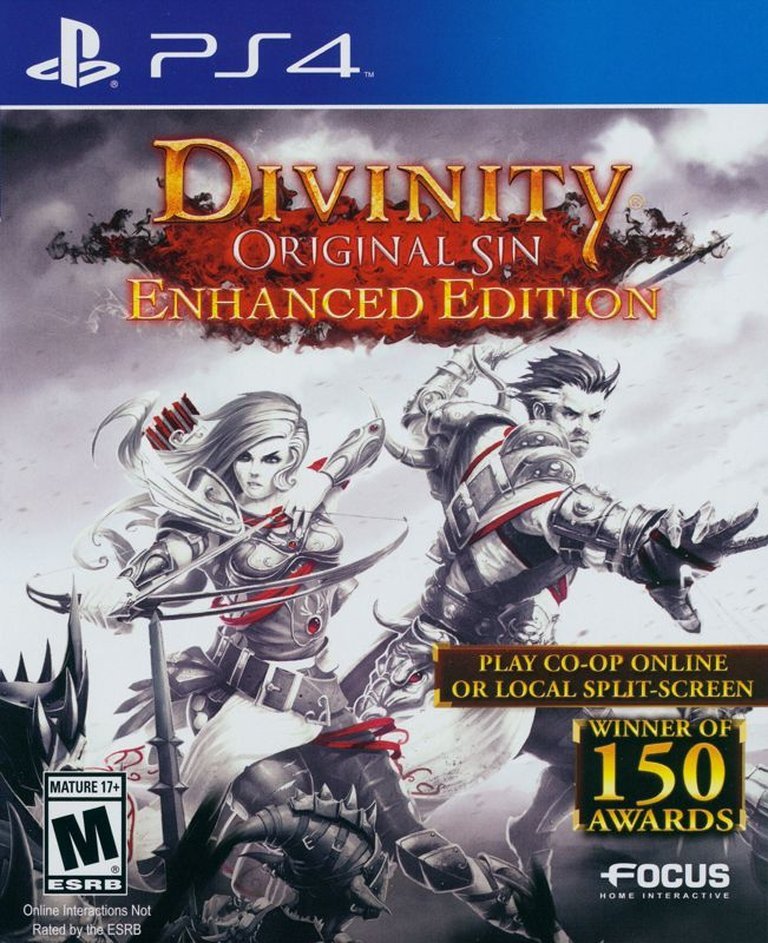
Divinity: Original Sin – Enhanced Edition is a fantasy role-playing game set in a rich, magical world where players control a party of characters, engaging in tactical turn-based combat and cooperative multiplayer as they explore expanded quests and locations. This updated version features a reworked storyline with extensive voiced dialogues, enhanced graphics, and new game modes like Explorer and Tactician, offering deeper narrative and gameplay variations.
Gameplay Videos
Where to Buy Divinity: Original Sin – Enhanced Edition
Divinity: Original Sin – Enhanced Edition Free Download
Divinity: Original Sin – Enhanced Edition Mods
Divinity: Original Sin – Enhanced Edition Guides & Walkthroughs
Divinity: Original Sin – Enhanced Edition Reviews & Reception
ign.com : Old-school, pen-and-paper roleplaying from the comfort of your couch.
beforeyoubuy.games : Epic adventure RPG with rich narrative and co-op, but uneven difficulty and pacing
Divinity: Original Sin – Enhanced Edition: The Definitive CRPG Resurrected
Introduction: The Converging Storm
In the mid-2010s, the role-playing game landscape was fractured. On one side, the sprawling, cinematic, hand-hold-y epics of the AAA Western RPG, and on the other, the niche but fervent preserve of the “CRPG”—computer role-playing game—a term evoking the dense stat-sheets, tactical combat, and systemic depth of the late-’90s and early-2000s. Into this breach stepped Divinity: Original Sin, a game that felt both anachronistic and profoundly modern. Its 2015 Enhanced Edition is not merely a director’s cut or a simple re-release; it is the culmination of a passionate post-laissance, a definitive artifact that crystallizes Larian Studios’ vision and, in doing so, re-established the template for what a modern, systems-driven RPG could be. This review will argue that Divinity: Original Sin – Enhanced Edition is a landmark title, a masterclass in environmental storytelling, emergent gameplay, and player agency that successfully bridged the chasm between PC purism and console accessibility, while simultaneously laying the foundational bedrock for the modern CRPG renaissance and its own genre-defining sequel.
Development History & Context: From the Brink to the Breakthrough
To understand Original Sin, one must understand Larian Studios. Founded in 1996 in Ghent, Belgium, by the indomitable Swen Vincke, the studio had a storied history of ambitious but commercially tumultuous projects. The early Divinity games (Divine Divinity, Beyond Divinity) were solid but suffered from rushed publishing deals that left Larian financially stranded. Divinity II underwent a troubled development, leading to a mixed initial reception before the salvaged The Dragon Knight Saga found its footing. The spin-off Dragon Commander was a creative but commercially risky departure. By 2012, Larian was once again in a precarious financial position, with Original Sin conceived as a potentially final, “do-or-die” project.
The initial vision was for a turn-based tactical RPG for Xbox Live Arcade. However, the team’s ambition expanded, pivoting to a full-fledged, isometric PC RPG with deep systemic interactivity. With funds from venture capitalists running low, Vincke made a decisive gamble: a Kickstarter campaign launched on March 27, 2013. It was a resounding success, raising nearly $950,000 in a month, with total funding exceeding $1 million against a final budget of ~€4 million. This crowdfunding triumph was twofold: it provided crucial capital and, more importantly, forged an immediate, deeply engaged community. Backers became evangelists, and their feedback directly shaped development. The original release in June 2014 was a critical darling but a raw, sometimes uneven experience, with a UI clearly built for mouse and keyboard and a narrative that, while clever, lacked full voice acting and certain narrative payoffs.
The Enhanced Edition, released October 27, 2015, was Larian’s response. It was not a sequel but a monumental overhaul, provided free to all original PC owners. Its development was a statement of intent: toperfect the original vision and to conquer the console market, a realm traditionally hostile to such complex CRPGs. Led by the same core team (Director Swen Vincke, Lead Designer Farhang Namdar, Lead Writer Jan Van Dosselaer), the Enhanced Edition added thousands of lines of fully-voiced dialogue, reworked the story with a new ending, introduced new areas (like the Hiberheim fairy realm), enhanced combat styles (notably dual-wielding), and implemented two major new difficulty modes: Explorer (streamlined combat) and Tactician (new puzzles, encounters, and monsters). Crucially, for consoles, it featured a completely redesigned interface and controller support, alongside the much-celebrated split-screen co-op. This edition was the game Larian always wanted to make, polished to a sheen and made universally accessible.
Narrative & Thematic Deep Dive: A Tale of Sisterhood, Source, and the Void
The plot of Divinity: Original Sin is a deceptively classic fantasy premise that unfolds into a cosmic, operatic tragedy. Players assume the roles of two customizable Source Hunters, agents of the Order of the Divine Divinity, tasked with eradicating the dangerous, life-leeching magic known as Source. The initial investigation—a murder in the port town of Cyseal—quickly spirals into a conspiracy involving the fanatical Immaculates cult, a brewing Orcish invasion, and a rising Undead threat.
The narrative’s true genius lies in its central metaphor: the fractured relationship between the White Witch Icara and her sister, the Conduit Leandra. Their bond, a psychic soulforge created in childhood, is the key to the world’s fate. Leandra, corrupted by ambition and manipulated by a demonic Trife, seeks to unlock the God Box—the prison of the Void Dragon—to unleash apocalyptic power. Icara, accidentally guilty of the initial murder while attempting to resurrect her shared lover (the murdered councilor), is imprisoned in Hiberheim. The player’s quest evolves from simple investigation to a race to either restore the soulforge between the sisters or slay Leandra to stop her.
This familial conflict is supercharged by mythic lore delivered via Star Stones. These crystals reveal the Source Hunters are not who they seem; they are the reincarnated Guardians, ancient generals who imprisoned the Source corruption (the Void’s taint) within the God Box. Their failure millennia prior, spurred by the Trife’s deception of the goddess Astarte, led to their mortal rebirth. The stones are fragments of their lost memories. This revelation elevates the personal drama to a cosmic scale: the sisters’ strife is a microcosm of the original sin that endangered all of Rivellon.
Themes are richly layered:
1. Responsibility vs. Power: Source is not inherently evil; it’s a tool. The Immaculates’ abuse contrasts with the Guardians’ duty. Leandra’s quest for power destroys her bond.
2. The Weight of History: The protagonists are bound by past-life failures. Rivellon’s current crises are echoes of ancient wars (the Legion’s war against Orcs).
3. Choice and Consequence: Dialogue and quests offer multiple solutions—combat, stealth, persuasion, bribery. Outcomes dramatically alter the world state and companion reactions.
4. Satirical Fantasy: The writing, penned by Jan Van Dosselaer and Sarah Baylus, is dripping with wry, Monty Python-esque humor. From talking cows to bureaucratic demons, the game undercuts epic tropes with delightful absurdity.
The Enhanced Edition’s additions significantly deepened this tapestry. The new voiced dialogue (a massive undertaking for nearly every NPC) gave emotional weight to key moments, particularly the sisters’ confrontations. The expanded areas and quests (like the Phantom Forest and Hunter’s Edge intricacies) provided more narrative branches and contextual depth, making the world feel more reactive and lived-in. The new ending offered greater narrative closure and thematic resonance.
Gameplay Mechanics & Systems: The Interactive Sandbox
Divinity: Original Sin’s core credo is “everything is interactive.” This philosophy permeates every system.
Character Progression & Builds: The classless system uses Attributes (Strength, Finesse, Intelligence, etc.) and Skills split into Combat (Warfare, Scoundrel, Archery, etc.) and Talent trees (Persuasion, Crafting, Lucky Charm, etc.). This creates staggering build diversity. A pyromancer can combine fire with poison pools to create clouds of burning death; a hydromancer can create steam clouds to obscure vision or electrify water. The crafting system is exceptionally deep and logical: combine a sword with a fire rube to create a fiery blade; mix an apple and a water bottle for a health potion. The Enhanced Edition rebalanced recipes and economy, making crafting even more viable.
Combat: The pinnacle of the game’s design. Turn-based, initiative-driven combat on a fully destructible, elemental environment. The “Surface” system is legendary:
* Water can be electrified, frozen, or evaporated.
* Oil slicks can be ignited.
* Fire spreads and creates smoke.
* Casting “Teleport” on a barrel next to an enemy is a valid tactic.
Environmental interaction isn’t a gimmick; it’s the primary strategic layer. Positioning, crowd control (knocking enemies into water or oil), and setting up chain reactions are essential. The Enhanced Edition’s Tactician mode dramatically amplified this, adding new enemy types (like Death Knights immune to physical damage until their tenebrium weakness is discovered), puzzles integrated into battlefields, and smarter AI. Honour mode (permadeath) catered to masochistic veterans.
User Interface & Controls: The original PC UI was functional but overwhelming. The Enhanced Edition’s console UI was a revelation. Using radial menus, smart button mapping (Triangle/Y for inspect, Square/B for action), and consistent tooltips, Larian translated an immense amount of information to a controller without sacrificing depth. Inventory management remained “fiddly” (a common critique), but it was a vast improvement. The PC version also gained full controller support, blurring the platform line.
Cooperative Multiplayer: A defining feature. Two players, either online or split-screen, control their own Source Hunter. The game is designed for dialogue disagreement: when a choice arises, players engage in a virtual rock-paper-scissors duel. The winner decides the party’s action, creating hilarious, tense, or dramatic moments unique to each playthrough. This mechanic embodies the game’s soul: role-playing is a collaborative, contested storytelling act.
Flaws & Innovations: The game’s complexity is its greatest strength and weakness. The early game pacing is slow, drowning players in tutorials and exposition. The quest log is a simple list of notes, offering no waypoint—a deliberate design choice that rewards attentiveness but can frustrate. Some puzzles (particularly late-game logic puzzles in the First Garden) can feel obscure and require exhaustive environmental scanning. The difficulty curve is uneven, with some random encounters feeling brutal while story bosses are manageable. However, these are often seen as features of a “hardcore” experience rather than bugs. The Enhanced Edition’s Explorer mode directly addressed difficulty concerns.
World-Building, Art & Sound: The Charm of Rivellon
Rivellon is a Euro-Fantasy world, less grimdark than The Witcher and less high-fantasy than Lord of the Rings. Its aesthetic is colorful, painterly, and charming, with a cartoony realism that ages gracefully. The art direction, led by Koen Van Mierlo, uses a warm, saturated palette. Environments are dense with detail: Cyseal’s docks smell of salt and intrigue; the Luculla Forest is a misty, magical wood; Hiberheim is a glacial fairy tale. The Divinity Engine (a proprietary tech) handles lighting and particle effects with competence, though it lacks the raw fidelity of contemporary AAA titles. Its strength is atmosphere and clarity—you can always read the combat board.
The sound design is exceptional. Kirill Vladimirovich Pokrovsky‘s (to whom the game is dedicated) soundtrack is a masterpiece of leitmotifs. It swells with heroic brass during exploration, turns melancholic in Hiberheim, and employs chaotic, choral arrangements for boss fights. It’s timeless and perfectly complements the visual tone. The Enhanced Edition’s addition of full voice acting was transformative. While not every line is Oscar-worthy, the performances (Swen Vincke himself voices several characters) add immense personality and humor, making companions like Madora (the undead warrior) and Jahan (the zealous dwarf) memorable.
The world feels alive and systemic. NPCs have schedules. Weather changes. Physics allow for barrels to be rolled, bridges to be collapsed. This simulationist approach makes exploration constantly rewarding. Finding a hidden chest behind a destructible wall or using a “Charm” spell to turn a hostile wolf into an ally for a fight feels like discovering a hidden rulebook, empowering the player in a way scripted events cannot.
Reception & Legacy: From Cult Hit to Industry Pillar
At Launch (2014): The original game was a critical smash, with PC scores on Metacritic around 87. Critics from Eurogamer (“best classic-style RPG in years”), GameSpot, and IGN (9/10) praised its depth, reactivity, and combat. However, its complexity and lack of hand-holding limited its mainstream reach. Sales were strong for a niche CRPG—over 500,000 copies by September 2014—but it was a word-of-mouth success among enthusiasts.
Enhanced Edition (2015): The reception was even warmer. Critics almost universally celebrated the free upgrade and console port. Metacritic scores jumped to 94 (PC), 88 (PS4, Xbox One). The narrative additions, voice acting, and flawless controller mapping were hailed as a masterclass in respect for both existing fans and new audiences. Jeuxvideo.com called it “a true proof of love from Larian.” IGN reiterated its 9/10, stating it was “as dedicated to the true spirit of role-playing as any game.” Some noted persistent UI clunkiness (inventory) and occasional bugs, but these were seen as minor flaws in an utterly monumental package.
Commercial Success: The Enhanced Edition was a commercial juggernaut. By making it free for original owners, Larian generated immense goodwill and ensured a vast install base. It sold millions of copies across all platforms, transforming Larian from a respected cult developer into a major industry player. It consistently ranks among the top-selling RPGs on Steam and GoG.com.
Legacy & Influence:
1. The Modern CRPG Renaissance: Original Sin proved there was a massive appetite for deep, systems-heavy RPGs. Its success directly inspired and paved the way for other modern classics like Pillars of Eternity, Wasteland 3, and Pathfinder: Wrath of the Righteous. It demonstrated that complex mechanics could be made accessible.
2. Foundation for Original Sin II: The Enhanced Edition served as the technical and design blueprint for the sequel. Divinity: Original Sin II (2017) refined everything—class system, narrative, companion depth—and ascended to near-perfection (Metacritic 93+), largely because the first game proved the formula and funded the studio’s expansion.
3. The Larian Studio Template: The development cycle—Kickstarter -> release -> massive free “Enhanced” overhaul -> console ports—became a trust-building, player-centric model. Larian’s commitment to post-launch support is now legendary.
4. Baldur’s Gate 3: The most direct lineage. Swen Vincke has repeatedly cited Original Sin as the prototype for Baldur’s Gate 3. The turn-based D&D 5e systems, the emphasis on environmental interaction, the co-op dialogue system, and the tactile, simulationist world are all direct descendants. Original Sin was the successful proof-of-concept that gave Wizards of the Coast the confidence to partner with Larian.
5. Genre Mechanics: The “surface” system of elemental interactions has become a gold standard for tactical RPG combat design. The idea of a reactive, “anything can be used” environment is now a sought-after trait in immersive sims and RPGs alike.
Conclusion: The Sin That Became a Virtue
Divinity: Original Sin – Enhanced Edition is far more than the sum of its celebrated parts. It is the definitive realization of a studio’s decade-long struggle for creative and financial autonomy. It is a loving, exhaustive, and often hilarious homage to the pen-and-paper RPGs of the 1980s, translated into a digital medium with unprecedented fidelity to the “theater of the mind.” Its occasional pacing hiccups, inventory management burdens, and obtuse puzzles are the minor taxes levied for a level of systemic depth, player sovereignty, and emergent storytelling that remains nearly unmatched.
The Enhanced Edition is the crucial artifact because it represents completion and universal access. It is the version that consoles players deserve and PC players always wanted. It solidified the game’s status not as a niche curio, but as a mainstream classic. Its influence echoes in every complex, interaction-rich RPG that followed, and its DNA is palpably present in the modern masterpiece Baldur’s Gate 3.
In the pantheon of video game history, Divinity: Original Sin – Enhanced Edition stands as the touchstone for the modern CRPG. It is the game that successfully argued for complexity in an era of simplification, for player-driven narrative in an era of scripted spectacle, and for the enduring power of a well-designed system to tell a better story than any linear script ever could. It is, quite simply, essential.