
- Release Year: 1997
- Platforms: DOS, Windows
- Publisher: Digital Integration Ltd., Interactive Magic, Inc., MicroProse Software Pty Ltd, Sold Out Sales & Marketing Ltd.
- Developer: Digital Integration Ltd.
- Genre: Simulation
- Perspective: 1st-person, 3rd-person
- Game Mode: LAN, Single-player
- Gameplay: Campaign, Combat, Flight Simulation, Mission planning
- Setting: Cyprus, Israel, Korea
Description
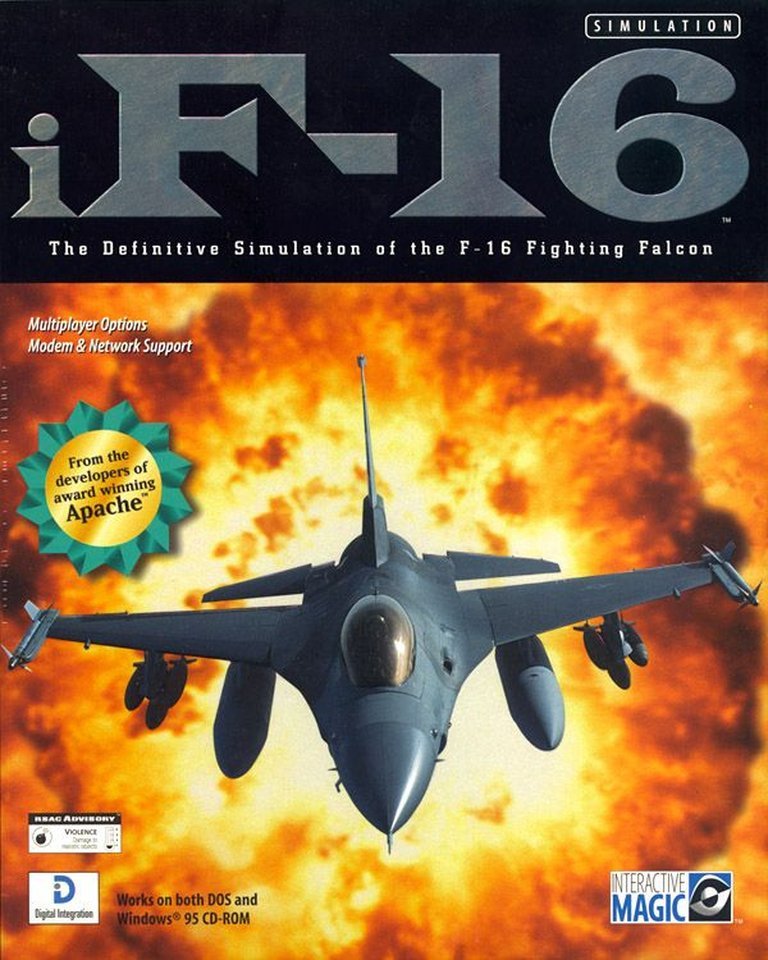
iF-16: The Definitive Simulation of the F-16 Fighting Falcon is a flight simulation game that immerses players in the cockpit of the iconic F-16 fighter jet. It features single missions, quickstart options, and campaign modes set across diverse terrains including Korea, Cyprus, and Israel, emphasizing accurate aircraft modeling, tactical mission planning, and challenging flight dynamics despite its period-appropriate graphics.
iF-16: The Definitive Simulation of the F-16 Fighting Falcon Reviews & Reception
myabandonware.com : I cannot really recommend anyone to buy this game right now.
iF-16: The Definitive Simulation of the F-16 Fighting Falcon: A Bridge Over Troubled Skies
Introduction: The Viper’s Bite or Its Buzz?
In the pantheon of combat flight simulators, few aircraft have been simulated as frequently—or with as much reverence—as the General Dynamics F-16 Fighting Falcon. By the mid-1990s, the “Viper” was not just a jet; it was an archetype, a symbol of Western air power that had been digitized across countless cabinets and desktops. Enter iF-16: The Definitive Simulation of the F-16 Fighting Falcon, a 1997 release from Digital Integration Ltd. (DI), the studio renowned for its hard-edged, systems-focused simulations like Hind and Apache. Its title promised finality, yet its arrival felt anything but definitive. Released into a landscape anxiously awaiting MicroProse’s legendary Falcon 4.0, iF-16 occupied a precarious space: a competent, deeply authentic, yet curiously unrevolutionary entry that embodied the strengths and limitations of its era. This review argues that iF-16 is not a lost classic, but a significant and telling artifact—a meticulously crafted, engine-tweaked bridge between the gritty, textured simulations of the early ’90s and the ambitious, dynamic campaigns that would define the genre’s future. It is a game of exceptional fidelity and frustrating omission, a testament to DI’s engineering prowess that ultimately succumbed to the weight of its own predecessor’s legacy and the shadow of a promised giant.
Development History & Context: The DI Engine and the Long Wait for Falcon 4.0
The Studio and Its Vision: Digital Integration Ltd. was not a household name like MicroProse or Origin, but among simulation connoisseurs, DI was a byword for uncompromising, if visually austere, realism. Their pedigree was built on helicopter sims—Apache (1995) and its celebrated successor Hind (1996)—which were praised for their detailed flight models and weapon systems but often critiqued for their blocky, low-resolution terrain and complex interfaces. iF-16 was a logical, if risk-averse, evolution: apply the proven, robust Hind engine to the most popular fighter jet in simulation history. The vision was clear: leverage existing technology to deliver a deeply authentic F-16C Block 50/52 experience, complete with the LANTIRN (Low-Altitude Navigation and Targeting Infra-Red for Night) pod, without the protracted development cycle of a ground-up rebuild. This was a pragmatic, business-minded decision—publish a solid product while the gaming world waited for the next paradigm-shifting Falcon.
Technological Constraints and the Gaming Landscape: 1997 was a year of transition. The 3D accelerator ( notably 3dfx Voodoo) was moving from luxury to necessity, but the base requirement for a mass-market sim was still a Pentium 90 with 16MB RAM—a system iF-16 could run on, albeit with compromises. The source material repeatedly notes the engine’s origins: “a slightly tweaked version of the APACHE/HIND engine” (Computer Gaming World). This provided a foundation of functional 3D graphics, texture-mapped terrain, and a robust damage model but left the game visually behind contemporaries like NovaLogic’s F-22 Lightning 3, which used voxel-based technology for stunning, if arcade-leaning, terrain. The competing visions were clear: DI’s “realistic” wireframe-over-texture look versus NovaLogic’s lush, polygonal worlds. Furthermore, the genre’s holy grail was a dynamic, persistent campaign—a feature Falcon 4.0 was teased to deliver. iF-16, therefore, entered the market as a “holdover” title. As one MyAbandonware reviewer starkly put it, “The recent Falcon 4.0 is the king of F-16 sims, and you should be able to get it cheap now. Falcon 4.0 is better in every respect, and a truly classic flight sim.” iF-16 was acutely aware of this looming shadow.
Narrative & Thematic Deep Dive: Stories in the Sky, Not in the Script
iF-16 does not possess a traditional narrative with characters and dialogue. Its “story” is emergent, born from the player’s actions within its campaign frameworks. The thematic core is not personal drama but the thematic authenticity of modern air warfare.
Campaigns as Abstract Theaters: The game offers three geographically distinct campaign settings: the Korean Peninsula, Cyprus, and Israel. These are not merely cosmetic changes; each terrain set provides a different tactical palette. Korea features lush, mountainous terrain that complicates low-level flight and radar horizons. Cyprus and the Middle Eastern maps are dominated by desert and coastal regions, favoring different approaches to strike missions. The narrative premise is the evergreen “Cold War turned hot” or regional conflict scenario, placing the player as a US Air Force F-16 pilot in a fictionalized escalation. There is no overarching plot with named protagonists or scripted cutscenes. The “story” is the campaign itself—a series of missions that, if won, shift the front lines and alter subsequent mission availability. This was standard for the era, but it’s a narrative of geography and attrition, not of human drama.
The LANTIRN as a Narrative Device: The game’s most significant thematic and gameplay element is the inclusion of the LANTIRN pod. This isn’t just another weapon; it’s a narrative of technological dependence and pilot skill. Using the LANTIRN for night precision strikes—locking onto laser designation, flying a calculated ingress, and releasing a Paveway II bomb—is a complex, multi-step ritual. The manual and reviews repeatedly stress its difficulty. As the MyAbandonware analysis notes, “Launching laser guided bombs is very realistic and very, very difficult (if you pass over the target, you will lose the laser lock).” This transforms a mission from a simple “fly-to-point-drop-bomb” affair into a tense, procedural narrative of sensor management, timing, and vulnerability. The theme is clear: modern air combat is won in the cockpit through mastery of complex systems, not just aceship.
Dialogue and Briefings: Mission briefings are functional, delivered with text and a static map. They provide targets, threats (SAM sites, enemy CAP), and loadout recommendations. There is no banter between wingmen (a feature later added in some sims), no personality. The absence of deep narrative voice work is a deliberate design choice that keeps the focus on the simulated systems and the pilot’s own decisions. The “character” is the F-16 itself, and the player’s relationship with it.
Gameplay Mechanics & Systems: A Deep, Flawed Fang
Core Loop and Campaign Structure: The gameplay loop is the classic sim trinity: Briefing -> Pre-flight (loadout, fuel) -> Takeoff -> Mission Execution -> Recovery (landing/rejoin). The campaign provides strategic persistence—success or failure in one mission affects the next, altering enemy strength and available targets. However, the lack of a true dynamic campaign engine is iF-16’s most frequently cited shortcomings. The campaigns are scripted sequences of individual missions, not a living battlefield that generates tasks based on front-line movements. The Hind engine’s “battlefield mechanics” are present but static. As a critic noted, “there is no dynamic campaign here, and there is no mission planner either.” This severely limits replayability and the sense of participating in a larger war.
Flight Model and Avionics: This is iF-16’s crowning achievement. The F-16C’s flight characteristics—its “fly-by-wire” stability, high-alpha capabilities, and powerful thrust—are meticulously modeled. The aircraft responds correctly to energy management, stalls realistically, and suffers from “departures” at extreme attitudes. The cockpit is a marvel of functional detail. Every switch, button, and Multi-Function Display (MFD) is modeled and operational. Cycling through radar modes (Air-to-Air, Air-to-Ground, Sea), managing the HUD, and employing the HUD “Fire” and “Sight” controls for gun attacks are all required for effectiveness. The inclusion of the LANTIRN pod’s infrared and laser designation systems adds a profound layer of complexity, especially for night interdiction.
Weapons Systems and Tactics: The arsenal is comprehensive: AIM-120 AMRAAMs, AIM-9 Sidewinders, AGM-65 Mavericks, various Paveway laser-guided bombs (LGBs), Mk-82/84 dumb bombs, CBU-87 cluster bombs, and the M61 Vulcan cannon. Weapon behavior is simulated with important nuances. Missile performance varies with altitude and aspect. LGBs require continuous laser illumination until impact. The shockwave from large bombs can damage your own aircraft if dropped too low. This encourages tactical thinking: you might use a Maverick for a precision strike on a radar site before a bomb run to suppress defenses. The depth is commendable, but the interface for employing these systems can be clunky. The review in PC Player (Germany) notes the “enormous requirements for the highest detail of the graphics engine” and the “unspectacular optics,” but the real frustration lies in the control scheme. Binding the myriad functions to a keyboard or joystick with limited buttons is a perennial challenge for flight sims, and iF-16’s default layout is less than intuitive.
User Interface and Viewing Problems: The HUD is informative and scalable, but a critical flaw is the inability to zoom the HUD view. As the Old PC Gaming review emphasizes, “you can’t zoom in on your HUD, a real drawback when fine tuning your aircraft for a few Gatling bursts.” The external viewing system is also problematic. While the padlock view (locking onto a target and having the camera follow it) is excellent and essential in dogfights, the cockpit view camera manipulation is rigid. The “fixed camera angles used to simply look around the cockpit is much less fluid, and the keys used to turn the camera up, down and sideways are awkward at best.” This breaks situational awareness during the hectic, six-degrees-of-freedom maneuvering of a dogfight.
Mission Editor and Training: The game includes a functional mission editor, allowing players to create custom scenarios. This extends its lifespan significantly for the dedicated community. The training missions are numerous (around 20) but are criticized as being dry and overly reliant on the manual. The GameStar review laments, “Manchmal hätte ich mir ein etwas ausführlicheres Handbuch gewünscht. Die knapp 100 Seiten reichen bei weitem nicht aus, um alle Fragen zu beantworten.” (Sometimes I would have liked a more detailed manual. The scant 100 pages are far from sufficient to answer all questions.) This creates a steep, manual-heavy learning curve that gatekeeps the sim’s best features from casual players.
Multiplayer: A standout feature is robust multiplayer support for up to 16 players via IPX or modem. This was a major selling point in 1997. Engaging in large-scale furballs with other Viper pilots is where the game’s solid flight model and weapon simulation truly shine in unpredictable, human-driven combat. The PC Action review highlights this as “hervorragend” (outstanding).
World-Building, Art & Sound: Beauty in the Eye of the Beholder
Visuals: The Hind Engine, Enhanced: iF-16’s graphics are its most debated aspect. Built on the Hind engine, it offers higher resolution (640×480) and optional 3dfx Glide support (added in a patch), which improved performance and added texture filtering. However, the fundamental limitations remain. Terrain textures are simplistic and lack vertical scale. As noted, “it’s hard to tell your altitude simply by looking outside.” The terrain is “exaggeratedly blocky.” While the Korean forests receive praise for being “pretty good,” the Middle Eastern and Cypriot terrains reuse a basic desert texture set and fare “considerably worse.” The F-16 model itself is accurate and detailed, both externally and in the cockpit, where every gauge is readable. Explosions and smoke are “really basic.” The aesthetic is one of functional, low-polygon utility rather than spectacle. It serves the simulation—you can identify ground targets and terrain features—but it never inspires awe. In an era where Comanche 3 and F-22 Lightning 3 were pushing visual boundaries, iF-16 felt dated at launch. The trade-off, however, was performance: it could run acceptably on mid-range hardware of the time, whereas its more beautiful competitors often demanded top-tier systems.
Sound Design: The audio is serviceable but unspectacular. Engine whines, weapon releases (the distinct whoosh of an AMRAAM, the rattle of the Vulcan cannon), and missile warnings are present and effective. The Game.EXE review (Russian) curiously praises the music as “великолепна” (magnificent), though this is an outlier. Most critics found the sound to be functional atmospheric filler—nothing that would sell the experience, but nothing that broke immersion either. It fulfills its role as an environmental cue without standing out.
Atmosphere and Immersion: Immersion comes not from audiovisual showmanship but from systems depth and cockpit fidelity. The feeling of being a pilot emerges from managing fuel state, navigating using the HUD, interpreting radar contacts, and wrestling with the Viper’s flight characteristics at low level. The campaigns, while scripted, provide context. Flying a night LANTIRN mission over a blacked-out Korean peninsula, using only the pod’s infrared image to find a bridge, is a uniquely tense and immersive experience that transcends the game’s graphical simplicity. The atmosphere is one of professional, focused, modern combat, not cinematic heroism.
Reception & Legacy: A Critical Divide and a Whispered Legacy
Launch Reception (1997-1998): Reviews were strikingly polarized, creating a clear schism between European and American critical perspectives, and between those who valued pure simulation and those who expected next-gen presentation.
- The European / Simulation Purist Camp (80-86%): German publications like Power Play (86%), Gamesmania.de (85%), and PC Action (84%) lauded the game. Their praise centered on its incredible gameplay depth and mission design. Power Play declared it “derzeit beste F-16-Simulator” (the best F-16 simulator currently), applauding its “famose Einsatzplaner” (famous mission planner—likely referring to the pre-mission planning screens) and tactical possibilities. Gamesmania.de favorably compared it to Tornado, noting that while it lacked that sim’s dynamic campaign and autopilot, it was the “bessere und vor allem fehlerfreiere Simulation” (better and, above all, error-free simulation) than the also-contemporary iF-22. This camp valued the accurate flight model, detailed avionics, and the sheer number of varied missions over graphical gloss.
- The American / Mainstream Simulation Camp (50-72%): The flagship American magazine, Computer Gaming World, delivered a scathing 2.5/5 verdict: “iF-16 is essentially a marriage of the most often simulated combat aircraft in history with a slightly tweaked version of the APACHE/HIND engine. It brings almost nothing new to the table.” This encapsulates the American critique: it was derivative, unoriginal, and graphically behind the curve. Gamezilla (69%) and Online Gaming Review (65%) echoed this, citing numerous graphical and interface problems and a lack of modern features like satellite terrain mapping or internet play. PC Games (Germany) (72%) found the missions engaging but was frustrated by “unzulängliche Bedienung des Flugzeugs” (inadequate aircraft operation).
- The Middle Ground (74-80%): Many reviews accepted iF-16 as a solid, if unspectacular, entry. PC Joker (74%) felt it showed “that not much has changed in recent years” except hardware requirements. Electric Games (80%) found the flight model “too touchy to be realistic” but praised the missions and campaign. Hacker (80%, Croatian) famously quipped that only “seasoned pilots who have survived hell in Vietnam, Iraq, Libya” would find it a “cat’s cough,” while for ordinary pilots it was “training until the last day.”
Evolution of Reputation and Legacy: iF-16’s reputation has fossilized around a specific niche. It is not remembered as a genre-defining masterpiece like Falcon 4.0 (which, despite its infamous rushed launch, eventually earned that title through mods and patches). Instead, it is recalled as:
1. The Competent Stopgap: The reliable, playable F-16 sim for those who couldn’t (or wouldn’t) wait for or deal with the initial bugs of Falcon 4.0. The MyAbandonware review calls it “a good stepping stone if you’re really keen on learning the inner workings of the F-16” and “an easier and sorta fun if visually castrated Falcon 4.0.”
2. A Victim of Its Own Engine and Timing: Its visual identity was forever tied to the Hind engine, dooming it to “dowdy” aesthetics next to voxel-based rivals. Its lack of a dynamic campaign made it feel instantly obsolete when Falcon 4.0’s campaign was finally patched into a masterpiece.
3. A Cultist’s Sim: For a small subset of players who prioritize systems simulation over graphics, iF-16 retains value. Its cockpit detail, weapon modeling (especially LANTIRN), and multiplayer are still cited as strengths.
4. Part of the “Front Line Fighters” Bundle: Its legacy is often linked with Apache and Hind in the Front Line Fighters compilation. In this context, it’s seen as the jet counterpart to DI’s acclaimed helicopter sims—not the best, but part of a consistent, high-quality lineup.
Its influence is indirect. It proved that a detailed, modern F-16 simulation could be built on a modified earlier engine, a lesson not lost on developers. However, it did not pioneer new systems or features that became standard. Its primary influence was to heighten anticipation for Falcon 4.0 by giving fans a playable, if flawed, Viper fix.
Conclusion: A Definitive Simulation of an Interim Era
iF-16: The Definitive Simulation of the F-16 Fighting Falcon is a game caught in time. It is definitive in its representation of the F-16C’s systems and cockpit, but not in advancing the flight sim genre. It is a masterpiece of engineering detail that is held back by an aging graphical engine and a conservative design that shied away from the dynamic, living campaigns that were on the horizon.
Its place in history is secure, but it is a place of transitional significance. It represents the last flowering of the “DI style” of sim: deep, demanding, and visually honest but unadorned, before the genre’s full embrace of 3D acceleration, dynamic battlefields, and online warfare. For the historian, it is an invaluable case study in how a studio leverages its existing tools to capture a iconic platform, and how market pressures (the imminent Falcon 4.0) can define a product’s perception before it even ships.
Final Verdict: iF-16 is a must-play for the hardcore simulation historian and the F-16 enthusiast, but with strict caveats. It demands patience, a willingness to grapple with manuals, and an acceptance of its 1997 visual limitations. Its strengths—an unparalleled cockpit, a punishingly realistic LANTIRN system, and solid multiplayer—are real. Its weaknesses—a static campaign, clunky view controls, and dated terrain—are equally real. It is not the “Definitive Simulation” its title claims, but it is a highly credible, deeply authentic, and historically important simulation of the F-16 Fighting Falcon from a pivotal, awkward moment in the genre’s evolution. It earns its 7.2/10 not as a classic, but as a skilled, honest, and ultimately interim bridge—a Viper that soared on systems depth but could never quite escape the long, dark shadow of the Falcon yet to come.