
- Release Year: 2003
- Platforms: Windows
- Developer: das TOBI-AS Interactive
- Genre: Adventure
- Perspective: Side view
- Game Mode: Single-player
- Gameplay: Graphic adventure, Item collection, Point and select, Talking
- Setting: Dream, Nightmare, Supernatural
Description
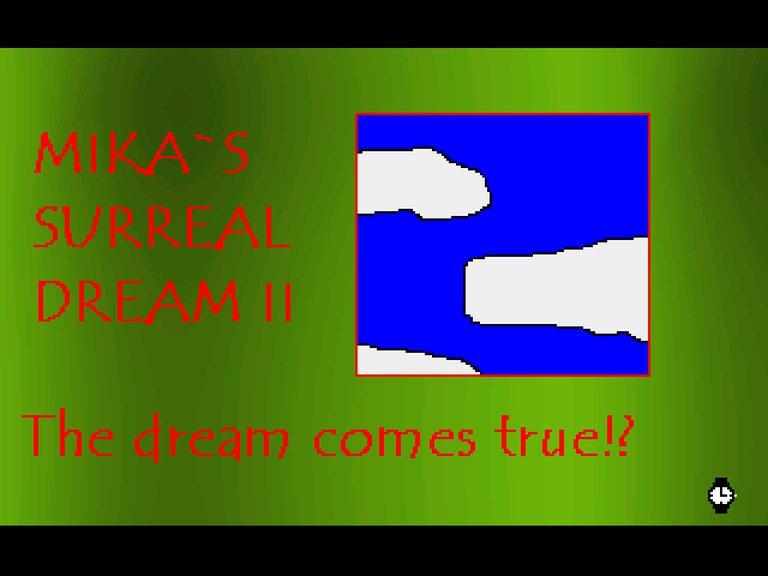
In the sequel to Mika’s Surreal Dream, local reporter Mika Huy is trapped in a surreal dream world populated by demons and strange creatures. Players navigate familiar and new locations, interact with inhabitants, and collect items through classic point-and-click gameplay to help Mika escape this nightmarish adventure.
Mika’s Surreal Dream II: The Dream Comes True!? Free Download
Mika’s Surreal Dream II: The Dream Comes True!?: Review
Introduction: The Nightmare sequel That Faded Away
In the sprawling, often baffling ecosystem of early 2000s independent game development, few projects embody the raw, unfiltered creative spirit—and subsequent self-critique—of the era quite like Mika’s Surreal Dream II: The Dream Comes True!? Released in May 2003 for Windows, this point-and-click adventure exists as a curious artifact: a sequel born from a surreal dream, crafted with the free, accessible Adventure Game Studio (AGS) engine, and ultimately disowned by its own creator. As a follow-up to the 2002 original Mika’s Surreal Dream, it promised to plunge its reporter protagonist, Mika Huy, back into a nightmare dimension teeming with “demons and strange creatures.” Yet, unlike the enduring classics of the genre, this title’s story is one of ambition met with dissatisfaction, a game that was officially withdrawn from the canon of its own shared universe in 2009. This review delves deep into the anatomy of a forgotten dream, examining how a passion project from the thriving “Reality-on-the-Norm” (RON) indie scene became a non-canonical footnote, analyzing its mechanics, narrative, and legacy not as a masterpiece, but as a poignant case study in the vulnerabilities of solo game development.
Development History & Context: The Dream Weaver’s Workshop
Mika’s Surreal Dream II emerged from the solitary workshop of das TOBI-AS Interactive, a pseudonym for Tobias Schmitt, who single-handedly handled the game’s story, drawings, photographs, and jokes. This was the golden age of AGS, a revolutionary tool that democratized adventure game creation, allowing anyone with a story to build a LucasArts-style title without programming expertise. In 2003, the landscape was ripe for such projects; commercial adventures were a dying breed, but a vibrant underground community flourished online, sharing resources, engines, and even entire fictional universes.
The game is explicitly part of the Reality-on-the-Norm series, a loose collective of AGS developers who created games set in a shared, bizarre meta-universe. Preceding it in the series chronology was The Tapestry – Chapter 1: The Unraveling (2003), and it was followed by Shadows of RON (2003), placing it squarely in a busy period for the RON project. However, Mika’s Surreal Dream II was Schmitt’s personal sequel, building directly on his 2002 original where Mika battled the seamonster Jackal.
Technologically, it utilized AGS 2.53, a mature version of the engine that enabled classic side-view, icon-based interfaces. The credits reveal a fascinating tapestry of collaboration and appropriation. Schmitt’s original art was supplemented by LucasArts’ Maniac Mansion graphics (a common practice in early AGS for placeholder or stylistic assets) and “RON Graphics by different RON Authors”, highlighting the community’s resource-sharing ethos. The music is perhaps the most striking—and legally nebulous—aspect: MIDI arrangements of songs by No Doubt, Red Hot Chili Peppers, and Garbage. This was a hallmark of amateur AGS games, where creators used freely available MIDI files of popular music to inject energy and familiarity, albeit with all the crude, synthetic timbres of the Sound Blaster era.
The game’s development was supported by a small team of beta testers and language correctors, including the notable David L. Gilbert (credited as Dave Gilbert), who would later found Wadjet Eye Games and become a pillar of the modern indie adventure scene. This web of connections underscores how the RON community served as an informal incubator for talent.
Narrative & Thematic Deep Dive: A Dream Logic Unmoored
The plot is refreshingly succinct: local reporter Mika Huy is again trapped in a dream, this one populated by demons and “strange creatures.” The player must guide her through a blend of “already familiar and new locations,” engaging in conversations and item collection to awaken. Where the first game centered on the aquatic terror Jackal, the sequel expands the nightmare’s palette to a more generalized surreal horror.
The narrative is pure dream logic, accessible only through the game’s environmental storytelling and dialogue. Conversations with characters like Mr. Reaper (the personified Grim Reaper examining his list), the philosophical Trops (a strange creature who discusses a killed fox), and a “stranger, Johnny” suggest a world where bizarre concepts are mundane. Screenshots from the Adventure Game Database reveal a gallery of unforgettable images: Mika exploring a men’s toilet, conversing with a literal cube, interacting with a “rainbow man” to obtain a coin behind a rainbow, and encountering another Mika tied to a board—a classic doppelgänger trope ripe for dream interpretation.
Themes of identity fragmentation, existential dread, and the arbitrariness of dreamscapes are evident. The inclusion of a “blue cup” (a specific asset credited to Chris Jones) and the reuse of RON graphics imply a world that is both personal and communally constructed. The writing, credited to Schmitt with “jokes” and “some dialog additions” by Gilbert, likely aims for a tone of absurdist humor mingled with low-grade horror—a hallmark of the RON series’ quirky, often darkly comedic sensibility.
However, the narrative’s execution is its first casualty of creator dissatisfaction. The game’s ultimate fate as “non-canonical” and withdrawn suggests that Schmitt saw fundamental flaws in its storytelling, character consistency, or thematic coherence. What survives in screenshots and descriptions feels like a collection of surreal vignettes in search of a binding narrative thread, a common pitfall of dream-based plots where stakes and progression can feel arbitrary.
Gameplay Mechanics & Systems: Classic Framework, Questionable Execution
As a “classic point-n-click icon-based adventure,” Mika’s Surreal Dream II adheres to a well-established template. The side-view perspective (unlike the first game’s mixed 1st/3rd person) restricts navigation to left-right movement across screens, a constraint that both focuses and limits exploration. The interface is the standard AGS verb coin or icon bar—likely featuring actions like Walk, Look, Take, Use, Talk—with inventory management via a separate screen, as hinted by a screenshot showing “Examining the inventory.”
The core gameplay loop is the adventure genre’s holy trinity: explore, dialogue, puzzle-solving. Puzzles presumably involve using collected items in the right place or with the right character, all in service of escaping the dream. The first game included two notable mini-games: one where a character named Vicks must escape a dead fish, and another where Mika navigates a ship through river obstacles. Given the sequel’s thematic continuity, it’s plausible similar minigames appear, perhaps integrated as dreamsequences or obstacles.
Where the game stumbles is in the unspoken details. AGS games of this era were notorious for cryptic, trial-and-error puzzles and dead-ends (inventory items that could be permanently wasted). Without a walkthrough, progress could halt indefinitely. The credits list beta testers, implying an attempt at quality control, but the creator’s later disillusionment suggests the puzzles may have been obtuse, unfair, or simply uninspired. The “point and select” interface, while classic, offers no innovation, and without modern conveniences like highlightable hotspots or context-sensitive cursors, the experience can feel archaic and frustrating.
The game’s systems represent a competent but unpolished application of the AGS formula—a framework that would be perfected by later, more disciplined AGS developers. It lacks any character progression or RPG elements, remaining pure in its adventure purism, but that purity exposes any design weaknesses starkly.
World-Building, Art & Sound: A Collage of Surrealism
The world of Mika’s Surreal Dream II is its most compelling and chaotic feature. It is a collage-style dreamscape built from:
* Original Drawings by Tobias Schmitt: The core aesthetic, hand-drawn in a simple, slightly crude style that evokes early 2000s indie comics.
* Stock Assets: The infamous LucasArts Maniac Mansion graphics repurposed as environmental elements, creating a jarring but weirdly cohesive dissonance—a dream where classic adventure game icons bleed into the narrative.
* Community Contributions: “RON Graphics by different RON Authors” means the world is a pastiche of various RON developers’ styles, further breaking visual consistency but tying it to the collective dream of the series.
* Photographs: Schmitt is also credited for “Photographs made by,” suggesting the use of real-world photos manipulated or integrated into the scenes—a surrealist technique that grounds the bizarre in the tangible.
The screenshots reveal a side-scrolling world of pastel colors, bizarre architecture (a “skull house,” a labyrinthine alley), and mundane objects turned uncanny (a giant refrigerator examined from within). This is surrealism as amateur art, where the limitation of skill becomes part of the aesthetic—the slightly off proportions, the limited color palettes, all contribute to a feeling of unease and familiarity.
Sound design is defined by that eclectic MIDI soundtrack. The use of popular bands like No Doubt and Red Hot Chili Peppers is a double-edged sword. For the creator, it was likely an easy way to get “cool” music without composing. For the player, it creates a bizarre cognitive dissonance: the upbeat ska rhythms of No Doubt underscoring a demon-infested nightmare? This juxtaposition is arguably the game’s most surreal element, a subconscious pop-culture bleed that could be interpreted as a commentary on media saturation in dreams—or simply a copyright-wary teenager’s best shot at a rocking soundtrack.
Together, these elements create an atmosphere that is unintentionally oppressive and disjointedly vivid. The world feels less like a designed location and more like a fever dream constructed from whatever artistic scraps were at hand. It’s authenticity lies in this very lack of polish—a raw nerve of creativity exposed.
Reception & Legacy: The Dream That Was Recalled
At its 2003 release, Mika’s Surreal Dream II existed in a deeply niche ecosystem. It was not reviewed by mainstream outlets (MobyGames has no critic reviews, only “Be the first to add a critic review”). Its audience was limited to AGS enthusiasts and followers of the RON series—a passionate but small community. As a free download, its “commercial” success is irrelevant; its impact was measured in downloads and forum discussions within the AGS community.
Its legacy, however, is defined by withdrawal. In 2009, Tobias Schmitt formally requested that the game be “withdrawn from the Reality-on-the-Norm canon,” citing dissatisfaction with its quality. On archive.org and MobyGames, it is now labeled “non-canonical” and “withdrawn.” This act of self-censorship is profound. It transforms the game from a mere forgotten title into a meta-narrative about artistic regret. Why was Schmitt so dissatisfied? Likely a combination of technical flaws, narrative incoherence, or simply embarrassment at his early work—a feeling familiar to many creators. His disowning of it suggests he felt it misrepresented his vision or the RON universe.
The game’s influence is indirect but significant. It was part of the wave of AGS titles that kept the adventure genre alive in the dark ages of the 2000s. Its credits include David L. Gilbert, whose later work on The Blackwell Series and Unavowed helped revive the genre with professional polish. Mika’s Surreal Dream II represents the unrefined, experimental root of that tree—the phase where creators learn by doing, flaws and all. For historians, it’s a time capsule of AGS 2.53’s capabilities and limitations, and of the RON community’s collaborative, anarchic spirit.
Compared to the surreal games listed in the CBR article (LSD: Dream Emulator, Hylics, The Stanley Parable), Mika’s Surreal Dream II occupies the “amateur, earnest” quadrant. Its surrealism is not a curated artistic statement but a byproduct of limited resources and boundless imagination. It will never be cited as an influence on Psychonauts or Superliminal, but it shares their DNA: a desire to translate the illogical landscapes of dreaming into interactive form.
Conclusion: A Fascinating Fragment of a Forgotten Dream
Mika’s Surreal Dream II: The Dream Comes True!? is not a game to be “enjoyed” by modern standards. Its puzzles are likely cryptic, its art inconsistent, its soundtrack an anachronistic jumble. Yet, as a piece of video game history, it is invaluable. It captures a precise moment: the early 2000s indie boom powered by accessible tools like AGS, where a single person could—and did—create a whole game, for better or worse.
Its definitive verdict is one of respectful dismissal. It is a flawed artifact, not a lost classic. The creator’s own repudiation is the most honest review one could ask for; it acknowledges that not all creative endeavors are meant to endure. But in its very failure and obscurity, it tells a truer story about game development than many polished triple-A titles. It speaks of the passion that drives someone to spend months on a dream project, the community that supports it, and the courage (or shame) to later say, “This one wasn’t good enough.”
For the digital archaeologist, Mika’s Surreal Dream II is a must-study specimen. To play it (via its archived download) is to experience the raw, unfiltered id of indie development—a surreal, frustrating, occasionally brilliant, and ultimately human dream that its author chose to lock away, ensuring it remains exactly what it always was: a private nightmare made public, then recalled. Its place in history is not as a masterpiece, but as a cautionary tale and a testament—a reminder that every beloved indie series has a humble, often awkward beginning, and that sometimes, the dream is better left in the subconscious.