
- Release Year: 2020
- Platforms: Android, iPad, iPhone, Macintosh, Nintendo Switch, PlayStation 4, Stadia, Windows, Xbox One
- Publisher: Handy-Games GmbH, THQ Nordic Japan KK
- Developer: Paintbucket Games UG
- Genre: Simulation, Strategy, Tactics
- Perspective: 1st-person
- Game Mode: Single-player
- Gameplay: Interactive fiction, Text adventure, Turn-based strategy
- Setting: Europe, Historical events, Interwar, World War II
Description
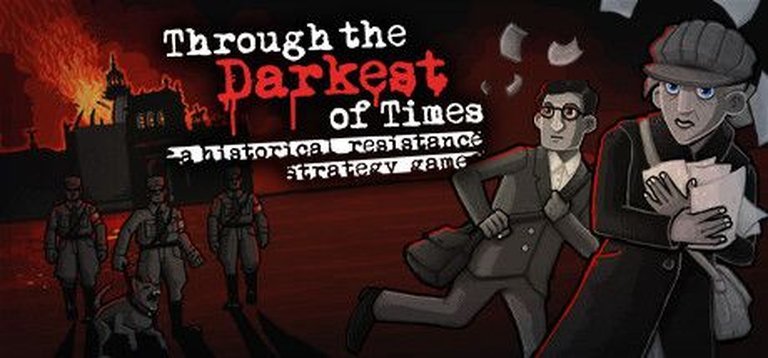
Through the Darkest of Times is a historical turn-based strategy game set in 1930s Berlin during the rise of Nazism and World War II. Players lead a resistance group, making strategic and narrative-driven decisions to undermine the fascist regime while navigating the perils of the era, blending simulation, interactive fiction, and tactics.
Gameplay Videos
Where to Buy Through the Darkest of Times
Through the Darkest of Times Patches & Updates
Through the Darkest of Times Guides & Walkthroughs
Through the Darkest of Times Reviews & Reception
mashable.com : Through the Darkest of Times doesn’t dare turn those death camps into a game, thanks be.
thirdcoastreview.com : Through the Darkest of Times is a harrowing historical strategy game.
Through the Darkest of Times: A Necessary, Flawed Masterpiece of Historical Engagement
Introduction: The Burden of Memory in Interactive Form
To play Through the Darkest of Times is to willingly shoulder a profound and uncomfortable burden. It is not a power fantasy wherein players become heroic liberators mowing down Nazis by the dozens; it is, instead, a grim, often heartbreaking chronicle of small, fragile acts of defiance in the shadow of an all-consuming totalitarian state. Released in 2020 by Berlin indie studio Paintbucket Games, this title represents a landmark—both artistically and culturally—for its unflinching, regulated depiction of Nazi iconography in its country of origin and its deliberate, systemic dismantling of the “good vs. evil” simplicity that typically defines World War II narratives in games. Its thesis is clear and sobering: historical change is not forged solely by generals and leaders, but by ordinary people making desperately difficult choices in the face of overwhelming terror and likely failure. This review will argue that while Through the Darkest of Times stumbles mechanically—often feeling repetitive and mechanically shallow—its narrative and thematic execution is so potent, its historical integration so meticulous, and its emotional resonance so profound that it secures a place as one of the most important “Games for Impact” of the 2020s, a necessary conversation piece about the banality of evil and the mechanics of resistance.
Development History & Context: Breaking a Cultural Taboo
The genesis of Through the Darkest of Times is inseparable from its socio-political context. Developed primarily by Jörg Friedrich (design/writing) and Sebastian St. Schulz (art direction)—veterans from Yager Development (Spec Ops: The Line, Dead Island 2)—the project emerged from a desire to create a historically grounded game about the German resistance. After three years of development, with funding from Medienboard Berlin-Brandenburg and publishing by HandyGames, it launched in January 2020. Its most seismic cultural impact was not its gameplay, but its very existence: it became the first video game published in Germany legally allowed to display swastikas, following the USK (Unterhaltungssoftware Selbstkontrolle) industry regulator’s pivotal revision of its interpretation of StGB § 86a (the law prohibiting the use of unconstitutional symbols). Paintbucket Games secured this approval by submitting a demo at Gamescom 2018, arguing for the symbol’s use in a critical, educational context. This decision sparked a national debate, with then-Family Affairs Minister Franziska Giffey initially declaring “You don’t play with swastikas,” before later supporting the USK’s nuanced stance. Historian Klaus-Peter Sick succinctly countered the criticism: “One doesn’t become a Nazi just by seeing a swastika.” This controversy foregrounded the game’s mission: to confront history directly, not to sanitize it for gameplay comfort.
Technologically, the game was built in Unity with FMOD for sound, featuring a stark, deliberately non-realistic art style inspired by 1920s German Expressionism (think a cross between Persepolis and the political woodcut art of the era). The monochromatic palette with splashes of blood-red is not an aesthetic flourish but a narrative device, evoking a world drained of color by fascism. The use of a hand-drawn, almost comic-book aesthetic was initially polarizing; PC Gamer’s Rick Lane called it “something from a Russian cartoonist’s nightmares,” though others, like Screen Rant’s Peter Morics, found it “complements the anxious, strained world of your resistance leader marvelously.” This visual approach allowed the developers to depict horrific events without venturing into exploitative realism, maintaining a degree of emotional distance that focuses the player on the moral, not the visceral.
Narrative & Thematic Deep Dive: The Anatomy of Despair and Defiance
The narrative structure is the game’s undisputed strength. Spanning four chapters (plus an epilogue) from 1933 to 1945, it follows a procedurally generated resistance leader and their cell. The story is not about changing the grand arc of history—the outcome of the war, the Holocaust—but about the human-scale struggles within it. As the Journal of Geeking Studies and numerous critics note, the game is inspired by real German resistance groups like the Schulze-Boysen-Harnack network and the Baum Group, emphasizing the small, disparate, and often disconnected nature of opposition.
Thematic Core: Helplessness, Complicity, and Micro-Resistance
The central, crushing theme is powerlessness. No matter what the player does, the newspaper clippings at the start of each week (a masterstroke of “meticulous historical accuracy,” as The Guardian‘s Simon Parkin notes) march inexorably toward the Nuremberg Laws, Kristallnacht, the invasion of Poland, and the horrors of the Eastern Front. The player knows what is coming. This creates a profound tension: the strategic layer asks you to plan “missions,” but the narrative layer constantly reminds you of their ultimate futility against the state apparatus. This is not a game about victory; it is about survival, witness, and moral insistence. The writing, credited to Jörg Friedrich and Andrew Nolen, is described by German outlet PC Games as “beeindruckend und furchteinflößend” (impressive and frightening), capable of delivering “Gänsehaut den Rücken hinunter” (goosebumps down the spine) through its quiet, personal moments.
Character & Dialogue: A Chorus of Frightened Voices
The resistance members are not blank slates. Each has randomized political leanings (Catholic Conservative, Moderate Liberal, Social Democrat, Communist, Anarchist), professions (welder, judge, waiter), and traits (Athlete, Doubtful Past, Calm, Paranoid). These directly impact mission success percentages. More importantly, they fuel inter-character conflict and loyalty dilemmas. A communist and a Catholic conservative in the same group will argue, affecting morale. Their personal backstories unfold through dialogue events, creating attachment—and making their eventual arrest, death, or betrayal by the Gestapo (the ever-present “heat” mechanic) unbearably personal. As Third Coast Review observes, you might “find out personal information that will endear them to you—or even make you despise them.” The protagonist is also a defined character with a past, whose own background (e.g., a communist lawyer arrested after the Reichstag fire) is woven into the historical tapestry.
Choice Architecture: Illusion or Agency?
A critical point of analysis is the degree of player agency. Critics are split. GameStar (Germany) praised how the visual novel passages leave you “alleine” (alone) with your decisions, creating genuine moral weight. However, GameSpot‘s David Wildgoose lamented a “frustrating lack of specificity” and that “the story was too rigid,” with choices not meaningfully altering the overarching narrative. This is a deliberate design choice, not an oversight. The game simulates the reality that individual resisters could not alter the regime’s course, only influence micro-outcomes: saving one person, distributing one more leaflet, delaying one shipment. The criticism reveals a player base conditioned by games like Mass Effect to expect butterfly-effect Grandfather Paradoxes. Through the Darkest of Times rejects that fantasy. Its “multiple endings” are minor variations on a tragic theme—who survives, who is captured, what small historical footnote your group scribbles into the margins. As the Save or Quit review notes, “Your action can affect events and change history,” but it’s a change measured in lives saved, not regimes toppled. The game’s power lies in this painful, historically honest limitation.
Modern Parallels: Heavy-Handed or Necessary?
The game does not shy from drawing contemporary parallels. Dialogue occasionally references “fake news” (for Goebbels’ propaganda), and the rise of a popular, vitriolic demagogue using legal means to dismantle democracy is unmistakably resonant. PC Gamer‘s Luke Kemp found some comparisons “clumsy” and “unnecessary.” Yet, as the academic review from e-International Relations argues, the developers explicitly aimed to show that “history is not only changed by generals and leaders, but by all of us,” motivated by rising fascism in the 2010s. For many, especially Jewish players like Mashable’s Adam Rosenberg, these parallels are not subtext but overwhelming, emotional text. The invocation of Max Mannheimer’s quote—”You are not responsible for what happened. But you certainly are responsible for preventing it from happening again”—at the game’s end crystallizes its purpose as a warning tool. Whether this approach is didactic or powerful depends entirely on the player’s receptiveness.
Gameplay Mechanics & Systems: The Grind of Desperation
The gameplay is a hybrid of turn-based strategy, resource management, and visual novel. Each chapter spans 20 in-game weeks. You manage a hideout screen (a fixed, side-view layout) where you assign your characters to missions on a map of Berlin. Resources—Supplies, Supporters, Morale—are reset each chapter, simulating the constant rebuilding required of a persecuted underground.
Core Loop & Mission Design:
* Missions: Range from low-risk (buying paint/paper, recruiting in safe districts) to high-risk (sabotage, bombing, intelligence gathering, hiding deserters). Success is a percentage chance based on a character’s relevant stats (Secrecy, Propaganda, Empathy, Strength, Literacy) and traits, modified by equipment (e.g., a bike for escape). Crucially, a separate “Heat” or Risk mechanic means that even a successful mission can lead to a character being “seen,” raising suspicion that may trigger arrest later.
* Resource Juggle: You need money (from supporters), materials (paper, paint, explosives), and information (intel). Acquiring these often requires risky missions themselves. This creates a feedback loop of risk and reward that feels appropriately tense and desperate.
* Character Progression: Characters gain experience and improve stats through successful missions. However, they can also acquire trauma (e.g., “Tortured,” “Grieving”) that penalize stats. Arrest leads to a rescue mission or a permanent loss.
* Narrative Events: Between weeks, text-driven sequences present historical moments (e.g., the 1936 Olympics, the invasion of France) and personal dilemmas (e.g., seeing an SA man beat a Jewish shopkeeper). Here, your choices can yield resources, alter character relationships, or trigger story flags.
The Strengths and Fatal Flaws:
The system’s strength is its thematic coherence. The constant pressure of Heat, the resetting of resources, the tiny margins for error all evoke the pervasive anxiety and fragility of underground life. The Journal of Geek Studies review notes this captures the “real difficulties and futility” faced by resisters. However, this same coherence becomes a gameplay liability. Critics universally cite repetition as a fatal flaw. Digitally Downloaded (Nintendo Switch, 70%) found it undermined by “resource juggling… like anime dating sims.” TheGamer and 4Players.de agreed the strategy layer is too shallow, feeling like a “mobile game” or “Brettspiel” (board game) lacking depth. Missions devolve into clicking the same district with the highest-success character, week after week. The lack of meaningful integration between the deep narrative choices and the strategic map is the core disconnect. As Save or Quit summarizes, “There isn’t extensive overlap between the story and mission elements.” A pivotal narrative decision might grant you a temporary ally, but its effect on the mission board is often indistinguishable from standard recruitment. This creates a frustrating cognitive dissonance: you feel the weight of a story choice, but its gameplay manifestation is trivial.
Difficulty Modes: The inclusion of a “Story Mode” (reduced pressure/morale penalties) is essential. It acknowledges that some players will want to engage with the narrative without the punishing, often arbitrary-seeming, RNG-driven failures of the “Resistance” (Ironman) mode. On normal difficulty, the balance is criticized—morale plummets too easily, Heat accumulates too relentlessly, making the final chapters feel like an impossible slog, which 4Players argued was “spielerisch viel mehr möglich” (much more possible in terms of gameplay). This difficulty, while perhaps historically accurate in its despair, can cross from meaningful challenge into frustrating punishment, undermining the narrative’s emotional beats with mechanical resentment.
World-Building, Art & Sound: The Somber Grammar of Fascism
The presentation is where the game achieves unqualified brilliance. The art direction by Sebastian St. Schulz is a character in itself. Using a high-contrast, monochrome palette with stark red accents (for blood, Nazi flags, propaganda posters), it evokes the political lithographs and Expressionist cinema of the Weimar era. This is not a “realistic” 1930s Berlin but a psychological landscape drained of hope and vibrancy. The character portraits are simple, emotive, and slightly distorted, focusing on weary eyes and tense Postures. This abstraction allows the game to depict violence and oppression symbolically rather than graphically, making the horror more suggestive and, in many ways, more potent.
Sound design by Almut Schwacke and The Rufus Temple Orchestra is equally integral. The soundtrack deftly contrasts jaunty, melancholic cabaret tunes (heard in safe houses or clubs when morale is high) with droning, dissonant ambient pieces that swell during missions or narrative crises. The sound of jackboots, distant sirens, a radio broadcasting Hitler’s voice—these auditory cues are used sparingly but with devastating effect, constantly reminding the player of the omnipresent terror. The UI sounds—the scratch of a pen writing a leaflet, the click of a match, the ominous thud of a Gestapo knock—are tactile and meaningful.
The historical atmosphere is further built through the weekly newspaper clippings. These are not just set-dressing; they are a narrative backbone. The Guardian praised their “meticulous historical accuracy,” charting the Nazis’ consolidation of power, the public’s Responses, and the escalating persecution. They create a devastating sense of a world hurtling toward catastrophe while your small acts seem like whispers in a hurricane. The choice to allow players to toggle the visibility of the swastika (in the options menu) is a masterful touch of player agency regarding personal trauma, acknowledging the symbol’s volatile power while refusing to erase it historically.
Reception & Legacy: A Catalyst for Conversation
Through the Darkest of Times received a mixed critical reception, aggregating to 71/100 on Metacritic and 77% from the critics tracked by MobyGames. The schism is almost perfectly mirrored in the reviews: Narrative/Premise: Acclaimed. Gameplay Mechanics: Criticized.
- Praise: German press (especially PC Games at 90%) and outlets like Rock Paper Shotgun and The Guardian celebrated it as an essential work of historical education and anti-fascist testimony. It was nominated for “Games for Impact” at The Game Awards 2020, cementing its status as a title valued for its message. Reviewers consistently highlight its emotional power, accurate historical framing, and success in making players feel the weight of complicity and the cost of resistance.
- Criticism: The repetitive, shallow strategy layer is the most common complaint. TheGamer stated it “would be better suited as a mobile game.” Digitally Downloaded felt the story was “undermined” by “systems that contain the same kind of resource juggling… as anime dating sims.” The lack of meaningful choice impact on the macro-narrative and low replayability (due to repetitive dialogue and mission structures) were also cited as major drawbacks.
- Commercial & Cultural Footprint: It achieved a “Very Positive” rating on Steam (84% from over 1,100 reviews as of 2026), indicating a strong resonance with its target audience despite mechanical flaws. Its legacy is twofold:
- The USK Precedent: It irrevocably changed the German and European games landscape by breaking the de facto ban on swastikas in games sold in Germany, opening the door for more mature, critical historical engagements.
- The “Serious Game” Template: It stands alongside Papers, Please and This War of Mine as a benchmark for narrative-driven strategy games about oppression and survival. It proved that a game about historical trauma, with no traditional victory condition, could find a dedicated audience and critical respect.
Its 2025 sequel, The Darkest Files, shifts focus to a post-war investigative/detective framework, suggesting Paintbucket Games is committed to exploring Germany’s reckoning with its past through interactive media.
Conclusion: An Imperfect, Indispensable Monument
Through the Darkest of Times is not a “fun” game. It is not designed to be. It is an experience of witness. Its mechanical flaws—the repetitive clicking, the opaque risk calculations, the often-frustrating reset-chapters—are real and diminish its standing as a strategy title. Yet, to judge it solely on those terms is to miss its profound achievement. It succeeds, brilliantly, on its own terms: to make the abstract statistics of fascism personal, to put the player in the shoes of those who whispered resistance in the dark, and to force a confrontation with the uncomfortable truth that “never again” is a continuous act of vigilance, not a historical footnote.
It is a game that earns its occasional clumsy modern parallels because the patterns of authoritarian rise are distressingly similar. It is a game that justifies its German swastika because to depict the Third Reich without its most potent symbol is to sanitize the monster. It is a game that makes you feel the crushing weight of helplessness, so that you might understand the courage required to act anyway.
In the canon of video games, Through the Darkest of Times will not be remembered for its innovative systems or its balance. It will be remembered as a cultural landmark, a piece of interactive historiography that dared to treat its players as adults capable of grappling with moral complexity without the crutch of power fantasy. It is a flawed, necessary, and haunting work—a digital memorial that asks you not just to play, but to remember, and to ask yourself what you would have done in the darkest of times. For that, it earns its place not merely as a good game, but as an essential one.
Final Verdict: 8.5/10 – A mechanically imperfect but thematically monumental achievement. Its repetitive gameplay is a fair criticism, but one that feels secondary to its primary mission: delivering a sobering, personal, and historically grounded education on the nature of resistance under fascism. A vital piece of interactive history.