
- Release Year: 2008
- Platforms: Windows
- Publisher: Micro Application, S.A.
- Developer: GamecoStudios SARL
- Genre: Adventure
- Perspective: 1st-person
- Game Mode: Single-player
- Gameplay: Cards, Music, Puzzle elements, rhythm, Tiles
- Setting: City – Prague, Europe
Description
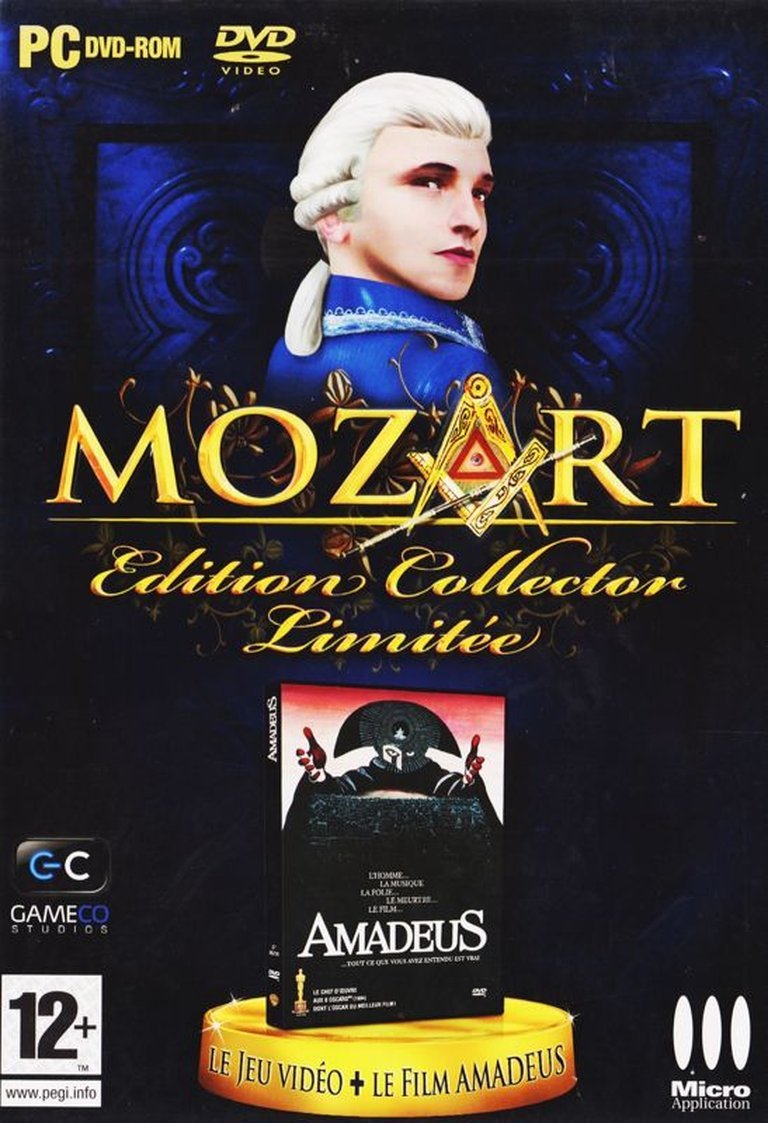
Set in historic Prague, Mozart: Edition Collector Limitée is an adventure game where players embody Wolfgang Amadeus Mozart, a musician protagonist, to solve a detective mystery involving conspirators in 18th-century Europe. This special limited edition bundles the base game ‘Mozart: The Conspirators of Prague’ with the 1984 film, offering an immersive blend of puzzle-solving, music-based gameplay, and cinematic storytelling.
Mozart: Edition Collector Limitée Reviews & Reception
adventuregamehotspot.com : Entertaining historical mystery desperately in need of fine tuning
Mozart: Edition Collector Limitée: A Symphony of Squandered Potential
Introduction: The Maestro as Secret Agent
The premise alone is a masterpiece of incongruity: Wolfgang Amadeus Mozart, the child prodigy of Salzburg, the composer of The Magic Flute and Requiem, reimagined not as a figure in silk stockings composing at a fortepiano, but as a 18th-century James Bond navigating a shadow war of Freemasons, Rosicrucians, and hidden Egyptian temples beneath the cobblestones of Prague. This is the audacious promise of Mozart: Edition Collector Limitée, a 2008 French adventure game repackaged as a special edition. Yet, for every note of genius in its concept—a narrative woven from historical conspiracy and musical puzzle-solving—there are a thousand dissonant chords of catastrophic design, a broken localization, and a baffling marketing strategy that transforms a niche European curiosity into a case study in collector’s edition missteps. This review will argue that while Mozart: The Conspirators of Prague (the game at the heart of this package) represents a fascinating, if deeply flawed, attempt to blend historical biography with pulp adventure, its “Collector’s Limitée” guise does little more than gild a cracked and dissonant instrument, offering a stark lesson in how premium packaging cannot compensate for a fundamentally unfinished product.
Development History & Context: A Studio Unseen, A Vision Unrealized
Mozart: Edition Collector Limitée is the product of GamecoStudios SARL, a French studio about which woefully little public information exists. The game’s credits, as documented on MobyGames, list a team of 69 individuals under roles typical of a mid-2000s European adventure game production: executive producers, level designers, 3D artists, and a screenwriter. The project was helmed by Jean-Martial Lefranc, who served as both Executive Producer and Screenplay writer, suggesting a deeply personal, perhaps vanity, project driven by a specific historical and architectural fascination with Prague. The publisher, Micro Application, S.A., was a French software house known for edutainment, utilities, and niche simulation titles, not for groundbreaking adventure games.
Technologically, the game was forged in the twilight of the classic point-and-click adventure’s dominance. Released in 2008, it arrived after the genre’s commercial nadir but before its indie-led renaissance. It employs a 2.5D aesthetic: pre-rendered, static backgrounds with 3D character models moving on a 2D plane—a technique used by contemporaries like The Black Mirror and Syberia. The constraints are evident. The original Windows version demanded a modest Intel Pentium 4, 512 MB RAM, and a 128 MB DirectX 9.0c-compatible 3D accelerator, with a 2.2 GB install footprint—large for its time, indicative of high-resolution background art. Yet, as the 2022 English release (“Mozart Requiem“) would reveal, this “high-resolution” was inconsistently applied, with some scenes remastered and others left in blocky, blurry low-res.
The gaming landscape of 2008 was dominated by action blockbusters and the rising tide of casual mobile games. A serious, adult-oriented historical adventure about Mozart was a profoundly niche proposition, likely targeting a European, culturally-aware audience and tourists fascinated by Prague. Its original titles—Mozart: De samenzweerders van Praag (Dutch), Mozart: Le Dernier Secret (French)—confirm this regional focus. The “Edition Collector Limitée” itself is part of a trend, as analyzed in collector’s edition design literature, of bundling games with physical extras (soundtracks, films) to justify a premium price and appeal to completists. Here, the physical bonus is the 1984 film about Mozart, a curious choice that feels less like curated content and more like a warehouse-sale bundling to add perceived value to a languishing title.
Narrative & Thematic Deep Dive: Conspiracy, Masonry, and Musical Mayhem
The narrative of Mozart: The Conspirators of Prague is a glorious, unapologetic pulp melodrama draped in powdered wigs. Set in 1788, it opens with Mozart in Prague for the premiere of Don Giovanni. He is not merely composing; he is wrestling with nightmares of Emperor Joseph II’s assassination. His immediate concern, however, is prosaic: securing payment for his opera to avoid eviction. This blend of the mundane and the momentous sets the tone.
The plot escalates with breathtaking speed. Mozart’s investigation into a stolen musical composition—a young Mason named Anton Epoch’s work, which Mozart recognizes as a plagiarism of his own symphony—leads directly to Anton’s murder and Mozart being framed. What follows is an epic nine-hour journey through a clandestine war. He must infiltrate and navigate the conflicts between his own Masonic lodge and the rival, occult-adjacent Rosicrucians. He is captured by a Romani (Gypsy) caravan, where, in a moment of sublime absurdity, he must prove his virtue by beating them at Blackjack. He discovers an entire Egyptian temple hidden beneath Prague, defuses a bomb, and romances the wife of the opera director—all while using his musical genius as both a tool and a weapon.
Thematically, the game explores secrecy, legacy, and the weaponization of art. Mozart’s music is not just background; it is a key to puzzles, a means of identification, and a symbol of Enlightenment rationality clashing with Rosicrucian mysticism. The theme of hidden histories—both beneath the city and within Mozart’s own biography—is pervasive. However, the execution is uneven. The dialogue, as the review from Adventure Game Hotspot savagely notes, is riddled with modern slang, spelling errors, and a disconnect between subtitles and voice acting that constantly shatters immersion. Character motivations, particularly Mozart’s own mercurial temperament and the Romani leader’s sudden offer to make him “king,” flit between historically-inspired intrigue and cartoonish logic. The story is undeniably “strangely compelling,” as the reviewer admits, but it is a compulsion born of its sheer, unbridled audacity rather than coherent plotting.
Gameplay Mechanics & Systems: A Labyrinth of Broken Interactions
Gameplay is traditional point-and-click adventure, but one where the fundamental act of “clicking” is fraught with peril. The core loop is exploration, dialogue, inventory acquisition, and puzzle-solving. The inventory system is basic: combine items in-world or in the inventory menu. However, the game’s greatest flaw is its hyper-specific, non-linear-hostile puzzle design.
- Hotspot Hell: As meticulously documented, the interactive areas (hotspots) are often invisible, misaligned, or provide no feedback. A crucial item may be a two-pixel area blending into a texture. A dog lying in the middle of a room might have its hotspot near the ceiling. Clicking a hotspot may yield no animation, no sound, no response—the only clue being an item’s removal from inventory. There is no object highlighter, forcing players into a pixel-hunting nightmare.
- Order is Law: The game operates on a rigid, scripted sequence. Deviating from the intended order of actions (e.g., combining items before initiating a crucial conversation) can trigger cinematics out of sequence and render the game permanently unwinnable, as the Adventure Game Hotspot reviewer experienced. This is a cardinal sin in adventure design, replacing puzzle logic with developer-prescribed luck.
- Music Puzzles: These are the game’s saving grace and its most interesting mechanic. Mozart finds corrupted sheet music where note sequences in red/blue must be swapped. The constraint of a limited number of incorrect swaps adds tension. This is followed by a conducting mini-game: a first-person view where a moving circle must be tracked with the mouse to keep the baton tip inside, simulating maintaining tempo. These are clever, thematic, and well-suited to the protagonist—a bright spot in an otherwise murky design.
- UI & Progression: The interface is basic and functional but offers little hand-holding. The manual save system, thankfully, is a necessity given the frequency of game-breaking state bugs. Character progression is non-existent; Mozart gains no abilities, only more inventory items and access to new areas.
The gameplay is not a failed experiment in innovation; it is a failed execution of a conventional template. The systems are brittle, the feedback is absent, and the world does not respond to the player in a consistent, logical manner. It feels less like a designed experience and more like a series of Rube Goldberg machines where one misplaced step collapses the whole mechanism.
World-Building, Art & Sound: Prague in Pieces
The game’s strongest asset, beyond its premise, is its atmospheric reconstruction of 1788 Prague. The setting is not just a backdrop but a central character. The visual direction aims for an “illustrated realism,” with painterly backgrounds depicting the Old Town Square, narrow alleys, the lavish opera house, and the hidden, mythic Egyptian temple. The intent is clear: to create a living, historical space infused with mystery.
The 2022 remaster (which is what the Collector’s Limitée essentially is) did partially upgrade environments to 2K resolution, and the results are mixed. The “good” rooms—the cavernous opera house, the majestic Charles Bridge, the intricate temple—are impressive, capturing a sense of scale and period detail. The “bad” rooms, however, are * glaringly low-resolution, blurry, and blocky, creating a jarring aesthetic whiplash. *Character models are serviceable for 2008 but look dated today, with stiff animations. Mozart’s infamous “skating” walk, where the animation is out of sync with movement speed, is a persistent, immersion-breaking joke.
The sound design and score are where the game achieves its authentic, classical dignity. The entire soundtrack is comprised of arrangements of actual Mozart compositions (Symphony No. 40, Eine kleine Nachtmusik, Requiem). The music is impeccably chosen, dynamically shifting from light, playful themes during exploration to darker, more ominous strains during suspenseful moments. This is not a synthetic approximation; it is the real thing, providing a constant, uplifting, and historically resonant thread through the gameplay. The voice acting, as noted, is of decent quality in terms of performance but is utterly sabotaged by the atrocious, often misleading English localization and subtitle synchronization.
The atmosphere, therefore, is a fractured thing: moments of breathtaking, music-accompanied immersion in a beautiful Prague are ruthlessly undercut by a horrible interface, visual inconsistencies, and a script that sounds like it was run through a poorly-tuned translator and never proofread.
Reception & Legacy: From Obscurity to Infamy
The original 2008 releases (Conspirators of Prague, The Last Secret) were regional curiosities, met with largely indifferent or negative critical reception. On MobyGames, the original game holds a critic score of 51% based on 8 reviews, ranking it poorly. Player scores from the scant few who have “collected” it are similarly low (2.5/5). It vanished into the archival ether of European PC gaming, remembered by almost no one.
Its “legacy” was cemented in 2022 with the Steam release as Mozart Requiem. This was not a remake or a remaster in the true sense, but a straight re-release with minor technical upgrades and a new, botched English localization. The Steam community response was universally scathing. Players were outraged to be charged $29.99-$43 for a 14-year-old game that was clearly still in a broken state. The developer’s (Hoplite Research/leebrown) defense—citing added language support, upgraded textures, and character models—was met with derision. As one user succinctly posted: “this is a 2008 game — Mozart: The Conspirators of Prague!!” The price was seen as an insult, the lack of polish as an act of negligence.
Mozart: Edition Collector Limitée itself is an even more niche artifact. With only 2 players recorded on MobyGames as having collected it, it represents the extreme tail end of the collector’s edition market: a physical bundle of an obscure, poorly-regarded game and an unrelated film, likely sold in limited runs in France. Its place in history is as a cautionary tale. It demonstrates the worst impulses of the collector’s edition model: using physical trinkets and bonus films to mask a core product that is fundamentally defective. It also highlights the perils of late localization without thorough QA, releasing a game with decades-old bugs and a translation so poor it actively harms gameplay.
Its influence is negligible. It did not revive the adventure genre. It did not inspire a wave of historical musical mysteries. Its sole impact is as a preservationist’s footnote and a consumer warning. The Adventure Game Hotspot review, with its meticulous documentation of bugs, becomes the definitive historical record—a forensic analysis of a failure.
Conclusion: A Muted Coda
Mozart: Edition Collector Limitée is a profound disappointment, but not because its premise is silly—its premise is its greatest strength. It is a disappointment because that premise is betrayed at every level of implementation. The game that could have been a witty, erudite, and musically rich adventure—a Professor Layton for the Classical era—is instead a bug-riddled, poorly-localized, mechanically brittle relic.
The 2022 Mozart Requiem release, which forms the basis of this collector’s edition, is arguably in a worse state than the original 2008 French release due to its misleading marketing and added layer of incompetent translation. The physical extras—the soundtrack and film—are inert objects, unable to breathe life into the digital corpse of the game itself. For a historian, it is a fascinating case study in missed opportunity and commercial tone-deafness. For a player, it is a frustrating, broken experience where even enjoying the clever music puzzles and the wild story is undercut by the constant, grating friction of a non-functional interface.
Final Verdict: This is not a game to be celebrated or recommended. It is a historical curiosity to be analyzed, not played. Its value lies entirely in its documentation as a failure state: a brilliant concept strangled by technical incompetence, sour localization, and a cynical collector’s edition strategy that mistook a garish wrapper for a worthy gift. Mozart composed symphonies of heaven-storming beauty from the constraints of his era. Mozart: Edition Collector Limitée is the sonic opposite: a cacophony of avoidable errors, proving that some editions should remain limitée to the archives.