
- Release Year: 2011
- Platforms: Windows, Xbox 360
- Publisher: Eclipse Games SC
- Developer: Eclipse Games SC
- Genre: Driving, Racing
- Perspective: Top-down
- Game Mode: Co-op, Single-player
- Gameplay: Credit collection, Racing, Vehicle unlocking
- Setting: Desktop, Kitchen, Playground
- Average Score: 66/100
Description
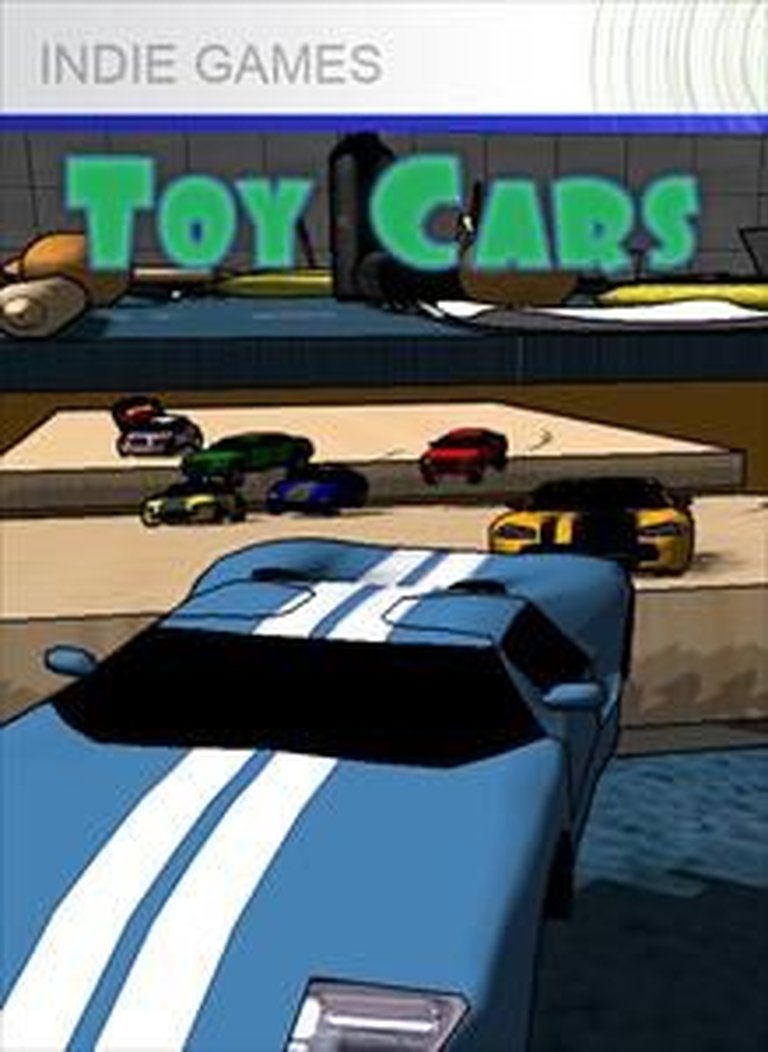
Toy Cars is a top-down racing game that draws visual inspiration from classic Micro Machine toys, set on creatively designed tracks using everyday locations such as kitchens, playgrounds, and desktops. Players can enjoy a season mode to collect credits and unlock nine vehicles, quick races on eight tracks across four visual settings, and local multiplayer split-screen for up to four players.
Where to Buy Toy Cars
PC
Toy Cars Reviews & Reception
moddb.com (66/100): Great Game, great developer!!
xblafans.com : It’s flashy, fun and is great in small doses, especially when you have a few pals sitting next to you.
Toy Cars: A Microscopic Masterpiece or a Forgotten Fling? An In-Depth Historical Review
Introduction: The Charm of the Miniature World
In the vast museum of video game history, some titles are colossal marble statues—canonical, influential, and impossible to ignore. Others are delicate, hand-carved miniatures, beautiful and precise but often relegated to a dimly lit shelf, known only to the most dedicated curators. Toy Cars, developed by the Spanish indie studio Eclipse Games SC and released in February 2011 for Xbox 360 (via Xbox Live Indie Games) and Windows, is unequivocally one such miniature. Conceived not as a blockbuster but as a heartfelt homage and a subtle evolution of a classic arcade formula, it represents a fascinating nexus of nostalgic design, indie ingenuity, and the harsh realities of the digital marketplace. This review will argue that while Toy Cars is a flawed and ultimately minor artifact, its existence is a crucial data point in understanding the indie scene of the late 2000s/early 2010s, the enduring legacy of the top-down racer, and the perils of developing outside the mainstream spotlight. Its true significance lies less in its execution and more in its intent: a love letter to Micro Machines that dared to add a layer of simulationist physics to a genre defined by pure, chaotic simplicity.
Development History & Context: The Indie Garage
The Studio and the Vision: Toy Cars was the brainchild of Eduardo Jiménez Chapresto (credited as “Barkley”), who served as the game’s idea originator, lead programmer, and primary artist. Working under the banner of Eclipse Games SC—a small, likely two-to-three-person operation as evidenced by the credits—the project was a passion project born from a clear, focused inspiration. The developers explicitly stated their goal: to create “both a homage and an evolution of classic top-down arcade racers,” with the visual and conceptual style of the legendary Micro Machines toys and games as their north star. This was not an attempt to reinvent the wheel but to refine a beloved, specific wheel.
Technological Constraints and Platform: The game was built using Microsoft’s XNA framework, a popular choice for XBLIG developers due to its accessibility and direct pipeline to the Xbox 360. This choice dictated both its strengths and limitations. XNA allowed for a relatively quick development cycle for a small team but also imposed technical ceilings, particularly in physics simulation and online networking. The decision to prioritize split-screen local multiplayer over any form of online play was likely a pragmatic one, given the team’s size and the tools at their disposal, but it would become a defining—and limiting—feature. Releasing on XBLIG meant the game existed in the “wild west” of the Xbox Marketplace, where discoverability was a constant battle against a flood of competing titles, from cheap asset flips to genuine gems.
The Gaming Landscape of 2011: The racing genre in 2011 was dominated by two poles: the gritty, sim-oriented Gran Turismo and Forza series, and the wildly popular, item-fueled kart racers led by Mario Kart. The mid-ground for accessible, physics-based racing was thinning. Arcade racers like Burnout had largely moved to 3D perspectives. The top-down racer, once an arcade staple (Super Off Road, R.C. Pro-Am), was a niche genre primarily sustained by retro compilations and the occasional indie title like Crap Cars or Supersonic RC. Into this space stepped Toy Cars, a game that felt less like a product of its time and more like a deliberate echo of the late 1980s and early 1990s, now dressed in a cel-shaded, “tabletop” aesthetic.
Narrative & Thematic Deep Dive: The Story of Speed (and Cupboards)
The Plot: There Is None (And That’s the Point). To analyze the “narrative” of Toy Cars is to engage in a fascinating exercise in minimalism. The game possesses no story mode in the traditional sense. Its “Season Mode” is a pure, unadulterated progression system—a ladder of tournaments where the only narrative beat is the player’s rise from a slow toy car to a champion piloting a “faster” vehicle. The “story” is purely emergent: the player creates their own narrative of rivalry, redemption, and triumph through the act of racing. The tracks themselves—a kitchen, a playground, a desktop, a garage—imply a diegetic world of childhood play, but this is pure aesthetic framing, not a plot. The game is a pure mechanics-first experience, a thematic through-line of “play” manifesting as pure, un-narrated competition.
Characters & Dialogue: A Cast of Plastic and Steel. There are no characters in the Toy Story or Cars sense. The “cast” consists of nine distinct vehicle archetypes (from a slow buggy to a swift formula racer), differentiated only by their statistical profiles (speed, acceleration, grip) and visual designs. There is no dialogue, no personality, no cutscenes. The only “character” is the player’s chosen car, which gains a faint sense of identity through its performance and the player’s attachment to it. This stark absence of narrative is its most significant thematic statement: here, the car is not a character; it is a tool. The joy is in the tool’s interaction with the environment, not in its backstory. This places Toy Cars in a different philosophical camp than its spiritual predecessor Micro Machines (which featured tiny, personality-filled drivers) and light-years from the anthropomorphic, character-driven Cars franchise. The theme is not who is racing, but what can be raced on.
Underlying Themes: Nostalgia as a Design Blueprint. The primary theme of Toy Cars is nostalgia engineered into gameplay. The entire project is an exercise in resurrecting a specific feeling—the thrill of seeing a toy car zoom across a school desk, perilously close to the edge of a cliff made of stacked books. The game’s very existence is a thesis statement on the evocative power of scale and context. The secondary, unintentional theme is the indie developer’s curse of scope. The ambition to create a “deep” vehicle handling system with “3D physics simulation” (as stated on the official site) is evident, but itscope overwhelmed the team’s capacity to polish it, leading to the infamous “ice rink” physics complaints. The game becomes a case study in the gap between conceptual evolution and practical execution.
Gameplay Mechanics & Systems: Precision or Panic?
Core Gameplay Loop: The loop is brutally simple and immediately accessible from the main menu: select a mode, select a track, select a car, race. The top-down perspective provides a clear, tactical view of the miniature circuits. The fundamental challenge is maintaining control and speed while navigating tight corners defined by everyday objects (pencils as guardrails, cups as chicanes, books as massive jumps). The “evolution” promised by the developers lies in the handling model.
Vehicle Handling & Physics: The Divisive Core. This is the game’s most analyzed and criticized system. The nine cars promise “unique handling,” but the community consensus, reflected in user reviews on ModDB and Grouvee, is that most cars suffer from excessive, unintuitive slide. The physics feel “floaty” and unstable, particularly after jumps or during sharp turns, leading to a sense of driving on a low-friction surface rather than a textured tabletop. This is the critical point of divergence from Micro Machines, which was beloved for its tight, responsive, almost slot-car-like control. Toy Cars attempts a more “simulationist” feel, where car weight and momentum matter, but the implementation feels unfinished. The AI exacerbates this, as opponents are often reported to handle better and be less affected by the same physics quirks, creating a sense of unfairness.
Progression & Unlockables: The Carrot on a Stick. The Season Mode provides the necessary structure. Winning races earns credits, which are used to unlock faster cars from the total pool of nine. This creates a satisfying, if shallow, power curve. The early races with the slowest car are a struggle for control; later races with the fastest car become a white-knuckle exercise in managing terrifying speed on treacherous tracks. The progression is logical and provides clear goals, which is a significant strength for a game of this scale.
UI & Menus: Functional, Not Fancy. The user interface is utilitarian. It gets the job done with clear menus for mode, car, and track selection. There is no flash, but also no confusion. This fits the indie aesthetic perfectly: no time or resources were wasted on elaborate menus.
Innovative or Flawed Systems? The innovative idea was to marry the Micro Machines aesthetic with a more nuanced, “physics-based” driving model. The flawed execution of that model is what defines the game. The other major “system” is the 4-player local split-screen multiplayer. This is the game’s undisputed highlight, repeatedly cited in reviews as the “real fun.” The chaotic, physics-enabled jostling for position, the ability to literally ram a friend off the track (or into a toy block tower), and the shared-couch, trash-talking dynamic transforms the game’s technical flaws into feature. The imprecise handling becomes a source of hilarious, unpredictable chaos when four humans are involved. It’s a brilliant example of a weakness becoming a strength in a specific context.
World-Building, Art & Sound: A Plastic Fantastic Paradise
Setting & Atmosphere: The Toybox Brought to Life. The game’s world is its most universally praised aspect. The four visual settings (Kitchen, Playroom, Desktop, Garage) are rendered with a cheerful, cel-shaded style that perfectly captures the essence of a child’s imaginative play space. Tracks are ingeniously constructed from everyday objects: a spaghetti colander becomes a tunnel, a roll of tape a looping corkscrew, a pencil cup a perilous jump. The attention to the “tabletop” scale is impeccable. The atmosphere is one of frenetic, playful energy. It feels like the moment before a parent walks in and the toys must freeze in place.
Visual Direction:抄袭 or Homage? The debt to Micro Machines is direct and unashamed. The tiny vehicles, the zoomed-out perspective, the use of real-world objects as track boundaries—it is a deliberate, reverential copy. The cel-shading, however, gives it a distinct, modern indie sheen that differentiates it from the 16-bit pixel art of its inspiration. It’s a loving tribute, not a theft, executed with clear passion. The track design, while limited to eight layouts (two per setting), is clever and varied, utilizing verticality (jumps) and tight corners to create challenge.
Sound Design: A Synthwave Lullaby. Composer Lucas González Torres delivers a perfectly fitting soundtrack. It consists of catchy, upbeat, synth-driven tunes that evoke both 80s arcade games and modern indie chiptune sensibilities. The music is energetic but never overpowering, complementing the frantic pace. Sound effects are清脆 and satisfying: the hum of motors, the crunch of collision with a plastic cup, the “thwack” of a car hitting a wall. They reinforce the toy-like aesthetic. Together, the art and sound create a cohesive, immersive, and joyful “toybox” atmosphere that is the game’s greatest asset.
Reception & Legacy: The Quietest Revolution
Critical and Commercial Reception at Launch: Toy Cars existed almost entirely in the ecosystem of the Xbox Live Indie Games marketplace and word-of-mouth on PC. It received no mainstream critic reviews (Metacritic shows “tbd” for both critic and user scores, though user scores are based on only a handful of ratings). Its reception was defined by the niche press and community. Reviews from sites like XBLAFans were mixed to positive, praising the multiplayer and aesthetic while crucifying the physics. On community aggregators like ModDB and IndieDB, it holds a moderate 6.6/10 average. The common refrain: “Great idea, flawed execution.” It was a cult curiosity, not a hit. Commercially, as a 80 Microsoft Point (roughly $1) title on XBLIG, it likely recouped its tiny development costs for Eclipse Games but vanished quickly into the marketplace’s abyss.
Evolution of Reputation: The game’s reputation has solidified into that of a cult curio and a “what could have been” case study. It is rarely mentioned in broad discussions of great racing games or even great indie games. However, within communities dedicated to Micro Machines fandom or obscure racers, it is remembered as the most direct and visually faithful spiritual successor of its era. Its reputation is tied inextricably to the success of its sequel.
Influence and Industry Impact: The Seed of Super Toy Cars. Toy Cars‘s true legacy is not in itself, but in its * progeny, *Super Toy Cars (2014)*. Developed by the same core team (Eclipse Games), the sequel took the fundamental concept and vastly improved upon it. It featured online multiplayer, a more robust track editor, a refined physics model, and a higher production value. *Super Toy Cars received significantly more attention and positive reviews, effectively retroactively validating the original’s core vision. The lineage is clear: Toy Cars was the rough prototype, the proof-of-concept that demonstrated a market for a modern Micro Machines-like game. The industry impact is indirect but present: it is a small, clear example of how an indie team can iterate on a niche concept, learn from a flawed first attempt, and successfully build a more polished product that finds its audience. It also serves as a stark lesson on the importance of tight, responsive controls in a genre where precision is paramount.
Conclusion: A Charming, Flawed Artifact of Indie Devotion
Toy Cars is not a great game by any conventional metric. Its physics are often frustrating, its AI is suspect, and its content is slim. It lacks the polish, depth, and sheer fun of the classics it apes. Yet, to dismiss it entirely is to overlook its unique value. It is a pure, unadulterated expression of a developer’s specific nostalgic desire, executed with limited means but clear heart. Its strengths—the sublime art direction, the brilliant use of scale, the conceptually fantastic local multiplayer—shine through its weaknesses. It captures the feeling of playing with toy cars on a tabletop better than almost any game before or since.
In the grand canon, Toy Cars belongs in a special annex: the hallway of noble failures and ambitious prototypes. It is not a foundational title like the original Micro Machines or a genre-defining king like Mario Kart. Instead, it is a fascinating footnote, a game that asks “What if?” and provides an answer that is imperfect but intriguing. Its historical importance is as a bridge, connecting the past of a dormant genre to its future via the indie scene’s capacity for revival. For the player willing to tolerate its jank, it offers a brief, brilliant return to a child’s bedroom floor. For the historian, it offers a clear window into the aspirations and constraints of indie development on the cusp of the modern, crowdfunded era. Final Verdict: A charming, flawed, and essential curiosity for racing game historians and Micro Machines devotees. For everyone else, a pleasant but ephemeral distraction best enjoyed with three friends on a couch.