
- Release Year: 2005
- Platforms: Windows
- Publisher: Bold Games
- Genre: Compilation
- Setting: Vietnam War
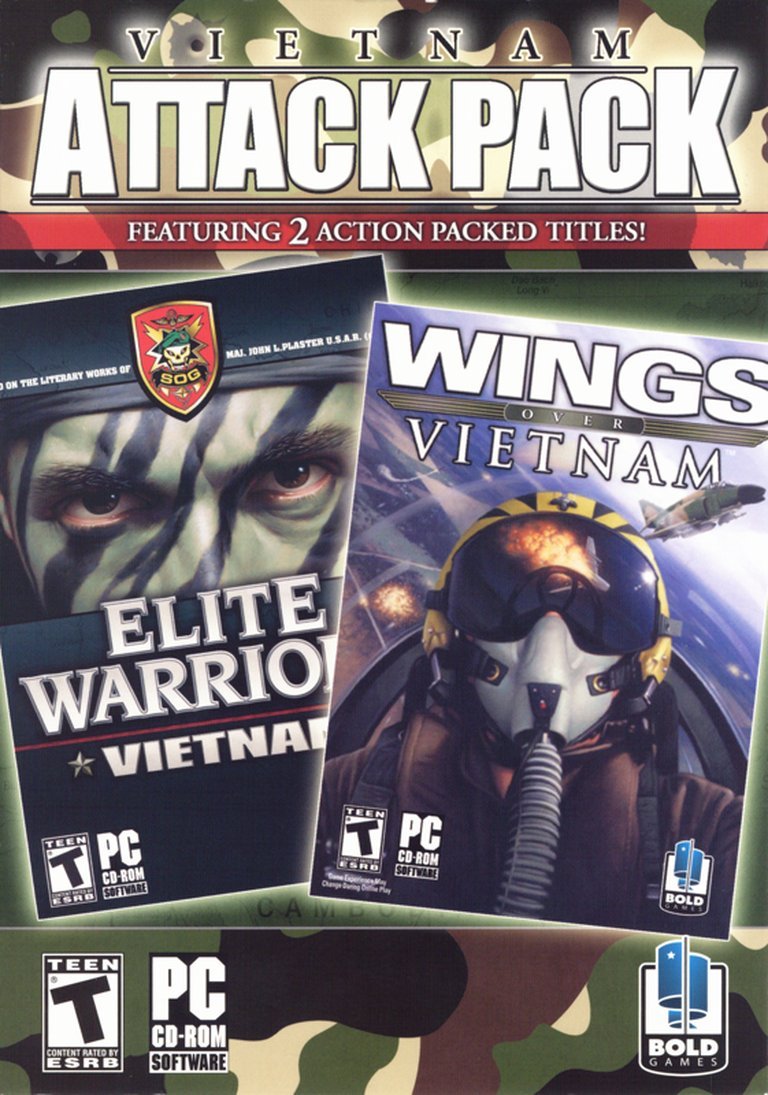
Description
Vietnam Attack Pack is a 2005 compilation released for Windows, bundling together Wings over Vietnam and Elite Warriors: Vietnam to immerse players in the Vietnam War through distinct gameplay experiences: one focused on aerial combat missions and the other on ground-based tactical operations, all set against the historical backdrop of the conflict.
Vietnam Attack Pack: A Dual-Front Survey of a Controversial Conflict
Introduction: Bundling the Fog of War
In the mid-2000s, the digital depiction of the Vietnam War stood at a fascinating crossroads. No longer dominated by the arcade sensibilities of the 1980s and early 1990s, nor yet fully absorbed into the Hollywood-esque blockbuster realism of the 2010s, the era was a fertile ground for dedicated, often niche, simulation. Into this space stepped Bold Games with Vietnam Attack Pack (2005), a Windows compilation that promised a two-pronged assault on the theme. By pairing Bold Games’ own Wings over Vietnam (2004)—a dedicated air combat simulator—with SAS Institute’s Elite Warriors: Vietnam (2005)—a slower, tactical ground engagement—the pack offered a rare, bifurcated perspective: the view from 30,000 feet and the grunt’s-eye view in the steaming jungle. This review argues that Vietnam Attack Pack is not a masterpiece but a historically significant curatorial artifact. It represents a specific moment when publishers sought to serve a dedicated “mil-sim” audience by bundling complementary, if uneven, takes on the same conflict, highlighting the technological and design schisms within Vietnam War gaming at the time. Its legacy is less in revolutionary design and more in its role as a time capsule of early-2000s simulation philosophy.
Development History & Context: The Publisher’s Gamble
The genesis of Vietnam Attack Pack is intrinsically tied to its publisher, Bold Games. An entity known for publishing a string of military and combat flight simulators in the early 2000s (including Wings of War series titles), Bold Games positioned itself as a conduit for historically-minded, if technically rugged, simulations. Their vision for the pack was straightforward: aggregate two of their Vietnam-themed releases into a single, value-priced product. This was a common budget-publisher strategy—repackaging existing titles to reach a wider audience—but it reveals much about the market.
The technological constraints of the era (2004-2005) are palpable. Both constituent games were built on proprietary, modestly scaled engines. Wings over Vietnam utilized a flight model that was praised for its depth but criticized for its dated graphics, even at release. Elite Warriors: Vietnam, developed by the SAS Institute (a company better known for its analytical software than games), felt like a transition title between the top-down strategy of earlier Vietnam games and the emerging third-person tactical shooter. The gaming landscape was dominated by the explosive success of DICE’s Battlefield Vietnam (2004) and Global Star’s Conflict: Vietnam (2004), which offered more accessible, action-oriented takes. Against this backdrop, Vietnam Attack Pack was a deliberate counter-programming: a no-frills, simulation-first offering for the patient enthusiast willing to grapple with clunky UIs and demanding systems. The “Compilation” genre tag on MobyGames is apt; this was not an integrated experience but a digital storefront of two separate products sharing a theme and a box art.
Narrative & Thematic Deep Dive: Operations Over Epics
Neither title in the pack aspires to a cinematic, character-driven war drama. Instead, they adhere to a doctrine of operational authenticity, where narrative is a functional layer over tactical objectives.
Wings over Vietnam employs a text-and-briefing-heavy approach. The “story” is the chronological progression of an American naval aviator’s tour of duty, loosely mapped onto historical campaigns like Operation Rolling Thunder and the 1972 Easter Offensive. Narrative delivery is almost entirely diegetic: mission briefings outline targets (bridges, SAM sites, truck parks), after-action reports detail successes or failures, and occasional historical snippets provide context. There are no character arcs, no personal motivations beyond “complete the mission.” This sterile approach serves the sim’s purpose: to make the player feel like a cog in the aerial warfare machine, where success is measured in tonnage of ordnance delivered and enemy aircraft destroyed.
Elite Warriors: Vietnam offers a marginally more personal, but equally sparse, narrative framework. Players command a four-man Special Forces/LLDB team on covert operations. The story emerges from squad radio chatter and mission intro/outro text. Objectives are classic special ops fare: reconnoiter a suspected VC base, rescue a downed pilot, secure a landing zone. The thematic undertone is one of isolation and tension, created not through scripted drama but through the game’s demanding mechanics—limited ammunition, the constant threat of ambush, and the need for careful stealth. Dialogue is functional (“Contact front!”) and procedural. The game’s silence on the war’s politics is deafening; it presents the conflict as a series of tactical problems to be solved, reflecting a certain dehumanized, professional military perspective common in early-2000s gaming.
Together, the pack’s narrative thesis is that the Vietnam War can be understood through the meticulous recreation of its logistics, weaponry, and tactical procedures. It’s a simulationist argument: that the “truth” of the conflict lies not in ideology or biography, but in the sensory and procedural experience of its combat.
Gameplay Mechanics & Systems: A Study in Contrasts
This is where the pack’s dual nature is most pronounced. The gameplay loops are fundamentally, almost antagonistically, different.
Core Loop 1: Wings over Vietnam – The Demands of the Sky
The loop is a pre-flight to post-flight cycle: Briefing → Loadout Selection → Takeoff → Navigation to Target Area → Combat Engagement (Air-to-Air or Air-to-Ground) → RTB (Return to Base) → Debriefing → Upgrade/Repair.
* Flight Model: Reportedly deep for its time, with attention to stall speeds, G-forces, and energy management. However, it lacks the visceral feedback of modern sims like DCS World. Mastering a landing in an A-6 Intruder on a carrier at night is a significant skill hurdle.
* Combat Systems: Air-to-air combat requires leading targets and managing missiles (AIM-9 Sidewinders) and guns. Air-to-ground involves navigating to a precise grid coordinate, identifying the target (often a small truck or bunker), and delivering unguided bombs or rockets with calculated dive angles. The precision requirement is extreme; a missed bomb run often means a wasted sortie and a punitive score penalty.
* Progression: Largely linear campaign progression with a modest upgrade system for aircraft weapons and armor based on mission performance and accrued score.
* Flaws: The interface is notoriously cluttered and non-standard. Navigation relies heavily on a paper map (included in the PDF manual) and in-game coordinates, offering little in-game guidance. The campaign’s dynamic elements are limited; mission failure rarely blocks the next scenario, undermining consequence.
Core Loop 2: Elite Warriors: Vietnam – The Calculus of the Jungle
The loop is a planning-to-extraction cycle: Squad Selection/Loadout → Approach (Stealth) → Contact → Tactical Engagement → Objective Completion → Extraction.
* Squad Command: The core innovation is controlling a four-man team in real-time. Commands are context-sensitive (point-and-click to move, right-click to engage a specific target, key binds for suppressive fire, grenades, and medical). The AI is basic but predictable; squadmates will automatically take cover and return fire.
* Tactical Emphasis: The game is brutally unforgiving. Ammo is scarce, health does not regenerate, and a single well-placed VC shot can be fatal. The slow pace is mandatory. Rushing leads to annihilation. Players must use cover, lean, and peek, employing suppressive fire to maneuver. The dense jungle environment is both a shield and a deathtrap, limiting visibility.
* Mission Design: Missions are small-scale and objective-based (plant explosives, retrieve intel, eliminate a commander). There is no persistent overworld.
* Flaws: Pathfinding is notoriously poor, with squadmates sometimes getting stuck on terrain. The interface for squad commands can be fiddly under fire. The graphics, while atmospheric, make enemy identification difficult at times.
The Pack’s Unifying (and Divisive) Philosophy: Both games share a high barrier to entry and a punishing, minimalist HUD. They demand player investment in learning their specific, often idiosyncratic, rule sets. There is little hand-holding; the manual is essential. This creates a stark divide: players who enjoy the cerebral puzzle of mastering systems will find deep satisfaction; those seeking immediate action will find both games archaic and frustrating.
World-Building, Art & Sound: Authenticity Through Constraint
Visually and aurally, the pack is a product of its time and budget, but it leverages limitations to create a specific, grounded atmosphere.
- Setting & Atmosphere: Both games eschew the lush, saturated greens of a later title like Battlefield: Bad Company 2: Vietnam. Instead, they opt for a drab, realistic palette. Wings over Vietnam features vast, low-poly terrain with simple texture tiling for rice paddies and jungle, but the sheer scale and accurate placement of real-world landmarks (Hanoi’s reservoirs, the Ho Chi Minh Trail regions) create a sense of place. Elite Warriors uses tight, claustrophobic levels—hut complexes, narrow trails, tunnel entrances—that brilliantly evoke the enclosed, paranoid terror of jungle patrols. The world feels dangerous because you can rarely see far.
- Visual Direction: The art style is utilitarian realism. Aircraft models are accurate but low-poly. Soldier uniforms are period-correct (ERDL camouflage, flak jackets). Explosions are simple sprite-based effects. The lack of spectacle forces attention onto the environment as a tactical tool. This is not a beautiful game, but it is often an effective and persuasive one in its moment-to-moment gameplay.
- Sound Design: Sound is functional and informative. The Wings soundscape is dominated by engine roar, radio chatter (often just static and coordinates), and the terrifying beep of a lock-on warning. Elite Warriors relies on directional audio: rustling leaves, distant rifle cracks, and the iconic thwump of an RPG. The absence of a dynamic soundtrack is notable; silence and diegetic sound heighten tension. Voice acting (in Elite Warriors) is stiff but period-plausible, with gruff commands and panicked shouts.
The cumulative effect is not immersion through graphical fidelity, but through procedural and auditory consistency. You believe you’re in a Phantom because the instruments behave a certain way and the engine sounds correct, not because the cockpit is photorealistic.
Reception & Legacy: The Niche That Was
Critical reception for Vietnam Attack Pack is virtually non-existent in the mainstream press, as documented by the empty critic review pages on MobyGames and Metacritic. This is telling. It was not a title that crossed over. Its audience was the dedicated simulation niche, a group already reading magazines like Computer Games Magazine or PC Gamer’s strategy/sim sections.
- Contemporary Reception (2005): Within its target community, the pack was likely seen as a value proposition—two games for the price of one. Reviews on minor gaming sites (like the provided Retro Replay piece) would have praised its depth and authenticity while heavily caveating its steep learning curves and dated presentation. It would have been favorably compared to other “hardcore” titles like Squad Battles: Vietnam or Men of Valor, but dismissed by fans of Battlefield Vietnam‘s accessibility.
- Commercial Performance: As a budget compilation from a minor publisher, sales were almost certainly modest. Its value was in extending the commercial life of its two components, which had already been niche products.
- Evolving Reputation & Influence: The pack’s legacy is symbiotic with the legacies of its parts.
- Wings over Vietnam is remembered as a competent, if flawed, precursor to the more refined Strike Fighters 2: Vietnam (2009) by Third Wire. Its flight model and mission structure influenced the expectations for that later, superior title. It stands as part of the lineage of detailed-but-accessible jet sims that began with Chuck Yeager’s Air Combat.
- Elite Warriors: Vietnam is a curious footnote in the evolution of the tactical shooter. Its heavy emphasis on squad command and lethality prefigured the “tactical realism” boom led by ARMA (2006) and Insurgency (2014), but its execution was too rough and its presentation too dated to gain traction. It represents a dead-end branch in design—too complex for arcade fans, too clunky for sim purists.
- As a compilation, it pioneered a model later perfected by publishers like Slitherine and Matrix Games: bundling complementary simulations on a single theme for the wargaming enthusiast. It lacked modern features like integrated mod support (though communities for both games separately created unofficial patches and mods), but its structure—”Air & Ground”—is conceptualized in later, more successful packs.
Its primary influence is preservative. It exists as a snapshot of what mid-2000s “hardcore” Vietnam War gaming looked like: two disparate, technically demanding, and unapologetically specialist experiences sold together under a single, broad thematic banner.
Conclusion: A Specialist’s Time Capsule, Not a Classic
Vietnam Attack Pack cannot be judged as a cohesive game but as a dual-product artifact. Separately, its components are products of their time: Wings over Vietnam is a demanding but rewarding flight simulator that feels authentic but awkward, while Elite Warriors: Vietnam is a brutally difficult and clunky tactical exercise that captures the tension of jungle patrols but stumbles in execution.
Together, they form a compelling, if flawed, survey course in early-2000s simulation design. The pack’s great achievement is conceptual: the insight that the Vietnam War’s experience was so multifaceted that it required two fundamentally different gameplay lenses. You cannot understand the air war through a ground-sim lens, nor the Grunt’s terror from a cockpit.
Its faults are numerous and forgivable only to the converted: a unified launcher that does little more than launch two separate executables, dated graphics that strain modern resolutions without community patches, incomprehensible navigation in Wings, and pathfinding hell in Elite Warriors. It is not a game for the uninitiated.
Ultimately, Vietnam Attack Pack secures its place in history as a curatorial success and a design snapshot. It serves the dedicated historian of virtual warfare, offering access to two obscure but passionately crafted simulations that, together, paint a more nuanced—if technically uneven—picture of the conflict than any single blockbuster ever could. For the patient, mod-friendly, and historically curious player, it remains a worthwhile, budget-priced excavation. For everyone else, it is a fascinating museum piece, a testament to an era when the Vietnam War in games was still a puzzle to be solved by engineers and grognards, not a setting to be exploited for mainstream thrills. Its verdict is one of qualified preservation value: not great, but genuinely important for a specific audience.