
- Release Year: 2001
- Platforms: Windows
- Publisher: Auran Games Pty Ltd., Global Software Publishing Ltd., Strategy First, Inc.
- Developer: Auran Games Pty Ltd.
- Genre: Simulation
- Perspective: First-person, Third-person
- Game Mode: Single-player
- Gameplay: Layout Design, Train driving
- Setting: Model Railroading
- Average Score: 90/100
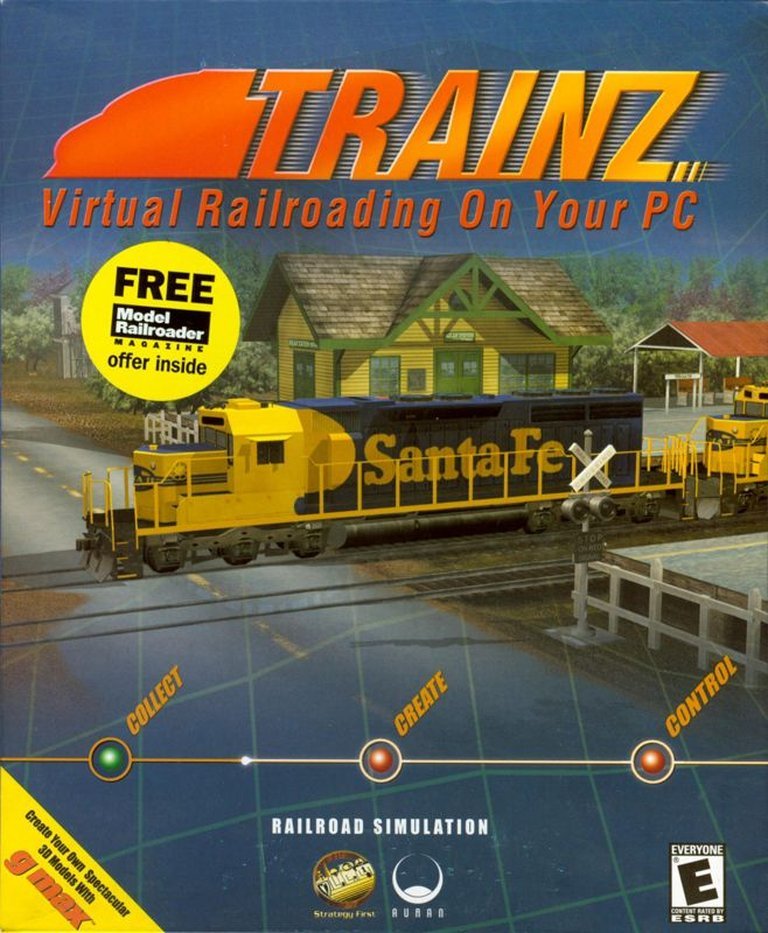
Description
Trainz: Virtual Railroading on your PC is a simulation game focused on model railroading, allowing players to design and construct custom railroad layouts using the Surveyor tool, then operate trains in Driver mode with options for both simplified controllers and realistic cab handles. It includes a variety of locomotives and rolling stock, with Emphasis on ease of design and expandability through additional downloadable content, providing an immersive virtual railroading experience.
Gameplay Videos
Trainz: Virtual Railroading on your PC Reviews & Reception
metacritic.com (90/100): Powerful, easy to use, and loaded with potential, it could become the flagship computer title for train enthusiasts.
oldpcgaming.net : Too few scenarios grinds Trainz to a halt.
old-games.com : The single most endearing attribute of this title is its simplicity and ease of use, regardless of which aspect of the hobby enthralls you.
Trainz: Virtual Railroading on your PC Cheats & Codes
PC
| Code | Effect |
|---|---|
| makemeamapgeorge | Automatically make a map. |
Trainz: Virtual Railroading on your PC: The Sandbox That Built an Empire
Introduction: The Bessemer Process of Virtual Railroading
Long before the era of seamless open worlds and photorealistic physics, the PC simulation landscape was a patchwork of niche experiences. Into this terrain stepped an unlikely titan: Trainz: Virtual Railroading on your PC. Released in October 2001 by the Australian studio Auran, it was not merely a game about driving trains. It was, as its title boldly claimed, a virtual model railroading system—a digital translation of a centuries-old tactile hobby into the boundless realm of the personal computer. At a time when “simulation” often meant painstaking recreations of cockpit procedures or economic spreadsheets, Trainz offered a radical, almost philosophical proposition: what if the joy of the hobby wasn’t just in the operation, but in the limitless creation? Its thesis was simple yet profound: the core pleasure of model railroading lies in the act of world-building itself. This review argues that Trainz‘s enduring legacy and defining genius stem not from its fidelity to prototypical train handling, but from its revolutionary, player-empowering design paradigm. It traded the rigid, scripted scenarios of its contemporaries for a sandbox of unprecedented depth, democratizing the complex arts of landscape sculpting, route design, and consist management. It was less a game and more a creative suite disguised as one, and in doing so, it inadvertently built one of the most dedicated and long-lived modding communities in PC gaming history.
Development History & Context: The Auran Ambition
The Studio and the Vision
Auran Games, founded in 1995 in Brisbane, Australia, was not a household name in simulation circles. Known previously for work on ports and lesser-known titles, the studio possessed a technical curiosity and a willingness to tackle complex 3D tooling. The original concept for Trainz came from Greg Lane, with design led by Steve Middleton. The team’s vision, as evident in the final product and subsequent series evolution, was not to create the most physically accurate train driver sim, but to replicate the holistic experience of the model railroader: the collector, the planner, the landscaper, and the engineer. This holistic “hobby simulation” approach was its defining differentiator.
Technological Constraints and Ingenuity
The game was developed for the Windows 98/ME/XP era, a time of burgeoning 3D acceleration but significant hardware variance. The Auran JET engine (and later iterations) was a formidable piece of middleware for its day. Critic reviews repeatedly highlighted its graphical prowess; Computer Gaming World called it “flat-out stunning” compared to the more utilitarian visuals of Microsoft Train Simulator (MSTS). This success was a direct result of clever optimization: the terrain and object editing tools in “Surveyor” mode were both powerful and, crucially, accessible. The team managed to create a flexible 3D world-builder that ran on a wide range of systems, a non-trivial feat. The constraint of limited polygon counts and texture memory forced an aesthetic of stylized, clean geometry that aged relatively well and prioritized clarity over hyper-realism—a perfect match for the “model” aesthetic.
The Gaming Landscape of 2001
Trainz launched into a fascinating simulation market. The “serious sim” was dominated by Microsoft Flight Simulator and the recently released Microsoft Train Simulator, which set a high bar for route authenticity and cab physics. The “tycoon” genre, led by Railroad Tycoon II, offered strategic economic management. Trainz carved a third path, one that felt more akin to a creative toolkit like The Sims or a level editor than a traditional game. Its closest conceptual cousin was perhaps Airfix Dogfighter (mentioned in the ActionTrip review), a failed attempt to translate model aircraft building to the screen. Trainz succeeded where that gamefailed by understanding its audience: it wasn’t trying to be an arcade shooter; it was a sincere, respectful digital translation of a contemplative, hands-on hobby. The release of Ultimate Trainz Collection in 2002, which bundled the base game with PaintShed and early community content, signaled Auran’s understanding that the product’s lifeblood would be user-generated expansion, not just the boxed content.
Narrative & Thematic Deep Dive: The Story You Write Yourself
To analyze Trainz through a traditional narrative lens is to miss its point entirely. It has no protagonist, no scripted plot, no dialogue, and no overarching theme in the literary sense. Its “narrative” is emergent, procedural, and wholly authored by the player. The game’s thematic core is autonomy, creativity, and the quiet joy of stewardship.
-
The Theme of Creation as Play: The entire structure of Trainz elevates building from a preamble to the real game. The reviews consistently note the absence of scenarios or missions (All Game Guide: “Trainz isn’t about scenarios or mission-based tasks…”). This was not an oversight but a philosophical stance. The “gameplay” is the act of Surveyor—shaping a mountain with a click, laying a curved track that hugs a riverbed, placing a village church at just the right spot. The “Driver” module is the reward for this curation. This mirrors the model railroader’s process: months of planning and construction for the sublime moment of watching the first train circle the layout. The game’s profound respect for this workflow is its most narrative statement.
-
The Theme of Collection and Curation: The “My Collection” module is more than a gallery; it’s a trophy room and a starting point. The initial roster of “fifteen engines with various liveries and over fifty pieces of rolling stock” (MobyGames) was a comprehensive sampler of global diesel and electric traction. The ability to reskin locomotives with PaintShed and, later, download thousands of user-created liveries transforms collection from passive ownership into active curation. You are not just a collector; you are a museum curator and a rolling stock historian for your own private railway.
-
The Theme of a Living, Persistent World: While lacking MSTS’s scripted services and dynamic industries in its initial release, Trainz planted the seeds for a living world through its AI traffic system (as noted in the Adrenaline Vault review) and, crucially, its community. The later introduction of interactive industries in TRS2004 (from the Wikipedia source) built upon this, allowing for freight operations. But the true “living world” was the global community of creators sharing routes, trains, and objects on the Download Station (DLS). The game’s theme expanded from personal creation to a collaborative, ever-expanding metaverse of railroading. Your private layout could instantly incorporate a painstakingly detailed recreation of the Settle-Carlisle line created by someone on the other side of the world.
In essence, Trainz‘s narrative is the story of the player’s own developing competence and imagination. The game provides the grammar of tracklaying and地形 sculpting; the player writes the novel.
Gameplay Mechanics & Systems: The Trinity of Modules
Trainz‘s architecture is deceptively simple, built on three interconnected pillars:
1. My Collection: The inventory and gallery module. Functionally, it’s a showcase and a launchpad. Its depth comes from the metadata—detailed specifications, historical notes (in later versions), and visual inspection of locomotives and rolling stock. Its genius is in its link to the other modules: selecting a locomotive here preps it for placement in Surveyor or for driving in Driver.
2. Surveyor: The World-Building Heart
This is the game’s revolutionary core. It is a full-featured, real-time 3D terrain and layout editor. Key systems include:
* Terrain Sculpting: Heightmaps, texture painting (with layers for ballast, grass, mud, rock), and water table adjustment.
* Tracklaying: A flexible spline-based system allowing for complex geometry, grades, and junctions. The “stitched track modelling technique” introduced in TS2009 (Wikipedia) was a major evolution, but the original’s track tool was already powerfully intuitive.
* Object Placement: A vast library of track-side objects—buildings, signals, roads, trees, vegetation, bridges. The ability to rotate, scale (to a degree), and position these freely is central to the creative experience.
* Consist Management: Defining train compositions by linking locomotives and cars, which then become “drivable” entities in the Driver module.
* Environment Scripting: Setting time of day, weather, and ambient traffic (cars on roads). Later versions added interactive industries and scripted “Driver Sessions” (scenarios).
The Adrenaline Vault review perfectly captures Surveyor’s appeal: “The amazing flexibility of the Surveyor tool guarantees zealous builders will have endless miles of track and numerous layouts on which to ride. The easy-to-use tools and controls makes the task at hand even more enjoyable.”
3. Driver: The Engine of Imagination
This is the operational mode, where the player’s creations come to life. It offers two distinct control paradigms:
* DCC Mode: Simulates a classic model railroad controller. A simple slider or keyboard control governs speed and direction. This is accessible, relaxing, and perfectly captures the “watch the trains go by” fantasy.
* Cabin Mode: A more sophisticated simulation. The player sits in a detailed 3D cab, manipulating separate levers for throttle, dynamic brake, train brake, and direction. Physics, while not as rigorous as MSTS, include wheel slip and momentum based on consist weight. The Old PC Gaming review notes a key flaw: “physics are lacking in some areas… head-on collisions aren’t possible.” This prioritization of fun and stability over hard simulation is a consistent design choice.
Critiques of the Core Loop:
The most consistent criticism across the critic spectrum was the paucity of official scenarios and structured gameplay. PC Games (Germany) stated plainly: “Keine Aufträge, keine Missionen, kein Spielziel” (No orders, no missions, no game goal). Jeuxvideo.com noted it “manque un peu de richesse au niveau du gameplay et surtout de challenges.” This is the fundamental trade-off: Trainz is a “play” system, not a “game” with win/lose conditions. Its replay value is “unlimited in terms of expansion” (All Game Guide), but only for the self-motivated creator. The lack of a challenging, realistic physics model compared to MSTS (cited by CGW) and the near-total absence of steam locomotives in the base game (lamented by Adrenaline Vault) were significant omissions for purists.
World-Building, Art & Sound: The Model Aesthetic
Visual Direction:
Trainz adopted a clean, bright, almost “toy-like” aesthetic that served its purpose brilliantly. The graphics were praised for their clarity and beauty (CGW: “graphics are superb”). The terrain rendering allowed for lush, readable landscapes. The locomotive and rolling stock models, while not photo-scanned, were accurately proportioned and featured working details like rotating wheels, dynamic brakes, and individual animations (e.g., coupler movement). A major strength was the atmospheric integration—how a steam plume from a diesel’s exhaust or the shadows cast by a late afternoon sun contributed to a cohesive, immersive model world. The Adrenaline Vault review succinctly tied this to the theme: “The art direction and environmental details work together superbly to transport players into the game’s surroundings.”
Sound Design:
The soundscape was a triumph of ambient authenticity. There is no musical score, a wise omission that would have broken the meditative mood. Instead, the sound design (by Chris Pyne) focuses on the visceral: the deep diesel rumble, the sharp air brake hiss, the clatter of wheels on jointed rail, the distant whistle echo. These sounds are not just effects; they are the primary feedback mechanism in Driver mode, informing the player of speed, brake application, and track conditions. The Old PC Gaming review correctly identifies this as a high point: “The sounds of the trains, whistles, and ambient track noises are excellent.”
The Limitation of the “Model” Lens:
The art style’s one drawback was a certain lack of grit and weathering. The world felt new and pristine, a “catalog” model rather than a weathered, industrial landscape. This was a conscious choice for accessibility and visual clarity, but it did Distance Trainz from the grimier, documentary-style realism of MSTS’s American routes or the industrial decay of later Train Simulator titles.
Reception & Legacy: From Niche Triumph to Industry Pillar
Critical Reception at Launch (2001-2002):
The response was strongly positive but bifurcated. Mainstream PC gaming press (GameSpot 87%, GameSpy 83%) championed its innovation and depth. Specialized simulation and European press were more measured. The German publications (PC Games 57%, PC Action 55%) were particularly harsh, reflecting a cultural tradition of exacting model railroading standards and perhaps a preference for more complex management sims. The common thread in the positive reviews was the recognition of a unique concept executed well. The common thread in negative reviews was a fundamental mismatch of expectations: reviewers seeking a “game” with objectives found a “tool” instead. The Armchair Empire review is telling: the reviewer admitted their low score stemmed from not being a “fan of trains,” underscoring that Trainz‘s appeal was intensely demographic.
Evolution of Reputation:
Trainz did not have a single “classic” moment but a slow-burn, community-driven ascendance. Its reputation transformed from “interesting niche product” to “unparalleled hobby platform” through:
1. The Power of User Content: From Trainz 1.1.1 onward (Wikipedia), user-created content (UCC) became the engine of the franchise. The DLS (Download Station) grew into a vast repository of millions of assets. This created a virtuous cycle: more content attracted more users, who created more content. The PC Games (Germany) review, while critical, unwittingly described this power: “zahllose Trainz-Benutzer liebevoll gestaltete Züge und Landschaften im Internet zum Download an” (countless Trainz users lovingly designed trains and landscapes available for download on the internet).
2. Technical Iteration and Feature Expansion: Each subsequent release (TRS2004, TRS2006, TS2009, etc.) addressed core limitations. TRS2004 added interactive industries and steam locomotives. TRS2006 introduced the Content Manager Plus (CMP), a crucial database tool. TS2009 overhauled Surveyor with “quad detail and normal-mapped terrain.” TRS2019 and TRS2022 added multiplayer surveying and “Living Railroad” automation. The series consistently evolved, but always retained its core trinity of Collection, Surveyor, and Driver.
3. Community and Commercial Symbiosis: Auran (later N3V Games) smartly fostered the community. The official forums, the wiki, and the DLS became integral to the product’s value. The shift to a subscription model (“Trainz Plus”) and controversial DRM checks in TRS19 were direct results of needing to fund ongoing server and tool development for this persistent community ecosystem.
Influence on the Industry and Genre
Trainz carved a permanent, third branch in the train sim genre:
* Vs. Microsoft Train Simulator / Dovetail Games’ Train Simulator: MSTS/TS prioritized route authenticity, prototypical operations, and precise physics. Trainz prioritized creative freedom and accessibility. The two co-existed, with many enthusiasts using both: MSTS for “driving the prototype,” Trainz for “building the dream layout.”
* Vs. Railroad Tycoon / Transport Fever: The tycoon genre is about economics and network growth. Trainz is about micro-level detail and artistic expression. It has no economy.
* Its True Legacy: Trainz proved the viability and immense appeal of a user-generated content (UGC)-first simulation. It predated the full embrace of UGC in games like Minecraft or Roblox within the serious simulation space. It demonstrated that a game’s longevity could be outsourced to its community, with the developer acting as platform curator and tool provider. This model is now standard in hardcore sims (e.g., War Thunder, IL-2 Sturmovik), but Trainz was a pioneering, decade-long experiment in its success.
Conclusion: The Indelutable Track
Trainz: Virtual Railroading on your PC is not the best train driving simulator ever made. That title likely belongs to later iterations of its own series or to its great rival, Microsoft Train Simulator. It is, however, one of the most important and conceptually pure simulation games ever created. Its genius was in identifying the core pleasure of a deep, expensive, space-consuming hobby—the act of creation—and translating it into a digital format with breathtaking freedom and zero physical constraints.
Its flaws are inherent to its design: a lack of guided content that alienates the casual observer, physics that prioritize stability over absolute realism, and an initial library light on steam power. Yet, these are the trade-offs for a paradigm that empowered a generation of digital modelers. The MobyGames score of 7.3 and critic average of 72% reflect this niche brilliance—highly respected by its intended audience, puzzling to those outside it.
In the pantheon of video game history, Trainz‘s place is secure as the definitive virtual hobby platform. It did not just simulate trains; it simulated the entire process of being a model railroader. It turned players into world-builders, collectors, and scenario designers. The sprawling, vibrant community it spawned—still active over two decades later, producing content for Trainz Railroad Simulator 2022 and beyond—is its most lasting monument. It is the ultimate proof that a simulation’s greatest asset can be the imagination it unlocks in its user, not the fidelity of its code. For that revolutionary shift in design philosophy, Trainz deserves its place as a landmark, not just in train simulations, but in the broader history of player-empowered, creative software. It is the Bessemer process of virtual railroading: it took the raw ore of a complex hobby and forged it into an accessible, enduring, and infinitely expandable standard.