
- Release Year: 2014
- Platforms: PlayStation 3, Windows, Xbox 360
- Publisher: Freedom Factory Studios, Ingress
- Developer: Freedom Factory Studios
- Genre: Action
- Perspective: 3rd-person
- Game Mode: Single-player
- Gameplay: Beat ’em up, Boss fights, brawler, Combo system, Disarm, Dodge, Puzzles, Roll
- Average Score: 50/100
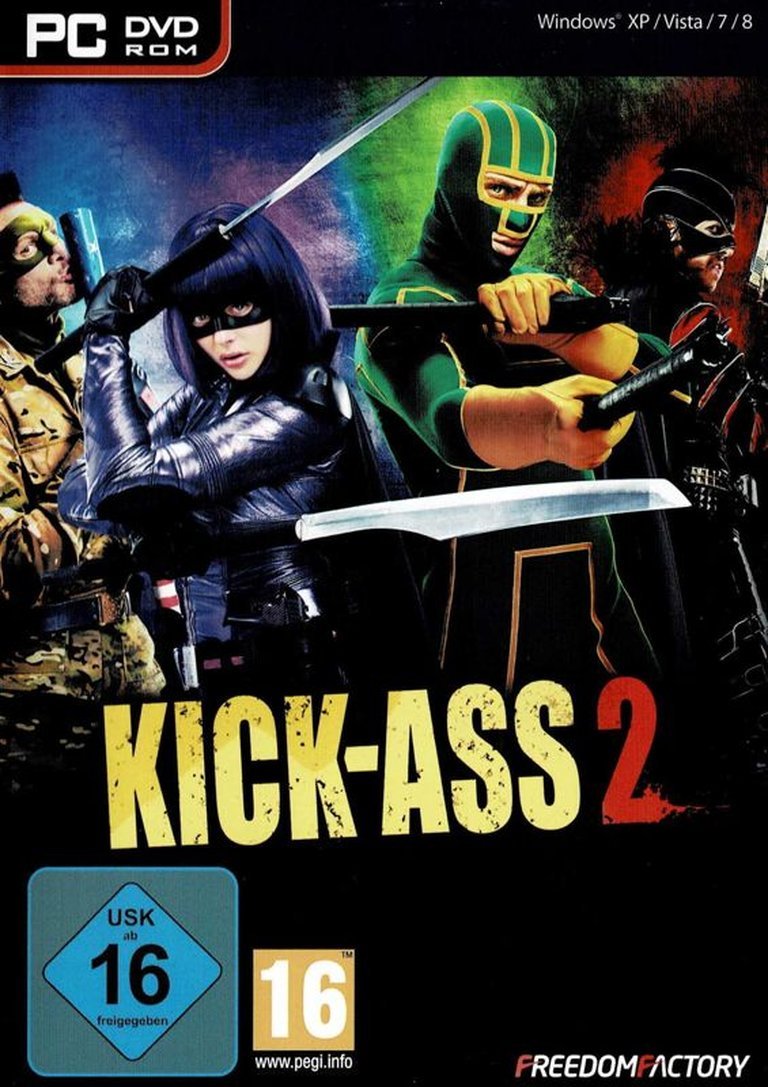
Description
Kick-Ass 2 is a 3D beat ’em up game based on the 2013 comedy/action film, set in a gritty urban landscape where players control the lone vigilante Kick-Ass as he patrols streets, fights villains through linear levels with combo-based combat and minor puzzles, and eventually joins the Justice Forever superhero team, while optional tasks include spraying over graffiti and using a Twitter-parody social network.
Gameplay Videos
Where to Buy Kick-Ass 2
Kick-Ass 2 Free Download
PlayStation 3
Kick-Ass 2 Reviews & Reception
metacritic.com (50/100): The game could be so much more with a little extra work though. The combat and poor voice acting are just too much for me to seriously recommend the game.
capsulecomputers.com.au : the overall feel of the game is definitely disappointing.
Kick-Ass 2: The Game – A Case Study in Squandered License and Developmental Missteps
Introduction: The Triumph of Cynicism Over Potential
In the landscape of licensed video games, few titles achieve the rare distinction of being both conceptually intriguing and critically reviled. Kick-Ass 2: The Game, released in 2014 by Spanish studio Freedom Factory Studios, stands as a monumental testament to wasted potential. Based on the hyper-stylized, R-rated superhero satire of the film and comic, the premise promised a visceral, over-the-top beat-’em-up that could capture the anarchic spirit of its source material. Instead, it delivered a technically bereft, mechanically monotonous, and creatively barren experience that managed to alienate the very fans it sought to attract. This review will argue that Kick-Ass 2: The Game is not merely a bad game, but a critical failure symptomatic of the low-budget, high-cynicism movie tie-in model of its era, whose primary legacy is as a cautionary benchmark for what to avoid in adaptations.
1. Development History & Context: A Studio Out of Its Depth
Freedom Factory Studios was a Spanish developer with a modest portfolio prior to Kick-Ass 2, including titles like Bloodbath and Cycling Evolution 2009. Their experience was in niche, often budget-conscious productions. The decision to hand the lucrative Kick-Ass license to this studio, rather than a more established action-game specialist, speaks volumes about the publisher’s (UIG Entertainment) priorities: low cost and rapid release to coincide with the 2013 film’s home video rollout. The technological constraints were self-imposed; utilizing the Havok Vision Engine (a variant of the widely licensed Havok physics engine) and FMOD for sound were standard, cost-effective choices for a mid-tier 2010s brawler. The development timeline was likely truncated, aiming for a May/August 2014 release window to milk the film’s ancillary revenue. This places the game in a 2014 landscape dominated by refined, narrative-driven action titles (The Last of Us) and polished character action games (Devil May Cry, Bayonetta). Against this backdrop, Kick-Ass 2 felt like a relic of an earlier, less demanding era of licensed gaming, seemingly unaware of a decade’s worth of progress in combat design and presentation.
2. Narrative & Thematic Deep Dive: A Ghost of a Story
The game’s plot is a severely truncated andSimplified adaptation of the 2013 film (and by extension, the Kick-Ass 2 comic arc). Set in New York City three to four years after the first film’s events, it follows Dave Lizewski (voiced by a famously disengaged Yuri Lowenthal) as a retired Kick-Ass who is bored with normal life. He trains briefly with Mindy McCready/Hit-Girl (voiced by a wooden stand-in for Chloe Grace Moretz), but she is grounded by her guardian Marcus, leaving Kick-Ass to go it alone. The central conflict arises from Chris D’Amico (voiced by Matthew Mercer), who accidentally kills his mother, blames Kick-Ass, and becomes the villain “The Motherfucker,” assembling the Toxic Mega-Cunts (including Mother Russia, The Tumor, etc.) for revenge. Kick-Ass eventually joins the superhero team “Justice Forever” (led by a Jim Carrey-impersonating Colonel Stars and Stripes) to stop them.
Thematically, the game completely eviscerates its source material’s core satires. The original Kick-Ass deconstructs superhero fantasies, exploring the grim reality of violence and the consequences of vigilante justice. This nuance is utterly lost. The game presents a simplistic, black-and-white “heroes vs. villains” morality with none of the film’s uncomfortable edge or social commentary. Key, defining moments from the film—the brutal murder of Colonel Stars and Stripes, the attempted sexual assault on Night-Bitch (or Katie Deauxma in the comics), The Motherfucker’s profoundly disturbing nihilism—are either absent, glossed over, or rendered impotent by the game’s juvenile tone and poor delivery. The dialogue is a parade of cringe-worthy, expository lines that fail to capture the dark wit of the property. The plot is not explored; it is merely stated, serving as a flimsy scaffold between linear combat arenas. The relationship between Kick-Ass and Hit-Girl, the emotional core of the franchise, is reduced to sporadic, poorly acted phone calls. The game’s narrative is not an interpretation but a hollowed-out corpse of the original story.
3. Gameplay Mechanics & Systems: The Roguelike of Repetition
Kick-Ass 2 is a 3D, third-person linear brawler with a fixed camera angle in most environments. Its core gameplay loop is brutally simple and fatally flawed:
- Combat System: Players control Kick-Ass with two attack buttons (light/heavy) that combine into a fixed list of pre-defined combos. There is no progression-based unlock system for new moves; the player’s entire move set is available from the first encounter. The combat is notoriously sluggish, with long wind-up and recovery animations for nearly every action. This creates a feeling of weighted, unresponsive control. The central mechanic is building a combo meter to trigger “finisher” prompts (QTE-style button presses). However, as critics noted, these finishers are painfully long, interrupting the flow of combat and making them actively undesirable for efficient play, turning a potential reward into a punishment.
- Progression & RPG Elements: There is no character progression, skill tree, or meaningful upgrade system. The only “progression” is combat proficiency through repetition. Weapons (baseball bats, guns, pipes) are found in levels but offer no persistent upgrade path. This stark lack of meta-game ensures no long-term engagement.
- Movement & Defense: A dodge/roll (Space bar) is available but feels imprecise. Enemy AI follows a primitive pattern of attacking when the player is engaged with another foe, making fights predictable and trivial once the rhythm is learned. The occasional “puzzle” is insultingly simple—a single-button timing minigame to disable electricity.
- Optional Objectives: Two types of collectibles exist: 24 pieces of offensive graffiti to spray over (a nod to street vigilantism) and “Weeter” (a parody of Twitter) signal spots to post updates. These are purely extrinsic, offering no gameplay benefit, and highlight the game’s lack of internal reward systems.
The Innovation? There is none. The game is a sterile, by-the-numbers execution of a late-90s/early-2000s brawler template, lacking even the charm of classics like Final Fight or River City Ransom. Its one claimed feature—”spectacular and powerful combat system reminiscent of the film’s scenes”—is its greatest failure, as the choreography is clunky and the impact absent.
4. World-Building, Art & Sound: A Cel-Shaded Facade
Visually, the game employs a cel-shaded art style intended to mimic the comic book aesthetic of the franchise. On a technical level, this is arguably its strongest suit. Character models are recognizable, and the New York City locations—alleys, rooftops, subway stations, warehouses—have a defined, if repetitive, look. The Havok physics allow for basic object interaction and ragdoll effects when enemies are hit. However, this aesthetic is undermined by repetitive level design (notably, critics lambasted the inclusion of “three sewer/subway levels” and a self-aware joke about asset reuse that only salt in the wound) and a general lack of visual polish. Textures are flat, animations are stiff, and the lighting is basic.
The sound design is where the presentation collapses entirely. The soundtrack is generic, forgettable rock/industrial tracks that do nothing to enhance the mood. But the voice acting is legendary in its awfulness. Yuri Lowenthal’s Kick-Ass delivery is flat and devoid of the character’s anxious, quippy charm. The Hit-Girl sound-alike is emotionless. The supporting cast, including the villains, reads lines with all the gravity of a high school play. The dissonance between the violent on-screen action and the amateurish vocal performances is jarring, constantly pulling the player out of the experience. It is a masterclass in how not to handle audio production for a licensed title.
5. Reception & Legacy:窑火中的批判 (Criticism in the Flames)
Kick-Ass 2: The Game was met with universal derision upon release.
* Critical Reception: The MobyGames aggregate critic score is a pitiful 27% (based on 6 reviews). Metacritic user scores are even lower, at 1.7/10 (“Overwhelming Dislike”). Reviews were scathing:
* GamingUnion.net (20%): “Highlights almost everything that’s wrong with movie tie-ins… gameplay is very underwhelming and the voice acting is horrible.”
* PC Invasion (10%): Awarded the score solely because “a game that contains three sewer/subway levels and then makes a joke about re-using assets deserves absolutely no higher.”
* GamezGeneration (15%): Called it “the worst game… in my almost 15 yearlong career as a gamer,” advising readers to buy it for someone they hate.
* The most generous, Calm Down Tom (50%), still cited “poor voice acting” and a combat system that “lacks a certain sparkle.”
* Commercial Performance: Precise sales figures are unavailable, given its digital-only, budget release ($9.99 on Steam). However, its abysmal reputation and low MobyGames “Collected By” count (34 players) suggest negligible commercial success. It vanished from market consciousness almost immediately.
* Legacy and Influence: Kick-Ass 2 has no positive legacy. It serves solely as a textbook example of failure in several areas:
1. The Perils of Rushed Tie-Ins: It proves that a license with built-in audience appeal is not a shield against criticism if the underlying product is shoddy.
2. Combat Design Obesity: Its sluggish, unresponsive combat became a case study in how not to design satisfying brawler mechanics, often contrasted with contemporary titles like Transformers: Devastation or Teenage Mutant Ninja Turtles: Mutants in Manhattan.
3. Voice Acting as a Canary: It is frequently cited in discussions about the worst voice acting in gaming, a benchmark for poor localization and direction.
4. Missed Thematic Opportunity: It is a primary example of a game that failed to translate the unique tone and themes of its source material, opting for blandness over edginess.
Within the Kick-Ass franchise itself, its existence is largely retconned by omission. The later comic series (The New Girl, Big Game) and the planned but unproduced Kick-Ass 3 film ignore the game’s events. It is a dead-end branch on the franchise tree.
6. Conclusion: A Forgotten Footnote, a Lasting Warning
Kick-Ass 2: The Game is not a misunderstood gem. It is not a flawed but earnest attempt. It is a cynical, technically inept, and creatively bankrupt cash-grab that failed on every fundamental level of game design: it offers no compelling combat, no engaging progression, no meaningful narrative, and no audiovisual cohesion. Its few minor strengths—a passable cel-shaded look and a conceptually interesting (if wasted) license—are utterly drowned in a swamp of poor controls, monotony, and atrocious voice work.
Its place in video game history is not one of significance, but of infamy. It is a fossilized example of a low-point in movie-game adaptations, a period when such projects were often farmed out to the lowest bidder with minimal oversight. For historians, it is a useful data point demonstrating the commercial and critical risks of such practices. For players, it is a title best left in the digital dustbin, a painful reminder that even the most provocative and popular intellectual property can be rendered inert by sheer developer incompetence. The 27% Metacritic score is not an insult; it is an act of mercy. Kick-Ass 2: The Game does not deserve to be played, only studied as a perfect, ugly specimen of its kind.