
- Release Year: 2001
- Platforms: Windows
- Publisher: Acer TWP Corp, Empire Interactive Europe Ltd., Microsoft Corporation, Ubisoft Entertainment SA
- Developer: ACES Game Studio
- Genre: Simulation
- Perspective: First-person and Third-person
- Game Mode: LAN, Online Co-op, Single-player
- Gameplay: ATC, Flight Simulation, Realistic, Weather simulation
- Setting: Earth
- Average Score: 90/100
Description
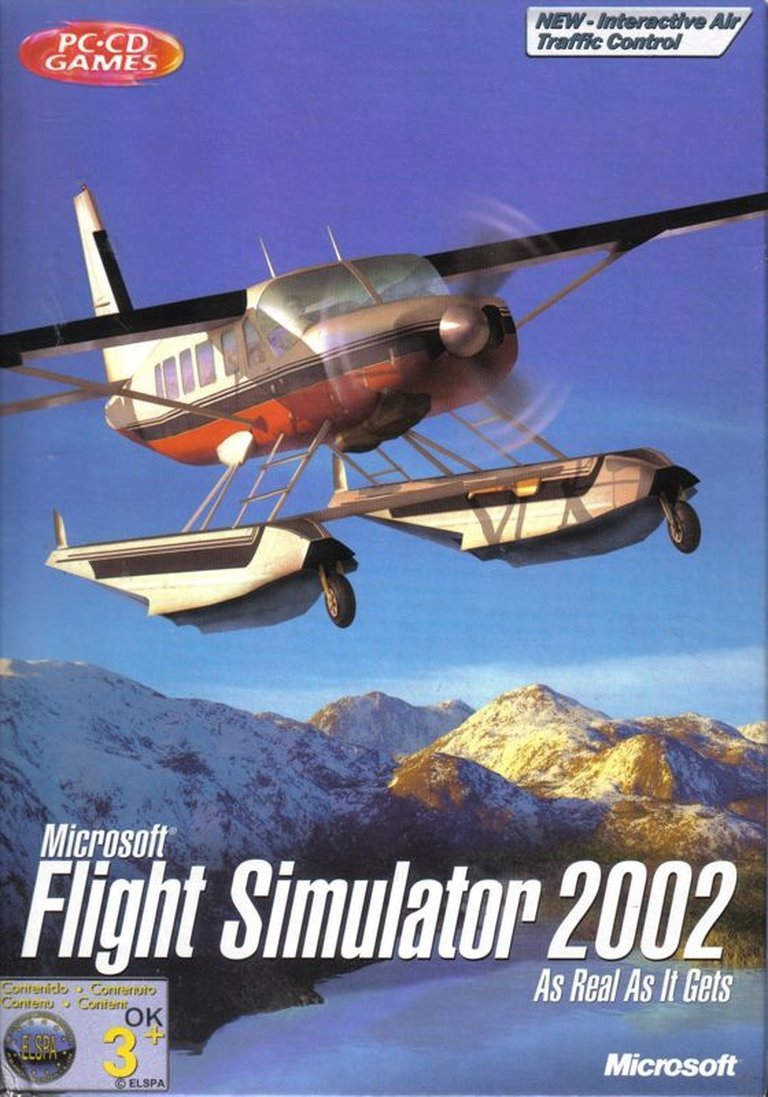
Microsoft Flight Simulator 2002 is a non-combat flight simulation game that leverages a new 3D graphics engine to deliver photorealistic terrain, volumetric clouds, and fully interactive 3D virtual cockpits across 12 aircraft, including the Cessna 208 Caravan and Boeing 747-400. Set in a globally detailed world with over 21,000 airports, it incorporates downloadable real-time weather and an Air Traffic Control module for authentic instrumental flight experiences, continuing the series’ legacy of realistic aviation simulation.
Gameplay Videos
Microsoft Flight Simulator 2002 Free Download
Microsoft Flight Simulator 2002 Cracks & Fixes
Microsoft Flight Simulator 2002 Mods
Microsoft Flight Simulator 2002 Reviews & Reception
metacritic.com (90/100): Delivers everything that a dedicated flight-simmer could ask for.
ign.com (90/100): Microsoft scores big with this must-have simulator for any armchair commercial pilot.
flightadventures.com : FS2K2 brings many welcome changes that should generate excitement among veteran flight sim fans and fledgling pilots alike.
Microsoft Flight Simulator 2002 Cheats & Codes
PC
Enter codes as specified: during flight or at the aircraft selection screen.
| Code | Effect |
|---|---|
| Hold [F4] while flying, then press Y | Plane climbs without tilting its nose |
| Press [Shift] + E | Open or close aircraft’s main door |
| Press [Left], [Right], [Left], [Right], [Up], [Down], [Up], [Down] | Unlock all aircraft from around the world |
| Press [Up], [Left], [Down], [Up], [Right], [Left], [Down], [Right] | Unlock all airlines from around the world |
| Press [Left], [Right], [Left], [Right], [Up], [Down], [Right], [Left] | Unlock all airlines |
| Press [Down], [Right], [Left], [Up], [Right], [Up], [Left], [Down] | Unlock all aircraft models |
| Press [Shift] + P | Enable auto backup |
Microsoft Flight Simulator 2002: Review – The Benchmark That Defined an Era
Introduction: The Sky’s No Longer the Limit
In the long and storied lineage of Microsoft Flight Simulator, each installment has been a calculated step forward, but 2002’s iteration was a monumental leap. Released in October 2001, Microsoft Flight Simulator 2002 (FS2002) arrived not merely as an update but as a comprehensive reimagining of what a civilian flight simulator could be. It traded the safe, iterative path for a bold new 3D graphics engine and a suite of features that plunged the player into an unprecedented level of global immersion. This review argues that FS2002’s true legacy is its masterful, if imperfect, synthesis of breathtaking visual realism and deeply authentic simulation, creating a product that was simultaneously a powerful technical showcase and a profoundly accessible gateway to the world of aviation. It set the template for decades of simulation to come, forever changing player expectations of a “living” game world.
Development History & Context: Building a New World from the Ground Up
Microsoft Flight Simulator 2002 was developed by ACES Game Studio, Microsoft’s dedicated internal team for simulation titles, under producer Ken Lavering and designer Carl Edlund. Following the biennial release cycle, FS2002 was positioned as the direct successor to the well-received Flight Simulator 2000. The development philosophy, as noted in pre-release coverage, was to “take on the daunting task of increasing the detail level of the entire world at least a hundredfold” (Computer Gaming World).
The project was defined by one core technical gamble: a completely new 3D graphics engine. Previous versions relied on flat, texture-mapped terrain. FS2002 introduced Auto-Generated (AutoGen) Scenery, a procedural system that used satellite-derived terrain and land-use data to automatically populate the entire globe with appropriate 3D objects—buildings, trees, bridges—based on classification. This allowed for a consistent, believable world from low altitude to high-level cruise, a feat of engineering that shifted the series from discrete, hand-crafted regions to a truly global simulation. This engine also brought volumetric clouds, jet contrails, and dynamic lighting, creating a visual fidelity previously unseen in the genre.
The development context was also indelibly marked by the real world. In the wake of the September 11, 2001 attacks, Microsoft made the unprecedented decision to alter the finished game. The iconic twin towers of the World Trade Center, present in the New York City scenery data, were digitally removed from all copies prior to release. As stated by Microsoft, this was done “to respect the victims” and out of “considerations of taste.” This pre-release edit made FS2002 one of the first major entertainment products to be directly and proactively altered due to the geopolitical trauma, a quiet but significant moment in gaming history.
The game launched in two editions: Standard and Professional Edition. The Professional variant, a $20 premium, included two additional aircraft (notably the Cessna 208 Caravan), the “Flight Instructor’s Station” for multiplayer training, and editing tools for custom scenery and aircraft performance. This created a clear tiered product line catering to both newcomers and hardcore simulation architects.
Narrative & Thematic Deep Dive: The Story is the Sky Itself
As a non-combat simulation, Flight Simulator 2002 has no conventional plot, characters, or dialogue. Its “narrative” is emergent and entirely player-driven, a theme of absolute agency within boundless possibility. The game’s core thematic statement is one of democratized aviation. The vast, procedurally generated Earth—with over 24,000 airports—is not a backdrop for a story but the primary protagonist. The player’s journey is one of self-directed mastery: learning to taxi, navigating by VOR beacons, battling crosswinds on landing, or simply sightseeing over the Grand Canyon at sunset.
Underlying this are several powerful subtexts:
1. The Pedagogy of Realism: The game is structured like a syllabus. Interactive tutorials (“Ground School”) and checklists for every aircraft teach real-world procedures. The ATC system, with its voice-guided clearances and strict adherence to FAA-style phraseology, transforms the player from a tourist into a participant in a complex, rule-bound system. The theme is responsibility and procedure.
2. The Contemplative Experience: FS2002 encourages a specific, slow-paced “sightseeing” gameplay. The tagline “As Real As It Gets” wasn’t just about fidelity but about the feeling of flight—the serenity of a cloud layer, the sprawling scale of a continent below, the changing colors of dawn. This positions the game as a meditative, almost spiritual tool for exploration.
3. The Illusion of a Living World: The combination of AI air traffic (other planes following real patterns), real-time weather fetched via Jeppesen, and the dense AutoGen scenery creates the powerful thematic illusion of a persistent, operational Earth. It’s not a theme park; it’s a functioning, if simplified, ecosystem. This was a profound shift from the static backdrops of past sims.
Gameplay Mechanics & Systems: A Deeply Layered Cockpit
FS2002’s genius lies in its ability to provide both depth and accessibility through a layered complexity model.
Core Flight Dynamics: At its heart is a sophisticated flight model based on differential equations simulating lift, drag, thrust, and atmospheric effects. Each of the 12-16 default aircraft (from the Cessna 172 to the Boeing 747-400) has handling characteristics derived from real-world data. The simulation accounts for P-factor on takeoff, the need for coordinated rudder in turns, and reduced lift at high altitudes. Crucially, it offered customizable realism sliders. A novice could enable simplified controls and crash detection turned off, while an expert could model gyroscopic precession, fuel flow limitations, and precise engine management. This slider system was revolutionary, allowing the same core simulation to serve a YouTube flight vlogger and a student pilot alike.
Air Traffic Control (ATC) and AI Traffic: This was FS2002’s killer feature. The integrated ATC system provided voice instructions for taxi, takeoff, and landing at all 21,000+ airports. It vectored you for ILS approaches, issued traffic advisories, and enforced separation—all in a synthesized but convincing voice. This wasn’t just aesthetic; it taught real IFR and VFR communication protocols. The AI aircraft were not mere models; they were part of the system, filling the skies and creating a sense of bustling, real-world airspace, as noted by GameSpot‘s praise for “intelligent procedural interactions.”
Virtual Cockpits & Instruments: For the first time in the series, every default aircraft featured a fully 3D, clickable virtual cockpit. Pilots could look around the cabin, manipulate switches and levers with the mouse, and fly “by the gauge” from a first-person perspective. The instruments were functional, directly tied to the simulation’s physics. This was a paradigm shift from the 2D “panel” view, massively increasing immersion and training value.
Multiplayer & Community Tools: LAN and internet multiplayer allowed for formation flying and shared cockpit experiences. More importantly, the Professional Edition’s editing tools (Scenery Modeler, Aircraft Performance Editor) empowered the community. This official support for modding seeded the vast ecosystem of third-party add-ons that would keep the sim alive for years, from photorealistic airport sceneries to highly detailed aircraft models.
Flaws and Friction: The system was not without its flaws. PC Action (Germany) and others noted the prohibitively high price (150 DM for Professional). The learning curve for full ATC and instrument flight was famously steep, a barrier for casual players. Rudder control issues were a common minor complaint in early reviews (Gamezilla). The AutoGen system, while brilliant, produced repetitive and sometimes illogical building placement, lacking the hand-crafted detail of major city add-ons. Most critically, as PC Games (Germany) sharply observed, the lack of any structured gameplay missions or scenarios meant “Spielspass” (play fun) was entirely contingent on the player’s intrinsic passion for aviation—a double-edged sword that defined its niche appeal.
World-Building, Art & Sound: A Planet Rediscovered
FS2002’s most immediate and lasting impact was its visual revolution. The jump from FS2000’s flat world to a fully 3D planet with volumetric clouds, translucent cloud layers, and dynamic lighting was staggering for its time. The AutoGen engine, despite its limitations, meant that flying over any part of the globe—a random field in France, a desert in Nevada—felt populated and coherent. The detail level in the United States, built from higher-resolution data, was particularly praised as “eine echte Augenweide” (a real treat for the eyes) by GameStar.
The sound design was exemplary and functional. The roar of a jet engine, the prop wash of a Cessna, the cyclic whine of a helicopter—each was distinct and dynamically tied to throttle and attitude. The ATC voices, recorded by professionals like Barry Dowsett and Christine Hill, delivered clear, calm, and authoritative instructions that sold the illusion of being in a real control zone. The ambient soundscape—wind noise at altitude, the bump of tires on a runway—was subtle but critical to immersion.
Atmosphere was everything. The ability to download real-time METAR weather via the built-in Jeppesen service meant you could fly into a simulated thunderstorm over the Atlantic or navigate by starlight on a clear night. This dynamic, data-driven weather system was not just a visual effect; it interacted with the flight model, creating turbulence, icing, and wind shear. The world felt meteorologically alive.
Reception & Legacy: Critical Acclaim, Commercial Success, and a Shadow
At Launch: Reception was overwhelmingly positive, with an aggregate critic score of 85-90%. GameSpot‘s 9.3/10 review hailed it as “the most complete civilian flying experience that the PC world has yet to see.” Awards were plentiful: PC Gamer US‘s “Best Simulation of 2001” and the Academy of Interactive Arts & Sciences’ “PC Simulation Game of the Year.” The praise centered on its unparalleled scale, the revolutionary graphics, and the depth of its ATC and flight systems. Criticisms were consistent: the high price, the steep learning curve, and the lack of structured gameplay.
Commercial Performance: It debuted strongly at #12 on NPD’s charts for October 2001 (at ~$70) and received a “Silver” award from ELSPA for UK sales exceeding 100,000 units. Its commercial success was a testament to the dedicated, affluent simulation audience.
The September 11 Aftermath: The game’s release and reception were clouded by its indirect association with the 9/11 attacks. The 9/11 Commission Report noted that some hijackers used earlier versions of Microsoft Flight Simulator for familiarization. Post-attack media narratives wrongly amplified the software’s role, leading to a brief backlash. UK retailers like Virgin and Woolworths pulled it from shelves. The New Yorker questioned if “millions of users could anonymously practice destructive scenarios.” This created a temporary reputational shadow for the entire flight simulation hobby, though aviation authorities and the FBI clarified that consumer software provided only rudimentary familiarity, insufficient for the attacks’ operational complexity. Microsoft’s pre-emptive removal of the World Trade Center was a direct response to this fraught atmosphere.
Legacy and Influence: FS2002’s impact on the series and genre is immeasurable.
* For the Series: It established the core pillars—global AutoGen terrain, 3D virtual cockpits, integrated ATC/AI traffic, and real-time weather—that would be refined, not reinvented, in Flight Simulator 2004: A Century of Flight and beyond. Aircraft models from FS2002 were often directly compatible with later versions due to shared physics standards.
* For the Industry: It raised the bar for open-world simulation, proving that a game could simulate an entire planet with convincing consistency. Its emphasis on procedural generation over hand-crafting influenced countless open-world games.
* For the Community: The official modding tools in the Professional Edition cultivated a golden age of add-on development. The FS2002 modding scene remains active today, with communities like AVSIM and FlightSim.com still hosting downloads and compatibility fixes to run the 2002-era sim on modern Windows systems. Its relatively low hardware demands compared to modern sims like MSFS 2020 have preserved it as a viable, lightweight alternative for purists.
Conclusion: The Indelible Benchmark
Microsoft Flight Simulator 2002 is not a perfect game. Its difficulty curve is a cliff, its price was (and remains) high, and its world, while vast, lacks the photorealistic detail and dynamic ecosystems of its modern descendants. Yet, its historical importance is absolute. It was the moment the Flight Simulator series ceased to be a niche modeling tool and fully embraced its identity as a mass-market, visually spectacular simulation platform. It successfully married an awe-inspiring, living global model with a flight physics engine of remarkable depth, all while offering on-ramps for both novices and veterans.
Its legacy is twofold: technically, it pioneered the 3D global engine that would evolve into the satellite imagery streaming of the 2020 reboot. Culturally, it cemented the idea of the flight simulator as a contemplative, exploratory medium—a “digital tourism” platform as much as a training tool. In the canon of gaming, FS2002 stands as a moment of quiet, profound ambition. It didn’t just simulate flight; for the first time, it simulated a place. That achievement, tarnished only by the tragic context of its release, secures its place as a foundational pillar in the history of simulation and open-world gaming. It was, and for many remains, “As Real As It Gets.”