
- Release Year: 2003
- Platforms: Windows, Xbox One, Xbox
- Publisher: Disney Interactive, LucasArts
- Developer: Planet Moon Studios
- Genre: Action
- Perspective: Third-person
- Game Mode: Single-player
- Gameplay: Jetpack, Run-and-gun, Shooter
- Setting: Futuristic, Sci-fi
- Average Score: 79/100
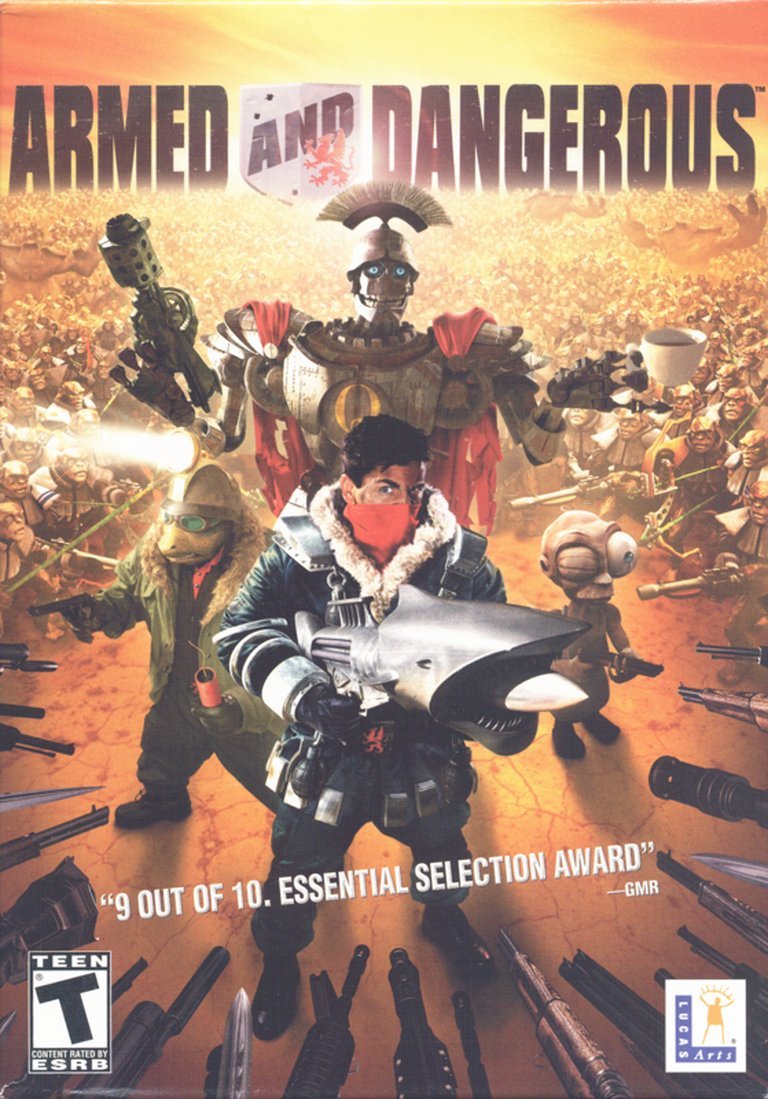
Description
Armed and Dangerous is a comedic sci-fi run-and-gun shooter where players control Roman, a thief in the Lionheads gang, who teams up with a blind seer, a tea-obsessed robot, and a Scottish mole to stop the evil King Forge from unlocking the magical Book of Rule. Set in a futuristic world, the game offers chaotic action with bizarre weapons like the shark gun and Topsy Turvy device, blending humor with intense third-person shooting gameplay.
Gameplay Videos
Where to Buy Armed and Dangerous
PC
Armed and Dangerous Free Download
Armed and Dangerous Mods
Armed and Dangerous Guides & Walkthroughs
Armed and Dangerous Reviews & Reception
metacritic.com (79/100): This is a game that re-invents nearly everything it does, from weapons fire to storytelling to rescue missions to boost-and-hover gameplay to bold new ways to humiliate farm animals.
ign.com : Like Giants before it, Armed and Dangerous is full of witty humor that is genuinely funny and sharp.
cinematicdiversions.com (80/100): While far from perfect, Armed and Dangerous avoids quite a few of the pitfalls that have encumbered recent 3rd person shooters and it has a Shrek meets Monty Python sense of humor to boot.
imdb.com (80/100): While certainly far from perfect Armed and Dangerous avoids quite a few of the pitfalls that have encumbered recent 3rd person shooters and it has a Shrek meets Monty Python sense of humor to boot.
Armed and Dangerous Cheats & Codes
Xbox
Enter codes at the code entry screen.
| Code | Effect |
|---|---|
| X, X, X, R, A, L, L, Y | Invincibility |
| Y, White, Black, L, A, R, R, Y | Play Any Level |
| X, R, A, Y, Black, B, A, R | Fill Health Bar |
| A, L, L, Black, B, White, L, L | Infinite Ammo |
| A, Y, A, Y, Black, R, A, Y | View Any Movie |
| Y, A, B, X, B, A, A, L | God Mode |
| L, Black, B, White, White, B, Black, L | Big Heads |
| R, White, X, L, White, R, R, Y | Big Hands |
| R, White, Y, A, L, B, White, X | Big Boots |
| Y, A, B, B, A, B, White, White | Topsy Turvy Bomb |
| Black, B, A, R, R, A, L, Black | Fill Ammo |
| B, L, A, B, white, A, L, L | Show All Cheats |
PC
Enter codes in the Cheat Menu under Options.
| Code | Effect |
|---|---|
| DAJIGSUP | List of Cheats |
| MISSIONS | Level select |
| PRAYTOME | God mode |
| SHIELDME | Invincibility |
| NDMRBLTS | Infinite ammunition |
| AMBULNCE | Restore health |
| SHOOTMOR | Restore ammunition |
| WAAAAAAH | Topsy Turvy mode |
| AMATINEE | View FMV sequences |
| SHOESIZE | Big feet |
| EATGRENZ | Big hands |
| VERYHIIQ | Big heads |
Armed and Dangerous: A Cult Classic of Chaotic Comedy and Over-the-Top Action
Introduction: The Unlikely Heist That Stole Our Hearts
In the early 2000s, as the third-person shooter genre leaned toward gritty realism and military spectacle, a small studio from San Francisco unleashed a title that felt like a Molotov cocktail tossed into a library. Armed and Dangerous (often abbreviated AnD) was not merely a game; it was an attitude, a raucous middle finger to convention wrapped in a Monty Python sketch. Released in December 2003 for Windows and Xbox by LucasArts and developed by Planet Moon Studios—the team behind the beloved Giants: Citizen Kabuto—the game promised a “big heist” but delivered something far more subversive: a relentless, absurdist joyride through a fantasy world colliding with sci-fi nonsense. Its legacy is that of a commercial footnote that became a cult phenomenon, a game remembered not for its graphical fidelity or narrative depth, but for its sheer, unadulterated comedic audacity and a weapon that literally fires a live shark. This review will argue that Armed and Dangerous is a pivotal, if flawed, artifact of early-2000s game design—a title that prioritized personality and player grin-factor over polish, and in doing so, carved out a permanent niche in the canon of comedy gaming.
Development History & Context: From Shiny’s Ashes to LucasArts’ Publisher
The story of Armed and Dangerous is intrinsically linked to the lineage of its developer, Planet Moon Studios. Founded in 1997 by Nick Bruty and Bob Stevenson—both veterans of Shiny Entertainment, the studio behind the iconic Earthworm Jim and MDK—Planet Moon was born from a desire to escape corporate constraints and pursue “innovative, humorous action games.” Their debut, Giants: Citizen Kabuto (2000), was a critical darling, lauded for its vibrant aesthetic, hybrid RTS/shooter gameplay, and signature British absurdism. This success established a clear creative DNA: high-energy action fused with a deranged, referential sense of humor.
Pre-production for Armed and Dangerous began in the winter of 2001. The initial vision was a third-person shooter that would parody epic fantasy and sci-fi tropes, drawing from sources like The Lord of the Rings, Star Wars, and Monty Python and the Holy Grail. The team, many of whom were ex-Shiny staff carrying forward the MDK ethos, brainstormed weapons in local pubs, leading to inventions born from bugs (the gravity-flipping Topsy-Turvy device reportedly originated from a spinning animation glitch) and sheer silliness. A key partnership with LucasArts provided publishing muscle and collaborative resources, including joint level design and audio production. However, the development was not without truncation. An intense 18-month production phase following LucasArts’ approval saw grandiose ideas—zeppelins, a colossus robot—cut to streamline the project, a decision that would later be cited by critics as contributing to a feeling of repetition.
Technologically, the game was built on the proprietary “Amityville II” engine, an evolution of the tech used for Giants. This engine allowed for expansive outdoor environments with high polygon counts and Havok physics-driven ragdoll effects, crucial for the game’s over-the-top enemy disposal. The simultaneous development for PC and Xbox necessitated adaptations for the console’s controller and hardware, though the Xbox version ultimately gained exclusive downloadable content (the “Summer Home” map) and split-screen multiplayer—features absent from the PC release. The game’s ESRB “Teen” rating reflected its crude humor, mild language, and fantasy violence, positioning it for a broad but specific audience.
The 2003 gaming landscape was dominated by serious military shooters (Call of Duty had just arrived) and cinematic action titles. Armed and Dangerous was an outlier, a deliberate rejection of the era’s gravitas. Its closest cousins were Giants and, in spirit, the anarchic action of Serious Sam. The stage was set for a game that would be judged not on its technical prowess but on the strength of its jokes and the novelty of its arsenal.
Narrative & Thematic Deep Dive: The Book of Basket Weaving and Prophecies of Penis
The plot of Armed and Dangerous is a deliberately thin scaffolding for its comedic set-pieces, a fact the game gleefully acknowledges. Set in the war-torn, anachronistic fantasy kingdom of Milola, the narrative follows the Lionhearts: Roman (a Cockney-thief protagonist with a cloth perpetually over his mouth), Q (a British robot whose sentience was triggered by an unconditional love for tea), and Jonesy (a burrowing Scottish mole with a promiscuous mother and, per the game’s repeated jokes, a small penis). They recruit Rexus, a blind, senile seer who resembles the “Smarties” from Giants, to pull off a heist: steal the magical Book of Rule from the tyrannical King Forge.
The central MacGuffin is subjected to a locking spell that renders it the “Book of Basket Weaving,” a parody of epic magical tomes. King Forge, voiced with magnificent pomposity by Tony Jay (The Jungle Book‘s Shere Khan), wants the book to turn Milola into a theme park for his dim-witted son, Prince Stig. The heist quickly escalates into a full-blown rebellion, weaving in a “Majorcan Prophecy” (a direct nod to Giants) and the “Dick Whittington Memorial Prison” (another Giants reference). The climax involves leading an army, fulfilling a prophecy that literally predicts Jonesy’s stupid comments and insults his anatomy, and a finale where Q, in a moment of sublime absurdity, shoves Rexus up an animal’s ass.
Thematically, the game is a satire of hero’s journey tropes. The “chosen ones” are incompetent, selfish criminals. The ancient prophecy is crass and arbitrary. The villain’s plan is ludicrously petty. The dialogue is a masterclass in British-derived absurdism, delivered by a cast including Brian George (Roman), Jeff Bennett (Jonesy), John Mariano (Rexus), and Pat Fraley (Q). Their impeccable comedic timing sells every ridiculous line, from Jedi mind tricks convincing literal Nazis they’re French and should surrender, to encountering basket-weaving monks, to a running gag about a simpleton seeing his father as a talking penguin while high. The cutscenes, rendered in the game’s engine and notoriously ugly (especially the human models), are paradoxically effective because the writing and voice acting are so committed. It’s a game that understands its own artifice; the fourth wall isn’t just broken, it’s used as a battering ram.
Gameplay Mechanics & Systems: Run, Gun, and Gravity-Flip
At its mechanical core, Armed and Dangerous is a “run-and-gun” third-person shooter. The camera hovers behind Roman, and gameplay primarily occurs on foot across 21 mission-based levels. The health system is a simple depleting bar, encouraging aggressive movement and use of cover only as a brief respite. Progression is linear, with objectives typically boiling down to “kill everyone,” “reach the point,” or “rescue peasants” (the latter a famously irritating mechanic where rescued villagers float awkwardly behind you, with a compass that often fails to guide you to their homes).
Where the game truly distinguishes itself is its arsenal, a blend of shooter staples and outlandish, physics-defying gadgets:
* Staples: A highly effective, auto-aiming machine gun (the “Flemming”), a sniper rifle (“Cyclops”), a rocket launcher, and a mortar cannon.
* Absurdities: The iconic Land Shark Gun, which fires a maturing infant shark into the ground; it “swims” through the earth, periodically surfacing to devour enemies with hilarious, chomping animations. The Topsy-Turvy, a corkscrew device that inverts gravity in a radius, causing enemies to fly into the sky before plummeting to their deaths when gravity returns—a scene of chaotic, slapstick beauty. The Vindaloo Rocket Launcher, firing homing incendiary missiles. The World’s Smallest Black Hole, a deployable gadget that sucks in enemies and objects. The Confusion Gas Grenade, which turns foes against each other. And a tuba that launches rockets.
Weapons are selected at checkpoint “pubs” between levels, with loadouts changing per mission. The design philosophy is clear: fun and unpredictability over realism. The machine gun is so potent it can trivialize most encounters, a point of critique, but the special weapons are saved for moments of tactical need or pure comedic indulgence. The game also features jetpack segments in later levels, allowing for aerial combat and platforming—a highlight that breaks up the ground-based monotony. Additionally, there are stationary turret defense sequences played in first-person, repelling waves of attackers.
The AI is notoriously inconsistent, both for enemies (who often charge mindlessly) and allies (the rescued villagers or squadmates who occasionally “help”). This simplifies combat into managing large waves rather than tactical engagements. A significant flaw is the scarcity of the most creative weapons; the Topsy-Turvy, for instance, is so overpowered and fun that its rarity is a consistent source of player frustration. The Xbox version added competitive deathmatch and co-op modes (including the downloadable “Summer Home” map), extending replayability beyond the 8-10 hour single-player campaign, though the online servers have long since shuttered.
World-Building, Art & Sound: A Patchwork Fantasy of Clipping and Charm
The world of Milola is a jarring, intentional collage. It blends medieval castles with Nazi-esque soldiers (complete with German accents), orcs wielding machine guns, primitive robots, and mystical monks. Environments range from icy Bergog Wastelands and dense forests to mountain passes and rain-slicked cliffs. The art direction, led by Nick Bruty and Bob Stevenson, aims for a stylized, cartoonish vibe but was technically limited by 2003 standards. The visuals are frequently criticized as subpar even for their time: textures are blurry, objects clip notoriously through the environment and character models (Roman’s mask clipping through his face is infamous), and the tree models are laughably simple poles with attached foliage. The cutscenes, using the in-game engine, are particularly rough, with stiff animation and poor lip-syncing.
Paradoxically, these technical shortcomings become part of the charm. The ugliness amplifies the comedy; the sheer chaos of a gravity-flipping scene with dozens of ragdolling, screaming orcs is made funnier by the low-poly models clipping through each other. The “so bad it’s good” aesthetic aligns perfectly with the Monty Python influence. The sound design, while loud and sometimes crushed (players are advised to adjust settings), features effective weapon sounds and, most importantly, stellar voice acting that sells every joke. Composer Anna Karney’s soundtrack is functional but unmemorable, often taking a backseat to the mayhem.
The atmosphere is one of relentless, cheerful violence. There is no attempt at gritty immersion; the game constantly winks at the player. Destroying buildings, humiliating farm animals, and watching a shark burst from the earth to eat a machine-gun nest are all presented with the same playful tone. It’s a world that doesn’t just not take itself seriously—it actively mocks the very concept of a “serious” fantasy epic.
Reception & Legacy: Generally Favorable, Commercially Forgettable, Culturally Enduring
Upon release, Armed and Dangerous received “generally favorable reviews,” with Metacritic scores of 78/100 (PC) and 79/100 (Xbox) based on 57 and 41 critic reviews, respectively. The consensus was clear: critics adored the humor and inventive weapons but were let down by repetitive level design, simplistic AI, and a short campaign.
Praise centered on:
* Humor: Universally lauded as “sheer comedic genius,” “side-splitting,” and comparable to Giants. The writing and voice performances were consistently highlight.
* Weapon Design: The Land Shark Gun and Topsy-Turvy were called “genius,” “hilarious,” and iconic.
* Fun Factor: Described as a “non-stop fun fest” and a game that reminded players of the pure joy of shooting games, akin to what Serious Sam did for the FPS genre.
* Personality: Recognized for its distinctive, aggressively British absurdity in a sea of generic shooters.
Criticisms were equally consistent:
* Repetition: The core loop of clearing waves of identical enemies in visually similar levels grew stale. As PC Zone noted, “the gags wear thin quicker than the knees on Dennis the Menace’s jeans.”
* Short Length: Completion times of 8-10 hours (or even under 2 for skilled players) felt insufficient for a full-priced retail title.
* Technical Flaws: Graphics, animations, and cutscenes were widely panned as dated and poorly executed.
* Underutilized Mechanics: The amazing weapons appeared too rarely, and squad/rescue mechanics were underdeveloped and annoying.
Commercially, the game was a modest disappointment. Producer Aaron Loeb later stated Xbox sales were “fine,” but the PC version “died a very hard death.” It failed to reach the audience of its predecessor, Giants, and did not become a mainstream hit. LucasArts, a powerhouse in adventure games, saw this as another niche title in a shifting market.
Its legacy, however, has flourished. The game developed a cult following, praised in retrospectives (like a 2011 Eurogamer analysis and 2024 YouTube features) as a “forgotten classic” and “underrated gem.” Modern digital re-releases on Steam (2009) and GOG (2016) have garnered “Very Positive” user reviews, with players celebrating its quirky charm and tactical depth often overlooked at launch. Its backwards compatibility journey—from Xbox 360 (2007) to Xbox One (2019)—introduced it to new generations, even earning a spot in Xbox’s “Games with Gold” in 2020.
Culturally, Armed and Dangerous is remembered for its weapon ingenuity (the Land Shark Gun remains a frequently cited example of hilarious game design) and its unwavering comedic voice. It stands as one of Planet Moon Studios’ two defining titles before the studio’s decline and eventual closure in 2010. It also serves as a touchstone for a specific era of comedy in games—a time before Portal or Psychonauts fully merged narrative and gameplay humor, when jokes were often delivered via cutscene and voiceover, but could still feel integral to the experience. Its influence is less direct in gameplay mechanics and more in spirit: it validated that a shooter could be utterly silly and still be mechanically competent and deeply enjoyable.
Conclusion: A Flawed Masterpiece of Mirth
Armed and Dangerous is not a perfect game. Its level design is repetitive, its graphics are dated, its campaign is brief, and its suite of amazing weapons is criminally underused. By the stringent metrics of modern game criticism—emphasizing depth, replayability, and polish—it would likely score lower today.
Yet, to judge it solely by those metrics is to miss its entire purpose. Armed and Dangerous is a game of pure, infectious id. It is a delivery system for laughter, a collection of brilliant jokes (both visual and verbal) wrapped in a competent, if simple, shooter shell. It achieves what it sets out to do: it is funny, and that fun is sustained through its entire runtime by a cast of endearingly idiotic heroes, a cast of scenery-chewing villains, and a arsenal of weapons so preposterously creative they create memories that last decades. From the initial prison break cutscene to the final, prophecy-fulfilling absurdity, it commits entirely to its bit.
In the pantheon of video game history, it is not a landmark of technical achievement or narrative complexity. Instead, it is a landmark of personality. It is proof that a game can be commercially overlooked and critically divisive yet still forge an unbreakable bond with its audience through sheer, unapologetic charm. For anyone who values humor as a core component of play—who believes a game can make you laugh out loud as often as it makes you aim—Armed and Dangerous is an essential, golden experience. It may be short, but as one player review perfectly noted, the amount of time it lasts is golden. It is, and remains, a bloody good game.