
- Release Year: 1999
- Platforms: Windows
- Publisher: Midas Interactive Entertainment BV
- Developer: Reactor Software
- Genre: Action
- Perspective: Top-down
- Game Mode: LAN, Single-player
- Gameplay: Arcade, Rocket interception, Shooter, Turret defense
- Setting: City
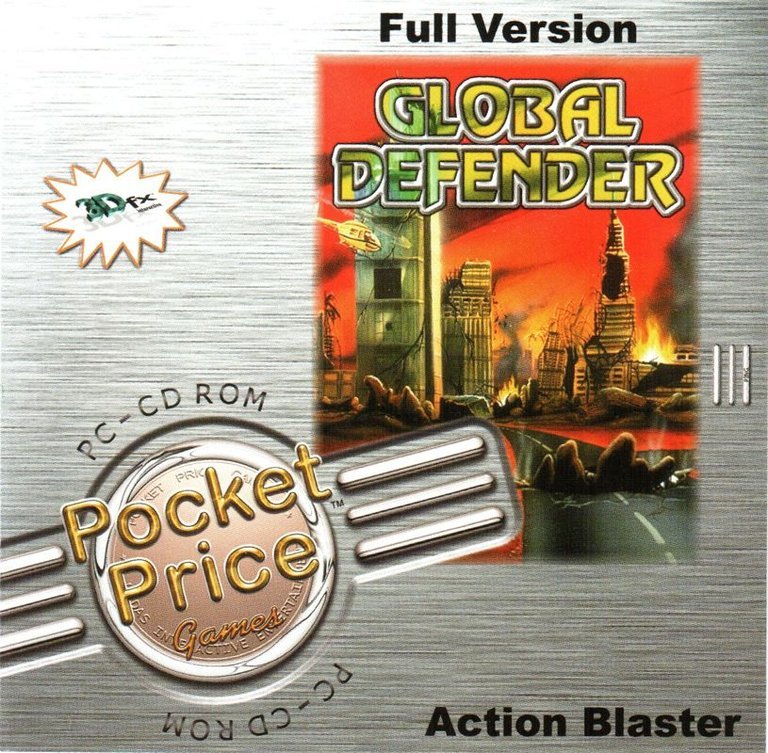
Description
‘Global Defender’ is a fast-paced arcade shooter from 1999 where players defend a city from above by controlling a stationary, rotating turret. The core challenge involves destroying incoming rockets before they hit the turret or destroy the surrounding buildings, across 36 single-screen levels featuring then-impressive 3D OpenGL graphics and CD-quality music. The game also includes a unique multiplayer mode supporting up to eight players competing for high scores.
Global Defender Free Download
Global Defender: A Forgotten Echo of Arcade Purity in the Late 90s
Introduction: A Turret in the Shadow of a Legend
In the crowded pantheon of video game history, few titles command the reverence of Eugene Jarvis’s Defender (1980). That seminal arcade masterpiece, with its daunting five-button-plus-joystick control scheme and punishing, scroll-based shoot-’em-up gameplay, didn’t just define a genre—it redefined the very limits of player adaptability. Nearly two decades later, as the video game industry hurtled toward immersive 3D worlds and narrative complexity, a curious ghost from the arcade past materialized on Windows PCs. Global Defender (1999), developed by the obscure Reactor Software and published by Midas Interactive Entertainment, is not a sequel, remake, or reboot of Jarvis’s classic. Instead, it is a distilled, almost minimalist, spiritual successor that captures the essence of a specific arcade archetype—the fixed-position, multi-directional shooter—while applying the technological aesthetics of its own era. This review posits that Global Defender is a fascinating case study in retrospective game design: a technically competent but narratively barren homage that speaks less to the future and more to a specific, increasingly niche vision of arcade purity. Its legacy is not one of influence, but of preservation—a digital artifact that asks us to consider what “arcade fidelity” means when stripped of the original’s notorious complexity and iconic context.
Development History & Context: The Obscure Studio and the “Classic” Revival
The late 1990s represented a peculiar schism in game development. On one path, cinematic narratives and 3D open worlds dominated the discourse. On the other, a smaller-scale “retro revival” was underway, fueled by emulation culture and a growing nostalgia for arcade mechanics. Reactor Software was not a household name. Little verifiable information exists about the studio beyond this single release, suggesting it was likely a small, possibly European, team operating with limited resources—a common profile for developers catering to the budget and “value” software market of the time, often centered around re-releases or original titles for the burgeoning PC “budget” segment.
The game’s publisher, Midas Interactive Entertainment BV, was a known entity in this space, specializing in bringing arcade and console-style games to the PC platform, often at lower price points. Their catalogue from the era is a graveyard of forgotten licenses and competent, if unspectacular, conversions. For Global Defender, the technological mandate was clear and typical for 1999: leverage the now-ubiquitous 3D accelerator card with OpenGL driver to render a genre traditionally rooted in 2D sprites. This was not an attempt to re-imagine the Defender formula in 3D (a path Defender (2002) would later boldly take), but to apply a real-time polygonal veneer to a fixed-screen concept. The choice of CD Audio tracks for music, rather than in-game sequenced sound, also points to a development ethos that prioritized生产成本效率 and a “premium” feel (CD audio was a marketing bullet point in the late 90s) over dynamic, situational scoring.
Crucially, the game’s direct lineage is not to the Defender series, but to the much older “Paratrooper” archetype (itself immortalized by games like Paratrooper (1982) and Saboteur! (1985)). In these games, a stationary defender at the bottom