
- Release Year: 2018
- Platforms: Macintosh, Windows
- Publisher: Big Fish Games, Inc, HH Games
- Developer: IronCode Gaming Pvt. Ltd.
- Genre: Puzzle
- Perspective: Side view
- Game Mode: Single-player
- Gameplay: Falling block puzzle, Tile matching puzzle
- Setting: Asia
- Average Score: 78/100
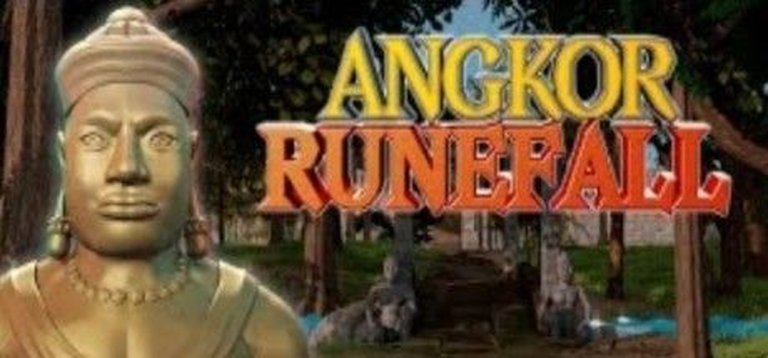
Description
Angkor: Runefall is a tile-matching puzzle game set in a hidden Asian village of magicians. Players take on the role of a young mage apprentice who must use ancient runes in match-3 challenges to uncover the secret behind a sudden catastrophe, brave hidden dangers, and save the village from destruction.
Gameplay Videos
Where to Buy Angkor: Runefall
PC
Angkor: Runefall: A Scholarly Review of an Obscure Casual Artefact
Introduction: The Puzzle in the Jungle
In the vast, ever-expanding ecosystem of digital games, certain titles emerge from the dense undergrowth not as towering sequoias of industry-defining innovation, but as hardy, specialized ferns—perfectly adapted to a specific niche, yet virtually invisible to the wider forest. Angkor: Runefall, developed by IronCode Gaming Pvt. Ltd. and published by Big Fish Games and HH Games in 2018, is precisely such a fern. A title within the saturated “match-3” genre, draped in the aesthetic of Southeast Asian mysticism, it represents a specific moment in the casual gaming landscape: the late 2010s persistence of the free-to-play-inspired, premium-priced puzzle game. This review posits that Angkor: Runefall is not a forgotten masterpiece but a fascinating case study in the econometrics of niche genre work. Its legacy is not one of critical acclaim or commercial blockbuster status, but of quiet, efficient production within a reliable corporate pipeline. To analyze it is to dissect the DNA of a game built not for immortality, but for predictable, low-risk utility within a vast distribution network like Big Fish Games’ and Steam’s casual bundles.
Development History & Context: The Studio, The Engine, The Ecosystem
The Architects: IronCode Gaming
IronCode Gaming Pvt. Ltd., the developer credited on MobyGames and Steam, is a studio that operates almost entirely in the shadows of the industry’s mainstream consciousness. A review of their known output—primarily entries in the Angkor series (Angkor, 2006; Angkor: Runefall, 2018; Angkor: Celebrations, 2020) and other match-3 titles like Bato: Treasures of Tibet—reveals a clear specialization. They are not risk-takers exploring new mechanics; they are practitioners of a refined craft within a established genre. Their vision, as inferred from their portfolio, is one of competency and consistency: deliver a visually competent, thematically consistent, and mechanically sound match-3 experience with a novel cultural wrapper to stand out on a crowded storefront.
Technological Constraints & The Unity Engine
The game’s listing on MobyGames explicitly notes its use of the Unity engine. In 2018, Unity was the undisputed workhorse of the indie and casual space, prized for its accessibility, cross-platform deployment (Windows and Mac are listed), and rapid iteration. For a studio like IronCode, Unity provided a mature, asset-store-friendly framework to build a 2D puzzle game with minimal custom engine development. The “Fixed / flip-screen” perspective and “Side view” are not artistic choices born of limitation, but standard, efficient configurations for this type of game. The minimal system requirements (1.5 GHz processor, 256 MB RAM) speak to a design philosophy of maximum accessibility, targeting even older or low-spec machines common in the casual player demographic.
The 2018 Casual Gaming Landscape
Angkor: Runefall arrived at a curious juncture. The “casual” market had long since been bifurcated. On one side were the free-to-play mobile behemoths like Candy Crush Saga, monetizing relentlessly through lives and boosters. On the other was the “premium casual” PC market, dominated by publishers like Big Fish Games, which sold complete games for a flat fee ($4.89-$6.99, as seen on Steam), often bundling them into massive collections. This model promised a finished, ad-free, and ethically “cleaner” experience. Runefall was a product of this latter pipeline—a game designed to be a consumable piece of content in a subscription (Big Fish Games’ own service) or a bundle (as evidenced by its inclusion in multiple “Match3 Mega Madness” bundles on Steam). Its release was an logistical event, not a cultural one.
Narrative & Thematic Deep Dive: Prose of the Proficient Apprentice
The official store description across all platforms provides the entire canonical narrative framework: “When the sudden catastrophe struck the hidden village of magicians, they turned to the only person in the village capable of using the ancient runes to cast magic: a bright, young, mage apprentice. Can you uncover the secret behind the catastrophe, brave the hidden dangers, save the village, and reach the happy ending?”
This is a textbook “hero’s journey” compressed into a single paragraph, dripping with the tropes of low-fantasy and anime-inspired sidekick narratives. The “hidden village of magicians” evokes a sense of secluded, ancient wisdom (the Angkor reference), immediately threatened by a “sudden catastrophe.” The protagonist is the classic “chosen one” archetype, but with a critical twist: they are an apprentice, not a master. This is a masterstroke of audience identification. The player is not some all-powerful archmage; they are a novice, learning and growing alongside the character, which perfectly mirrors the experience of a player learning the game’s match-3 mechanics and rune-based power-ups.
Thematically, the game appears to explore competence over innate power. The apprentice’s “bright[ness]” and capacity to use runes, not necessarily command them innately, suggests a world where knowledge and application trump pure lineage. The “secret behind the catastrophe” implies a narrative of hidden corruption or forgotten history—a common theme in puzzle-adventure hybrids where each completed board reveals a fragment of lore. However, without access to the game’s actual script, dialogue, or cutscenes, the depth of this theme remains purely speculative. The narrative exists as a skeletal motivator, a “skin” for the puzzle gameplay, adhering to the casual game principle that story must be instantly graspable and emotionally safe (the promise of a “happy ending”).
Gameplay Mechanics & Systems: The Calculus of the Match-3 Engine
Angkor: Runefall is explicitly categorized on MobyGames under “Falling block puzzle” and “Tile matching puzzle,” with an interface of “Point and select.” This firmly places it in the lineage of Bejeweled and Candy Crush Saga.
Core Loop and Level Structure:
The fundamental loop is the match-3 core: swap adjacent tiles to create lines of three or more identical “runes” (the tiles) to clear them from a grid. A Steam community post from user ‘shadree’ on September 14, 2021, complaining about the difficulty of “Level 49,” provides the only concrete glimpse into specific level mechanics. This level is described as a “drop objects level” where:
* “It takes several (over 3) tokens to drop before a chest does,” indicating a resource-gathering mechanic where clearing matches generates currency or items (chests).
* “The objects take ages to appear. They only appear one at a time,” pointing to a slow, controlled pace of new item introduction.
* Environmental obstacles are present: “There are ledges for the object to get stuck on” and “blocks to clear but not nearby blocks to clear them with.”
From this, we can deduce a sophisticated, multi-layered level design system beyond simple “clear X tiles.” Levels incorporate:
1. Resource Collection Goals: Chests (or similar objects) must be collected, requiring matches to generate them.
2. Gravity & Obstacle Physics: “Ledges” suggest a grid where tiles fall with realistic or semi-realistic physics, getting caught on protrusions—a mechanic that adds strategic depth to tile placement.
3. Spatial Puzzles: The complaint about “blocks to clear but not nearby blocks” suggests barriers or locked tiles that require creating matches in specific, non-adjacent locations, often using special tile effects.
Character Progression & Runes:
The store blurb mentions “discover new runes with magnificent powers.” This indicates a standard progression system where completing levels or achieving certain feats unlocks new tile types (runes) with special effects. These likely include explosives (clear a 3×3 area), row/column clears, color bombs, etc. The “runes” serve a dual purpose: they are the core matching tiles and the source of “magic” that impacts the board, tying the narrative theme directly into the mechanics. The player’s “mage apprentice” grows in power as they unlock more potent runes, creating a tangible progression system.
Innovation vs. Flaw:
Angkor: Runefall likely exhibits incremental innovation at best. Its specific use of “ledges” and a slow-falling object mechanic, as noted by the frustrated player, suggests an attempt to differentiate its puzzle boards from the flat, open grids of its contemporaries. However, the same post highlights a potential flaw: poor player onboarding or escalation. The user’s struggle on level 49 implies a sharp, perhaps un-telegraphed, difficulty spike, a common issue in match-3 games where early levels are tutorials and later levels introduce complex, multi-objective challenges without sufficient mid-game scaffolding. The “lack of player training” cited by the user is a critical design critique for any game that transitions from simple matching to complex spatial resource management.
World-Building, Art & Sound: The东南亚 Aesthetic as Package
Setting & Atmosphere:
The setting is unequivocally “Asia,” specifically invoking the “Angkor” name, which conjures the awe-inspiring temple complex of Cambodia. This is not a historically accurate simulation but a stylized, romanticized “mystical Asia” common in Western casual games. The “hidden village of magicians” is likely depicted as a fusion of Khmer architectural silhouettes (pointed temple roofs, stone textures) and generic fantasy village elements, bathed in a warm, golden-hour palette. The atmosphere aims for “mysterious but welcoming,” a balance between exotic location and familiar, cozy puzzle-game comfort.
Visual Direction:
As a Unity-based 2D game from 2018, the art is functional and polished within its budget. Expect hand-drawn or carefully painted 2D assets for tiles (the runes, which likely feature glowing, intricate symbols), background scenes, and UI elements. The color scheme is probably vibrant and high-contrast to ensure tile clarity—a paramount concern in any matching game. The “Colorful” tag on Steam is apt. There is no indication of 3D modeling or advanced effects; this is a realm of crisp sprites, particle explosions upon matches, and serene background panoramas that change as the player “saves” the village.
Sound Design:
Sound design in this genre follows a strict convention. The source material provides no direct details, but the pattern is universal:
* Background Music: Likely a looped, calming, ethnic-fusion track featuring instruments like bamboo flutes, soft percussion (like a khim or drums), and atmospheric pads, designed to be non-intrusive.
* Sound Effects: Crisp, satisfying audio cues for tile selection, successful matches (a chime or magical “whoosh”), and special rune activations (a deeper hum or explosion). The sound of tiles falling and clicking into place provides tactile auditory feedback.
* Voice Acting: The Steam page indicates “Full Audio” in English and German, suggesting there is at least some voice-over, almost certainly for the apprentice’s eager exclamations, the village elder’s dire warnings, and perhaps the villain’s ominous pronouncements during cutscenes. This is a budget-conscious addition that greatly enhances the “story” feel for a minimal increase in production cost.
The synthesis of these elements creates a cohesive, if formulaic, experience: the player is audibly and visually immersed in a magical, Asian-inspired world where their puzzle-solving is literally casting spells and healing the land.
Reception & Legacy: The Silence of the Niche
Critical and Commercial Reception at Launch:
The data is stark and telling. On Metacritic, the game has a “tbd” Metascore with the clear note: “Critic reviews are not available yet.” On MobyGames, the “Moby Score” is “n/a”, and the reviews section is empty, with a plea: “Be the first to add a critic review for this title!” The Steam user reviews are minimally populated, with a Steambase aggregate score of 78/100 based on only 9 total reviews as of early 2026, split between 7 positive and 2 negative. The Steam store page itself states: “All Reviews: 4 user reviews – Need more user reviews to generate a score.”
This is not a game that registered on the radar of the professional critic sphere. Its commercial performance is equally obscure, but its persistent presence in Steam bundles and on the Big Fish Games platform suggests it met its modest financial targets within its intended corporate ecosystem. It was not a flop in the way a major AAA title might be; it was a functional, cost-recovered product in a high-volume, low-margin segment.
Evolving Reputation and Influence:
Angkor: Runefall has no evolving reputation because it has no reputation to evolve. It exists in a state of perpetual obscurity. Its influence on the industry is negligible to zero. It did not pioneer a mechanic (the “ledge” concept is a minor variation). It did not shift aesthetic trends. It did not generate a franchise (the Angkor series itself is a minor footnote). Its primary legacy is as a data point in theBig Fish/HH-Games library, a title that contributes to the perceived value of their “Match3 Mega Madness” bundles. It is part of the invisible infrastructure of the casual game market: a reliable, unremarkable product that helps fill catalogues and satisfy the subscription habits of a dedicated, non-competitive player base that prioritizes relaxation and predictable completion over innovation or prestige.
Conclusion: The Verdict on a Fungible Funhouse
To judge Angkor: Runefall by the standards of narrative-driven RPGs, competitive esports, or visionary indie art games is to commit a categorical error. It is a fungible casual puzzle game, designed with a clear, unambitious brief: to provide 100+ levels of pleasant,-themed match-3 gameplay with a light narrative veneer, built cheaply on Unity and sold in volume.
Its strengths are those of its genre’s competent mid-tier: likely a relaxing soundtrack, bright and clear visuals, a steady and understandable progression of level goals, and a complete, ad-free package for a low one-time fee. For its target audience—the player seeking 20 minutes of meditative clicking with a fantasy skin—it presumably delivers.
Its weaknesses are equally genre-typical: a paper-thin, clichéd narrative; a lack of mechanical innovation that would elevate it above the hundreds of similar titles; and, as hinted by community posts, potentially uneven difficulty design that can frustrate without offering strategic depth to compensate.
In the grand tapestry of video game history, Angkor: Runefall is a single, unnoticed thread. It does not deserve a place in the canon. However, as an anthropological artifact, it is perfect. It exemplifies the late-2010s casual PC game model: the Unity engine’s democratization of development, the bundling strategies of digital distributors, the reliance on timeless genre mechanics, and the use of exotic-but-safe aesthetics to create product differentiation. It is not a game to be celebrated, but a game to be understood as a symptom of a healthy, if creatively stagnant, economic niche. Its true final score is not out of 5 stars, but its place in the endless, scrolling catalog of a Big Fish Games bundle: a reliable, replaceable component in the machinery of casual entertainment.