
- Release Year: 2018
- Platforms: Windows
- Publisher: Anuman Interactive SA
- Developer: Mzone Studio
- Genre: Adventure, Puzzle
- Perspective: 3rd-person
- Game Mode: Single-player
- Gameplay: Hidden object, Point and select
- Setting: Europe, Middle East
- Average Score: 66/100
Description
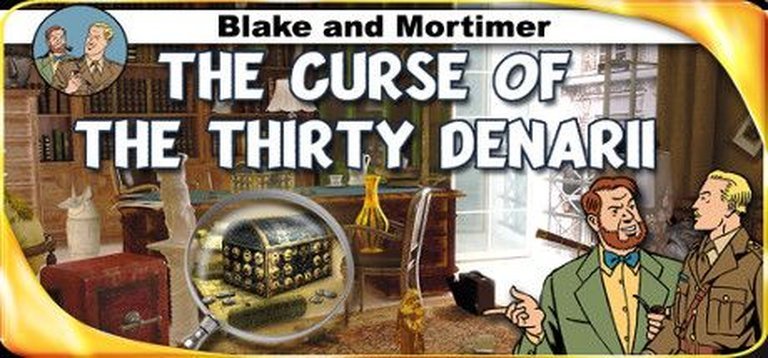
Blake and Mortimer: The Curse of the Thirty Denarii is a hidden object adventure game that immerses players in the thrilling world of the iconic comic series. Following detectives Captain Francis Blake and Professor Philip Mortimer, the game tasks players with solving puzzles and uncovering clues across Europe and the Middle East to stop a sinister plot involving the thirty pieces of silver from Judas Iscariot’s betrayal, all while evading the villainous Colonel Olrik.
Where to Buy Blake and Mortimer: The Curse of the Thirty Denarii
PC
Blake and Mortimer: The Curse of the Thirty Denarii Reviews & Reception
store.steampowered.com (66/100): Mixed (66% of the 30 user reviews positive).
Blake and Mortimer: The Curse of the Thirty Denarii: Review
Introduction: A Niche Adaptation in a Crowded Genre
In the vast ecosystem of licensed video games, adaptations of European comics occupy a peculiar, often underserved niche. Among them, the Blake and Mortimer series—beloved for its intricate “ligne claire” artistry, globe-trotting pulp adventures, and the iconic duo of the stoic MI5 captain Francis Blake and the brilliant, impetuous Professor Philip Mortimer—has seen sporadic interactive interpretations. Blake and Mortimer: The Curse of the Thirty Denarii, released in March 2018 by the French studio Mzone Studio and published by Anuman Interactive’s Microïds Indie label, arrives not as a flagship action-adventure but as a modest hidden object game (HOG) for the PC. Its thesis is clear: to faithfully translate the spirit and plot of the 2009-2010 comic two-part story by Jean Van Hamme (with art by René Sterne and Chantal De Spiegeleer) into the accessible, click-driven mechanics of the casual HOG market. The game’s success hinges entirely on its ability to leverage its source material’s rich narrative and atmospheric settings to elevate a genre often criticized for repetition. The result is a competent, visually faithful but ultimately conventional adaptation that serves more as a companion piece to the comics than a standalone experience, illustrating both the potential and the persistent limitations of the “hidden object” form for literary transposition.
Development History & Context: A Low-Budget Nod to a Classic
The Studio and Vision: Mzone Studio, the developer credited on MobyGames, is a small French team with a portfolio largely consisting of hidden object and casual puzzle games, including titles like Haunted House Mysteries and Secrets of the Vatican: The Holy Lance. Their experience lies in efficiently producing games that fit a well-established, cost-effective template. For The Curse of the Thirty Denarii, the vision was almost certainly pragmatic: to capitalize on the enduring popularity of the Blake and Mortimer franchise (which had already seen several games, from 1997’s The Time Trap to 2005’s Mortimer and the Enchanted Castle) with a low-risk project that could be developed on a tight budget and timeline. The game was not designed to reinvent its genre but to provide a familiar, accessible entry point for fans of the comics and casual gamers alike.
Technological and Market Constraints: Released in 2018, the game operates within the technical and design confines of the mid-to-late 2000s casual game boom. Its minimum system requirements (1 GHz processor, 512 MB RAM, 128 MB graphics card) are trivial even by 2018 standards, indicating a design for maximum accessibility on low-spec machines. The graphics, as noted in user screenshots, employ a hybrid approach: static, beautifully painted 2D scenes derived from the comic’s aesthetic are populated with 3D-rendered, often clumsily integrated, interactive objects. This clash—the “2d comic art and 3d-rendered environment” noted by a Steam community user—highlights the budget constraints. The game engine is proprietary and anonymous, built for efficiency over spectacle. The market context is the then-dominant “casual games” sector on platforms like Steam, Big Fish Games, and the Masque Publishing label (which also distributed it), where hidden object games sold steadily at low price points ($1.99-$6.99) to an audience seeking relaxing, puzzle-focused sessions.
Licensing Landscape: Securing the Blake and Mortimer license from Éditions Blake et Mortimer/Studio Jacobs (Dargaud-Lombard s.a.) was the project’s cornerstone. The source comic, La malédiction des trente deniers, was a major story arc—a two-volume thriller involving Nazis, apocalyptic cults, and a biblical artifact—offering dramatic locations (Greek islands, caves, a Nazi yacht) perfect for hidden object scene diversity. The adaptation strips the complex, 200-plus-page plot down to its essential MacGuffin: the search for the thirty pieces of silver paid to Judas, cursed to bring doom to its possessor.
Narrative & Thematic Deep Dive: Faithful but Flattened
The game’s narrative is a severely condensed, chapter-based retelling of the comic’s plot, delivered primarily through static text panels and minimal voice-over (the store page lists no full audio, only subtitles). This is both its greatest strength for purists and its greatest weakness for anyone seeking interactive storytelling.
Plot Condensation: The game follows the comic’s arc: an archaeological discovery in Greece leads to the involvement of Mortimer; the villainous Colonel Olrik is broken out of prison by the neo-Nazi Belos Beloukian (revealed as SS Count Rainer von Stahl); Blake joins the FBI/MI5 hunt; Mortimer and allies (including journalist Jim Radcliff and his niece Eleni) pursue clues across the Peloponnese and to the fictional island of Syrenios; the chase culminates at the mythical “Door of Orpheus” in the Cave of Acheruse in Epirus, where the grave of Judas is found. The supernatural climax—the cursed corpse of Judas animating to curse von Stahl before turning to dust—is included, preserving the comic’s borderline supernatural thriller tone.
Character and Dialogue: The characterization is paper-thin, existing only as archetypes: Mortimer the curious academic, Blake the authoritative agent, Olrik the brutal mercenary, von Stahl the megalomaniacal Nazi. Key relationships—Mortimer and Blake’s deep friendship, the romantic tension between Jim and Eleni, the mentor-student dynamic between Mortimer and Dr. Markopoulos—are mentioned but not explored. Dialogue is functional, advancing plot points without nuance. The game misses the Blake and Mortimer series’ trademark witty banter and philosophical debates, a casualty of the genre’s focus on object-finding over conversation.
Themes: The comic explores themes of historical evil (the Nazi war chest), religious fanaticism (the curse), and the cyclical nature of greed and power. The game retains the surface plot of stopping Nazis from obtaining a world-ending artifact but strips away the deeper historical weight. The “curse” is treated as a literal supernatural threat rather than a metaphor for the corrupting nature of the coins themselves. The setting’s potential—ancient Greece juxtaposed with post-war Nazi intrigue—is purely aesthetic, used for locale variety (chapel ruins, yacht, village café, cave) rather than thematic depth.
Gameplay Mechanics & Systems: By-the-Books Hidden Object Design
The gameplay is a textbook example of a mid-tier hidden object game from the late 2000s/early 2010s, with no meaningful innovations to distinguish it.
Core Loop: Each scene is a meticulously detailed, static illustration (in the style of the comics). Players are given a list of objects to find within the scene. The cursor changes to a magnifying glass when hovering over interactive elements. A “zoom x2” feature, as per the store description, allows closer inspection of crowded areas—a standard but essential tool. Finding objects progresses the narrative to the next scene or unlocks a mini-game.
Inventory and Progression: Objects found are added to an interactive inventory. Some are used within the same scene (e.g., a key to open a box), while others are carried forward to combine with later finds. This creates a basic, linear puzzle logic. There is no character progression, skill tree, or stat system. The “progression” is purely narrative: moving from “The Museum in Athens” to “The Chapel in the Peloponnese” to “The Yacht Arax.”
Mini-Games: The game breaks up hidden object scenes with a handful of standard mini-games: sliding block puzzles, matching pairs (a “Match-3” variant), and simple jigsaw-style puzzles. These are not mechanically unique and serve primarily as palette cleansers. The store page’s mention of a “range of mini-games” is accurate but unexceptional.
UI and Quality-of-Life: The interface is simple point-and-click. The “tips” and “bonus stars” mentioned in the store blurb are standard hint systems (limitless hints available, often with a cooldown or cost) and bonus objectives (finding a certain number of extra objects for score boosts). Two game modes are offered: “Classic” (no time pressure) and “Timed” (adding a stopwatch), catering to different player preferences. The system works reliably but offers no accessibility features beyond the zoom.
Innovation and Flaws: There is no innovation. The game faithfully executes a proven formula. Its primary “flaw” is its utter lack of ambition. The integration of the narrative is passive; the story is something that happens between hidden object scenes, not something that dynamically changes the scenes or gameplay. The hybrid 2D/3D art, while aiming for depth, often results in visual clutter and makes object-hunting less elegant than in purely 2D stylized HOGs like the Mystery Case Files series at its peak. A Steam user’s complaint about full-screen issues (“Even when I click Full Screen in the options, it’s still not covering the entire screen”) points to a sloppy implementation of the display settings, a minor but telling sign of the polish level.
World-Building, Art & Sound: Faithful Aesthetics, Functional Audio
Visual Direction and Setting: The game’s strongest suit is its visual fidelity to the source comic’s aesthetic. The “sumptuous scenes” promised in the store description are indeed detailed, painterly backgrounds that directly evoke René Sterne’s and Chantal De Spiegeleer’s artwork. The locations—a cluttered professor’s office, a sun-drenched Greek taverna, the eerie interior of a Nazi submarine—are distinct and thematically consistent. The color palette uses the muted, earthy tones of the comics, with occasional dramatic contrasts for puzzles. The 3D object integration, however, remains a jarring element. Objects often look like they’re floating on the 2D plane, breaking the immersion the beautiful backgrounds try to create.
Artistic Cohesion: The game successfully captures the mise-en-scène of the comics. You feel you are inside a Blake and Mortimer story. The character portraits (Mortimer’s wild hair, Blake’s sharp jawline, Olrik’s menacing scowl) are recognizable. The architectural details—Greek chapels, 1950s-era American cars, fascist-era design—are period-appropriate. This is a game made for fans who will appreciate seeing these settings rendered interactively. For non-fans, it’s merely a collection of competently drawn scenes.
Sound Design: Sound is minimal and functional. There is a looping, atmospheric but generic suspenseful soundtrack (the store page credits one track, “In The Waiting” by Dan Foster, likely for menu/credit use). Sound effects are limited to clicks, object retrieval sounds, and occasional ambient noise (waves, wind). There is no voice acting, a significant omission for a narrative-driven adaptation. The silence during the text-based story sequences makes the plot feel even more inert. The audio does not enhance emotion or tension; it merely provides auditory wallpaper.
Reception & Legacy: A Fading Echo in the Casual Galaxy
Critical and Commercial Reception: Upon release, The Curse of the Thirty Denarii received little to no critical attention from mainstream outlets. Its reception is defined by its Steam user reviews: “Mixed (66% of the 30 user reviews for this game are positive).” Positive reviews typically come from Blake and Mortimer fans happy to see any new interactive content for the series, or casual HOG players who find the price point ($0.77-$1.99 on deep sale) acceptable for a few hours of diversion. Negative reviews cite the lack of innovation, the poor integration of 3D objects, the barebones story presentation, and technical issues like the full-screen bug. On platforms like GOG, it sits on user “Dreamlists” with minimal votes, indicating niche interest.
Evolution of Reputation: The game’s reputation has not evolved significantly. It remains a forgotten footnote in the Blake and Mortimer gaming lineage, positioned below the more ambitious (if still flawed) early adventure games like The Interactive Adventures of Blake and Mortimer: The Time Trap (1997) in the memories of series fans. It is seen not as a failure, but as an inconsequential entry—competently assembled but artistically and mechanically unremarkable. Its legacy is as a case study in the limitations of the HOG format for adapting dense, action-oriented comics.
Influence on the Industry: The game has had no discernible influence on the industry. It did not innovate mechanics, push graphical boundaries, or redefine narrative integration in casual games. It represents the tail end of a specific production model: low-budget, licensed, hidden object games for the PC casual market, a model rapidly being supplanted by mobile free-to-play models and more narrative-focused indie adventures. Its existence is a testament to the continued, low-priority licensing of European comic properties for the casual space, a practice that persists but rarely produces memorable titles.
Conclusion: A Competent Artifact, Not a Landmark
Blake and Mortimer: The Curse of the Thirty Denarii is a paradox. It is arguably the most visually faithful video game adaptation of the Blake and Mortimer style, yet it is one of the weakest in terms of capturing the series’ narrative soul and suspenseful pacing. As a hidden object game, it is technically proficient, offering a steady, undemanding stream of puzzles with a clean interface and two difficulty modes. As an interactive story, it is fundamentally inert, reducing a complex tale of neo-Nazi conspiracies and biblical curses to a series of static, object-hunting vignettes.
Its place in video game history is minor: a catalog item in the annals of licensed casual games, a product of a specific moment (2018) when the Steam market was still saturated with low-cost hidden object titles. For the historian, it is a clear example of the “lowest common denominator” adaptation strategy—prioritizing recognizable IP and affordable development over gameplay innovation or narrative depth. It preserves the look of its source material but not its feel. For the Blake and Mortimer completist, it is a curious curio, a digital diorama of a beloved story. For the general gamer, it is entirely skippable, offering nothing that a better, more original hidden object game does not do better. Its final verdict is one of polite, professional mediocrity: a game that does exactly what it sets out to do with competent craftsmanship, but sets its sights so low that its achievement, while technically successful, feels ultimately inconsequential.
Final Score: 5/10 – A functional but forgettable hidden object game that captures the aesthetics of its comic source but fails to translate its thrilling spirit into engaging gameplay.