
- Release Year: 1999
- Platforms: Windows
- Publisher: Acer TWP Corp, Eidos Interactive Limited, Sold Out Sales & Marketing Ltd., Square Enix, Inc.
- Developer: Cinematix Studios, Inc.
- Genre: Role-playing
- Perspective: Diagonal-down
- Game Mode: LAN, Online Co-op, Single-player
- Gameplay: Action RPG, Hack and Slash, Real-time combat, Spellcasting
- Setting: Fantasy
- Average Score: 84/100
Description
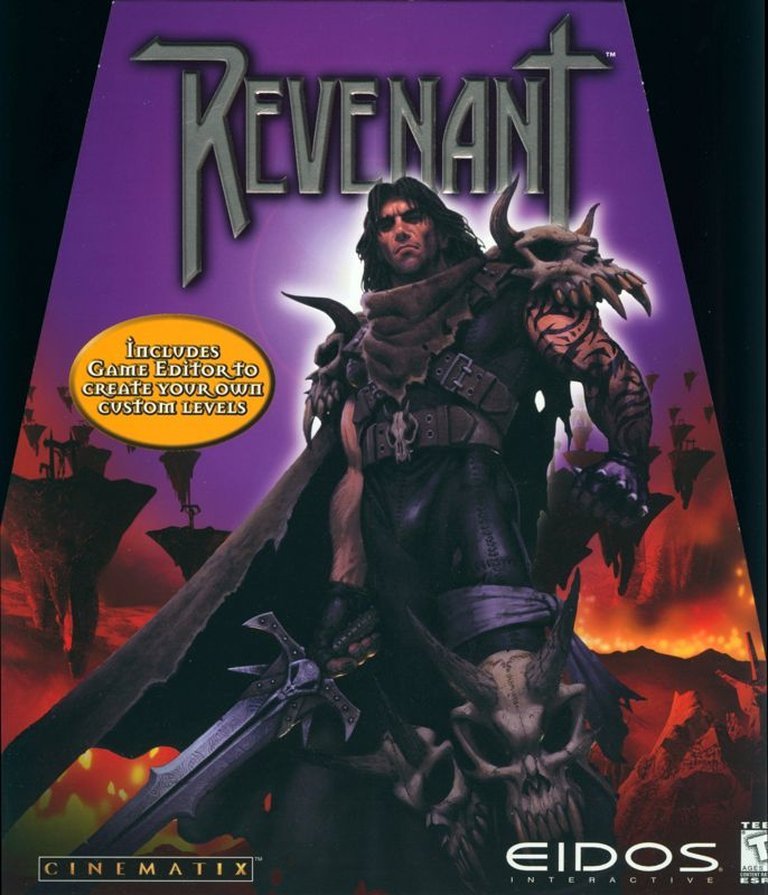
Revenant is an action RPG set in a fantasy kingdom where you assume the role of a Revenant—a being brought back from the brink of death—summoned and controlled by a mage. Tasked with infiltrating a besieged castle overrun by a sinister cult and rescuing the king’s missing daughter, you must engage in real-time combat using punches, kicks, and an innovative magic system based on elemental talismans to earn your freedom, all within an isometric 2D world reminiscent of games like Diablo.
Gameplay Videos
Where to Buy Revenant
Revenant Free Download
Revenant Patches & Updates
Revenant Guides & Walkthroughs
Revenant Reviews & Reception
metacritic.com (86/100): Excellent game! Interesting story. Cute graphics and superb fighting system!
ign.com (83/100): Eidos’ latest RPG is full of action and gorgeous graphics. Sign me up.
Revenant Cheats & Codes
PC
Press [Enter] during gameplay and type the cheat code.
| Code | Effect |
|---|---|
| abracadabra | All spells and unlimited mana |
| alchemy | 999,999 gold |
| alchemyinfinit | Unlimited gold |
| alreadydead | God mode (full health and invincibility) |
| dummies | Disable monster AI |
| debug | Debug mode (press F12 for game editor) |
| gimmesomegrub | Gives 5 of each food type |
| godsubzero | Unlimited ice arrows |
| lookunderthehood | List items for purchase |
| nahkranoth | One hit kills |
| noamnesia | Increase life, mana and stamina |
| potionmix | Unknown effect |
| potionsnlotions | More potions |
| showmetheway | Get navigation map |
| spellpouch | Unknown effect |
Revenant: Review
1. Introduction: The Undying Ambition of a Fallen Warrior
In the crowded landscape of late-1990s PC gaming, few genres were as feverishly contested as the isometric action role-playing game. The 1996 release of Diablo didn’t just create a hit; it forged a blueprint, spawning a deluge of imitators hungry to capture its dark, loot-driven, mouse-clicking magic. Into this arena, in October 1999, strode Revenant, a title that arrived with the weighty backing of publisher Eidos Interactive and the苦修 (kuxiu—bitter cultivation) of a small, ambitious studio, Cinematix. It was a game that promised more than mere cloning. Its premise—a resurrected, amnesiac warrior-king, bound by magic to save a kingdom he neither knows nor cares for—whispered of a narrative depth closer to Planescape: Torment than Diablo. Its combat system boasted a complexity that felt more like a beat-’em-up than a traditional RPG.
Yet, Revenant remains a fascinating paradox: a game critically praised for its audacious innovations and stunning presentation, yet one that failed to achieve commercial success or secure a lasting place in the pantheon of genre classics. This review will dissect that paradox. We will argue that Revenant is a seminal “what-if”—a game whose technical brilliance and bold systemic design were ultimately undermined by a rushed development cycle, uneven execution, and a fundamental tension between its narrative aspirations and its gameplay realities. It is not a forgotten masterpiece, but it is an essential case study in the perils of ambition met with constraint, a beautiful, broken relic from the golden age of PC RPGs that deserves to be remembered not for what it achieved, but for what it so clearly tried to be.
2. Development History & Context: Born in the Shadow of Giants
The Studio and the Genesis: Revenant was the brainchild of Cinematix Studios, a developer with a modest pedigree. The studio’s leadership, including Co-Presidents Jong Beum-Yoon and Benjamin Cooley (who also served as Lead Programmer), embarked on an ambitious project. The game’s original title, Forsaken: The Thrall of Chaos, hints at the darker, more personal tone they were aiming for. Over its development, it would be renamed twice more, finally settling on the more concise and evocative Revenant.
Technological Ambition: The team built the game using the Direct3D API, a significant choice in 1999 that allowed for true 3D models rendered from an isometric perspective. This was not a sprite-based Diablo clone; it was an attempt at a fully 3D action RPG with a fixed camera angle. This technical decision would be a double-edged sword: enabling the fluid animations and impressive spell effects that critics would praise, but also contributing to higher system requirements and potential hardware compatibility issues that limited its audience.
The Eidos Crucible: Cinematix’s fate was inextricably linked to its publisher, Eidos Interactive. At the time, Eidos was riding high on the success of the Tomb Raider series but was also reeling from the catastrophic failure of Ion Storm’s Daikatana, a project with which several Revenant staff were also credited. According to the Codex Gamicus entry, the fallout from Daikatana‘s flop led Eidos to enact budget cuts across its portfolio. This context is crucial. Revenant was likely developed under significant financial pressure, and the evidence of a rushed or truncated production is visible throughout the final product—most notably in the game’s infamous mid-point collapse, where NPCs become unresponsive and the narrative momentum stalls. The game’s three official names may reflect internal turmoil or marketing indecision as much as creative evolution.
The Competitive Landscape: The game launched in a crowded window, hot on the heels of Diablo and its imminent sequel. It was explicitly compared to Westwood’s Nox and Blizzard’s Diablo in official descriptions. To stand out, Cinematix and Eidos emphasized Revenant‘s combat depth and atmospheric graphics. However, with Diablo II on the horizon (released in June 2000), the window for a successful “Diablo-like” was narrow, and Revenant arrived just as the genre’s flagship was preparing to redefine it once more.
3. Narrative & Thematic Deep Dive: An Empire of Regret
The Core Premise and Structure: Revenant‘s story is its most praised and its most flawed element. It begins with a powerful, filmic sequence: Locke D’Averam, a soul tormented in the hellish dimension of Anserak for ten millennia, is forcibly resurrected by the sorcerer Sardok. Bound by a summoning spell that grants Sardok absolute control over his will and emotions, Locke is given a grim bargain: serve as a weapon to rescue the kidnapped Princess Andria and save the kingdom of Ahkuilon, and he will be granted his freedom. This “Resurrected for a Job” setup immediately establishes themes of agency, servitude, and existential bitterness.
The Unfolding Mystery and Amnesia: Locke’s amnesia is not just a gameplay device; it is the engine of the narrative. As he traverses the island of Ahkuilon, battling the cult known as the Children of the Change, fragmented memories of his past life return. The central revelation—that Locke was once a mighty king who ruled Ahkuilon—transforms the quest from a simple rescue into a labyrinthine exploration of consequence and reincarnation. The cult leader, the demon Yhagoro, is revealed to be an avatar of Kraxxus, the very demon-god Locke betrayed centuries ago by refusing to sacrifice his beloved queen. Princess Andria is the reincarnation of that queen. This creates a powerful, cyclical structure of betrayal, punishment, and a desperate second chance.
Themes of Identity and Control: The narrative is steeped in the “Who am I?” dilemma of Planescape: Torment, as one MobyGames user review astutely noted. Locke is literally a tool, his free will subsumed. This external control mirrors the internal possession he later experiences when he acquires the demonic power of the Nahkranoth. The theme of “Sanity Slippage” is well-executed: after imbibing the Nahkranoth, Locke’s dialogue options become increasingly aggressive and unsettling, and the people of Misthaven react with fear, seeing the “darkness” surrounding him. This brilliantly ties gameplay choice (taking a powerful, corrupting artifact) to narrative consequence (social alienation).
Betrayal and Bitter Twists: The plot is driven by successive betrayals. Sardok is the obvious treacherous advisor, but his ultimate act—murdering the reincarnated queen, Andria, moments after her reunion with Locke—is a cruelly effective “Cruel Twist Ending.” It transforms a potential “Happily Ever After” into a quintessential “Bittersweet Ending.” Locke succeeds in his mission: the cult is destroyed, Yhagoro is slain, and he breaks free from Sardok’s control. But his reward is the silent, heartbroken task of carrying his beloved’s corpse back to the portal. The story’s power lies in this profound cost. However, as critics from Power Play and GameRevolution noted, the execution is uneven. The mid-game section, particularly the endless cave systems, saps narrative momentum, and crucial backstory details about Locke’s original empire and the nature of Anserak remain frustratingly opaque. The game also suffers from the “Ion Storm effect”: several NPCs (including potential allies) become oblivious to Locke’s deeds after a certain point, breaking immersion and sense of consequence.
4. Gameplay Mechanics & Systems: A Combat Masterpiece in a Cumbersome Frame
The Dual-Control Combat System: This is Revenant‘s most acclaimed and innovative feature. The system offered two distinct philosophies:
1. Mouse Control: Designed for accessibility, it allowed for standard attacks with minimal input, functioning like a traditional Diablo-style click-to-attack.
2. Keyboard/Gamepad Control: This is where the depth resided. Using the keyboard (or a mapped gamepad), players gained access to three basic attack types (likely high, medium, low or thrust, slash, kick). The true genius was the combo system. These weren’t just preset strings; they were context-sensitive and enemy-specific. The detailed player review highlights the “special death animations” or “fatalities”—crushing a spider with a stomp, beheading a swordsman. This created a visceral, skill-based combat loop where observing an enemy’s animation and telegraphing was as important as clicking. The “fluid cycle of attacks” allowed for creative, continuous engagement that felt more like a fighting game than an RPG.
Progression and Special Moves: Character advancement was tied to this combat system. Every three levels (up to a presumed cap of 24), Locke could visit a trainer in town (the veteran Jong) to learn new special moves. This created a compelling “level-grind” incentive but introduced a major flaw: if you leveled up mid-dungeon, you had to trek back to town to train, or you would permanently miss that move. This arbitrary gate was a notorious source of frustration, as noted by multiple reviewers.
The Talisman Magic System: Rejecting the reagent-based systems of Ultima or Wizardry, Revenant implemented a brilliant, tactile spellcraft. Spells were not learned directly; spell scrolls were recipes. The player had to find elemental talismans (e.g., Fire, Water, Earth, Air) and combine them in specific sequences to cast spells. A “Lava” spell might be Fire + Earth. This system encouraged experimentation and inventory management as a core part of progression. It was innovative and satisfying. Furthermore, it featured a unique line-of-sight mechanic: if an enemy’s icon was visible on the minimap (or perhaps in the game world’s fog of war), the spell would hit them, even through walls. This rewarded tactical positioning and map awareness.
The Weight of Systems: Cumbersome UI and Obtrusive Design: For every brilliant system, Revenant introduced a friction point. The game demanded constant management of multiple on-screen windows (spells, stats, inventory), which cluttered the view and disrupted flow. The inventory used a “paper doll” system but with quirky storage sacks that could make finding specific items a chore. The map, while useful for showing monster positions, was stubbornly non-fullscreen, making navigation in the expansive, obstacle-filled world frustrating. Movement, constrained by the 30-degree isometric perspective, was notoriously awkward, especially on stairs or when circling enemies—pathfinding often failed against simple geometry.
The Mid-Game Stagnation and Grind: The game’s structure is famously problematic. After a strong opening act in and around the town of Misthaven, the player is funneled into an enormous, sprawling cave system. As the Power Play review starkly states, the game “mutated” from a “story-based, atmospherically dense Action-RPG” to a “pure Hack & Slay-Gemetzel.” These caverns were vast, mazelike, and populated with repetitive encounters. The sense of adventure gave way to a relentless grind, and the lack of meaningful new gear or story progression exacerbated the fatigue. This design shift is widely seen as a result of the rushed development, where an intended mid-game narrative payoff was either cut or underdeveloped.
Multiplayer: The game supported up to 4 players via LAN, modem, or null-modem cable. Intriguingly, bows were far more common in multiplayer, offering a ranged gameplay option less accessible in single-player. However, multiplayer was reportedly unstable over the internet (as per the Hacker review) and suffered from the same core combat and UI issues, making it a niche feature rather than a saving grace.
5. World-Building, Art & Sound: A Sight and Sound to Behold
Visual Presentation and Atmosphere: Revenant‘s strongest and most consistent praise lies in its audiovisual presentation. The isometric 3D graphics, while demanding a high-end PC for the era, were exquisite. The art direction focused on a cohesive, dark fantasy aesthetic. The town of Misthaven and the surrounding landscapes of Ahkuilon were rendered with a realistic, painterly detail that felt tangible. The proportionality of characters and monsters was frequently highlighted—giants truly felt colossal, spiders tiny and skittering. The armor and weapon models were exceptionally detailed, and the color-coordinated sets meant a well-equipped Locke was a visually distinct and satisfying sight on screen.
The game featured a dynamic day-night cycle, a rare touch for the genre at the time, which subtly altered ambient lighting and contributed to the world’s believability. The special effects for spellcasting were the crown jewels. Described as “flamboyant,” with “atmospheric swirls and sounds,” spells like Lava created dramatic, screen-filling spectacles that made magic feel potent and physical. This technical polish in effects was a genuine notch above contemporaries like Diablo.
Sound Design and Music: The soundscape was equally lauded. The battle sounds were gruesomely satisfying: monsters howled, groaned, and cried out in agony. Locke’s own pained screams and grunts upon being hit added weight to combat. The death animations for specific foes were accompanied by unique audio cues, enhancing the “fatalities” feel. The soundtrack, composed by Victor J. Palagano III, Patrick J. Collins, and Ronny Moorings (of Clan of Xymox fame), provided an atmospheric, sometimes driving score that suited the dark fantasy tone without being intrusive. The combination of these elements created a consistently engaging and immersive atmosphere, even when the gameplay loops became repetitive.
6. Reception & Legacy: Critical Admiration, Commercial Silence
Critical Reception: Revenant was a critically divisive but generally well-received title. Aggregate scores hovered in the high 70s (77% on MobyGames, 74% on GameRankings). The spread was telling:
* The Zealots: Game Vortex awarded a perfect 100%, hailing it as “RPG Game of the Year.” GameSpy (90%) and Absolute Games (90%) championed it as a “Diablo killer” with a superior story and combat.
* The Praisers: RPGFan (87%), IGN (83%), and PC Gamer UK (82%) focused on its technical strengths, engaging combat, and atmospheric world. PC Player (Germany) (80%) noted its ability to “sweep a magician out of his felt slippers” with its graphics.
* The Cautious: GameSpot (70%) and Eurogamer (70%) praised its looks and fun factor but criticized it as a disjointed “Frankenstein’s monster” of features. Computer Gaming World (60%) was particularly harsh, calling the ending “one of the lamest closing scenes in recent gaming history” and suggesting it was only for those with “a high tolerance for redundancy.”
* The Genre Purists: Several reviews, like that from ComputerGamers.com, bluntly stated it was “not a RPG” but a linear action game. They advised hardcore role-players to steer clear, a sentiment echoed by Jeuxvideo.com and others who found the RPG elements superficial.
The most consistent praise was for combat, spell effects, and graphics. The most consistent criticisms were for the learning curve (largely due to poor manual organization), the cumbersome UI and movement, the repetitive cave sections, and the narrative’s mid-game collapse. The infamous issue of NPCs becoming unresponsive post-mid-game, likely a cut-content bug, was a specific point of derision (Codex Gamicus).
Commercial Performance: By all accounts, Revenant was a commercial disappointment. Wikipedia and GameSpot cite a figure of 37,000 units sold in the U.S. by March 2000. GameSpot’s Desslock explicitly called it a game that “sold quite poorly.” This failure can be attributed to a perfect storm of factors: arriving just before Diablo II, the lingering stigma of the “Daikatana” era affecting Eidos’s reputation, the high system requirements, and a marketing message that couldn’t quite clarify if it was a hardcore action game or an RPG.
Legacy and Cult Status: Revenant never achieved the cult following of, say, Arcanum or Fallout 2. Its availability on GOG.com has preserved it for a small audience of retro enthusiasts and genre historians. It is remembered primarily in three ways:
1. As a “What If”: A frequent topic in discussions of great missed opportunities in game design—what could Cinematix have achieved with more time and resources?
2. For its Combat System: Its deep, combo-based melee system is still cited as an innovative but under-explored approach in the ARPG genre, which largely settled on click-to-attack simplicity.
3. As a Cautionary Tale: It stands as a case study in how a game with stellar components ( graphics, sound, core combat ideas) can be undone by poor UI/UX design, uneven pacing, and the brutal realities of release timing and publisher woes.
Its influence on subsequent games is minimal and difficult to trace directly. It did not spawn a series or inspire a wave of imitators. Its legacy is that of a beautiful, flawed artifact—a game that reached for the stars of narrative depth and mechanical sophistication but was grounded by the gravity of its own ambition and circumstance.
7. Conclusion: The Unfree Revenant
Revenant is a game of magnificent, haunting contradictions. It is a title that delivers some of the most viscerally satisfying combat and spectacular spell-casting ever seen in an isometric RPG, yet saddles the player with some of the most frustrating movement and inventory management of the era. It tells a story of profound mythological weight and personal tragedy, yet botches its pacing and leaves crucial chapters of its own lore unwritten. It showcases a 3D graphical prowess that was years ahead of many of its 2D-sprite-based peers, but these same technical ambitions likely contributed to its performance issues and commercial obscurity.
To call Revenant a “Diablo clone” is to miss its point entirely. It is too strange, too committed to its own complex systems, and too narratively idiosyncratic for that label. But to call it a “Diablo killer” or a lost classic is, in the end, an overstatement. It is a flawed masterpiece of ambition. Its heart was in the right place: in the intricate dance of its keyboard-controlled combos, in the satisfying clink of newfound armor, in the swirling vortex of a perfectly cast Lava spell, and in the grim, poetic tragedy of a king carrying his queen’s corpse through a Hellscape he saved.
Ultimately, Revenant is a game that cannot escape its own context. It is the product of a studio firing on all creative cylinders while operating under the shadow of a major publisher’s financial crisis and the looming, inescapable specter of Diablo II. Its 77% aggregate score and 37,000-unit sales tell the story of a game that was too rough, too flawed, and too late to claim the throne it sought. Yet, for those willing to navigate its considerable hurdles, Revenant offers a uniquely intense and atmospheric experience. It is not a pillar of the RPG canon, but it is a fascinating, melancholic monument to what might have been—the story of a revenant not just in its plot, but in its very existence: a game resurrected from development hell, struggling against its own chains, fighting valiantly but ultimately failing to achieve the freedom and recognition it so dearly earned. Its place in history is not as a king, but as a tragic, undying warrior whose legend persists in the whispers of those who remember its fierce, flawed glory.