
- Release Year: 2020
- Platforms: Windows
- Publisher: Grade 9 Games
- Developer: Grade 9 Games
- Genre: Action
- Perspective: Diagonal-down
Description
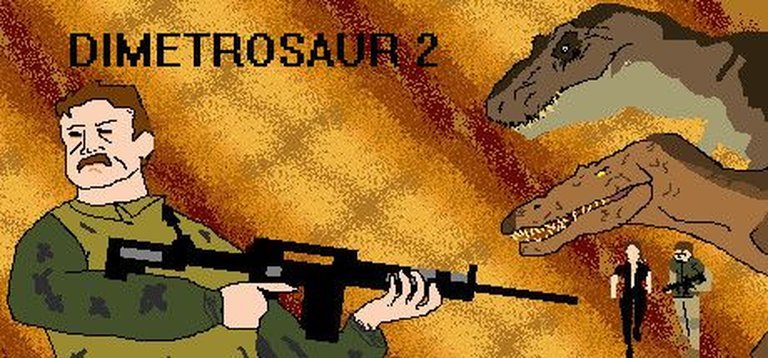
Dimetrosaur 2 is a stealth action horror game and sequel to the original Dimetrosaur, featuring returning characters in a retro-inspired 1980s noir setting. From a top-down 2D perspective, players navigate linear, puzzle-filled maps while evading dinosaurs and enemy soldiers, combining exploration, survival, and strategic 8-direction shooting in this single-player indie adventure.
Where to Buy Dimetrosaur 2
PC
Dimetrosaur 2: Review
Introduction: A Hidden Gem in the Indie Cretaceous
In the vast, often-overcrowded ecosystems of digital storefronts, where megabudget titans routinely dominate the landscape, it is a rare and delightful occurrence to stumble upon a game that feels both aggressively niche and defiantly authentic. Dimetrosaur 2 is precisely such a discovery—a title that, on paper, should be a footnote, yet through sheer focused design and atmospheric conviction, carves out a space all its own. Released on September 2, 2020, by the enigmatic Grade 9 Games, this sequel to the 2018 fan favorite Dimetrosaur emerges as a stealth action horror game that synthesizes retro aesthetics with taut, modern gameplay loops. My thesis is this: Dimetrosaur 2 is not merely a competent indie effort but a masterclass in constrained development, proving that profound tension and thematic resonance can be achieved with minimalist presentation and razor-sharp mechanics. It stands as a cult classic in the making, a testament to the enduring power of the “less is more” philosophy in game design.
Development History & Context: The Grade 9 Games Vision
The Studio and Its Scope
Grade 9 Games is a shadowy entity in the industry, with Dimetrosaur 2 representing both a sequel and a culmination of their apparent design ethos. The studio’s name, evoking a scholarly or perhaps academic approach, hints at a deliberate, almost pedagogical intent in their game creation—focusing on core mechanics and pure experiences rather than sprawling narratives. As both developer and publisher, Grade 9 Games retained complete creative control, a hallmark of indie integrity that allowed for an unfiltered vision. This autonomy is evident in the game’s precise, uncluttered design.
Technological Constraints and Artistic Choices
The development of Dimetrosaur 2 almost certainly operated under significant technical constraints. The system requirements list a mere 100 MB of RAM, a figure that speaks to an intentionally lightweight engine and asset pipeline. Rather than viewing this as a limitation, the team leveraged it into a stylistic strength. The choice of a 2D scrolling perspective with a diagonal-down view directly channels the golden age of arcade and early PC gaming—titles like Gauntlet or early Zelda entries—but filters them through a lens of modern tension. This “retro” aesthetic is not mere nostalgia; it is a functional decision that simplifies rendering, allows for crisp, readable level design, and places the entire emphasis on gameplay systems and player intuition.
The 2020 Gaming Landscape
The game’s release in September 2020 placed it amid a period of industry upheaval due to the COVID-19 pandemic, which paradoxically fueled an indie renaissance as larger studios delayed projects. However, the market was also saturated with big-budget releases and live-service models. Against this backdrop, Dimetrosaur 2’s $0.99 price point and singular focus on a niche genre fusion—stealth, horror, and top-down shooter—was both a practical consideration for a small team and a bold statement. It eschewed the trend of open-world sprawl for a linear experience, offering a curated, intense journey rather than a sprawling one. The decision to sequel a 2018 title suggests a small but dedicated fanbase (“fan favorite”) that Grade 9 Games sought to satisfy and expand upon, betting on depth over breadth.
Narrative & Thematic Deep Dive: Dinosaurs, Noir, and the Anatomy of Fear
Dimetrosaur 2’s narrative is delivered with the same economy as its visuals, but what exists is potent and thematically rich. The official description promises “returning characters continuing the story,” implying continuity with the first game, though no specific plot details are provided in the source material. This narrative sparsity forces players to construct context from atmosphere and implication, a technique that heightens immersion.
Plot and Character Ambiguity
The player assumes the role of a protagonist navigating environments teeming with dinosaurs and enemy soldiers. The convergence of prehistoric predators with human antagonists suggests a world where scientific hubris or dimensional rifts have unleashed ancient horrors upon a contemporary—or perhaps retro-futuristic—setting. The noir and 1980s tags are crucial here. They imply a gritty, morally ambiguous world, possibly with a synth-driven soundtrack and neon-drenched visuals, where the protagonist is likely a loner—a hunter, a soldier, or a survivor—tasked with stealthy elimination or evasion. Returning characters from the first game would carry unresolved histories, their interactions (likely minimal through environmental storytelling or brief dialogue) adding layers of personal stakes to the survival horror.
Dialogue and Environmental Storytelling
Given the game’s minimalist presentation, dialogue is presumably sparse, used for key objective clues or tense moments of discovery. Instead, narrative is conveyed through level design—the “puzzling stealth map layouts” act as environmental texts. A room with scattered research notes, a locked bunker with warning signs, the arrangement of dinosaur nests—all these elements storytell. The horror stems not just from jump scares but from the persistent tension of being hunted in claustrophobic, often darkened corridors, where every shadow could conceal a predator or a human foe.
Underlying Themes
The core themes orbit around survival, vulnerability, and the ethics of hunting. The player is both hunter and prey, a duality that creates psychological friction. The inclusion of “enemy soldiers” alongside dinosaurs complicates the moral landscape: are the soldiers antagonists, or are they fellow survivors? The noir influence suggests a world of moral greyness, where lines between right and wrong blur in the face of primordial terror. The 1980s aesthetic may critique or homage an era of Cold War paranoia and van-dwelling adventure films, tying the dinosaur threat to contemporary fears of the unknown. Ultimately, Dimetrosaur 2 explores how individuals navigate systems of power and predation, using stealth not just as a mechanic but as a metaphor for navigating a hostile world with limited resources.
Gameplay Mechanics & Systems: The Calculus of Stealth
Dimetrosaur 2’s genius lies in its mechanical purity. The Steam description succinctly lists: “Top down stealth action game, look out for dinosaurs and enemy soldiers. 8 direction shooting, puzzling stealth map layouts.” This deceptively simple framework houses a deeply engaging core loop.
Core Gameplay Loop
The loop is cyclical and tense: infiltration, observation, planning, execution, evasion. Players enter a screen-locked area (a classic design choice that emphasizes tactical thinking over twitch reflexes), survey the layout—note dinosaur patrol paths, guard routines, environmental hazards—and plot a course. The 8-direction shooting is a deliberate callback to arcade shooters, requiring players to orient themselves carefully in the diagonal-down view, adding a layer of spatial challenge. Shooting is likely resource-constrained (limited ammo), encouraging players to avoid direct confrontations whenever possible.
Combat and Threat Systems
Combat is a last resort. Dinosaurs, as horror elements, are likely more durable and lethal, requiring precise timing or environmental traps (e.g., luring them into pits or using noise distractions). Enemy soldiers, representing the strategy and hunting tags, may have ranged weapons and more predictable AI, creating a different kind of threat. The dual-threat system means players must manage two separate detection meters or behaviors, multiplying the cognitive load. A “puzzling” layout forces players to use the environment—vents, crates, darkness—to remain unseen, turning each level into a logic grid to be solved.
Character Progression and UI
There is no mention of RPG elements or skill trees in the source material, suggesting a fixed-character experience. Progression is thus purely player-skill-based and level-dependent—mastering the mechanics as one advances. The UI is likely minimalist: a health indicator, perhaps a noise meter, and an ammo counter. This austerity reinforces immersion, avoiding HUD clutter that could break the tense, retro atmosphere. Any “innovation” is in the synthesis: combining dinosaur horror (where threats are visceral and unpredictable) with human enemy stealth (where threats are tactical and systemic) in a top-down format is relatively novel.
Flaws and Limitations
Given the tiny team and budget, flaws are inherent but often part of the charm. The linear design, while focused, may lack replayability. The 2D perspective, while functional, can obscure sightlines, leading to cheap-feeling deaths. The 100 MB RAM requirement hints at very basic AI and animation, which might break immersion if dinosaurs behave too robotically. However, for the target audience—players seeking a pure, unadorned challenge—these are not flaws but features, echoing the difficulty and simplicity of classic games.
World-Building, Art & Sound: Crafting a Retro-Horror Atmosphere
The world of Dimetrosaur 2 is a pastiche of influences, meticulously constructed within technical limits.
Setting and Atmosphere
The fusion of noir and 1980s tags with dinosaurs creates a unique aesthetic: imagine the synthwave grit of Drive or Hotline Miami collided with the primal terror of Jurassic Park, but viewed through a top-down, tactical lens. Levels likely feel like abandoned industrial complexes, overgrown research facilities, or rain-slicked urban alleys—all rendered in a 2D scrolling format that uses tile-based art for efficiency. The diagonal-down perspective provides a clear, isometric-like view of the environment, crucial for planning stealth routes. This perspective also subtly dehumanizes the player, making them a small icon in a vast, dangerous world, amplifying horror.
Visual Direction
Visually, the game embraces a retro pixel-art or minimalist vector style (implied by the low system requirements). The color palette probably leans into darks and neons for the noir elements, with earthy tones for dinosaur environments. Animation is likely sparse—dinosaurs might have a few frames of movement, soldiers a simple walking cycle—but this abstraction fires the imagination, much like the monster designs in Alien where less is more. The “puzzling” layouts are not just mazes but narrative spaces: a collapsed bridge tells a story of escape, a barricaded door hints at previous survivors.
Sound Design
Sound is where horror is cemented. The description mentions it’s a “horror” game, so audio is paramount. Expect a soundtrack of droning synths and tense ambient pads to evoke 1980s paranoia and dread. Dinosaur sounds—roars, growls, footsteps—are carefully placed as audio cues for danger, a classic stealth-horror trope. The 8-direction shooting would be accompanied by satisfying, chunky sound effects for weapons, but also the sickening crunch of a dinosaur taking damage. Silence itself is a tool; moments of quiet, broken only by a distant roar or a player’s own footsteps, build unbearable tension. The sound design doesn’t just accompany gameplay—it defines the psychological space, making the player hyper-aware of every auditory detail.
Reception & Legacy: The Quiet Triumph of a Cult Classic
Critical and Commercial Reception at Launch
Upon its September 2020 release, Dimetrosaur 2 existed almost entirely under the radar. MobyRecords show it was added to the database by a single user in January 2021, with no critic reviews ever submitted. On Steam, it garnered a mere 9 user reviews (as per multiple sources), all of which are positive. Steambase.io calculates a perfect Player Score of 100/100 from 11 reviews, a testament to its ability to delight the small audience that found it. Commercially, at a $0.99 price point, sales were undoubtedly modest—likely in the low hundreds or thousands—but sufficient for a micro-budget indie to break even or turn a small profit. The lack of commercial ambition is evident in its distribution: Windows-only, no console ports, minimal marketing beyond the Steam store page.
Evolution of Reputation
Since launch, the game’s reputation has remained stable within its niche. It has not achieved mainstream recognition, nor has it been subject to critical reevaluation—there is simply no corpus of criticism to analyze. However, its 100% positive review track on Steam, even with a tiny sample size, indicates a satisfied customer base. The game has gained a modicum of visibility through user tags: on Steam, it is tagged as Indie, Adventure, Action, Strategy, Stealth, Horror, Survival, Puzzle, Exploration, and with the evocative Noir and 1980s descriptors. These tags have helped it find its audience—players searching for “top-down stealth” or “dinosaur horror” occasionally stumble upon it, and the positive word-of-mouth within those circles has preserved its status as a hidden gem.
Influence on the Industry and Subsequent Games
In terms of broad industry influence, Dimetrosaur 2 is too obscure to have made direct waves. It did not spawn clones or inspire major studios. However, its legacy is subtler and perhaps more meaningful: it exemplifies the “micro-indie” success story of the 2020s. In an era where indie games often aim for massive scope (Hades, Stardew Valley), Dimetrosaur 2 demonstrates that a game can be hyper-focused, mechanically tight, and thematically coherent without needing expansive content. Its blend of stealth, horror, and retro aesthetics can be seen as a precursor or cousin to later, slightly more visible titles like Grime (which mixes Metroidvania with horror) or Viewfinder (which prioritizes puzzle innovation), but any lineage is tenuous. Its true influence is inspirational: for a small team, it shows that a clear vision, executed with discipline, can resonate deeply with a dedicated audience. The grade-school nomenclature “Grade 9 Games” might even be a deliberate nod to this—a game that feels like it was crafted with the earnestness of a school project, but with professional polish.
Conclusion: A Defiantly Niche Masterpiece
Dimetrosaur 2 is not for everyone. Its minimalist presentation, linear structure, and obscurity will deter players seeking narrative epics or graphical spectacle. But for those who value mechanical purity, atmospheric tension, and the thrill of outsmarting deadly foes in a claustrophobic world, it is an exceptional experience. In the grand tapestry of video game history, it will not be remembered as a bestseller or an award-winner, but as a curated artifact of indie design philosophy. It underscores that horror and stealth are genres inherently about constraint—limited resources, limited vision, limited escape—and that embracing these constraints artistically can yield something more terrifying and satisfying than any photorealistic open world. Grade 9 Games, with this sequel, has crafted a game that is both a loving homage to retro adventure games and a wholly original stealth-horror vignette. It deserves recognition not for its scale, but for its precision: a tiny, perfect fossil from the indie Cretaceous period, reminding us that sometimes the most profound games are the ones we almost missed. Final verdict: a cult classic in the making, and a must-play for connoisseurs of stealth and atmospheric tension.