
- Release Year: 2000
- Platforms: Windows
- Publisher: TalonSoft, Inc.
- Developer: Mission Studios
- Genre: Action, Simulation
- Perspective: 1st-person, 3rd-person
- Game Mode: LAN, Online PVP, Single-player
- Gameplay: Aerial combat, Bombing missions, Dogfighting, Flight Simulation
- Setting: North America
- Average Score: 72/100
Description
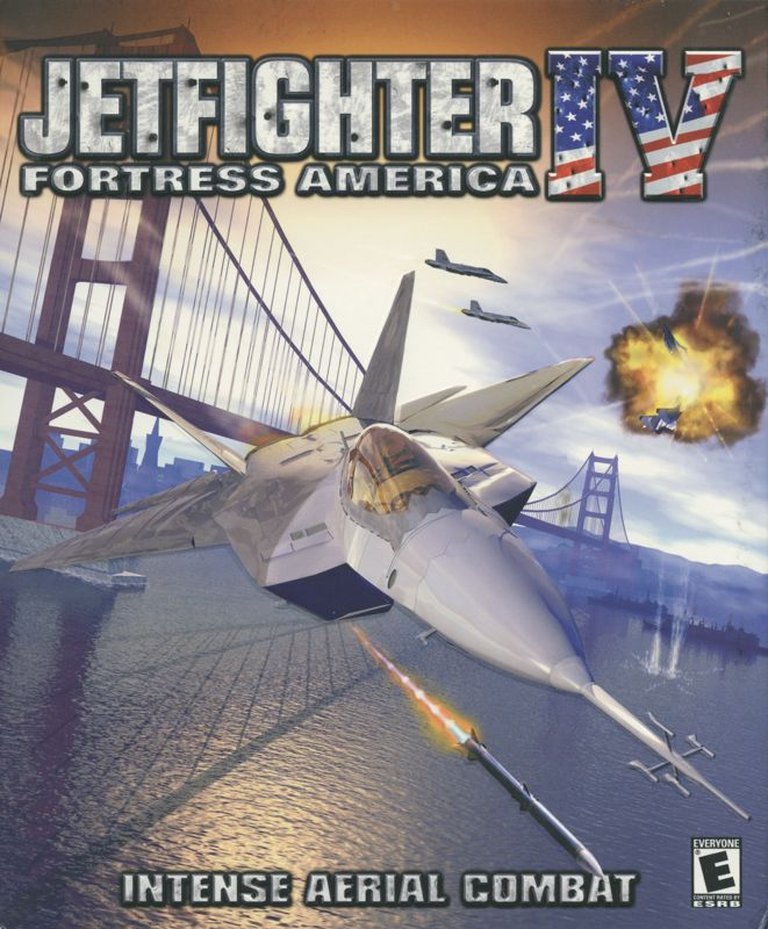
JetFighter IV: Fortress America is an action-oriented flight simulation game where players defend the United States from terrorist insurgencies and a large-scale invasion by Russian and Chinese forces. Set in recognizable areas of Northern California, including landmarks like the Golden Gate Bridge, pilots fly advanced fighter jets such as the F-22 Raptor, F/A-18 Hornet, and F-14 Tomcat in intense combat missions across various terrains.
Gameplay Videos
JetFighter IV: Fortress America Patches & Updates
JetFighter IV: Fortress America Guides & Walkthroughs
JetFighter IV: Fortress America Reviews & Reception
metacritic.com (60/100): Gameplay is complex enough to feel realistic, action-packed enough to be exciting, and easy enough to learn for players who are flight-challenged.
ign.com : Creating a flight sim for the masses proves an elusive target.
neoseeker.com (98/100): This game is one of my favorites, I never stop playing it.
JetFighter IV: Fortress America Cheats & Codes
PC
| Code | Effect |
|---|---|
| Shift+M | more ammo |
| Shift+F | more fuel |
JetFighter IV: Fortress America: A Patriot’s Sim or a Flawed Fantasy?
Introduction: The Promise of a Digital Homeland Defense
In the annals of PC flight simulation, few titles have so brazenly worn its political heart on its sleeve as JetFighter IV: Fortress America. Released in late 2000 by Mission Studios and TalonSoft, this fourth main entry in a long-running series made a singular, unambiguous promise: to let players experience the visceral thrill of defending the United States homeland from a massive, coordinated invasion. It was a concept ripped from a 1980s action movie script—a Sino-Russian-North Korean coalition, having neutralized the rest of the world, turns its sights on the West Coast, forcing a lone America to fight for its very soil. This review will dissect Fortress America not merely as a product of its time, but as a fascinating cultural artifact and a deeply compromised technical achievement. My thesis is this: JetFighter IV is a game of profound contradictions—a visually striking, conceptually bold “action sim” that is ultimately undermined by a bafflingly poor user experience, mission design that swings wildly between trivial and impossible, and a failure to meaningfully differentiate its core assets, resulting in a title that is remembered more for its ambitious premise and technical workarounds than for its actual gameplay.
Development History & Context: From EGA to “Action Sim”
The Jetfighter series is one of the oldest in PC gaming, debuting in 1989. By 2000, Mission Studios had carved out a specific niche: accessible, arcade-oriented flight combat set primarily along the American West Coast. JetFighter IV was developed during a transitional period for the genre. The late ’90s saw a bifurcation: hardcore, ultra-complex simulations like Falcon 4.0 (1998) and Jane’s F-15 (1998) on one side, and increasingly popular “light sims” or “arcade-sims” like F-22 Lightning 3 (1999) and EA’s USAF (1999) on the other. Mission Studios explicitly targeted the latter market. As noted in the source material, the game’s vision was to “put the ACTION back into flight sims!”—a direct response to perceived complexity barriers.
Technologically, the game leveraged 3D hardware acceleration, a standard by 2000, and famously included a second CD-ROM of ultra-high-resolution ground textures to push graphical fidelity. The development team, led by figures like Project Director Brian Boudreau and Simulation Design lead Robert Dinnerman, had experience with the Hidden & Dangerous and Metal Fatigue series, suggesting a small, multi-tasking studio. Their technological constraint was balancing these high-res textures (a 1.5GB install) with performance, a challenge even for high-end rigs of the era (e.g., a 64MB GeForce 2 Ultra was mentioned as ideal). The gaming landscape was crowded with competitors offering similar “accessible jet combat” experiences, demanding JetFighter IV to stand out. Its chosen differentiator was clear: a hyper-patriotic, homeland-based narrative set in a semi-plausible near-future.
Narrative & Thematic Deep Dive: A Worthy Setup, Bumbled Execution
The Premise: The campaign’s backdrop is a geopolitical powder keg. In a near-future scenario (alluded to be around 2012), Russia, China, and North Korea form a new “Axis of Evil” (the sources use similar terminology). They exploit global chaos—an Arab coalition attacking Israel, Balkan unrest, Iraq “pissing off everyone”—and use a fantastical “orbital weapon” (a “space cloud” that destroys satellites) and cyber-attacks to isolate the United States. The UN abstains, leaving America to fight alone against a full-scale conventional invasion of its northern California territories.
Thematic Ambition: The game attempts to tap into a potent, post-Cold War, pre-9/11 anxiety: the fear of a multipolar world turning against American exceptionalism. It’s a pure power fantasy of “defending the homeland,” with tangible targets like the Golden Gate Bridge, Bay Bridge, and Transamerica Pyramid. The slogan “Defend the USA!” is not just marketing; it’s the entire narrative engine. The theme is unambiguous, un-ironic patriotism.
Execution & Dialogue: Here, the game collapses. Reviews consistently lambaste the narrative’s lack of emotional weight or plausibility. The IGN review scathingly notes the “space cloud” and North Korean internet attack as laughable plot devices, comparing the scrolling-text intro to “an episode of the A-Team.” The PC Action review (Germany) states the story “reiz[t] kaum zum Weiterspielen” (hardly entices you to keep playing). Briefings are read in a flat, radio voice, and wingmen are non-entities. There is no character development, no sense of a larger war beyond the immediate mission, and no exploration of the geopolitical “why.” The premise is a skeleton without flesh. It’s a missed opportunity to explore the paranoia and stakes of a homeland invasion, instead serving as a thin veneer for repetitive mission structures. The theme of patriotic defense is so bluntly rendered it becomes parody, lacking the gravitas of a Red Dawn or the nuanced tension of a Call of Duty campaign.
Gameplay Mechanics & Systems: The Illusion of Choice and the Reality of Chaos
Core Loop & Flight Model: The game is explicitly not a simulation. It’s an “action sim” or “sim-lite.” The flight model is drastically simplified: stalls and spins are negligible, energy conservation is irrelevant, and aircraft feel nearly identical regardless of which of the three you choose (F-14 Tomcat, F/A-18 Hornet, F-22 Raptor). As the MyAbandonware review states, “each aircraft looks, feels and flies almost identically.” This directly undermines the historical and technological diversity between a 1970s-era variable-sweep wing fighter (F-14) and a 5th-generation stealth fighter (F-22). The goal is “point and zoom” accessibility, which it achieves.
Weapons & Combat: Weapons are “fire-and-forget” to a fault. The AGM-65 Maverick, an anti-armor missile, becomes a do-everything tool capable of destroying skyscrapers, ships, and SAM sites, and can even be fired backward. The LANTIRN night-vision/guided bomb system is praised as a well-balanced implementation. However, the M61 Vulcan cannon is “worthless” for air, ground, and sea combat—a staggering flaw in a combat flight game. The HUD is criticized as vague, providing no “shoot now” cue or hit probability, forcing players to guess weapon effectiveness. This creates a frustrating meta-game of trial-and-error.
Mission Design & Campaign: This is the game’s greatest failure. The campaign is simply 32 individual strung-together missions. The IGN review delivers the most scathing critique: missions are “brutally difficult” and “static and geskriptet” (scripted). There is no planning; waypoints and danger zones are absent from the briefing map. You are thrown into overwhelming odds (10-to-1 enemy aircraft, dense SAM coverage) with no foreknowledge. Wingmen are cowardly, often aborting early. The design seems to assume players will use cheats (refuel/re-arm, invulnerability) or endure endless trial-and-error deaths. This oscillates between “milk runs” and “impossible tasks,” creating a punishing, unfair experience utterly at odds with the “casual” target audience. The mission generator is derided as “clumsy” and “rigid.”
Interface & Stability: The interface and controls are a major pain point. The review from The Adrenaline Vault mentions “control and interface problems.” Critically, advertised features like force feedback and online multiplayer (beyond LAN) were broken or non-functional at launch. The game is also noted as “unstable,” frequently crashing to the desktop without warning. The MyAbandonware and user comments are filled with modern workarounds (using dgVoodoo2 wrapper, compatibility modes) just to make it run on Windows 10/11, cementing its reputation as a buggy, poorly finished product.
World-Building, Art & Sound: A Gorgeous, Broken Sandbox
Visuals & Terrain: This is JetFighter IV‘s strongest suit. The game uses actual USGS satellite imagery to model a 50,000-square-mile area of Northern California. Flying over recognizable landmarks—the Golden Gate Bridge, Bay Bridge, Transamerica Pyramid, Lake Tahoe, Yosemite—is an undeniably cool, if destructible, experience. The 3D models for aircraft and ground units are “nicely done” with dynamic lighting and real-time weapon loads. However, the base terrain textures are “dark and muddy.” The optional Hi-Res Scenery CD improves this but at a massive 1.5GB install cost and performance penalty. The 3D engine is “sloppy,” with “gaping seams” and pronounced clipping. Performance was generally “solid and smooth” on recommended systems (Pentium II 400MHz, 64MB RAM, 3D accelerator), a point in its favor for the era.
Sound Design: Universally panned. Engine sounds are compared to a “Dustbuster held under water.” Bomb explosions are “weak.” Radio chatter from wingmen is inaudible (“almost as a whisper”). The game lacks critical audio cues for incoming missiles or threats, forcing players to spot dangers visually—a major immersion and gameplay killer. The music is sparse and unmemorable. The sound design fails to provide the “pulse-pounding” feedback expected of an action title.
Atmosphere: The atmosphere is one of sterile, beautiful emptiness. The real-world terrain provides a powerful sense of place, but the lack of a compelling story, lifeless wingmen, and poor audio strip the world of any tension or life. You are a ghost pilot in a gorgeous, silent, and lethally hostile sandbox.
Reception & Legacy: A Middling Entry in a Shifting Genre
Critical Reception (2000-2001): Reviews were mixed-to-negative, reflected in its MobyGames score of 59% (13 critics) and Metacritic metascore of 60. The spectrum ranged from:
* The Mildly Positive (70%): Adrenaline Vault and GameSpy acknowledged the fun aerial action but noted significant flaws. GameSpy‘s verdict is damning: “Does it wind up… ‘Putting fun back into flight sims?’ No. Most flight sims are already fun, don’t have show-stopping bugs… JetFighter 4… doesn’t quite fit that bill.”
* The Lukewarm (55-68%): Most reviews (GameStar, PC Action, PC Joker, Gry OnLine) agreed it was suitable for “Gelegenheitspiloten” (casual pilots) or “simulation recruits” but cited repetitive missions, lack of depth, poor sound, and technical issues.
* The Negative (40%): Computer Gaming World and Gamekult were brutal. CGW stated it “lacks the substance to be anything special,” criticizing the repetitive missions, lack of features, and poor mission design. Gamekult called it a “sympathetic game that could have been” ruined by “major design flaws” and no evolution from its predecessor.
Commercial & Cultural Legacy: The game sold modestly but left no significant mark on the genre. It did not spawn a new trend. Its legacy is threefold:
1. The “Home Defense” Niche: It remains a notable, if unsuccessful, attempt to make the “defend America” scenario a central, serious campaign premise. Later games like the Ace Combat series (which often featured fictional nations) or IL-2‘s historical focus avoided such overt, contemporary geopolitics.
2. A Cautionary Tale of Ambition vs. Polish: It exemplifies how a great concept (real terrain, patriotic narrative) and solid core tech (graphics, flight accessibility) can be derailed by terrible mission design, broken features, and poor audio/UI.
3. An Abandonware Artifact: Today, it’s primarily known among retro sim enthusiasts as a technical headache. The user comments on MyAbandonware and Neoseeker are a testament to its fragility, detailing complex multi-step processes (dgVoodoo2 wrappers, compatibility settings, disabling music) just to achieve a stable play session on modern Windows. One user review passionately recalls its online multiplayer glory days (“actual fighter pilots!!”), hinting at a fun, broken gem that might have been with proper support.
Conclusion: A Flawed Artifact of Its Time and Ambition
JetFighter IV: Fortress America is not a good game by any traditional critical standard. It is buggy, unbalanced, thematically blunt, and fails in its core promise of providing a fun, accessible aerial combat experience due to punishing mission design and broken mechanics. Its flight models erase the distinction between iconic aircraft, its weapons are unrealistically overpowered or useless, and its narrative is a cringe-worthy afterthought.
Yet, it persists in memory. Its audacious, if naive, premise—to let you dogfight over the very bridges and skyscrapers of your home city—was revolutionary for its time. Its visual scale, using real satellite data, was impressive. And within its jingoistic, low-fidelity shell, there existed the potential for a thrilling, “Air Quake”-style multiplayer playground that some players clearly cherished in its heyday.
Its place in history is as a curio—a fascinating “what-if” of the light-sim genre. It represents a studio reaching for a unique identity (the patriotic homeland sim) but being unable to execute with the polish, balance, or respect for its audience required. It is the antithesis of the meticulous, systems-driven Falcon 4.0 and the polished, arcade-perfect Ace Combat titles. Instead, it is a rough-hewn, technically troubled monument to a specific post-Cold WarAmerican fantasy, remembered less for what it achieved and more for the gaping chasm between its spectacular, sky-high ambitions and its earthbound, bug-ridden reality. It is, ultimately, a 6.1/10—a game you install, patch, configure with wrappers, and then probably abandon after a few frustrating missions, all the while wondering what might have been if the developers had actually “defended” their own game from its inherent flaws.