
- Release Year: 2012
- Platforms: Android, iPad, iPhone, Macintosh, Windows
- Publisher: Alawar Entertainment, Inc., Big Fish Games, Inc
- Developer: Alawar Friday’s Games
- Genre: Adventure
- Perspective: 1st-person
- Game Mode: Single-player
- Gameplay: Hidden object, Puzzle elements
- Average Score: 80/100
Description
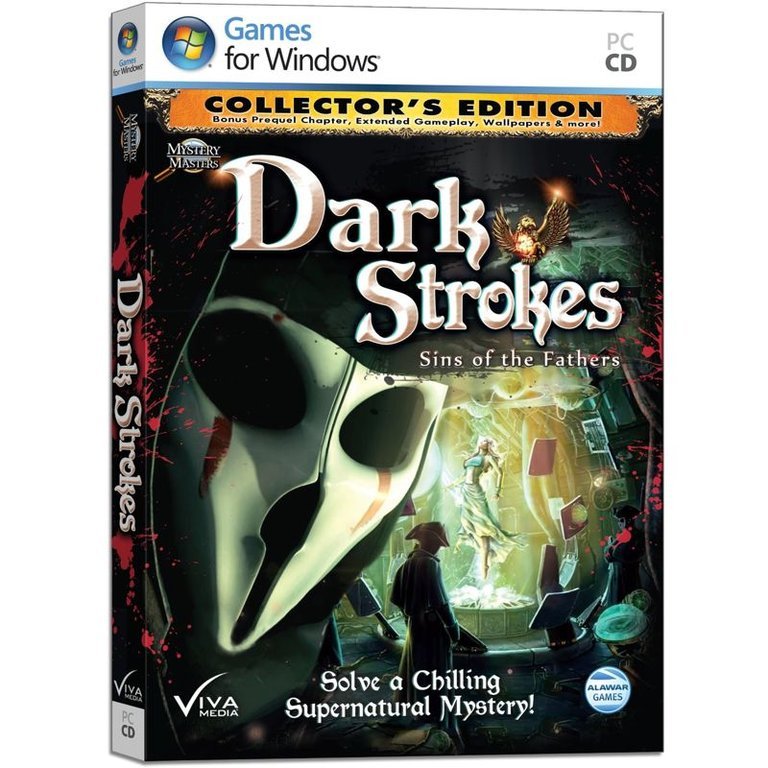
Dark Strokes: Sins of the Fathers (Collector’s Edition) is an adventure game blending hidden object challenges with puzzle-solving mechanics. Set in a shadowy, supernatural realm, the narrative follows protagonist Ethan Black as he strives to rescue his bride-to-be from the menacing entities known as the Faceless Ones, weaving a tale of dark mysteries and familial sins. This enhanced edition expands the experience with bonus content including a strategy guide, concept art, wallpapers, character art, additional gameplay chapters, and music tracks.
Gameplay Videos
Dark Strokes: Sins of the Fathers (Collector’s Edition) Guides & Walkthroughs
Dark Strokes: Sins of the Fathers (Collector’s Edition) Reviews & Reception
gametop.com (80/100): Dark Strokes: Sins of the Fathers offers an immersive hidden object adventure with a haunting atmosphere and a gripping storyline.
Dark Strokes: Sins of the Fathers (Collector’s Edition): A Haunting Masterpiece of the Hidden Object Genre
Introduction: A Shadow Cast Across the Genre
In the early 2010s, the casual “hidden object puzzle adventure” (HOPA) genre was a dominant force in PC gaming, a bustling marketplace of titles where players scoured countless painterly scenes for lists of mundane items. Within this crowded field, Dark Strokes: Sins of the Fathers (2012) emerged not as a mere entry, but as a defining exemplar—a game that transcended its logistical formula to deliver a genuinely cohesive, atmospheric, and narratively compelling experience. Developed by Alawar Friday’s Games and published by Big Fish Games, this Collector’s Edition stands as a monument to the genre’s potential, weaving a gothic mystery of familial sin and supernatural retribution into a tightly woven tapestry of exploration, deduction, and visual storytelling. This review argues that Dark Strokes is a masterclass in genre synthesis, where its mechanics are not arbitrary obstacles but integral threads in the fabric of its dark, romantic, and ultimately tragic tale. Its legacy is that of a high watermark for narrative ambition within the HOPA framework, proving that even the most standardized gameplay template can house profound thematic weight when guided by a singular, unwavering vision.
Development History & Context: The Alawar Engine of Efficiency
To understand Dark Strokes is to understand its creator, Alawar Entertainment. Founded in the late 1990s in Russia, Alawar evolved from a casual game portal into one of the world’s most prolific developers and publishers of mid-core casual games, particularly the HOPA hybrid. By 2012, Alawar Friday’s Games (a key internal studio) had honed a highly efficient, assembly-line approach to genre production, churning out titles like the Sacra Terra, Mystery Expedition, and Dark Parables series with remarkable consistency. Dark Strokes: Sins of the Fathers was not an experimental outlier but a polished, high-budget iteration of a proven model.
The game was built with the technological constraints and artistic idioms of its era. It utilized a proprietary engine capable of rendering detailed, static 2D scenes with slight parallax effects and seamless transitions. The visual style leaned heavily into a “dark fairy tale” aesthetic—high-contrast lighting, saturated but somber color palettes, and environments dripping with ornate, decaying grandeur. This was the era before photorealistic hidden objects; artistry lay in the clever hiding of items within painted environments, a craft Alawar had perfected. The game’s simultaneous release on Windows, Mac, iOS, and later Android (2014) reflects the multi-platform strategy common for casual hits of the time, targeting the dominant PC download market (via Big Fish Games) and the rapidly growing mobile touchscreen audience.
Within the 2012 gaming landscape, the HOPA was a cash cow but often derided by “core” gamers as simplistic. Dark Strokes competed directly with series like Mystery Case Files (by Big Fish’s own Elephant Games) and Dark Parables (also by Eipix/Blue Tea Games). What set it apart, as reviews noted, was its unprecedented length and density of content. While many HOPAs could be completed in 3-4 hours, Dark Strokes demanded 8-10, cramming fourteen chapters of intricate puzzles and story beats into a single package. This was a statement of value in a market where consumers were often wary of short experiences.
Narrative & Thematic Deep Dive: The Weight of a Father’s Sins
The narrative of Dark Strokes is its beating, tormented heart, a direct adaptation of the Old Testament adage, “The sins of the fathers shall be visited upon the children” (Exodus 20:5, though the review correctly notes it’s often misquoted). The story follows Ethan Black, a young man whose wedding to his fiancée, Clair, is violently interrupted. Their train to Cedar Falls is attacked by spectral, masked figures known as the Faceless Ones, who kidnap both Clair and Ethan’s estranged father, the Judge. Ethan arrives in the ghostly, fog-shrouded ruins of Cedar Falls, a town frozen in a supernatural purgatory.
Plot Architecture and Pacing: The plot is deceptively simple—a rescue mission—but its brilliance lies in its relentless escalation and constant revelation. The fourteen-chapter structure acts as a serialized mystery, with each location (the Mountain Lift, the Town Square, the Courthouse, the Forbidden City, the Cathedral, the ship, the Tower) unveiling a new layer of the curse’s history. The pacing is methodical, almost operatic. Key plot points are punctuated by stunningly produced cinematics (a rarity in the genre), especially the reveal of the Faceless Ones’ origin and the tragic backstory of the artist, Leonard, and his beloved, Mary. The central twist—that the Judge (Ethan’s father) is not a victim but the original perpetrator, and that Leonard (the apparent antagonist) is a tormented soul seeking to complete a ritual to break the curse—is handled with remarkable subtlety. Clues are scattered throughout: the Judge’s evasive behavior, Leonard’s anguished warnings, the recurring motif of the paintbrush. The final confrontation at the Tower, where Ethan must choose to sacrifice his own heart to break the cycle, provides a thematically resonant climax that elevates the entire enterprise from puzzle game to morality tale.
Characters as Thematic Vessels:
* Ethan Black: The classical hero, but defined by his relationship to paternal legacy. His journey is one of uncovering the ugly truth about his father and choosing a different path. His love for Clair is his motivator, but his ultimate act of self-sacrifice for Leonard’s dissipated soul completes his moral arc.
* The Judge: The embodiment of the “sins of the fathers.” His crime—using a magical paintbrush to trap Mary’s soul to save his own dying son (Ethan as a child)—is an act of selfish love that perpetuates endless suffering. His ghostly presence is one of guilt and evasion.
* Leonard: The tragic, Frankensteinian figure. An artist cursed to become one of the Faceless Ones for his part in the Judge’s ritual. His decades-long quest to gather the seven figurines (representing the seven cursed souls) to perform a counter-ritual makes him an antagonist with a wholly sympathetic goal. His line, “The sins of the fathers… I will visit them upon you,” reframes the entire conflict.
* Clair: More than a MacGuffin, her capture is the emotional engine. The figurine of her found early on is a constant reminder of what’s at stake. Her role in the final ritual ties her fate directly to the town’s curse.
* The Faceless Ones: Not mere monsters, but the literal masked identities of the cursed townsfolk, including Leonard. Their design is chilling in its simplicity—featureless porcelain masks—representing the erasure of identity by ancestral guilt.
The Figurine Mechanic as Narrative核心: The most ingenious design choice is the “jeweled box” that Ethan acquires in the Attic. Each major character (Judge, Officer, Priest, Chef, Doctor, Captain) has a figurine. Collecting them is not a collectible side-quest; it is the primary method of story delivery. Placing a figurine in the box triggers a cutscene that reveals that character’s fate and their connection to the curse. This system makes progression intrinsically narrative. You are not just opening a door; you are piecing together a shattered history, one tragic soul at a time. The final figurine, the Boy (representing Ethan’s younger self, saved by the curse), completes the set and provides the crucial key to the final ritual, tying the personal and the supernatural into one.
Dialogue and Tone: The dialogue is utilitarian but effective, with the walkthrough noting minor typos (e.g., “Clair” vs. “Claire”). The tone is consistently grave and earnest, leaning into gothic romance rather than outright horror. The themes of artistic creation twisted into a tool of evil (Leonard’s paintbrush), the corruption of justice (the Judge), and the possibility of atonement through sacrifice give the story a weight uncommon for its genre.
Gameplay Mechanics & Systems: The Engine of Investigation
Dark Strokes operates on a classic HOPA/adventure hybrid loop, but with exceptional density and logical coherence.
Core Loop: The player navigates between static, beautifully rendered scenes using arrow cursors. Each screen contains multiple “Hotspots” (magnifying glass icons) that trigger either:
1. Hidden Object Scenes (HOS): The genre’s staple. A scene (a cluttered room, a shed, a street) presents a list of ~10-15 items to find. Dark Strokes innovates slightly with “interactive” HOS, where some items require using one found object on another (e.g., use a KNIFE on an APPLE to get a WORM). Items found are either immediate-use tools or stored in the inventory tray at the bottom of the screen.
2. Inventory-Based Puzzles: The vast majority of progression. An object from the inventory must be used on a specific hotspot in a scene (e.g., use a KEY on a LOCK, a WEIGHT on a SCALE). The puzzle logic is almost always diegetic—the key fits the lock, the weight balances the scale—which maintains immersion.
3. Mini-Games: Diverse and well-integrated. These include:
* Tile Sliding Puzzles: (The Replica Cache in the Secret Archive) Arranging architectural tiles to form a sun pattern.
* Find-the-Differences: (The Courthouse cabinet) Comparing two nearly identical images.
* Logic puzzles: The alarm token-matching, the statue weight-balancing, the code lock based on scattered numbers.
* Pattern Recognition: The organ mini-game (playing notes from sheet music), the door blade-turning puzzle, the crystal ball symbol sequence.
* Mechanical Simulations: The drawbridge boat-docking slider puzzle, the crane control sequence.
All mini-games have a “Skip” button that charges over time, a crucial accessibility feature.
Progression and Inventory: The game’s genius is its non-linear item chaining. An item found in Chapter 1 (a POSTER FRAGMENT) might not be used until Chapter 3. The inventory becomes a growing toolkit, and the player must constantly recall where an object might be applicable. The Journal is well-organized, tracking story beats and, crucially, unlocking a Map after a few chapters that shows all visited locations and indicates where HOS or puzzles remain (though it is not interactive for fast travel). This encourages backtracking, which is both a strength (revisiting atmospheric locales) and a potential weakness (can feel like padding).
Difficulty & Accessibility: The two-mode system (Casual/Expert) is expertly tuned. Casual mode provides sparkling interactive hotspots and faster hint recharge (~1 min), making it welcoming for newcomers. Expert mode removes glints and extends hint cooldown (~2 min), demanding more observation and memory. The hint system itself is intelligent: in scenes, it points to the next actionable area; in HOS, it highlights a specific object with a puff of blue smoke. This prevents frustration while maintaining challenge for those who seek it.
The Collector’s Edition Bonus: The added content is substantial. The built-in strategy guide is a fully annotated walkthrough (like the one sourced), invaluable for the game’s many intricate puzzles. The “Bonus Chapter” is a fully voiced, multi-scene epilogue that continues the story after the main game, providing closure for secondary characters and the fate of Cedar Falls. The concept art and wallpapers are high-quality and appreciated by fans. This transforms the purchase from a one-time play into a lasting reference and a deeper dive into the game’s world.
World-Building, Art & Sound: The Gothic Stage
Cedar Falls is not just a setting; it is a character, a physical manifestation of the curse. The world-building is achieved almost entirely through environment and artifact.
Visual Direction & Atmosphere: The art direction, led by Art Director Stepan Komarov and Lead Artist Darya Pavlova, is the game’s most celebrated aspect. It adopts a stylized, almost storybook-gothic aesthetic. The color palette is dominated by deep blues, desaturated greens, and sepia tones, punctuated by occasional warm glows (candlelight, furnace fire, the glowing Orb). Locations are meticulously detailed: the Mountain Lift Station feels isolated and industrial; the Forbidden City is a rigid, police-state nightmare with a stark, bureaucratic feel; the Cathedral is a baroque masterpiece of stained glass, stonework, and shadow; the ship is a rusting, wooden vessel frozen in time; the Tower is a stark, ancient ziggurat. The transition from the snow-dusted mountains to the rain-slicked city streets to the dusty catacombs creates a palpable sense of geographical and emotional journey. The character designs are strong, particularly the uniformly eerie Faceless Ones and the geometric, mask-like portraits in the Tower.
Sound Design & Music: The audio, while not featuring a memorable orchestral score, masterfully employs ambient soundscapes. The constant drip of water, the distant tolling of a bell, the low groan of the drawbridge mechanism, the howl of wind—these are the true “music” of Cedar Falls. Sound cues are critical for gameplay (the click of a correctly placed object, the hiss of steam). The voice acting, sourced from the credits, is competent if not exceptional, serving the story without distraction. The overall soundscape is one of oppressive, melancholic silence broken by sudden, jarring noises (a window breaking, a door slam), perfectly complementing the visual dread.
Environmental Storytelling: The world tells the story without words. Leonard’s Artist Studio is a time capsule of the past, with a hidden painting revealed by solvent. The Mortuary is clinical and cold, filled with notes about “accidents” and “freezing.” The graves in the Cemetery are specific, with Leonard’s wife’s headstone bearing a green crystal. The Tower’s portraits each require an object associated with the profession of the depicted soul (Stethoscope for the Doctor, Spyglass for the Captain). This is world-building at its most efficient—every puzzle item has a narrative rationale.
Reception & Legacy: A Cult Classic of its Era
Upon its release in March 2012, Dark Strokes was met with quiet acclaim from its target audience. On MobyGames, it holds a perfect 4.0/5 average from player ratings, though it lacks a critical mass of formal critic reviews. The Amazon and Big Fish storefronts list it favorably among thousands of titles. Reviews from dedicated casual gaming sites like Gametop (8.0/10) and JayisGames (highly positive) praised its “captivating story,” “atmospheric visuals,” and exceptional “length and gameplay density,” while noting that veteran HOPA players might find the puzzles too straightforward in Casual mode.
Its commercial success is implied by its presence across multiple platforms (Windows, Mac, iOS, Android) and the release of a sequel, Dark Strokes 2: The Legend of the Snow Kingdom, indicating a franchise status. However, its legacy is somewhat double-edged:
- The High-Water Mark for Narrative Ambition: Dark Strokes demonstrated that a HOPA could have a serious, continuous plot with genuine emotional stakes and a complex villain. It raised the bar for story integration, where every hidden object scene felt part of a larger investigation.
- A Peak of the “Classic” HOPA Formula: Its 2012 release date places it at the zenith of the genre’s pre-mobile, PC-download-store dominance. Later titles would increasingly prioritize casual mini-games, match-3 elements, and simpler stories. Dark Strokes represents the last of the “pure” adventure-hybrids with deep, scene-based puzzles.
- Limited Cultural Footprint: Despite its quality, the HOPA genre was largely ignored by mainstream games press and academia. Its influence is seen more in the continued production of similar titles by Alawar, Big Fish, and others than in any direct mechanical innovation that seeped into AAA development. It is a masterpiece within its niche, not a trendsetter outside it.
- The Collector’s Edition Standard: Its CE package—strategy guide, art gallery, bonus chapter—became a standard model for premium casual game sales, reinforcing the value proposition for dedicated fans.
Conclusion: An Enduring Shadow
Dark Strokes: Sins of the Fathers (Collector’s Edition) is not a flawless game. Its interface can feel dated, its backtracking occasionally tedious, and its localization has minor imperfections. Yet, these are trivial blemishes on an otherwise extraordinary achievement. It is a game that respects its player’s intelligence, trusting them to piece together a haunting mystery from environmental clues, fragmented documents, and the very tools they collect. It marries gameplay and narrative in a symbiosis rare for any genre, let alone the often-maligned HOPA.
The final image—Ethan, having thrown his heart into the abyss to break the cycle, standing with a redeemed Leonard as the curse lifts from Cedar Falls—is a powerfully bittersweet conclusion. It rewards the player not just with “game over,” but with thematic resolution. For historians, Dark Strokes is a vital artifact: a peak of the early 2010s casual adventure boom, a testament to Alawar’s craft, and a blueprint for how to build a meaningful story from the ground up using the humble mechanics of hidden objects and point-and-click puzzles. It is a game that understands the power of a shadow, the weight of a sin, and the satisfaction of a puzzle solved not just for progression, but for closure. Its legacy is secure as one of the finest, most complete examples of its kind—a dark stroke of genius that continues to cast a long, influential shadow.