
- Release Year: 2000
- Platforms: Windows
- Publisher: Global Star Software Ltd., Swing! Entertainment Media AG
- Developer: InterActive Vision A/S
- Genre: Simulation
- Perspective: 1st-person, 3rd-person
- Game Mode: Single-player
- Gameplay: Flight Simulation, Mission-based, Precision landing, Rescue missions, Weather effects
- Setting: Aviation, Coast Guard
- Average Score: 70/100
Description
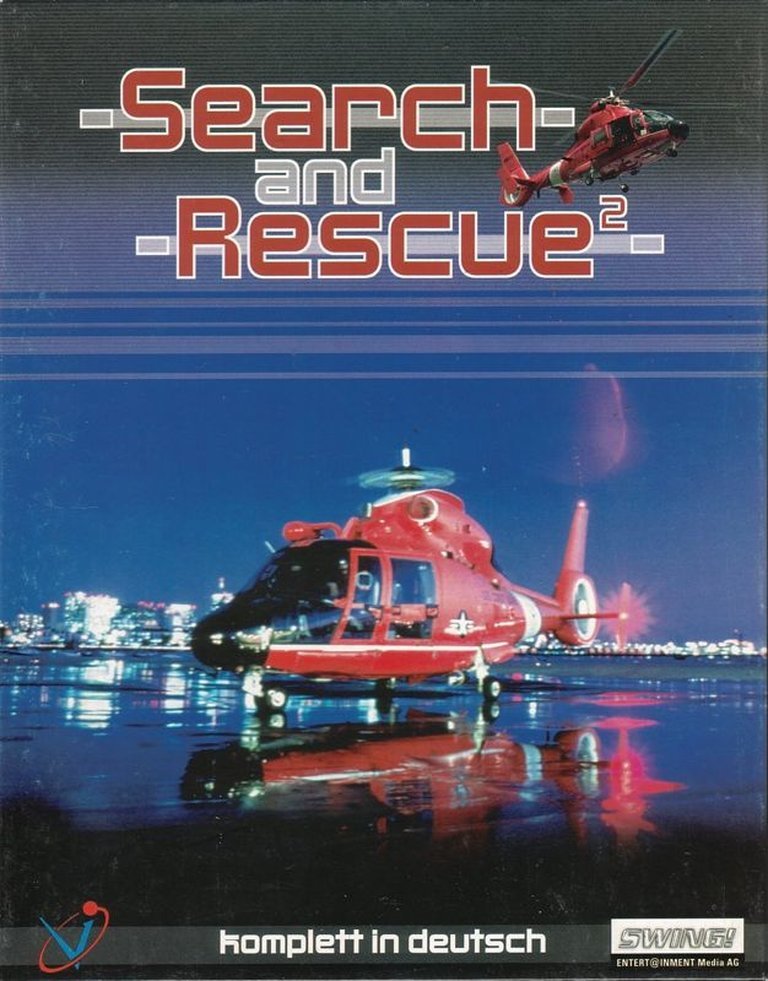
Search and Rescue 2 is a helicopter simulation game where players pilot a US Coast Guard Dolphin HH65, engaging in non-violent missions such as maritime inspections, hazardous rescues, and search operations across diverse environments. Set in over 10 realistic flight areas with dynamic weather effects like clouds, rain, fog, and day-night cycles, the game emphasizes precision flying through a career mode that rates performance after each mission, capturing the challenges of civilian Coast Guard aviation.
Gameplay Videos
Search and Rescue 2 Reviews & Reception
mobygames.com : One of the few civilian chopper games on the market, could be better though…
ign.com (70/100): We’re not your typical armed forces, we’re the other guys.
gamegenie.com : All of the variations in missions make Search and Rescue 2 quite a complete game.
Search and Rescue 2 Cheats & Codes
PC
During gameplay, press PAUSE and enter the code.
| Code | Effect |
|---|---|
| unlimitedfuel | Unlimited fuel |
Search and Rescue 2: A Cult Classic of Humanitarian Flight Simulation
Introduction: The Unlikely Hero of the Simulator Shelf
In the crowded pantheon of late-1990s and early-2000s flight simulations, dominated by screaming fighter jets and strategic bombers, Search and Rescue 2 (SAR2) represents a deliberate, almost quixotic, act of niche defiance. Released in 2000 by the Danish developer InterActive Vision A/S and published internationally by Swing! Entertainment and Global Star Software, this title eschews combat entirely, instead offering players the meticulous, tension-filled experience of piloting a U.S. Coast Guard Sikorsky HH-65A Dolphin helicopter. Its thesis is radical in its simplicity: the thrill of flight simulation can be derived not from destruction, but from preservation; not from firepower, but from fine motor control and procedural adherence. SAR2 is not a game about winning a war; it is a game about preventing tragedies, one delicate winch operation at a time. This review will argue that Search and Rescue 2 is a fascinating, deeply flawed, and profoundly sincere artifact—a game that prioritized unparalleled authenticity in helicopter dynamics and Coast Guard procedure at the often catastrophic expense of user accessibility, ultimately securing its place as a beloved cult classic for simulation purists and a cautionary tale about the perils of uncompromising design.
Development History & Context: A Scandinavian Take on American Heroism
The development context of Search and Rescue 2 is as unusual as its subject matter. InterActive Vision A/S, a Danish studio, undertook the task of simulating an iconic American military service with no obvious domestic cultural touchstone. As IGN astutely observed, “I am at a loss to understand what may have possessed a Scandinavian company to take on a project involving such subject matter, since I can’t think of a single related movie or television export over the last twenty years that could have inspired them.” This suggests a fascination with the technical and procedural authenticity of the U.S. Coast Guard, rather than its cinematic mythology. The team, led by Lead Designer/Artist Allan Abildgaard Kirkeby and Lead Programmers Mikkel Steensgaard and Thomas Gjørup, was clearly composed of aviation enthusiasts and technical perfectionists.
Technologically, SAR2 was a product of the tail end of the Windows 95/98 era. It required a 3D accelerator card and targeted a Pentium II 300MHz with 64MB RAM, placing it in the mainstream of PC gaming at the turn of the millennium. Its use of 3D accelerated graphics for terrain, water, and detailed vehicle models was contemporary, though not cutting-edge. The more significant technological constraint was the complexity of its flight model and mission systems, which strained not only the hardware but the player’s cognitive load. The gaming landscape of 2000 was saturated with combat flight sims (Jane’s series, F-22 series) and arcadey action titles. SAR2’s explicit non-violence and its laser focus on a single, complex vehicle in a non-combat role made it an outlier. It was a direct descendant of the hardcore sims of the early 1990s but applied that same rigor to a humanitarian context, a “virgin gaming territory” as IGN termed it. This ambition was both its defining characteristic and its primary commercial barrier.
Narrative & Thematic Deep Dive: The Story is the Procedure
SAR2 possesses no traditional narrative with characters, plot arcs, or dialogue-driven drama. Instead, its “story” is emergent and procedural, woven entirely from the player’s career progression and the simulated consequences of their actions. The narrative framework is the Campaign Mode, where the player assumes the role of a newly commissioned Coast Guard pilot. There is no protagonist name, no backstory—the player is the avatar. The story unfolds through:
- Briefing Documents: Before each mission, text-based briefings outline the emergency—a medical crisis on an oil platform, a vessel in distress, a car accident. These establish the stakes: someone is injured, time is limited, and specific protocols must be followed.
- Radio Chatter: In-mission communications from the crew (pilot, co-pilot, hoist operator, mechanic) provide constant, often stilted, updates. They report on victim status (“Patient’s condition is deteriorating!”), confirm procedures (“Winch is ready, sir!”), and relay weather updates. This audio, while criticized as “stiffly delivered” and “read right off the pages of the standard Coast Guard regulations manual” (IGN), is crucial for immersion, making the cockpit feel like a busy, professional environment.
- Debriefing & Pilot’s Log: After mission completion, a detailed deb screen lists every mistake: hard landings, improper hoist use, excessive time, damage to the helicopter. These errors deduct from a performance score and are permanently logged in the Pilot’s Log, which catalogs the player’s entire career history. This log is the character’s biography. Promotion is tied directly to successful, mistake-free missions.
- Thematic Underpinnings: The game’s core theme is non-violent heroism through extreme competence. There are no enemies, only victims and hazards. The “antagonist” is physics (torque, wind, weight), time, and the unforgiving sea. The reward is not points or unlocks, but the abstract satisfaction of a “flawless” rating and a higher rank. One Russian critic from Absolute Games perfectly captured this ethos, calling it “Настоящая анти-Carma” (“The real anti-Carma”)—a direct counterpoint to the violent, amoral universe of Carmageddon. The game suggests that saving lives, even virtual ones, carries a “кармический баланс” (karmic balance). The narrative is one of quiet, professional responsibility, where heroism is measured in precise hover control and correctly deployed rescue baskets.
Gameplay Mechanics & Systems: The Gauntlet of Realism
SAR2’s gameplay is a bifurcated experience, defined by the chasm between its lofty simulation goals and its user interface failures.
Core Flight Model: A Torqued Love-Hate Relationship
The heart of SAR2 is its ultra-sensitive, physics-based helicopter model. It simulates the four main controls of a helicopter: cyclic (pitch and roll), collective (overall rotor blade angle/thrust), anti-torque pedals (yaw), and the throttle. The model accurately represents torque effect (the fuselage wanting to spin opposite the rotors), translational lift, vortex ring state, and weight dynamics (fuel load, victim/cargo weight). This is a simulator of a complex machine, not a vehicle.
- The Realism Problem: As countless reviews noted, this model is “overly accurate” (GameGenie) and “virtually uncontrollable from the keyboard” (player reviewer Kasey Chang). The collective control is particularly maligned; it “ramps up so slowly the engine will overtorque almost immediately if it’s at full throttle.” The artificial horizon is inexplicably not a primary cockpit instrument (“huh?”), making level flight a constant guessing game. Wind and turbulence have a devastating, realistic effect, causing the helicopter to drift “ALL OVER THE PLACE.”
- Control Schemes & Options: The game supports keyboard, mouse, joystick, and optional throttle/rudder pedals. However, key controls are not remappable, forcing players to adapt to a fixed, often awkward layout. The player review highlighted the specific failure: the keyboard interface lacks separate “big step” and “small step” keys for collective adjustment, making fine control nearly impossible. An “automatic hover” function exists as a mercy, but as IGN pointed out, its omission from the “arcade” flight mode is a baffling design decision that “seriously hobbled” that option. There are two flight models (“Realistic” and “Arcade”), but the latter still demands a level of input precision that alienates beginners.
Mission Design & Systems: The Variety of Crisis
The game offers over 50 missions across more than 10 coastal/inland landscapes. Missions are generated from a pool of seven core rescue procedures:
1. Stretcher Deployment
2. Land and Deliver (touchdown to offload)
3. Direct Deployment (hovering delivery via hoist)
4. Radio Inspection (low-level flyover)
5. Hoist Pickup (rescue from water/terrain)
6. Hoist Delivery (deliver supplies/personnel)
7. Free Fall/Sling Deployment (dropping cargo)
This procedural diversity is SAR2’s greatest strength. One mission might involve a low, slow “radio inspection” of a merchant ship’s deck (where the vagueness of “how low is ‘low'” was a noted criticism), while another could be a treacherous night hoist pickup of a sailor overboard in hurricane-force winds, requiring the player to maintain a stable hover over a heaving deck. Many missions have time limits, as the victim’s health deteriorates based on over 30 different injury types (from skull fractures to jellyfish stings). This creates immense tension, especially during the long transits to remote hospitals.
Campaign & Progression:
The Campaign Mode ties these missions together into a career. Success leads to promotion (through USCG ranks) and access to more complex, hazardous missions in new areas. Failure results in a demerit-filled debrief. The “space-warp” feature, praised in the player review, allows players to compress the long, uneventful portions of a flight, focusing on the critical approach and rescue phases. This is a smart design choice that respects the player’s time without breaking immersion.
User Interface & Criticism:
The front-end is described as “simple and attractive” (IGN). However, the in-cockpit UI is a point of contention. The omission of a prominent artificial horizon is a repeated flaw. Furthermore, the manual often fails to explain critical nuances (like the precise altitude for an “inspection”), and the included keyboard reference sheet is “marred by a number of typos” (IGN). The game expects, even demands, that players learn through painful trial and error or external resources.
World-Building, Art & Sound: Beauty in the Details, Void in the People
Visuals & Atmosphere:
For its time, SAR2’s graphics were competent and often impressive. The Dolphin HH-65 model is detailed, with a fully modeled 3D cockpit and smooth rotor animations that even “spin up” during engine start. The 10 distinct landscapes—coastal towns, fishing villages, open ocean, oil rigs—are rendered with a sense of proper scale and proportion. Objects are not “enlarged for your benefit”; power lines and transmission towers are accurately sized, making navigation challenging but authentic. The weather system is a standout: volumetric clouds, fog, rain, and dynamic day/night cycles dramatically affect visibility and flight dynamics. Approaching a stormy coastline at dusk, with rain streaking the canopy and waves crashing below, is a genuinely atmospheric moment.
However, the graphics have significant flaws. Frame rates could “ruckeln” (stutter) near large buildings even on fast PCs (PC Games). The most glaring failure is the static, non-animated human models. Victims, crew, and bystanders are “cardboard cutouts exhibiting no animation whatsoever” (IGN). This is a devastating oversight for a game about saving lives; it breaks immersion completely and makes the human element feel cheap and disposable.
Sound Design:
The audio profile is split. The helicopter soundscape is universally praised—the whine of the twin turbines and the chop of the rotors are “very realistic” and enhance the feeling of controlling a heavy machine. The radio communications, while procedurally repetitive, add life. The criticism falls on the musical score: a couple of “moody, New Age pieces” (IGN) that are inappropriate for the tension of a rescue and do not dynamically react to gameplay events. They feel like an afterthought, failing to elevate the emotional stakes.
Reception & Legacy: The Critically Divided Niche Classic
Critical Reception at Launch:
SAR2 received mixed-to-positive reviews, aggregating to a 69% on MobyGames from 9 critic scores. The reception was starkly divided along a “realism vs. accessibility” fault line.
- The Praise (70-80%): Reviews from Absolute Games (80%), GameGenie (80%), and Gamesmania.de (77%) celebrated its unique premise, authenticity, and mission variety. They saw it as a “quality, original” (Absolute Games) and “interesting alternative” (Gamesmania) to combat sims, praising the detailed flight model and the sheer number of scenarios. The German magazine GameStar (72%) noted its “polish” relative to SimCopter and enjoyed its challenging, non-violent gameplay, calling a potential missions expansion pack a welcome idea.
-
The Criticism (55-62%): Reviews from PC Games (57%) and PC Action (55%) were far harsher. They focused on the unenjoyable difficulty, poor performance, and lack of visual polish. PC Games lambasted the “unbe lively” and “empty” landscape, framerate issues, and the fact that the simulation’s complexity made it “absolut nicht für Einsteiger geeignet” (absolutely not for beginners). IGN (70%) delivered the most balanced critique, acknowledging the “deep and rich simulation” but concluding it was “overly complex and frustrating” and would “prove too frustrating to the average gamer.” Kasey Chang’s influential player review became a canonical text for the game’s frustrations, detailing the keyboard’s inadequacies and the punishing, unexplained mission requirements.
-
Commercial Context: Published by Global Star Software, known for budget titles, its sub-$20 price point was a double-edged sword. It signaled accessibility but clashed with the daunting simulation inside. It found its audience not in mainstream gamers, but in helicopter sim enthusiasts and Coast Guard history buffs.
Legacy & Influence:
SAR2’s direct legacy is a single sequel, Search and Rescue: Coastal Heroes (2002), which suggests limited commercial success. Its broader influence is more philosophical than mechanical. It stands as one of the first—and still rare—mainstream simulations dedicated entirely to humanitarian, non-combat aviation. It validated that a market exists for players seeking tension and reward in preservation rather than destruction. Its extreme flight model became a benchmark for “hardcore” helicopter physics, influencing later, even more demanding sims. However, its lesson about the necessity of scalable difficulty and clear tutorials was learned by subsequent developers. Later titles in the Emergency series or Ship Simulator would capture the spirit of SAR2’s missions but with more forgiving mechanics and better player guidance. SAR2 remains a cult classic, preserved on abandonware sites, remembered fondly (and fearfully) by those who mastered its ungainly controls. It is a testament to a specific design philosophy: that authenticity, even when it borders on user-hostile, has profound value for a dedicated minority. As one GameGenie reviewer concluded, it is a “recommended addition to any avid helicopter enthusiast”—a phrase that perfectly encapsulates its niche, acquired-taste status.
Conclusion: A flawed monument to a singular vision
Search and Rescue 2 is not a great game by conventional measures. It is inaccessible, visually inconsistent, and often punishingly frustrating. Its flight model, while technically impressive, alienates more players than it captivates. Its world is beautiful yet hauntingly empty of life. Yet, within its imperfections lies a remarkable purity of purpose. InterActive Vision sought to simulate a specific, honorable profession with a reverence that few games afford any subject. They built a world governed by physics and procedure, where success is measured in saved lives and flawless checklists, not kill counts.
Its MobyScore of 7.0 and critic average of 69% reflect this duality—respect for its ambition tempered by disappointment in its execution. For the patient few willing to endure its steep learning curve, who will map the collective control to a spare joystick axis and study the debriefing logs like a pilot studies weather reports, SAR2 offers an unmatched experience. It is the ultimate “respect the machine” simulator. It does not hold your hand; it demands you become worthy of the helicopter you’re flying.
In the history of video games, SAR2 occupies a crucial space. It is a reminder that the medium’s potential extends far beyond fantasy violence into the realm of skilled, empathetic, real-world labor. It is a flawed monument to a singular, humanitarian vision—a game that, for all its technical and design missteps, asks us to consider the profound satisfaction that might come not from being a hero of war, but from being a servant of peace, one turbulent hover at a time. It didn’t land safely on the mainstream oil rig of gaming, but for a small, dedicated crew, it performed a perfect rescue.