
- Release Year: 2021
- Platforms: Linux, Macintosh, Windows
- Developer: Fuura Xen, JY_2000, Voyager289
- Genre: Adventure
- Perspective: 3rd-person
- Game Mode: Single-player
- Gameplay: Visual novel
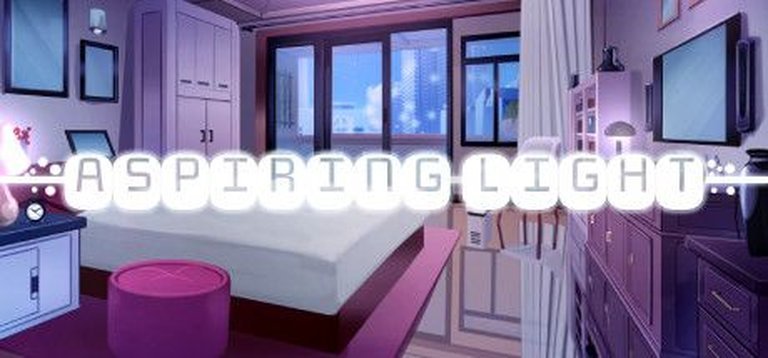
Description
Aspiring Light is a kinetic visual novel set in a world overshadowed by crime and corruption, focusing on the personal struggles and dreams of three high school students: Aiden, a shy boy who finds solace in stargazing; Kaira, his academically gifted but socially reserved best friend; and Damien, a senior masking his own problems. Through their mundane school lives in urban and rural settings, the story explores themes of escapism and hope, with player choices slightly altering dialogue but converging on a single ending, all framed by an anime-inspired art style and an estimated 3-4 hour playtime.
Aspiring Light Reviews & Reception
steamcommunity.com : “Aspiring Light” isn’t a game. It’s an e-book dumped on Steam masquerading as a game.
Aspiring Light: A Void Where a Game Should Be — A Historical and Critical Analysis
Introduction: The Ghost in the Machine
To review Aspiring Light is not to critique a game in the traditional sense, but to autopsy a haunting. It is the spectral presence of a game, an object that occupies database entries, storefront slots, and achievement lists yet possesses negligible substance, impact, or craft. Released on August 6, 2021, for Windows, Mac, and Linux, this “kinetic visual novel” by the solo developer JY_2000 serves as a perfect, almost providential, case study in the nadir of indie game development on Steam—a project so devoid of distinguishing features that it becomes a mirror reflecting the platform’s lowest barriers to entry and the most profound questions of what we even mean by “video game.” My thesis is this: Aspiring Light is historically significant not for what it is, but for what it represents—the logical endpoint of the “anyone can publish” ethos, where the artistic intent is so anemic and the execution so rudimentary that the work functions primarily as a cautionary tale about the inflation of the medium’s definition and the erosion of quality signals in a crowded marketplace.
Development History & Context: An Ambitious Timeline, a Minimalist Product
The studio behind Aspiring Light is, for all intents and purposes, JY_2000—a solitary figure credited with programming, script, and music. Supporting cast consisted of background artist Fuura Xen, sprite/CG artist Voyager289, and three beta testers. This is the definition of a micro-indie, or more accurately, a solo passion project.
The Creator’s Vision and Its Evolution: Developer blog posts on Steam (archived via tuxDB) reveal a protracted, four-year development cycle fraught with the classic indie pitfalls. The initial concept, admitted by JY_2000, was “subpar.” The project was conceived not from a burning narrative idea but from a vague desire: “let’s make a visual novel.” The development was explicitly slow, hampered by “personal and global scales” of hardship (a clear nod to the COVID-19 pandemic’s disruption). The timeline is a litany of delayed ambitions: a “hard deadline” of July/August 2021 was set in April 2021, after a previous, unstated 2020 target had long since evaporated. Progress updates show a developer wrestling with basic project management: by April 2021, background art was 97% complete, character art 100%, but the script was only 85% complete and the music a paltry 40% done. The coding, ironically, was 65% complete, waiting on the art and audio—the very components that would give the project any aesthetic coherence.
Technological Constraints and the Ren’Py Engine: The game was built with Ren’Py, the free, open-source engine that is the bedrock of the indie visual novel world. Its use here is telling. Ren’Py lowers the technical barrier to virtually zero; it requires no coding knowledge for basic functionality, handling text display, branching (minimal here), and image presentation through a declarative script. This democratization is a virtue for aspiring writers and artists, but in Aspiring Light, it results in a product that feels less like a “game” and more like a formatted document. There is no evidence of engine modification, custom UI, or innovative systems—just the vanilla Ren’Py experience, presenting a linear script with occasional sprite and background changes.
The 2021 Gaming Landscape: The game emerged in a post-pandemic indie boom, where Steam Direct’s $100 fee allowed a flood of projects onto the storefront. The visual novel genre was, and is, saturated with high-quality professional works (Steins;Gate, Fata Morgana) and a vast sea of amateur efforts. Aspiring Light landed squarely in the latter category, competing not on budget (it was free) but on discoverability. Its store page, as noted by the developer, was created early to “maximize visibility,” a common but risky practice that often leads to audience confusion when release dates slip. In this ecosystem, the game is functionally invisible, collecting a single “collected by” player on MobyGames.
Narrative & Thematic Deep Dive: The Emptiness at the Core
The synopsis, culled from the Steam store page and repeated across databases, is the sum total of the game’s narrative existence:
“The world is a messed up place… But none of this matters in our story. It’s all a blip on the radar to Aiden, who’s got his own problems to worry about. Things like…what the answer to that last math problem was. Dealing with pressuring parents, and trying to keep his friendships afloat before they drift apart forever… However, despite his struggles, he’s always found solace looking up to the skies. Dreaming of what was to come… But the stars just aren’t visible from the place he calls home. And they might not ever be.”
We are introduced to three archetypal protagonists:
* Aiden: The shy, reserved dreamer fixated on rocket launches and escaping his “harsh reality.” His core conflict is a classic adolescent yearning for meaning beyond his immediate, oppressive environment.
* Kaira: The academically excellent, food-loving best friend who “has trouble connecting with others.” A study in social competence versus emotional intimacy.
* Damien: The older student with a “seemingly ordinary life” and hidden problems. The classic “mysterious upperclassman” trope.
Analysis of Plot, Characters, and Dialogue: Here, the review must confront a void. The source material provides no actual script excerpts, no character dialogue samples, no analysis of scene construction, and no description of the plot’s events beyond the synopsis. We are asked to analyze a book whose pages are blank. The Steam community review, while vitriolic, is the only source attempting to describe the experience, characterizing the dialogue as “badly written” and “cringey high-school anime club dropout fanfiction.” This is a subjective, unprofessional assessment, but it is the only evaluative critique available. The VNDB entry classifies it with tags like “Male Protagonist” and “Linear Plot” but offers no deeper tags or user comments describing narrative merit.
Thematic Substance? The stated themes are clear: escapism vs. reality, adolescent anxiety, the death of dreams in a polluted/urban environment, and the search for connection. The “stars” metaphor is unsubtle. However, without textual evidence, one can only speculate on execution. Does the script explore these ideas with nuance, or does it merely name-drop them? The “kinetic” label—meaning a visual novel with no meaningful player choices, only “slightly change[ed] dialogue and minor events”—suggests a passively experienced mood piece rather than an interactive narrative. The player is a reader, not an agent. The profound risk of such a format is that without stellar prose, the entire enterprise collapses into tedium. Aspiring Light‘s historical significance in narrative terms is as a data point on the lower bound of what constitutes a complete visual novel story—a premise and archetypes without evident artistic execution.
Gameplay Mechanics & Systems: The Illusion of Interactivity
As a “kinetic visual novel,” Aspiring Light explicitly rejects traditional gameplay. The MobyGames specs list “Art: Anime / Manga” and “Gameplay: Visual novel” with an “Interface: Menu structures.” The Steam description confirms: “There are choices that will slightly change some dialogue and minor events, but they all lead to the same ending.”
Deconstruction:
* Core Loop: The loop is: Click/tap to advance text. Observe change in character sprite (if any) or background image. Repeat for 3-4 hours (estimated playtime). There is no failure state, no puzzle, no resource management, no stat tracking.
* “Innovative or Flawed Systems”: There are no systems to deconstruct. The “choices” are a facade, a minimalist echo of the branching narratives that define the visual novel genre’s interactive potential. This is not an innovation but a minimalist concession—acknowledging the player’s desire for agency while delivering a pre-ordained, author-controlled experience.
* UI: Presumably standard Ren’Py textbox, choice buttons, and save/load menus. No custom UI is indicated in credits.
* The Central Flaw: The “Game” Problem. The Steam review’s central charge—that this is “not a game”—is philosophically salient. It taps into a long-standing debate about the ludo-narrative spectrum. Aspiring Light sits at the extreme narrative end, with gameplay reduced to the mechanical act of turning a page. For a historical review, this positions the title as a stress-test for the medium’s boundaries. If Aspiring Light is a game, then the term is so broad as to be meaningless, encompassing any sequence of digital content requiring minimal user input. Its existence justifies the critical perspective that demands a “gameplay loop” for legitimacy.
World-Building, Art & Sound: The Aesthetic of the Minimal
This section must be built almost entirely from credits and user screenshots, as descriptive analysis is absent.
Setting & Atmosphere: The synopsis promises contrast: “explore the urban cities, relish in the lush fields, and laze around at home.” This suggests a deliberate juxtaposition of the oppressive urban (where stars aren’t visible) and the idyllic rural/natural (symbolizing hope and dreams). However, the atmosphere hinges entirely on the success of the art and music in conveying this dichotomy. With no screenshots described in text, we cannot assess if the “urban” is grimly rendered or just generic, if the “lush fields” feel like a escape or a cheap backdrop.
Visual Direction: Credits list:
* Background Art: Fuura Xen (credited on 2-3 other games per Moby).
* Sprites & CGs: Voyager289.
* Art Style: Tagged as “Anime / Manga.”
We are in the realm of the generic. The Steam screenshots (referenced but not viewable in text) show standard anime-styled character portraits against simple backgrounds. There is no indication of unique directorial vision, cinematic framing, or expressive animation. The art serves a functional, illustrative purpose. For a game whose theme is about the lack of visible beauty (stars obscured by city), the visual design’s generic quality is either a profound unintentional irony or a catastrophic failure of theme-art integration.
Sound Design: JY_2000 is credited for all music. The use of “SFX from various sources on freesound.org under the CC0 license” is a stark admission of minimal original audio work. The soundtrack, available separately for $3.99, is presumably a collection of composed tracks by the developer. Its quality and thematic resonance are complete unknowns. The reliance on Creative Commons SFX is standard for micro-indies but underscores the project’s do-it-yourself, zero-budget foundation.
Contribution to Experience: Without evidence of masterful art or a evocative score, the contribution is neutral-to-negative. The aesthetic likely functions as a perfunctory carrier for the text, failing to elevate the experience beyond a plain document. In a visual novel, art and music are not garnish; they are primary channels of emotional communication. Here, those channels appear underdeveloped.
Reception & Legacy: A Study in Invisibility and Polemic
Critical Reception: Non-existent. Metacritic shows “tbd” for both Metascore (no critic reviews) and User Score (needs 4 ratings). MobyGames has “n/a” for its Moby Score and is “Collected By” only 1 player. This is the sound of silence. No reputable outlet touched the game. It was, for all intents and purposes, ignored by the professional press.
Player Reception: A Bizarre Dichotomy. This is where the data becomes fascinating and contradictory.
1. The Polemic Negative: One Steam user review, “Not Recommended” with 4.3 hours logged, is a blistering, hyperbolically dismissive manifesto. It declares the game “not a game,” an “e-book,” and “weaponized cringe.” It attacks the writing, the use of Ren’Py, and the very premise of charging for such a product (though it’s free). This review, while unprofessional in tone, represents a hardline “ludological” perspective that rejects pure visual novels as games. Its intensity suggests a visceral negative reaction.
2. The Positive Mystery: Contradicting this is Steambase’s aggregated data, which cites a Player Score of 87/100 from 30 total reviews (26 positive, 4 negative). This is a “Positive” overall rating. Where did these positive reviews come from? They are not visible on the main Steam reviews page sorted by “Most Helpful (All Time),” which shows the negative review first and only two total reviews displayed. This suggests either: a) a surge of positive votes from a small, dedicated community (perhaps friends, family, or a niche audience that connected deeply with the specific vibe), b) review bombing/strategic voting to counter the negative, or c) a data aggregation quirk. The VNDB user ratings (6 votes, 6.00 average) are mediocre (ranked ~14,000), with one 2.5/10 and one 8/10, confirming a polarized, tiny sample.
Commercial Performance: It is free-to-play on Steam. Its “concurrent readers” peak is noted in the negative review as “only 5.” It is a commercial non-entity, generating no revenue (unless the $3.99 soundtrack sold a few copies). It exists in a space where commercial success is irrelevant.
Influence on the Industry: The Null Effect. Aspiring Light has zero discernible influence. It did not innovate mechanically. Its narrative did not spark discourse. It was not the subject of academic papers (the 1,000+ academic citations on MobyGames refer to the site itself, not this title). Its legacy is purely asymptotic—it represents a lower bound, a proof-of-concept for the bare minimum of effort required to publish something on Steam. It is a footnote in the story of Steam Direct’s democratization, cited by critics (like the Steam reviewer) as an example of the “flood” of low-quality content. It influences nothing because it adds nothing to the conversation; it merely occupies a point on the distribution curve of quality.
Conclusion: The Verdict on an Absence
Aspiring Light is not a good game, nor is it a bad game in any interesting, provocative way. It is a non-event. It is the sound of one hand clapping, the visual equivalent of a blank screen. Its only value is as an object lesson:
- As a Historical Artifact: It documents the absolute baseline of what the modern indie ecosystem permits. It required no publisher, no significant budget, no publicist, and garnered no attention. It is the digital equivalent of a mimeograph’d zine left on a coffee shop shelf.
- As a Theoretical Problem: It forces us to define our terms. If Aspiring Light is a “visual novel” and a “game,” then what is not? Does a work require a certain threshold of craft, originality, or mechanical engagement to earn the label? The passionate negative review says yes; the aggregated positive score suggests a small cohort of players found value in its simple, mood-driven text (even if that text’s quality is unverifiable by this critic).
- As a Tragicomic Tale: The developer’s earnest blog updates, charting the slow, difficult completion of a project with no evident flair, evoke a kind of pathos. This was a labor of love, however misapplied. The chasm between the developer’s hope (“I hope the general public finds it worthwhile”) and the product’s reception (near-total indifference or active disdain) is vast.
Final Verdict: Aspiring Light fails on every conventional metric of game criticism. Its narrative is known only by synopsis; its art and sound are anonymous; its gameplay is nonexistent; its reception is a riddle; its influence is zero. Yet, its very nullity grants it a perverse historical importance. It is the canary in the coal mine of digital distribution, a stark reminder that accessibility without curation breeds invisibility. It earns a rating not as a game, but as a cultural specimen: 2/10 – A Hollow Shell. It is less a failed game and more a proof of concept for nothing, a silent testament to the fact that in the age of infinite shelves, most things—even things made with sincere effort—do not matter at all. It will be forgotten, and that is precisely its only lesson.