
- Release Year: 2006
- Platforms: Windows
- Publisher: ValuSoft, Inc.
- Developer: Dragonfly Game Design, LLC, ImaginEngine Corp.
- Genre: Puzzle, Strategy, Tactics
- Game Mode: Hotseat, LAN, Single-player
- Gameplay: Board game, Word construction
Description
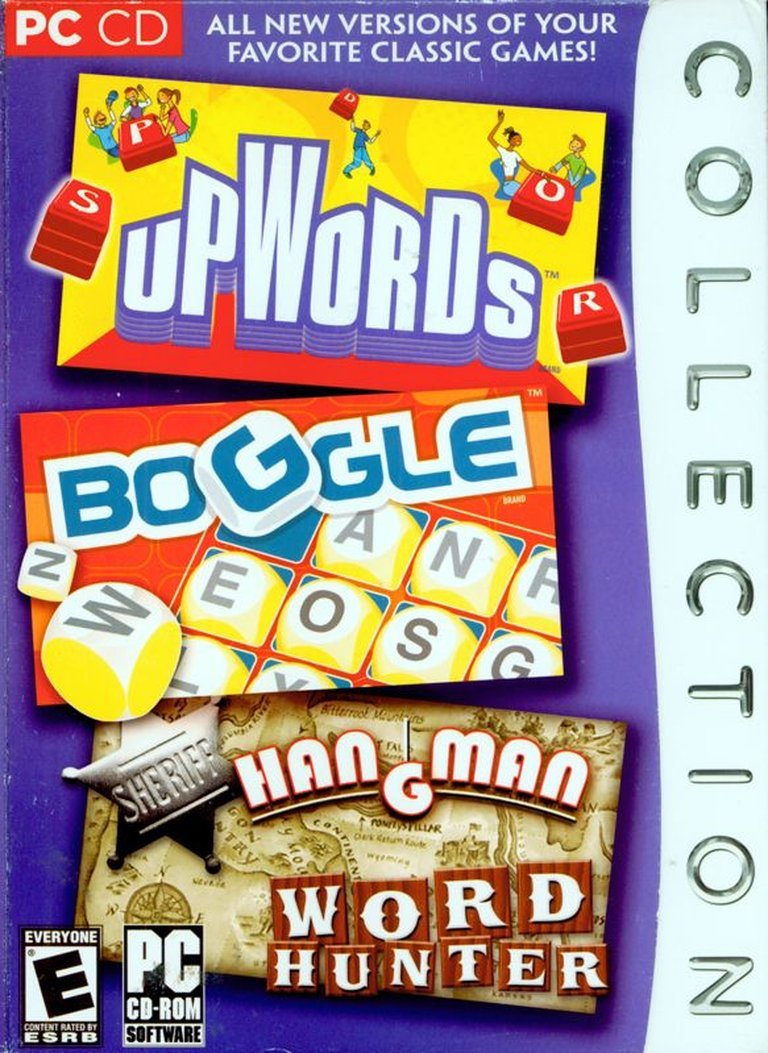
UpWords, Boggle, Hangman & Word Hunter Collection is a 2006 Windows compilation that bundles four word-based puzzles: the licensed Hasbro games UpWords and Boggle, alongside the original Hangman and Word Hunter. Players engage in diverse wordplay, from stacking tiles to form words in UpWords and finding adjacent letters in timed Boggle grids, to guessing mystery words in Hangman and unscrambling letters in Word Hunter. The collection supports multiple modes, including single-player, challenge, hotseat, and LAN multiplayer, catering to both puzzle and strategy enthusiasts.
Gameplay Videos
UpWords, Boggle, Hangman & Word Hunter Collection Reviews & Reception
retro-replay.com : this bundle delivers endless hours of vocabulary-fueled fun.
UpWords, Boggle, Hangman & Word Hunter Collection: Review
Introduction: The Lexicon of a Bygone Casual Era
In the mid-2000s, the digital adaptation of board games and classic puzzles underwent a peculiar renaissance. Fueled by the explosion of “casual gaming” on PC and the nascent mobile space, publishers aggressively mined the intellectual property vaults of companies like Hasbro and Mattel, translating tabletop staples into cheap, often disposable, CD-ROM compilations. It is within this landscape—a period of frantic bundling and low developmental ambition—that ValuSoft’s UpWords, Boggle, Hangman & Word Hunter Collection emerges as a quintessential artifact. Released in December 2006 for Windows, this compilation gathers two officially licensed Hasbro properties (UpWords and Boggle) with two generic, internally-developed word games (Hangman and Word Hunter). Its thesis is not one of innovation, but of utility: offering a suite of time-tested verbal diversions under one affordable, if forgettable, digital roof. This review posits that the collection’s historical value lies not in its execution, but in its role as a commercial and design footnote—a perfect specimen of the late-2000s “shovelware” strategy targeted at budget-conscious families and the technologically uninitiated.
Development History & Context: The ValuSoft Model
The development history of this collection is a story of efficiency over artistry. The project was a collaboration between Dragonfly Game Design, LLC and ImaginEngine Corp., studios known for pragmatic contract work rather than signature titles. For ValuSoft, a publisher specializing in budget software and compilations, the business model was clear: acquire inexpensive licenses (Hasbro’s UpWords and Boggle), supplement them with in-house, rules-accurate clones of evergreen concepts like Hangman, and package them into a single product with minimal overhead.
The technological constraints were nominally those of mid-2000s Windows (XP/Vista), but the design philosophy was one of extreme conservatism. The games are presented in a unified, simple 2D interface likely built with a straightforward game engine or even a Rapid Application Development tool. The use of Bink Video middleware (noted in MobyGroups) suggests pre-rendered intro sequences or perhaps help videos, but the core gameplay is purely 2D sprite/tile-based—a conscious choice to ensure compatibility with even the most modest integrated graphics of the era. This was not a product pushing boundaries; it was a product designed to run on anything with a CD-ROM drive and a mouse.
The gaming landscape of late 2006 is critical context. This was the year The Elder Scrolls V: Skyrim was announced, but also the height of the “Big Brain Academy” and “Brain Age” casual cognitive training fad. publishers saw massive, untapped demand in the “mom and grandparent” demographic for simple, recognizable, and non-threatening software. Hasbro’s board games were perceived as safe, trusted brands. A compilation like this, sold in big-box stores and through mail-order catalogs (as eBay listings from 2007 show), targeted consumers who might walk into a store looking for “a word game for the computer” and recognize the Boggle box. Its lack of critical attention—zero critic reviews on MobyGames as of 2025—speaks volumes about its place in the industry: a commodity, not a creative endeavor.
Narrative & Thematic Deep Dive: The Absence of Story and the Narrative of Utility
As a compilation of pure puzzle games, UpWords, Boggle, Hangman & Word Hunter Collection possesses zero traditional narrative, characters, or dialogue. There are no cutscenes, no protagonists, no fictional worlds to explore. This absence is, in itself, a significant thematic statement about its design philosophy. These are not games about immersion; they are tools for mental exercise, digital versions of a pencil-and-paper pastime.
The “story” is entirely emergent and player-driven. In UpWords, the narrative is one of architectural construction and territorial conflict on a 10×10 grid. Each layered tile tells a story of blocking an opponent’s potential 3-letter “AT” to build “TANG” vertically over it, or of a risky, late-game play to stack three tiles high and convert a simple “IN” into “BINGO.” The board becomes a palimpsest of linguistic history.
Boggle’s narrative is one of frantic discovery and difference. Each 4×4 shake of the virtual dice creates a new micro-world of letters. The player’s story is the hunt for the long, obscure word (“QUARTZ”) that earns massive points, juxtaposed against the simple, safe words (“THE”, “AND”) that guarantee a baseline score. The end-of-round comparison creates a social narrative of triumph and frustration: “I found ‘SYZYGY’!” vs. “We both had ‘CAT’?”
Hangman is pure, distilled suspense theatre. The stick figure’s slow construction is a narrative of approaching doom, with each guessed consonant or vowel a plot point. The mystery word is the unseen antagonist. The theme is one of deduction under pressure, a silent dialogue between the guesser and the lexicon.
Word Hunter (the most generic title) frames its challenge as an archaeological dig. A scrambled set of letters (e.g., “SILENT”) is a site to be excavated. The player’s narrative is the methodical uncovering of all hidden terms (“SILENT”, “LISTEN”, “INLET”, “TILES”, etc.), a race against a theoretical “perfect list.”
The overarching theme binding all four is the democratization of language as play. It strips words of their communicative purpose and reduces them to raw material—scoring units, puzzle pieces, or graphical blocks. It reflects a very specific, utilitarian view of literacy valued in certain educational and casual gaming contexts: vocabulary breadth and speed are paramount, not nuance or meaning.
Gameplay Mechanics & Systems: Functional Fidelity
The collection’s success hinges on the accurate digital translation of its source material’s rulesets, which it achieves with workmanlike precision.
1. UpWords: The core innovation is the vertical stacking mechanic. Tiles can be placed on top of existing tiles, but the entire word formed (both horizontally and vertically) must be valid at the moment of placement. This creates a deep, spatial-strategic layer absent from Scrabble. A key rule—a tile placed on a 2-letter word must be part of making that word at least 3-letters long—is implicitly enforced by the game’s validation system. The scoring (points per tile, with bonuses for words using a red ‘S’ tile in some versions) is straightforward. The “Challenge Mode” likely imposes stricter time limits or AI opponents with higher scoring thresholds. The UI is functional: a clear grid, a tile rack, and clear highlighting for valid/invalid placements. Its flaw is a lack of visual flair; stacked tiles are merely offset, with no perspective or shadow to clearly indicate a third layer, which can lead to misreads inheated play.
2. Boggle: The digital adaptation faithfully simulates the shake-and-search ritual. The 16 dice (with “Qu” as a single face) are rendered, shaken visually (via a simple animation), and settled into a grid. The player clicks or drags to form words with adjacent (including diagonal) letters. The timer is the primary antagonist. The most critical system is the word validation and de-duplication at round’s end. The game’s dictionary must be sizable enough to accept common plurals, verb tenses, and proper nouns (a perennial Boggle debate). The “Challenge Mode” presumably shortens the timer or eliminates the “same word different path” scoring rule. The innovation here is the digital “trace” feature, where your cursor path lights up, providing essential visual feedback impossible on physical cubes.
3. Hangman: This is the most archetypal and unaltered translation. The player guesses letters; correct ones fill in blanks; incorrect ones draw the classic 6-part stick figure (head, body, left arm, right arm, left leg, right leg). The word dictionary is paramount—it should include both common phrases and single words. The tension is purely systemic. There is no “Challenge Mode” complexity beyond perhaps limiting guesses to 5 parts or disabling the “vowels must be guessed first” common rule.
4. Word Hunter: This is essentially a timed anagram generator. Given a set of 7-10 scrambled letters, the player must form as many valid words as possible (of 3+ letters) from that set. The game’s system must validate submissions against a dictionary and track unique words found. The challenge lies in combinatorial thinking—finding the anagram root and then permuting it into all possible sub-words. This mode is the most cerebral and solitary. Its “Challenge Mode” likely adds a scoring timer or a “find all words” puzzle structure.
Multiplayer & Systems: The collection’s primary systemic value is in its multiplayer architecture. All four games support:
* Single Player: Against a basic AI (likely with selectable difficulties) or against a “puzzle” (pre-set boards for UpWords, pre-defined word lists for Hangman/Word Hunter).
* Challenge Mode: Presumably a series of escalating puzzles or time trials.
* Hotseat: Multiple players using one keyboard/mouse, passing the device. This is classic budget PC multiplayer.
* LAN: The most sophisticated feature, allowing 2-4 players over a local network. This was a relatively premium feature for a budget compilation in 2006, leveraging the common home network setup of the era (Windows XP networking wizard). It fixes the hotseat’s physical limitation and allows for private, networked game nights.
The UI/UX is consistent across all four: a main menu launcher with four icons, leading to each game’s options screen. The flawed system is a lack of online play. By 2006, Xbox Live and Steam were thriving, but this budget title was confined to the LAN, missing the broader social wave. Its innovative system is simply its bundling philosophy: a single install, unified interface, and consistent control scheme across four distinct puzzle genres, lowering the barrier to entry for a family.
World-Building, Art & Sound: Aesthetic of Efficiency
The art and sound design are deliberately generic and functional, serving the puzzles without distraction.
-
Visual Direction: The aesthetic is “Generic Late-2000s Casual.” Dark blue or grey menu backgrounds with bright, primary-colored buttons. Each game board is a clean, high-contrast 2D plane.
- UpWords: Tiles are flat colors with white letters. Stacking is shown by a slight horizontal offset and a subtle border highlight. The board grid is clear.
- Boggle: The dice are rendered with a fake 3D effect (simple bevels and shading), with each face a clear letter. When a word is traced, the path lights up in a bright color, which is crucial feedback.
- Hangman: The quintessential minimalist stick figure, drawn in black on a beige/white background as each wrong guess occurs. It’s timelessly effective.
- Word Hunter: Scrambled letters sit in circular “slots.” When selected, they animate with a small pop or movement into a word-building area at the bottom.
The unifying element is the consistent font, button style, and color palette across all titles, creating a cohesive “package” feel. There is no thematic world-building—these are abstract puzzles.
-
Sound Design: The audio is equally sparse and utilitarian.
- UI Sounds: Crisp, electronic beeps for menu selection.
- Gameplay Feedback: A positive, ascending chime or ding for a correct action (valid word, correct letter). A negative, descending buzz for an invalid move, wrong guess, or time-up. These sounds are clear, non-intrusive, and provide immediate auditory feedback.
- Ambiance: There is no background music during gameplay, only the timer’s subtle (or sometimes urgent) ticking in Boggle and Word Hunter. This silence forces focus on the mental task. The only musical element is likely a short, cheerful title screen jingle.
- The sound design’s contribution is to not contribute. It avoids being a distraction, which is the perfect approach for a concentration-heavy puzzle compilation.
Reception & Legacy: The Epitome of the Silent Shovelware
Upon its December 2006 release, UpWords, Boggle, Hangman & Word Hunter Collection existed in a critical and commercial blind spot.
-
Critical Reception: There is no record of professional critic reviews. It was ignored by mainstream gaming press (IGN, GameSpot) and likely relegated to brief, dismissive mentions in “budget game” roundups, if reviewed at all. Its MobyGames score is “n/a” despite being collected by a handful of enthusiasts. The user reviews on the few retail sites (eBay, Amazon) are non-existent or reflect confused buyers (“Is this the same as Boggle Deluxe?”). This silence is its review: it was perceived as a commodity, not a game.
-
Commercial Performance: It was a budget title, sold at a low price point (retailing for ~$19.99). Its continued presence on eBay, often listed for $5-$20 used and occasionally at exorbitant “new” prices ($199), suggests limited print runs and low sell-through, but also a long, slow tail of availability through discount bins and software liquidators. Its status as abandonware (available on MyAbandonware and the Internet Archive) confirms its commercial obsolescence and the rights holder’s disinterest in digital distribution.
-
Evolving Reputation & Legacy: The collection’s reputation has not evolved; it has stagnated. It is not remembered as a great adaptation, nor as a disastrous one. It is simply there—a functional artifact. Its legacy is triple:
- As a Historical Document: It represents the peak of the early-2000s “game compilation” model applied to licensed board games. It’s a direct ancestor to the无数 “Hasbro Family Game Night” bundles that would follow, though those often had more polish and console support.
- As a Preservation Artifact: For purists, it provides a digital snapshot of how UpWords and Boggle were presented on PC in the mid-2000s—the interface, the AI (if any), the specific dictionary used. It’s a piece of software archaeology.
- As a Cautionary Tale: It demonstrates the limits of the “license + clone” model. Merely having the rights to a great board game does not guarantee a great digital product. Execution, innovation, and platform integration matter. The collection offers no reason to exist over playing the physical games or using modern, superior digital alternatives (like Boggle on mobile with online leaderboards).
It had no discernible influence on the industry. It did not pioneer new mechanics. It did not revive a genre. It was a product of, and contributor to, the stigma that “digital board games” were cheap, low-effort cash grabs—a stigma that titles like Catan Universe, Tabletop Simulator, and Carcassonne on mobile/Steam have only slowly begun to erode.
Conclusion: The Thesaurus of Budget Gaming
UpWords, Boggle, Hangman & Word Hunter Collection is not a game to be evaluated by the standards of The Legend of Zelda or Half-Life 2. It is a utilitarian tool, a retail shelf-filler, and a faint echo of the cultural capital of its licensed board game progenitors. Its execution is competent but sterile, its presentation dated but functional, its value proposition purely combinatorial (“four games for the price of one”).
Its definitive place in video game history is as a marginalia—a footnote in the story of casual gaming’s commercialization. It exemplifies a strategy where brand recognition was leveraged with minimal creative investment, targeting an audience presumed to value familiarity over feature depth. It is the gaming equivalent of a generic “Classic Puzzles” CD-ROM sold at a drugstore checkout.
For the historian, it is useful data: a confirmatory data point showing how Hasbro’s licensing was handled in the pre-app-store era. For the enthusiast, it is a mildly nostalgic curiosity, perhaps worth a single download from an archive for 20 minutes of honest UpWords on a PC. For the general player, it is entirely skipable. Its only lasting merit is its abandonware status, which allows it to serve as a free, if passionless, portal to four of the most enduring verbal puzzles ever conceived—proof that even the most generic digital vessel cannot fully contain the timeless appeal of a good word game.
Final Verdict: 4/10 – A functional but lifeless compilation that succeeds only in its basic task of rule fidelity, failing entirely to capture the social spirit or tactile joy of its physical inspirations. Recommended only for archival purposes or absolute novelty.