
- Release Year: 2017
- Platforms: Windows
- Publisher: SurrealVR, Inc.
- Developer: SurrealVR, Inc.
- Genre: Action, Simulation
- Perspective: 1st-person
- Gameplay: Arcade
- Setting: Futuristic, Sci-fi
Description
Drone Fighters is a virtual reality action-simulation game set in a futuristic sci-fi world where players pilot customizable weaponized drones in high-stakes cage fights across exotic arenas. Inspired by a Highlander-like premise, it challenges users to battle adaptive AI or global human opponents, demanding precise hand-eye coordination and strategic combat in a VR-first design with cross-platform multiplayer and deep customization options.
Where to Buy Drone Fighters
PC
Drone Fighters Guides & Walkthroughs
Drone Fighters: A Pioneering but Flawed Foray into VR Drone Combat
Introduction: The Sky’s Not the Limit, But the HUD Is
In the nascent era of consumer virtual reality (2016-2017), developers were captivated by the medium’s potential to revolutionize genres, from horror to simulation. Amidst this gold rush of “VR-first” experiments, SurrealVR, Inc. (also operating as Surreal Games) released Drone Fighters into Steam Early Access on April 21, 2017. The game arrived with a bold proposition: an arcade-style, competitive drone combat simulator built from the ground up for VR, promising the adrenaline of a fighter jet dogfight with the tactile immediacy of piloting a remote-controlled quadcopter. Its official Steam description invoked the iconic “there can be only one” ethos of Highlander, transposed onto weaponized drones in futuristic arenas. However, a deep dive into its development, mechanics, and reception reveals Drone Fighters not as a landmark title, but as a fascinating, if ultimately limited, case study in the growing pains of VR game design. It is a game that ambitiously tackled the core challenges of VR interaction—motion sickness, control mapping, and accessibility—only to become a cautionary tale about niche appeal, development stagnation, and the perilous economics of early-stage VR. This review will argue that Drone Fighters is historically significant primarily as a technological prototype and a lesson in the gulf between VR’s potential and its practical execution for mainstream audiences, rather than as a polished or influential game in its own right.
Development History & Context: Building in the VR Wild West
Drone Fighters was the brainchild of SurrealVR, Inc., a small independent studio led by figures like Lead Developer Arthur Goikhman and Lead Designer Orchun Koroglu. The project benefited from the creative and UX consultancy of Brian Favia, whose post-mortem provides the most granular view of the development process. The team’s stated mission was clear: create a cross-platform (HTC Vive and Oculus Rift) multiplayer e-sports candidate that leveraged VR’s unique capabilities without inducing discomfort.
The technological and design context of 2017 was defined by two major constraints:
1. The Motion Sickness Epidemic: A primary concern for any VR title was user comfort. As Favia details, the team’s solution was to anchor the player’s avatar and camera to a fixed ground position. This eliminated forward locomotion, a notorious trigger for simulator sickness, but also fundamentally shaped the game’s perspective and gameplay. Players experienced the battle as a stationary “operator” remotely controlling a drone, rather than as a pilot in the cockpit.
2. The Control Scheme Conundrum: Mapping flight controls (pitch, yaw, roll) and weapon systems onto the novel, motion-tracked controllers of the Vive wands or Oculus Touch was a monumental UX challenge. Favia’s account reveals a tumultuous design process. The initial “Arcade” mode used the left controller’s gyroscope for pitch and roll, and directional buttons for yaw. Playtesting exposed significant flaws: testers (especially those with traditional gaming muscle memory) intuitively expected the left/right buttons to control pitch, not yaw. Furthermore, the input for roll (bending the elbow) was imprecise and uncomfortable.
This empirical testing led to a pivotal, player-centric decision: the developers eventually implemented three distinct control schemes to cater to different preferences:
* Arcade Mode: The original gyroscopic approach.
* Mix Mode: A compromise, using directional buttons for pitch and the gyro for roll (Favia’s recommended solution).
* Drone RC Mode: A more simulation-oriented setup attempting to mimic a physical drone controller’s stick layout.
This willingness to iterate based on user feedback was a strength of the Early Access model they embraced. The developers explicitly stated their goal was to build a “community driven” title, planning features like spectator mode and team tournaments based on player wishlists.
However, this grassroots development occurred against the backdrop of a saturated VR launch window and a market still determining viable genres. Drone Fighters entered a space with few direct competitors but also a tiny installed base of VR headset owners, limiting its potential audience from day one.
Narrative & Thematic Deep Dive: The Illusion of Story in a Pure Mechanics Game
A critical analysis of Drone Fighters must confront its almost complete absence of traditional narrative. The Steam store blurb provides the sole narrative framework: a “Highlander” scenario where “there can only be one top Drone Fighter.” It mentions clashing with a “murderous AI that learns your moves” and battling in “exotic locales.” Yet, the game itself offers no characters, no dialogue, no plot, and no contextualization for its arenas. The “AI” is not a character with motives (unlike the nuanced, lore-rich Z.O.E. (Zone of the Endless) AI from the Ace Combat series, which fans passionately analyze); it is merely a gameplay descriptor for solo challenge modes—opponent drones that supposedly adapt to the player’s tactics.
The themes present are therefore entirely mechanical and experiential:
* Mastery and Expertise: The core loop is a relentless practice regimen. The blurb’s mantra—”Learn, master and show off your skills. Practice, practice, practice…”—is the game’s entire thematic spine. It celebrates the visceral satisfaction of hand-eye coordination and calm under pressure in a high-stakes virtual environment.
* The Operator, Not the Pilot: The fixed-camera perspective reinforces a theme of remoteness and abstraction. You are not a daring ace; you are a technician, a gamer controlling a tool. This aligns with the real-world rise of drone warfare but presents it in a sanitized, sportified arcade context.
* Community and Competition: The integration with the SurrealVR Social App and emphasis on cross-platform voice chat point to a theme of global, connected competition, aspiring to the communal spirit of e-sports.
In essence, Drone Fighters is a thesis on pure gameplay. Its “story” is written not in scripts but in player skill progression, the layout of its 18 solo arenas, and the statistical balance of its weapon and drone loadouts. This isn’t a flaw per se for an arcade title, but it does relegate the game to a specific niche: those seeking a mechanically deep, narratively neutral VR sport.
Gameplay Mechanics & Systems: A Triumph of Iteration, a Prison of Potential
This is where Drone Fighters invests all its design capital. The core gameplay is a 1v1 drone duel (or, with the Arena expansion, multi-player free-for-all/team deathmatch) in enclosed, futuristic arenas. The objective is simple: destroy the opponent’s drone before time expires or your own is destroyed.
- Core Loop & Progression: Players begin with basic drones and weapons. Through playing 18 solo “games” (essentially challenge modes across different arena layouts), they unlock new drone frames, weapon types, and cosmetic skins (including camouflage and sci-fi themes like Battlestar Galactica-inspired designs, per Favia). Customization is persistent, allowing players to tailor loadouts for versus play. This creates a basic but effective grind-loop: practice in solo mode to earn tools, then test them against human opponents.
- The Control Schemes (Deconstructed): As detailed, the three control modes are the game’s most significant innovation and its greatest barrier to entry.
- Arcade (Gyro): Offers the most immersive, “natural” feeling of gestural flight but has a steep learning curve and inconsistent input due to individual physiology.
- Mix (Button Pitch, Gyro Roll): A pragmatic middle ground, widely considered the most accessible.
- Drone RC (Button-Based): The most precise and traditional for simulator fans, but least immersive.
The necessity to even choose a scheme underscores the unresolved question of VR’s “native” control language for flight games.
- Combat & Systems: Combat is fast-paced and physics-based. Weapons include projectiles (likely laser-like beams and rockets) with travel time and collision. The “murderous AI” in solo mode is less about true machine learning and more about scripted, aggressive enemy patterns that may feel adaptive. A notable, unfulfilled promise in the blurb is an AI that “learns your moves as you go”—this appears to be aspirational marketing rather than a implemented system.
- UI & VR Presentation: Following Favia’s design philosophy, the UI is diegetic and anchored. Drone status (health, weapon charge) is likely displayed on a virtual wrist-mounted panel or within the environment to avoid breaking the grounded perspective. This is smart VR design but limits information density.
- Flaws & Unfinished Promise: The game, even post-Arena expansion, felt sparse. The original Early Access version had only 4 arenas and 4 drones. Plans for “live team tournaments” and “co-op solo missions” never materialized, as the last major update was over eight years ago. The game remains a fascinating snapshot of a stalled Early Access project, with its ambitious roadmap frozen in time.
World-Building, Art & Sound: Gritty Neon and the Silence of Space
Drone Fighters eschews a rich narrative world for thematic, aesthetic world-building. Its setting is the “futuristic arena”—a series of “exotic locales” and “cage fights” in a sci-fi dystopia. The environments, while limited, use Unity’s capabilities to create sterile, neon-lit industrial complexes, night-city rooftops, and crystalline geodesic domes. The atmosphere is one of cold, high-tech combat sport, devoid of life or civilian presence.
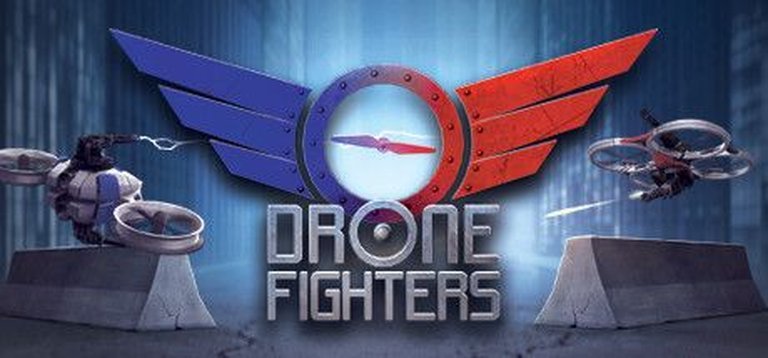
- Visual Direction & 3D Art: Brian Favia’s contributions define the game’s visual identity. The logo, inspired by pilot wing insignias and featuring a quadcopter propeller ring in brushed steel with split blue/red lighting, perfectly encapsulates the blend of military aesthetic and sport. The drone skins move beyond simple camouflage into clear sci-fi homages (Battlestar Galactica, Portal), giving players a sense of stylistic ownership. The avatar customization system (via the SurrealVR Customization System) allows for detailed humanoid models, but they are seen only from a third-person “spectator” view when your drone is destroyed or in the pre-fight lobby, reinforcing the operator perspective.
- Sound Design: Available sources are silent on specifics, but VR audio typically prioritizes spatialization and diegetic sounds—the hum of your drone’s motors, weapon firing and impact sounds within the 3D space, and environmental echoes in the arenas. The lack of a musical score or narrative voice would be consistent with its pure-sport ethos. Sound’s primary function is tactical feedback and immersion in the physical space of the arena.
- Cohesion: The art and sound work in service of a single, clear fantasy: being a skilled remote operator in a global, sterile VR league. The grit of the textures contrasts with the vibrant neon of the arenas, creating a visual tension between the “real” operator and the “virtual” arena. It’s a cohesive, if limited, aesthetic that prioritizes clarity of gameplay (identifying enemies, projectiles) over narrative depth.
Reception & Legacy: A Niche Positive, a Historical Curiosity
Drone Fighters exists in a strange reception limbo.
* Critical Reception: There is no aggregate critic score on Metacritic, and MobyGames notes “n/a” for its Moby Score and that it’s “Collected By” only 1 player. This indicates it was virtually ignored by the professional press.
* Player Reception: On Steam, it boasts a “Overwhelmingly Positive” (100%) rating from 15 reviews. This tiny sample size is a red flag for a game with 540 owners (per Raijin.gg data). The positive reviews likely come from the small core of VR enthusiasts who found the control scheme worked for them and enjoyed the tight 1v1 gameplay. Common Steam comments from the era (found in community hubs) praise the fun but frequently cite the steep control learning curve and request features like controller vibration (which was absent).
* Commercial Performance: Sales are modest. Raijin.gg estimates ~540 units sold with approximately $6,366 in gross revenue—pocket change for a studio. Its wishlist count (~2.2K) suggests a small, curious audience but minimal conversion.
* Legacy and Influence: Drone Fighters has no direct, documented influence on major titles. It is not cited as an inspiration by larger studios. Its legacy is twofold:
1. A Technological Prototype: It stands as an early, public experiment in solving VR flight controls. Its three-mode approach is a direct response to the “VR control problem” and can be studied by designers. Its fixed-operator perspective is a clear alternative to cockpit sims like Elite Dangerous.
2. A Cautionary Early Access Tale: Its development stalled, with promised features (spectator mode, co-op) abandoned. It exemplifies the risk of VR niche markets: building a complex, control-intensive game for an audience too small to sustain long-term development. Later drone combat games (Drone Gladiator, Drone Striker) seem to have learned this lesson, often offering more traditional (non-VR) control schemes or broader gameplay modes.
It is a forgotten footnote, but a perfectly preserved one, in the archaeology of VR’s “wild west” period.
Conclusion: The Top Drone Fighter That Never Was
Drone Fighters is not a lost classic. It is not a flawed masterpiece. It is a curious and technically interesting artifact from a moment of profound experimentation. Its historical value lies almost exclusively in its documents of design iteration (via Brian Favia’s blog) and its embodiment of the early VR community’s struggles: how to build engaging, comfortable, and accessible games for a new medium with no established conventions.
The game successfully created a functional, enjoyable 1v1 VR combat experience with a deep customization system and a commendable commitment to multiple control schemes. However, its minimalist narrative, limited content, stalled development, and extreme niche appeal prevented it from achieving the “e-sports candidate” status its developers envisioned. It remains a game for a specific kind of player: the VR enthusiast who enjoys mastering intricate control schemes in a vacuum.
In the grand history of gaming, Drone Fighters is a singleplayer’s note in a symphony of VR evolution. It proves that pioneering a solid mechanical idea is not enough; a game requires a sustainable ecosystem of content, community, and commercial viability to truly fly. For the historian, it is an essential case study. For the player, it is a fascinating but ultimately empty arena, waiting for a crowd that never arrived. Its final verdict is one of respectful observation: a brave, flawed, and now quiet testament to the difficult birth of virtual reality gaming.
Final Score (Historical Assessment): 6.5/10 – A technically adept but narrowly focused prototype whose legacy is in its lessons, not its play.