
- Release Year: 1984
- Platforms: FM-7, PC-6001, PC-88, PC-98, Sharp MZ-2000, Sharp MZ-2500, Sharp MZ-80B, Sharp X1, Windows
- Publisher: Micro Cabin Corp.
- Developer: Arrow Soft
- Genre: Adventure
- Perspective: 3rd-person
- Game Mode: Single-player
- Gameplay: Interactive fiction, Text adventure
- Setting: Forest
Description
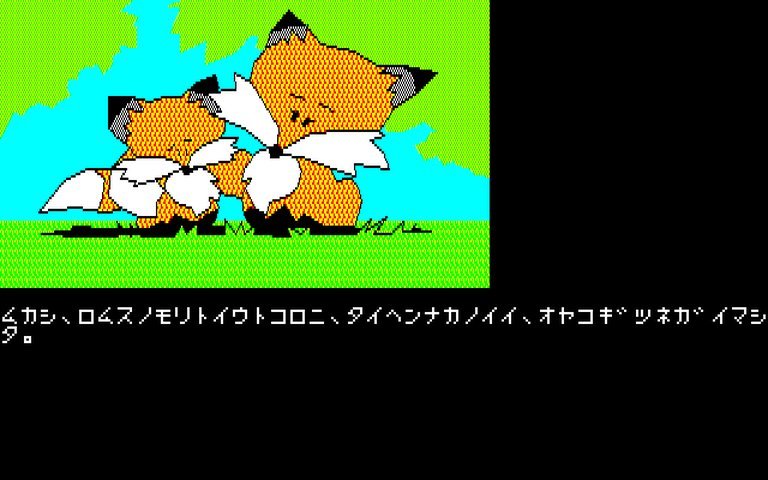
Hurry Fox is an interactive fiction adventure set in Romulus Forest, where a mother fox embarks on a journey to cure her cub’s rare Romulus disease by finding a shrine that serves abura-age (deep-fried tofu). Inspired by classics like Mystery House, players use a text parser with katakana commands to navigate, accompanied by simple static anime-style illustrations.
Gameplay Videos
Hurry Fox Reviews & Reception
hardcoregaming101.net : an adorable classic
Hurry Fox: Review
Introduction: A Digital Time Capsule from Japan’s Formative Years
In the vast, often-overlooked archives of 1980s Japanese computing, certain titles exist not merely as games but as cultural artifacts—shards of a creative energy that exploded across the NEC PC-8801, Sharp X1, and FM-7 platforms. Hurry Fox (は~りぃふぉっくす, Hurry Fox), released on December 10, 1984, by Micro Cabin and developed by Arrow Soft, is one such artifact. It is a game that simultaneously looks backward to its Western textual roots and forward toward the visual novel, a charming yet flawed hybrid that captures a pivotal moment when Japanese developers were absorbing, adapting, and ultimately transforming the global adventure game lexicon. This review posits that Hurry Fox’s true significance lies not in its mechanical innovation alone, but in its role as a transitional bridge: a text parser adventure wrapped in an anime aesthetic that foregrounds emotional narrative and character in a way that would become a hallmark of later Japanese game design, even as it remains stubbornly, endearingly tethered to the trial-and-death ethos of its predecessors.
Development History & Context: From Plagiarism to Paternalistic Charm
To understand Hurry Fox, one must first understand its publisher, Micro Cabin, a studio emblematic of the scrappy, contest-driven Japanese PC game industry of the early 1980s. As chronicled by Hardcore Gaming 101, Micro Cabin’s initial forays were inauspicious. Their first adventure title was an unabashed clone of Mystery House (1980), even appropriating its name before Mystery House’s official Japanese localization. Their second effort, Dreamland, was a marginally more original parody of the Disneyland logo. This was an era of rapid iteration and, often, direct mimicry—a pragmatic response to a hungry market with few domestic precedents.
Hurry Fox represents a conscious pivot from this derivative phase. Following the common practice of “public recruitment contests” (kōkai yōshi) where publishers solicited game proposals from the public, Micro Cabin greenlit a project that would break from mere copycatting. Developed by Arrow Soft—a team credited as Isao Harada, Hisashi Gokyu, and Kazuhiko Ito, with a story by Toshio Urata and graphics by Masashi Katō—the game was built for the dominant NEC PC-8801 series and swiftly ported to the PC-6001, PC-9801, Sharp X1, Sharp MZ-80B/2000/2500, and FM-7 between 1984 and 1986. This multi-platform release strategy underscores the title’s commercial ambition within the fragmented but vibrant Japanese computer ecosystem.
Technologically, the game operated under significant constraints. The 8-bit era’s limited memory and color palettes meant that large, detailed illustrations had to be stored efficiently, likely using a combination of simple graphic blocks and a minimal, carefully chosen color set. The text parser itself, requiring input in katakana (the phonetic Japanese script), was a direct adaptation of Western interactive fiction systems but localized for Japanese typing. The decision to move the player character via arrow keys, rather than parsing directional commands (e.g., “go north”), was a critical innovation—one that catered to the physical layout of Japanese keyboards and reduced the burden of typing for what was fundamentally a navigation-heavy experience.
In the broader gaming landscape, 1984 was a watershed. In the West, Infocom’s sophisticated Z-machine and the rise of graphical adventures like King’s Quest were redefining expectations. In Japan, Enix’s Dragon Quest (1986) was still on the horizon, and the adventure genre was dominated by text-heavy, often difficult parser games. Hurry Fox entered this arena not as a technical powerhouse, but as a title with a distinct emotional and aesthetic identity, aiming to stand out through its cute (kawaii) presentation and simple, heartfelt premise.
Narrative & Thematic Deep Dive: Maternal Love, Folklore, and a Subversive Cure
At its core, Hurry Fox is a故事 of profound maternal devotion. The narrative, penned by Toshio Urata, is deceptively simple: a mother fox and her kit live idyllically in Romulus Forest until the child contracts the mysterious “Romulus disease.” The mother, embodying desperation and hope, recalls an old legend: the disease can be cured by travelling to a distant shrine and consuming the abura-age (deep-fried tofu) found there. Her quest is thus framed as a mythic pilgrimage, a journey from the natural world of the forest into the enigmatic realm of humans.
This plot structure is deeply informed by Japanese folklore (monogatari). The fox (kitsune) is a shapeshifting yōkai in traditional tales, and the game mechanizes this by granting the protagonist the ability to change forms—a direct nod to her supernatural heritage. The journey itself follows a classic “heroine’s journey” archetype: departure (leaving the forest), trials (talking to forest animals, navigating hazards), approach (entering human settlements), and the ultimate revelation. The theme of transformation operates on multiple levels: the literal shapeshifting, the mother’s psychological shift from peaceful forager to determined warrior, and the narrative’s subversion of the “magical cure” trope.
The game’s genius, and its most poignant thematic twist, lies in the resolution. After navigating a perilous world filled with sudden, often ludicrous deaths (a staple of the era), the player discovers that the prophesied “cure” is not a mystical ritual but a literal hospital. The abura-age is simply hospital food. This revelation quietly dismantles the folkloric premise, replacing magical thinking with pragmatic, modern medicine. It’s a narrative sleight-of-hand that transforms the game from a fantasy quest into a story about the compatibility (or tension) between traditional lore and contemporary solutions. The mother’s love is validated, but the means of salvation is astonishingly mundane—a hospital bed, not a shrine altar.
The sequel, Hurry Fox: Yuki no Maō-hen (“Chapter of the Demonic Snow Lord,” 1986), complicates this themes. Here, the mother has died, and the now-parentless kit, with the help of a human girl named Mari, must rescue her from an “evil demon.” The focus shifts from parental sacrifice to child agency and reciprocal rescue. The introduction of a clear antagonist and a more overtly fantastical “demonic” threat moves the series closer to a conventional RPG plot, while retaining the emotional core of found family.
Gameplay Mechanics & Systems: Parser, Pixels, and Peril
Hurry Fox is an interactive fiction game with a graphical presentation, placing it in the same lineage as Mystery House (1980) but with a distinct Japanese sensibility. The gameplay loop is quintessential adventure game design: explore locations, examine objects, converse with non-player characters (anthropomorphic animals and humans), collect inventory items, and use them to overcome obstacles.
Text Parser & Input: The parser accepts commands typed in romaji (Latin alphabet) which the system translates into katakana for processing. This is not a local convenience but a fundamental design constraint. The vocabulary is limited and often specific; success requires guessing the exact verb-noun combinations the programmer anticipated. This is the game’s greatest source of frustration and, for retro enthusiasts, its primary puzzle. As Hardcore Gaming 101 notes, there are “a whole bunch of sudden deaths” for wrong moves—a cruel inheritance from early computer adventures where failure was a teacher, albeit a harsh one.
Movement & Interface: The revolutionary input is the use of arrow keys for movement. On-screen, available exits are always printed (e.g., “N S E W”), allowing the player to simply press the corresponding key to move. This was a monumental quality-of-life improvement over the standard “GO NORTH” parsers, reducing typing overhead and aligning navigation with a more intuitive, gamepad-like feel. The screen is divided: roughly half is a static, detailed anime illustration of the current scene, and the other half is text output. The art is not merely decorative; it visually narrates the environment, providing clues about objects and exits.
Progression & Inventory: The mother fox, despite lacking opposable thumbs (a charming detail noted in source material), can pick up and store items in an abstract inventory. These items—which might include a leaf, a nut, or later, a hospital gown—are used in specific contexts with specific objects or characters. The shapeshifting ability is a key progression tool, often required to access new areas or speak to certain beings. However, the game’s short length (noted as “not terribly long”) means these mechanics feel more like a linear sequence of puzzles than an open-ended system.
Comparison to MSX Special: The spinoff Hurry Fox MSX Special (1986) radically reinterprets these systems. It transforms the adventure into an overhead-perspective RPG, with random encounters and turn-based combat against animals. This shift from parser-driven puzzle-solving to statistical combat and exploration highlights the flexibility of the core concept and the era’s trend of genre hybridization.
World-Building, Art & Sound: The Power of Kawaii
The single most enduring and celebrated aspect of Hurry Fox is its visual design, credited to Masashi Katō. The art style is pure, unadulterated anime—specifically, the cute, big-eyed, softly rounded aesthetic that would define characters like Hello Kitty a few years prior. The mother fox is depicted with expressive, worried eyes, her kits as impossibly fluffy bundles. Even the “weird smoking monkey” (from the sequel) or the grim reaper-style death illustrations possess a whimsical, non-threatening quality. This artistic choice is not superficial; it is the game’s primary emotional engine.
In an era where Western text adventures relied on prose to build atmosphere (e.g., the grim dungeon descriptions of Zork), Hurry Fox uses its static illustrations to instantly establish tone. The forest is dappled and friendly, the human village oddly scaled and curious. The “charming visuals,” as Hardcore Gaming 101 observes, make even failure delightful—a death screen might show the fox comically flattened or startled, mitigating player frustration with a smile. This use of kawaii as a buffer against difficulty and as a narrative anchor was innovative. It prefigured the “moe” aesthetics that would later saturate visual novels and character-driven games.
Sound design, typical for the PC-8801 era, would have been provided by the built-in FM synthesis or simple programmable sound generator (PSG) chips. The likely output was sparse melodic chiptunes for title screens and perhaps simple, evocative sound effects (a boop for item pickup, a sad wah-wah for death). While no audio files survive from the original releases that are widely accessible, the visual reliance suggests sound was supplementary, not central, to the experience. The atmosphere is carried 90% by the art and text.
Reception & Legacy: Obscurity with a Cult Heart
Contemporary reception of Hurry Fox is almost entirely lost to history, a common fate for niche Japanese computer games of the period. MobyGames shows a single user rating of 5.0/5, but zero written reviews—a testament to its status as a collector’s curiosity rather than a critically analyzed title. There is no evidence of Western magazine coverage at the time. Its legacy is therefore not built on critical acclaim or sales figures, but on its rediscovery by retro gaming enthusiasts and its influence within specific circles.
Its primary legacy is as a pioneering work in the animal protagonist adventure subgenre and an early example of the “visual novel” format before the term was coined. By marrying a text parser with large, frequent, illustrative images that told the story visually, Hurry Fox created a precedent for games like Chunsoft’s Portopia Renzoku Satsujin Jiken (1983, though less graphically intensive) and later, the Sound Novel and Visual Novel formats. The arrow-key movement system is a small but significant QoL innovation that would echo in later Japanese adventure titles.
Furthermore, its existence spurred the Hurry Fox series and its genre-bending spinoffs. Yuki no Maō-hen refined the formula with better text (including kanji) and art while shifting the protagonist and stakes. MSX Special demonstrated the franchise’s conceptual elasticity by adapting it into an action-RPG. This adaptability speaks to the strength of its core concept: a heartfelt journey with a simple, scalable premise.
Today, Hurry Fox is preserved primarily through emulation and dedicated databases like MobyGames and Hardcore Gaming 101. It is studied not as a masterpiece of design, but as a charming, historically important footnote—a game that tells us as much about the aesthetics and creative constraints of 1984 Japan as it does about interactive storytelling. Its obscurity is total outside of deep retro circles, yet within them, it is affectionately remembered as “an adorable classic.”
Conclusion: A Sweet but Simple Relic
Hurry Fox is not a lost masterpiece waiting to be rediscovered and canonized. It is a product of its time and place, bearing the hallmarks of its era: a finicky parser, sudden deaths, and a short, linear path. Yet, within these limitations, it achieves something remarkable. It wraps a traditional Western adventure game skeleton in a distinctly Japanese skin of maternal narrative and anime charm. The juxtaposition of a deadly serious quest (saving a child from a fatal disease) with an aesthetic of overwhelming cuteness creates a unique, dissonant, and ultimatelyendearing experience.
Its historical importance rests on three pillars:
1. Aesthetic Pioneer: It was among the first to demonstrate that the adventure game format could be a vehicle for kawaii storytelling, influencing the visual presentation of countless Japanese genre titles.
2. Interface Innovator: Its arrow-key movement was a clever, player-friendly solution to the parsing problem, a small but meaningful step toward more intuitive adventure game interfaces.
3. Narrative Bridge: It subtly subverted its own fairy-tale premise with a modern, medical resolution, hinting at the nuanced storytelling Japanese developers would later perfect.
For the modern player, Hurry Fox is a fascinating curiosity—a brief, sweet journey that is more valuable as an evolutionary snapshot than as a timeless play experience. Its frustrations are real, but its heart is undeniable. In the grand tapestry of video game history, Hurry Fox is a single, vibrant thread, woven into the border between text and image, between West and East, and between the harsh logic of early computing and the emotional storytelling that would come to define an industry. It is, in the end, a game that hurries not to save a fox, but to save a feeling—and in that, it succeeded admirably.