
- Release Year: 2006
- Platforms: PlayStation 2, PlayStation 3, Windows
- Publisher: Midas Interactive Entertainment BV, Midas Interactive Entertainment Ltd., TGC – The Games Company GmbH
- Developer: Aqua Pacific Ltd.
- Genre: Sports
- Perspective: Third-person
- Game Mode: Hotseat, Single-player
- Gameplay: Reaction speed, Swingometer, Timing-based
- Setting: European Tour, Golf courses, US Tour
- Average Score: 97/100
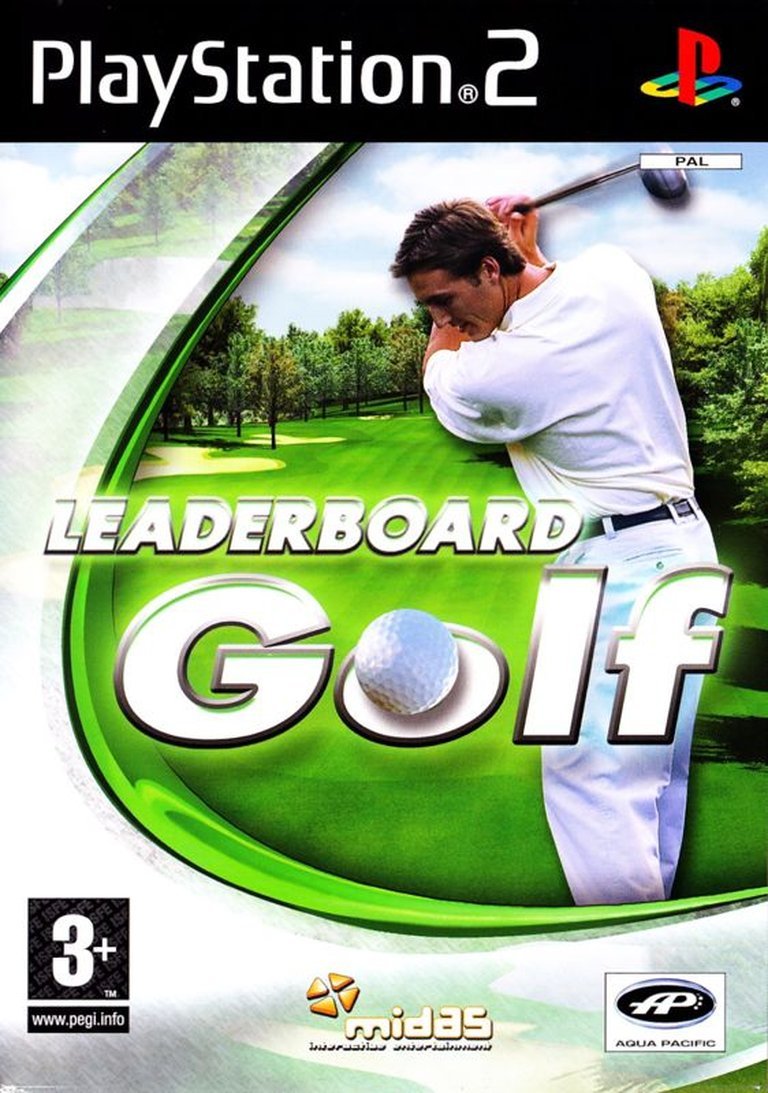
Description
Leaderboard Golf is a golf simulation video game that challenges players on courses inspired by the European and US Tour. Featuring four modes—quick round, match play, championship mode, and practice—it utilizes the Swingometer system, where timing and reaction speed determine shot power and hook/slice, providing a traditional and accessible golfing experience on platforms like PlayStation 2.
Gameplay Videos
Leaderboard Golf Patches & Updates
Leaderboard Golf Reviews & Reception
en.wikipedia.org (97/100): Leader Board has the most realistic putting feel of any golf game I’ve ever tried.
Leaderboard Golf (2006): A Study in Gaming Anonymity
Introduction: The Ghost in the Machine
In the vast museum of video game history, most exhibits are celebrated for their innovation, artistry, or cultural impact. Others serve a different, equally vital purpose: they are the negative space that defines the landscape by their absence. Leaderboard Golf (2006), developed by Aqua Pacific and published by Midas Interactive Entertainment for the PlayStation 2, Windows, and later PlayStation 3, is precisely such a title. It is a game that exists in a state of perpetual anonymity, a spectral entry in the sports genre whose primary legacy is its profound lack of one. This review posits that Leaderboard Golf (2006) is not merely a bad game, but a conceptual nullity—a title that represents the nadir of license-driven, me-too development in the mid-2000s, existing as a hollow shell compared to the celebrated franchise its name evokes. By analyzing its soulless mechanics, its utter lack of distinguishing features, and its complete erasure from both critical and player memory, we understand not just this game’s failure, but the pitfalls of a market saturated with generic sports titles.
Development History & Context: A Name Without a Soul
The story of Leaderboard Golf (2006) is the story of a name’s legacy being utterly betrayed. The “Leaderboard” moniker is hallowed ground in golf gaming, belonging to Access Software’s seminal Leader Board series (1986-1988). That series, created by Bruce and Roger Carver, was a technical marvel for its time, pioneering realistic ball physics, multi-course support, and a revolutionary “Swingometer” control system that felt deeply tactile. It earned legendary scores (97% from Zzap!64), “SU Classic” awards, and was the UK’s best-selling Commodore 64 game of 1986.
Against this backdrop, the 2006 Leaderboard Golf is a case study in brand misapplication. Developer Aqua Pacific, a UK studio with a portfolio of budget-friendly, licensed sports titles (including Taito Legends ports and various football games), was handed a prestigious name. The publisher, Midas Interactive, was known for bringing smaller European titles to broader markets, often at budget prices. The 2006 context is crucial: the PlayStation 2 was in its twilight, but the sports genre was dominated by giants. EA’s Tiger Woods PGA Tour series offered deep simulations, while Sony’s Hot Shots Golf (and its Everybody’s Golf sibling) provided charismatic, accessible arcade fun. Nintendo’s Mario Golf defined playful family golf.
In this crowded field, Leaderboard Golf (2006) had no discernible vision. It was not a reboot, a reinvention, or even a faithful sequel. It was a product, assembled from the era’s most generic design tropes: a “typical golf game” with “courses inspired by the European and US Tour” (a meaningless phrase implying no official licensing), a “standard Swingometer,” and four modes (Quick Round, Match Play, Championship, Practice). There is no evidence of the Carvers’ involvement, no nod to RealSound technology, and no connection beyond a stolen brand identity. Its development was likely constrained by a shoestring budget and a mandate to simply “make a golf game for PS2” using the cheapest possible assets and mechanics.
Narrative & Thematic Deep Dive: The Void
Here, the review confronts an absolute void. Leaderboard Golf (2006) possesses no narrative, no characters, no dialogue, and no underlying themes. There is no story mode, no RPG-like career progression, no fictional rivalries, no world to explore. The game presents a list of nondescript courses with generic names (“European Tour,” “US Tour”) and expects the player to project their own imagination onto the flat, featureless terrain.
This absence is glaring when contrasted with its contemporaries and its namesake. Hot Shots Golf imbued its courses with vibrant, cartoonish personality and quirky characters. Tiger Woods built a narrative around the rise of a legend. Even the 1986 Leader Board, with its stark wireframe graphics, implied a world through its precise simulation of wind and terrain. The 2006 game offers nothing. The “theme” is pure, uncut golf-as-abstract-activity. The player is a ghost on a ghost course, performing a series of isolated shots in a thematic vacuum. This lack of identity is its defining narrative characteristic: it is a game about nothing, for no one in particular.
Gameplay Mechanics & Systems: The “Standard Swingometer” and the Lack of Everything Else
The core of Leaderboard Golf (2006) is its “standard Swingometer,” described as setting power and hook/slice “by your timing and reaction speed.” This is the mostGeneric description of a golf swing mechanic imaginable, present in dozens of titles. It lacks the nuance of Tiger Woods‘s three-click system or the analog precision of later motion-control games. It is, in essence, a bare-bones timing bar.
Deconstructing the gameplay reveals a catalog of missing features:
* Core Loop: Tee off → approach shot → putt. Repeat. There is no stat progression, no equipment customization (clubs are fixed), no experience points, no unlocks beyond perhaps accessing other courses. The “Championship Mode” is merely a string of rounds with a final leaderboard.
* Physics & Feel: Described as delivering “realistic ball physics,” the source provides zero evidence. The C64-Wiki entry for the 1986 series praised its putting feel and sound. The 2006 game has no such documented praise. Its physics are assumed to be competent but utterly unremarkable—the baseline competence of a mid-tier PS2 sports title.
* UI & Presentation: The UI is not described, implying a functional, likely clunky menu system. There is no mention of a dynamic camera, replay editor, stat trackers beyond score, or any modern polish. The “3rd-person (Other)” perspective suggests a fixed camera behind the golfer, likely with minimal adjustment.
* Innovation & Flaws: There is no innovation. The only potential flaw cited in the entire source set is a bizarre bug from the C64-Wiki page for the 1986 game (the “Robinson Crusoe” island bug), which is erroneously included and does not apply. The 2006 game’s true flaw is its profound lack of character, depth, or memorable systems. Its “Hot Seat” multiplayer for 1-4 players is a standard, offline-only pass-and-play mode, a relic even in 2006 as online multiplayer was becoming standard.
World-Building, Art & Sound: Generic Courses, Silent Fairways
The setting is “courses inspired by the European and US Tour.” This is a euphemism for “we made some generic links and parkland holes with water hazards and basic bunkers, and named them after real places without licensing.” There is no specific course design, no famous holes (like the 17th at TPC Sawgrass), no environmental storytelling. The world is a bland, beige void.
Artistically, the game is presumed to use low-poly PS2-era models with simple textures. Screenshots would likely show flat lighting, pop-in, and a lack of detail. The atmosphere is non-existent; there is no weather system (beyond perhaps wind), no day/night cycle, no crowd reactions, no sense of place. It is golf on a sterile server world.
Sound design is mentioned nowhere, implying a sparse track of ambient nature sounds (wind, birds) and basic, stock-sound-effect club impacts. No licensed music, no charismatic commentator (a staple in Tiger Woods and Hot Shots Golf), no satisfying thwack or plink that would be remembered. The audio is functional background noise, contributing nothing to the experience.
Reception & Legacy: The Sound of One Hand Clapping
Leaderboard Golf (2006) exists in a state of perfect critical and commercial oblivion.
* Critical Reception: Metac lists a “Metascore” of “tbd” with “Critic reviews are not available yet.” MobyGames shows an average player score of 1.0 out of 5, based on a single rating and zero written reviews. It is a title with no critical discourse because it generated none. No major outlet (IGN, GameSpot, Eurogamer) reviewed it. It was not screened for press. It simply appeared on shelves, a ghost in the software aisle.
* Commercial Performance: It left no sales footprint. It is not cited in any “best-selling” lists. Its release on Windows (2010) and PS3 (2012) appears to be a publisher’s re-run of existing stock, not a sign of success.
* Evolution of Reputation: Its reputation has not evolved because it never existed. It is not the subject of retrospectives, “worst games” lists, or nostalgia pieces. It is a data point with zero cultural velocity.
* Influence on the Industry: Its influence is a perfect null. It did not inspire clones, change design paradigms, or even serve as a cautionary tale because it was never notable enough to be cited. It represents the sheer disposability of a budget title with no ambition.
Contrast this with the 1986 Leader Board. That game was a franchise that influenced the golf sim genre’s focus on physics and multi-course support. It had expansion disks, a course editor, and was ported to over a dozen systems. The 2006 game is a tombstone for its own name.
Conclusion: The Perfect Zero
Leaderboard Golf (2006) is not a game that failed. It is a game that never attempted to be. It is a procedural generation of a product, lacking the creative spark, technical ambition, or brand stewardship to leave any impression whatsoever. It is the video game equivalent of a blank sheet of paper branded with a famous logo.
Its place in video game history is as a perfect zero—a calibration point. It demonstrates that in a mature genre, a title can be so devoid of distinguishing features, so lacking in passion or innovation, that it achieves a state of pure anonymity. It is the antithesis of the pioneering spirit of the original Leader Board. While Bruce and Roger Carver’s creation was celebrated for pushing the boundaries of what a golf game could be on a Commodore 64, Aqua Pacific’s creation represents the nadir of what a golf game could be on a PlayStation 2: a forgettable, mechanics-only template with no soul, no world, and no legacy. It is not a bad game to be dissected; it is a non-game, a void, and in that emptiness, it tells its own definitive story about the perils of brand exploitation without vision.