
- Release Year: 2008
- Platforms: Macintosh, Windows
- Publisher: PlayFirst, Inc.
- Developer: Viqua Games
- Genre: Action
- Perspective: Diagonal-down
- Game Mode: Single-player
- Gameplay: Time management
- Setting: Pet spa
- Average Score: 80/100
Description
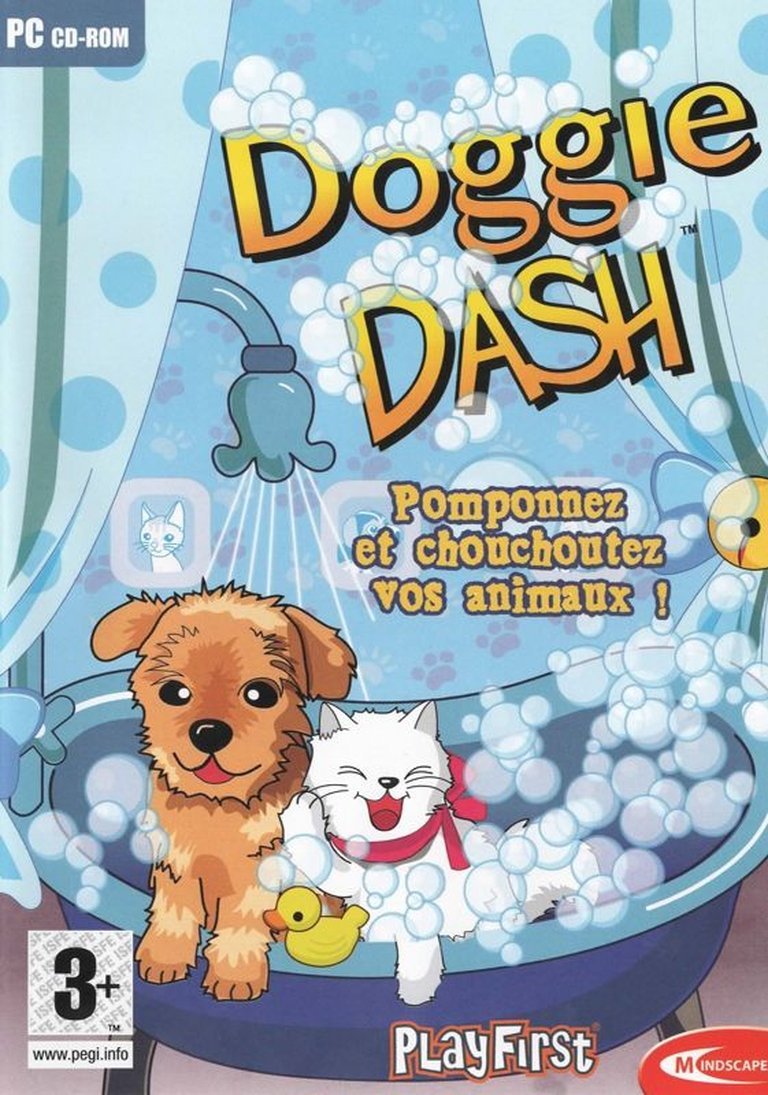
Doggie Dash is a time management spin-off from the Diner Dash series, where players help Rocky the dog and Wendy the cat run an abandoned pet spa. Customers bring various pets that must be swiftly moved to stations like cleaning, with each breed having unique patience levels that can lead to agitation if neglected. The game offers 50 story levels and an additional endless mode, challenging players to maintain smooth operations in a real-time, diagonal-down perspective.
Gameplay Videos
Doggie Dash Guides & Walkthroughs
Doggie Dash Reviews & Reception
denofgeek.com (80/100): Great fun, but can’t see it appealing to guys very much.
Doggie Dash: A Cutesy But Derivative Romp Through DinerTown’s Pet Spa
Introduction: The Purr-fect Spin-Off or a Ruff Innovation?
In the late 2000s, the casual gaming market was dominated by a single, elegant concept: the time management “Dash” game. At the forefront of this phenomenon was PlayFirst’s Diner Dash, a title that defined a generation of browser and downloadable games with its frantic, rewarding, and charmingly simple gameplay. From this successful franchise came several spin-offs, each attempting to graft the core “dash” formula onto a new theme. Doggie Dash, released in 2008 for Windows and Macintosh, is one such spin-off, transporting players from the bustling counters of Flo’s diner to the fluffy, fragrant halls of a pet spa. My thesis is this: Doggie Dash is a perfectly competent and enjoyable piece of casual entertainment that successfully translates the Diner Dash core loop into a new setting, but it is ultimately hamstrung by a profound lack of ambition. It is a game that plays it safe, offering littleBeyond cosmetic changes to justify its existence beyond catering to animal lovers. As a historical artifact, it represents the peak and the impending stagnation of the Dash formula—a polished but predictable iteration that failed to push the genre forward, leaving its legacy as a pleasant footnote rather than a pivotal chapter.
Development History & Context: Banking on a Proven Formula
Doggie Dash was developed by Viqua Games and published by PlayFirst, Inc., the studio that had become synonymous with the “Dash” genre following the monumental success of Diner Dash (2004) and its sequels. By 2008, PlayFirst had mastered a lucrative model: take a simple service-industry concept, layer on escalating difficulty through level design and customer types, and wrap it in bright, accessible visuals. The technological constraints of the era—targeting mid-range PCs and early mobile devices—dictated a 2D, isometric (diagonal-down) perspective with minimal system requirements, ensuring accessibility for the broad “casual” audience, often defined as older demographics and female gamers.
The gaming landscape of 2008 was seeing the casual boom reach its zenith. Platforms like Big Fish Games and GameHouse thrived on downloadable time management and hidden object titles. Doggie Dash entered this crowded field not as an innovator, but as a brand extension. Its development philosophy was clearly one of minimization of risk: reuse the tested Diner Dash engine and mechanics, replace human diners with animals, and reskin the stations. This is evident in the game’s specs (released as a commercial download for single-player, using keyboard/mouse) and its placement as a direct spin-off within the “DinerTown” franchise, a shared universe first established by Diner Dash that also included Wedding Dash and Cooking Dash. The choice of a pet spa was savvy—animal themes have perennial appeal—but the execution suggests a project prioritized speed-to-market over creative risk-taking.
Narrative & Thematic Deep Dive: A Comic Book Romance With Ruff Puns
The narrative framework of Doggie Dash is delivered through static, comic book-style panels between levels, a style consistent with other entries in the franchise. The plot centers on an interspecies romance that catalyzes the business venture: Rocky the dog and Wendy the cat have fallen in love. Their owners—also named Rocky and Wendy, creating a confusing naming layer—are initially reluctant but are convinced to team up and purchase an abandoned pet spa in DinerTown. This premise sets up the core gameplay: the玩家 (player) manages the spa to make it a success, proving the owners’ venture worthwhile.
The character dynamics are paper-thin. The owners, Walter and Scarlett (as noted in some sources like VideoGameGeek, though MobyGames uses “Rocky & Wendy” for the owners, creating inconsistency), are portrayed as bickering partners who “fight like cats and dogs,” a cliché the game leans into heavily. The real “characters” are the pet customers, each breed representing a different customer type with prescribed behaviors. Dialogue is the game’s most critically panned element. As Joel Brodie notes in his Gamezebo review, the banter between the animal protagonists is “downright painful,” relying on a relentless barrage of animal-themed puns: “Our furless friend is going to have a RUFF day,” “the kitties are looking MEWtiful,” “We have this place looking PURRfect,” and “Color me CATatonic.” This writing is not merely cute; it is aggressively saccharine, breaking immersion for any player over the age of eight and signaling the game’s primary target audience: young children and casual players seeking low-stress, visually engaging content. Thematically, the game promotes ideas of entrepreneurship, customer service, and multitasking, all wrapped in a veneer of animal care and affection. However, the theme is superficial; the act of “pampering” is reduced to a series of clicks on stations, devoid of the emotional resonance a game like Nintendogs might aim for.
Gameplay Mechanics & Systems: A Direct Clone With Minor Trims
At its mechanical core, Doggie Dash is a 1:1 translation of the Diner Dash formula into a pet spa context, with one significant thematic twist: each pet requires multiple services in sequence. The gameplay loop is as follows:
1. A customer (a pet owner) enters with their animal.
2. The player must quickly identify the pet’s required services via thought bubbles (e.g., a bath brush, scissors, a bow).
3. The player clicks the pet, then clicks the appropriate station (Bath, Grooming, Beauty). The pet is transported there automatically.
4. While the pet is being serviced, the player must manage other incoming customers, seat them at the reception, and shuttle them to their next required station upon completion.
5. Pets have a “patience” meter (visualized as a heart or smiley face icon). Different breeds have different base patience levels and service speeds (e.g., “Abyssinians have medium patience and medium service speed and poodles with low patience but fast service speed” per the MobyGames description). If left waiting too long, they become agitated (dogs whimper, cats frown), and may eventually leave, costing the player money and a failed level.
6. The player’s helper (the other animal, Rocky or Wendy, depending on the level) automatically returns finished pets to their owners. Periodically, the helper is “away,” forcing the player to perform this return task manually, increasing the cognitive load.
7. The level objective is to meet a minimum cash quota (through service fees and tips) before the timer runs out.
Innovations & Flaws:
* Combo System: The game introduces a “combo” mechanic where using a station exclusively for a specific pet type (e.g., always using one grooming table for cats) builds a chain. Successfully swapping a finished pet for a new one of the same type at that station awards bonus points. This encourages strategic routing and station specialization, a slight but meaningful strategic layer absent from the basic Diner Dash loop.
* Multi-Service Pets: The requirement to move a single pet through 2-3 stations in sequence is the primary gameplay differentiator. It creates more complex routing puzzles, as players must plan the path for multiple multi-step pets simultaneously, juggling queues at reception and at stations.
* Lack of Spatial Variety (A Critical Flaw): This is the game’s most cited weakness. As the Gamezebo review starkly states, “each location had the same counter and station layout so it didn’t feel like there was much incentive to unlock new locations.” From the starting spa to the beach, New York City, and beyond, the physical arrangement of stations remains static. The only changes are cosmetic reskins of the background graphics. This robs the progression of a sense of discovery and environmental mastery that Diner Dash achieved by introducing new obstacles and layouts in different restaurants (e.g., outdoor patios, multi-floor setups).
* Cosmetic Upgrade System: Money earned can upgrade station speed, player/partner speed, or purchase cosmetic items (wallpaper patterns, flooring). The cosmetic system is widely derided as pointless (“do you really care if your spa has a circle pattern on its wallpaper or flowers?” – Gamezebo), offering no gameplay benefit and superficial customization.
* Dialogue & Punishment: The relentless, low-quality pun-based dialogue between levels is a consistent irritant. Furthermore, the challenge curve is steep early on, with quotas that can feel arbitrary and punishing on first attempts, though this is a hallmark of the genre.
World-Building, Art & Sound: Cutesy but Repetitive
The world of Doggie Dash is the “DinerTown” universe, a cartoony, pastel-hued Americana populated by anthropomorphic animals. The pet spa setting is realized with bright, clean, and intentionally “fluffy” graphics. The art direction is consistent with PlayFirst’s brand: inoffensive, colorful, and designed to appeal to a wide, non-gamer audience. The character designs for the various dog and cat breeds are recognizable and charming in a generic way.
However, the world-building is肤浅 (shallow). The “abandoned spa” premise is never visually reflected; every location looks new and sparkling. The transition from a regular spa to a “beach” or “New York City” locale is achieved solely by changing the background image behind a static, identical station layout. There is no sense of place, no environmental storytelling. The atmosphere is one of sterile, repetitive cuteness.
Sound design follows suit. The soundtrack is light, bubbly, and inconsequential. The sound effects are the stars: squeaky toy pops, blow dryer whirs, contented animal sighs, and the aforementioned whimpering and moaning of impatient pets. These sounds are clear communicative cues, which is good design, but they lack the memorable character of, say, the Diner Dash bell rings or customer sighs. The audio/visual package is professionally executed but artistically unremarkable and, due to the repetitive level layouts, incredibly fatiguing over the 50-level story mode.
Reception & Legacy: A Middling Entry in a Saturated Franchise
Contemporary critical reception to Doggie Dash was lukewarm to negative, though it found its audience within the established casual gaming space. Gamezebo awarded it a 70/100, summarizing it as “we liked – but not loved” and “doggone disappointed,” citing its failure to innovate: “it’s virtually the exact same experience Diner Dash will give you from start to finish, but with dogs and cats instead of people.” The critic specifically called out the repetitive locations, pointless cosmetic upgrades, and cringe-worthy dialogue as major detractors.
Conversely, Den of Geek‘s Lucy Felthouse (a self-professed “casual games freak”) gave it a more positive 4/5 stars, praising its increased challenge and the inherent appeal of its animal theme: “they’ve found ways to make it more challenging and different, and all the cuteness and fluffiness appeals to my softer side.” This split highlights the game’s divisive nature: it excels at delivering a familiar, cute experience for those seeking more of the Dash formula with an animal twist, but fails to impress those looking for evolution.
Commercially, it was likely a modest success as a downloadable title, benefiting from the Diner Dash brand. However, it left no significant mark on the industry. It did not spawn a Doggie Dash 2 or influence other time management games. Its mobile port (by Glu Mobile, 2009) was a straightforward adaptation, cementing its status as a franchise also-ran. Compared to the cultural footprint of the original Diner Dash, Doggie Dash is largely forgotten, a victim of its own derivativeness. In the grand timeline of casual gaming, it represents the point where the “Dash” template began to feel exhausted, paving the way for newer casual genres (like match-3 and hidden object hybrids) to dominate.
Conclusion: A Competent but Inessential Chapter
Doggie Dash is a paradox. It is, by the standards of the time management genre, a well-oiled machine. The core loop of identifying pet needs, shuttling them through stations, managing patience meters, and chaining combos is satisfying in the same primal way as its predecessor. The addition of multi-step service requests adds a welcome layer of complexity. For a player seeking 5-10 hours of mindless, colorful clicking, it delivers.
However, as a work of game design and a piece of video game history, it is profoundly unambitious. It betrays no desire to explore its pet spa premise beyond the most superficial reskin. The repetitive level layouts are a cardinal sin in a progression-based game, and the insulting dialogue suggests a lack of respect for the player’s intelligence. Its legacy is that of a safe corporate investment—a game made because “Dogs + Dash = Sales” on a spreadsheet, not because there was a creative fire to explore pet pampering in a novel way.
In the pantheon of PlayFirst’s Diner Dash series, Doggie Dash occupies the lower tier. It is better than the widely panned Wedding Dash but falls short of the innovation seen in Diner Dash: Flo on the Go or the refined mechanics of later entries. Its place in history is as a cautionary tale about franchise fatigue and the perils of resting on laurels. It is not a bad game, but it is an utterly skippable one. For historians, it is a clear datapoint showing the limits of the “theme swap” model in the late-2000s casual explosion. For players, it remains a quaint relic—a game that will satisfy a nostalgic itch for Dash gameplay with a furry coat, but one that offers no reason to return once that itch is scratched. Final Verdict: A derivative, repetitive, yet occasionally fun time-waster that exemplifies the creative drought of a once-vibrant casual franchise.
Note: This review synthesizes data from MobyGames (specs, descriptions), Gamezebo (critical analysis of mechanics and dialogue), Den of Geek (player perspective), and other aggregators (release dates, platform info). The Russian title “Салон красоты «Питомец»” (Pet Beauty Salon) and French title “Pomponnez et chouchoutez vos animaux !” (Pamper and Spoil Your Animals!) are acknowledged as alternate spellings per MobyGames.