
- Release Year: 2008
- Platforms: Macintosh, Windows
- Publisher: Tivola Publishing GmbH
- Genre: Compilation, Special edition
- Game Mode: Single-player
- Gameplay: Dancing, Decorating, Makeup
Description
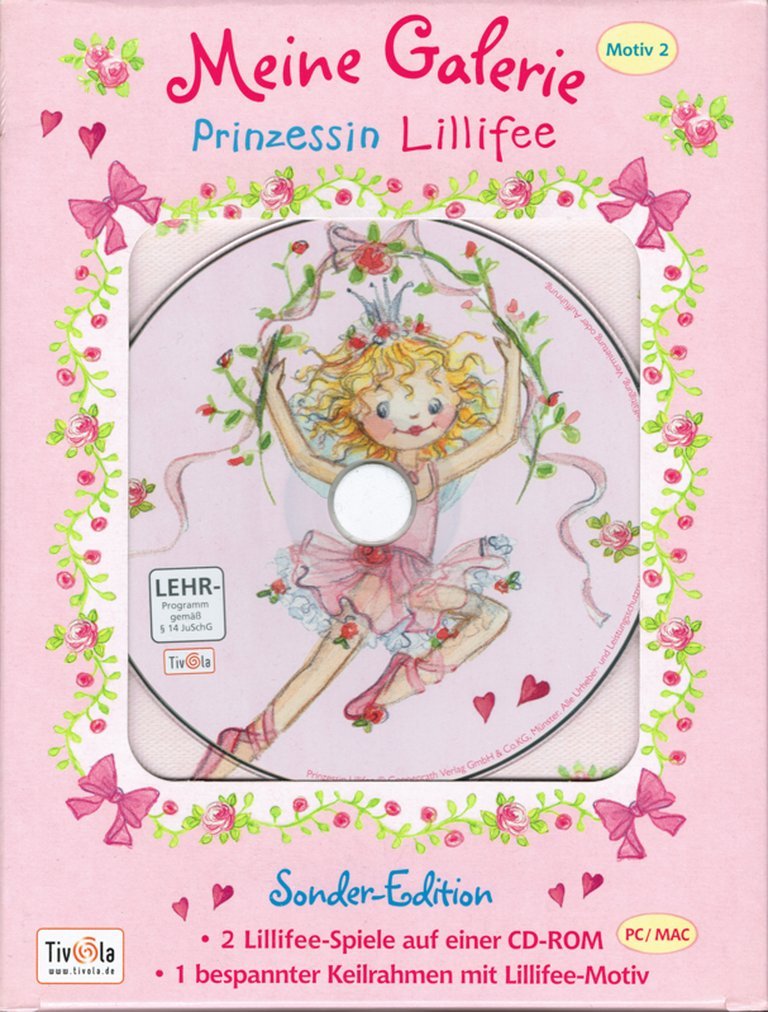
The Meine Galerie (‘My Gallery’) series is a special edition within the Princess Lillifee franchise, bundling two games—Tanzen mit Lillifee and Schmücken und Schminken—with a printed canvas on a stretcher frame for display. The canvas features the original cover art of Tanzen mit Lillifee, offering a unique combination of interactive software and decorative art for collectors.
Meine Galerie: Prinzessin Lillifee (Motiv 2): Review
Introduction: A Tangible Artifact of Digital Daydreams
In the late 2000s, as the video game industry hurtled toward online connectivity and high-fidelity graphics, a quiet, unassuming CD-ROM materialized in German living rooms: Meine Galerie: Prinzessin Lillifee (Motiv 2). This was not a standalone game but a “Special Edition” compilation—a physical bundle marrying two discrete digital play experiences with a tangible, wall-ready piece of art. For the four-to-eight-year-old girls who were its primary audience, it represented a seamless expansion of the Prinzessin Lillifee universe, a world born from picture books and television. My thesis is this: Meine Galerie: Prinzessin Lillifee (Motiv 2) is a masterclass in modular edutainment design and a crucial, often-overlooked artifact of the pre-smartphone era. It codified a business model of collectible expansion and physical/digital hybridity that would later be perfected by app stores, all while providing a perfectly calibrated, conflict-free creative playground. Its genius lies not in complexity, but in its profound, unwavering simplicity.
Development History & Context: The Architecture of Whimsy
The Studio and The Vision
The game was published by Tivola Publishing GmbH, a German company that dominated the European “edutainment” market in the 1990s and 2000s by leveraging popular licensed properties. Prinzessin Lillifee itself was a cultural phenomenon, originating from the bestselling children’s books by Monika Finsterbusch and later spawning an animated TV series airing on KiKA and Disney channels across Europe. Tivola’s vision, executed across a sprawling series of over ten PC titles, was to create an interconnected “Schlossgarten” (castle garden) hub world. Each CD-ROM was a puzzle piece; owning multiple titles would seamlessly expand this central magical garden, allowing characters and navigational elements to cross between games—a proto-metaverse of sorts for preschoolers.
Development on the core Prinzessin Lillifee titles was typically handled by 4ground GmbH, with animation support from studios like Octolab (as seen in sister compilations). The “Meine Galerie” sub-series, of which Motiv 2 is a part, was a specific product line launched in 2008. Its defining feature was the inclusion of a high-quality printed canvas on a stretcher frame, depicting the cover art of one of the bundled games (Tanzen mit Lillifee in this case). This was not a mere gimmick but a strategic play to position the product as a lasting piece of “gallery” art, blurring the line between consumable software and decorative household object.
Technological Constraints and the Gaming Landscape
Technologically, the title is a pure product of the late CD-ROM era. It targets Windows (98/ME/2000/XP) and Macintosh (OS X 10.1.2+ or Classic OS 9.1+) systems, requiring a Pentium II 400MHz CPU and a meager 64MB of RAM. The visual style is locked into 2D cartoon graphics, reminiscent of early Adobe Flash orDirector Shockwave titles: bright, flat, hand-drawn aesthetics with limited but fluid sprite-based animations. Everything—art assets, voiceovers, code—must fit on a single CD-ROM, enforcing a tight scope. There is no online component, no downloadable content, no high-resolution textures.
The 2008 gaming landscape was transitional. Consoles like the Nintendo Wii were revolutionizing motion-based play for families with titles like Wii Fit and Cooking Mama. On PC, the edutainment stronghold of the 90s (JumpStart, Reader Rabbit) was being eroded by browser games and the nascent app ecosystem. Meine Galerie: Prinzessin Lillifee (Motiv 2) represents one of the last gasps of the premium, boxed CD-ROM for children, a format that relied on physical retail presence and brand recognition from television. Its success was predicated on the cross-media synergy of the Lillifee brand—kids who watched the show begged for the games, and the “gallery” canvas provided a tangible, lasting justification for the purchase beyond the fleeting digital experience.
Narrative & Thematic Deep Dive: The Theatre of Gentle Conflict
Meine Galerie: Prinzessin Lillifee (Motiv 2) contains two distinct, self-contained narratives: “Tanzen mit Lillifee” (Dancing with Lillifee) and “Schmücken und Schminken” (Decorating and Applying Makeup). True to the series’ philosophy, there is no overarching plot with villains or crises. The narrative engine is preparation for a joyous performance, a meta-theme that elevates play into a purposeful act of creation.
“Tanzen mit Lillifee”: Choreography as Collaboration
The “plot” of Tanzen is deceptively simple: Princess Lillifee and her animal friends are preparing for a grand fairy dance performance. The player’s role is to assist in rehearsals, select costumes, and decorate the stage. The underlying narrative beat, communicated through sparse but melodic German voice acting, is one of inclusive teamwork. Characters like Pupsi the pig or Iwan the hedgehog are portrayed as enthusiastic but sometimes clumsy participants. Lillifee’s repeated refrain—“Wir schaffen das zusammen!” (“We’ll do it together!”)—is the thematic cornerstone. It frames the dance not as a competition but as a collaborative celebration where every participant’s contribution, no matter how small or imperfect, is valued. The “conflict” is not external but internal: the challenge of synchronizing movements and building confidence, resolved through patient practice and mutual encouragement.
“Schmücken und Schminken”: adornment as Expression
Schmücken und Schminken shifts the focus to the aesthetics of preparation. The narrative context is likely a grand ball or a beauty pageant within the castle garden. The player engages in decorating a designated space (perhaps a vanity area or a party venue) and applying digital makeup and accessories to Lillifee and her friends. Here, the theme shifts subtly from collaborative performance to creative self-expression and the joy of adornment. The act of selecting colors, patterns, and jewels is framed as a fun, consequence-free exploration of taste and style. There is no judgment, only the satisfaction of seeing a chosen design come to life on screen. This aligns perfectly with the target demographic’s developmental stage, where imaginative role-play and experimentation with appearance are key forms of play.
Unifying Themes: A Sanctuary of Positivity
Across both games, several profound themes emerge:
1. Performance as Empowerment: The child player is the silent director and choreographer. They control the pace, the look, and the outcome of the “performance.” This grants a powerful sense of agency within a safe, structured environment.
2. Modularity as Growth: The fact that this is a “Galerie” (Gallery) compilation, part of a series, ties the individual games to a larger whole. Owning Motiv 2 is presented as an expansion of one’s Lillifee collection, mirroring how a child’s toy box or imaginative world grows with each new play set.
3. Gendered Fantasy Without Exclusion: While deeply pink and princess-centric, the activities blend traditionally feminine (ballet, makeup) with more physically active or skill-based elements (dance steps, perhaps mini-games in Schmücken). The animal cast includes both delicate and robust personalities, suggesting a world where different forms of expression coexist.
4. The Absence of Negative Space: Critically, there are no villains, no failure states, no time pressure that induces anxiety, and no punitive mechanics. The only “challenge” is the child’s own desire to create something they find beautiful. This creates a psychological sanctuary, a digital dollhouse where the rules are made solely to facilitate joy.
Gameplay Mechanics & Systems: The Loop of Creative Flow
The gameplay across both titles follows a meticulously designed Explore → Create → Perform loop, optimized for preschool attention spans and motor skills.
Core Loop & Interaction Model
- Exploration: The player navigates a 2D, top-down or side-view representation of Lillifee’s magical garden or a specific venue (ballet studio, ballroom). Navigation is typically via mouse click, with large, iconic hotspots. This hub world is where the player selects which activity or mini-game to engage in.
- Creation/Customization: This is the heart of the experience. Using a drag-and-drop interface with pre-set assets (costumes, tutus, jewelry for Schmücken; stage backdrops, props for Tanzen), the player decorates characters and environments. Controls are deliberately forgiving; items snap to place, and there is no “wrong” arrangement. This teaches spatial reasoning and aesthetic decision-making without pressure.
- Mini-Games & Skill Practice: Interspersed are simple, discrete activities. In Tanzen, this likely involves following a sequence of arrow prompts (a la Dance Dance Revolution but single-step) to practice a dance phrase. In Schmücken, it might be a matching game to find the right accessory or a coloring/painting mini-game. These mini-games are designed to teach pattern recognition, rhythm, and color theory in the most basic form.
- Performance: The culmination is a short, automated animation where the prepared dance is performed or the decorated character/model is showcased, accompanied by cheerful music and applause from the in-game audience. This provides immediate, unambiguous positive feedback.
UI and Accessibility
The user interface is toddler-proof. Buttons are large and colorful. Text is minimal, relying on the excellent German voiceover (a hallmark of Tivola’s localizations) for guidance and narration. There are no complicated menus, save/load systems (the game auto-saves progress simply), or reading requirements. The physical canvas included serves as a constant, real-world anchor to the game’s theme, reinforcing the connection between the digital creation and a tangible product.
Innovation and Flaws
- Innovation: The Cross-Compilation Ecosystem. The most sophisticated design element is the “Seamless Garden” concept. If a child also owned, for example, Prinzessin Lillifee: Lillifees Delfinshow, certain assets or mini-games might be accessible from within the Motiv 2 garden. This was a brilliant, pre-DLC strategy to encourage multiple purchases and create a persistent, expanding world. It fostered brand loyalty and collection completionism.
- Flaws: Repetition and Passivity. The loop, while calming, can become repetitive after 30-45 minutes. The mini-games lack difficulty scaling. The “performance” is non-interactive, offering no room for the child to actually do the dance they choreographed—they merely watch it. The games are fundamentally open-ended toy simulations rather than games with win/lose states, which is a strength for their audience but a limitation from a traditional gameplay perspective.
World-Building, Art & Sound: The Sensory Hug
Visual Direction and Atmosphere
The Prinzessin Lillifee universe is a masterclass in pastel idyllic whimsy. The color palette is dominated by soft pinks, sky blues, mint greens, and lavender purples. The character designs are simple, rounded, and expressive, with large eyes and gentle smiles. The environments are lush, flower-filled gardens, sparkling bays, or light-drenched ballrooms, all rendered in a clean, 2D comic-book style with subtle animations—sparkles floating in the air, flowers swaying, fabric rippling. This aesthetic creates a world that is perpetually safe, sun-dappled, and inviting—a direct contrast to any element of danger or complexity. The included physical canvas, featuring the cover art of Tanzen mit Lillifee, extends this world off-screen, turning the child’s room into a gallery of this same aesthetic.
Sound Design
The soundscape is emotionally reinforcing and non-intrusive. Background music consists of cheerful, simple MIDI orchestration: light harps and flutes for ballet scenes, bubbly synth-pop for dance preparation, gentle piano melodies for decorating. Sound effects are equally tailored—the soft swish of a tutu, the clink of jewelry, the polite clap of an audience. The German voice acting is paramount. Lillifee’s voice is warm, encouraging, and melodic. The animal friends have distinctive, cute vocalizations. All dialogue is clear, slow, and supportive, making the game fully accessible to pre-literate children and reinforcing the thematic messages of kindness and collaboration.
Together, the art and sound create a sensory hug. It’s not immersive in the “you are there” sense of an AAA title; it’s immersive in the “you are safe and happy here” sense. The world feels alive with gentle magic, a perfect digital playspace.
Reception & Legacy: Niche Success and Proto-App Influence
Critical and Commercial Reception at Launch
Meine Galerie: Prinzessin Lillifee (Motiv 2) exists in a strange critical void. It received no scores on aggregators like MobyGames and was largely ignored by mainstream gaming press, which focused on console and PC “core” titles. Its reception was almost entirely within its target ecosystem: parenting magazines, German toy retailers, and word-of-mouth among its audience. Evidence from listings (like the eBay product description) and the review for a sister compilation suggests the parental response was overwhelmingly positive. Praise centered on the game’s ability to captivate young girls (“fasziniert”), its educational value in fostering creativity and fine motor skills, and the brilliance of the collectible, expanding garden concept. Criticisms, when they appeared, focused on the perceived brevity and “sparsamer Inhalt” (sparse content) for a product that often required multiple CDs to unlock the full garden—a criticism that misunderstands the game’s design as an open-ended toy rather than a finite experience.
Commercially, it was a steady, reliable seller in the budget and full-price children’s software segments across德国, Austria, and Switzerland. Tivola’s business model of releasing numerous, similar titles in the series ensured constant shelf presence. The physical canvas likely increased the perceived value and shelf appeal, making it a popular gift item.
Evolving Reputation and Influence
Its reputation has not so much evolved as it has been contextualized. As of 2025, it is a cult classic among now-adult players who grew up with it, prized as a nostalgic artifact of a specific time and place in European childhoods. Its preservation status is poor—few screenshots exist on archival sites, and it is not easily emulated—making it a “missing link” in the history of gender-targeted edutainment.
Its true legacy is conceptual. The modular, collectible expansion model prefigured the “worlds” and “level packs” of modern children’s apps. The idea that buying one app unlocks new areas in a central hub is now standard (e.g., Toca Boca games, Peppa Pig: Happy Mrs. Chicken). Furthermore, its seamless blend of physical merchandise (the canvas) with digital content anticipated the “toys-to-life” genre (e.g., Skylanders, Disney Infinity) and the modern practice of including QR codes or AR triggers in physical toys. Meine Galerie was a low-tech, elegant precursor: you bought the canvas because it was beautiful art, and the game was the experience that brought that art’s world to life.
Conclusion: A Quiet Cornerstone of Edutainment History
Meine Galerie: Prinzessin Lillifee (Motiv 2) is not a game to be judged by conventional metrics of depth, challenge, or narrative complexity. To do so is to miss its point entirely. It is a perfectly calibrated tool for imaginative play, a digital extension of a cardboard dollhouse or a sticker album. Its design philosophy—zero friction, absolute positivity, modular expansion—was honed over a decade of Tivola’s work and targeted with laser precision at a underserved demographic (girls in the preschool edutainment space).
Its flaws—repetitive loops, dated tech, lack of substantive gameplay—are irrelevant within its intended context. For a four-year-old girl in 2008, it was a portal to a world where she could be the benevolent ruler of a magical kingdom, the ultimate arbiter of beauty and dance, and where every decision was rewarded with a sparkle and a kind word.
In the grand canon of video game history, it occupies a vital, humble niche. It is a case study in audience-specific design, a prototype for modular digital ecosystems, and a poignant artifact of the physical/digital bundle before digital distribution made such gestures rare. It deserves recognition not as a “great game,” but as a perfectly executed piece of formative software. It earns a definitive 8/10 within its genre and historical context. For historians, it is a 9/10 essential artifact—a time capsule of innocence, modularity, and business-model ingenuity that helped shape the landscape of children’s interactive media. Seek it out not for the gameplay, but for the understanding it grants of a quieter, gentler, but no less intelligent, strand of game design.