
- Release Year: 2011
- Platforms: Windows
- Publisher: Koch Media GmbH (Austria)
- Genre: Special edition
- Average Score: 72/100
Description
A New Beginning is a point-and-click adventure game set in the fjords of 1990s Norway and a dystopian 2500, where players control two protagonists: Bent Svensson, a scientist who developed a clean fuel source, and Fay, a time-traveller from a climate-ravaged future. Across 11 puzzle-driven chapters, they must work together to alter key historical decisions and prevent a solar flare from causing total extinction, blending environmental themes with time-travel narrative.
A New Beginning (Spiel des Jahres) Patches & Updates
A New Beginning (Spiel des Jahres) Guides & Walkthroughs
A New Beginning (Spiel des Jahres) Reviews & Reception
adventurecorner.de : Wir haben den Titel, der vor dem Hintergrund einer Klimakatastrophe spielt, genau unter die Lupe genommen.
metacritic.com (72/100): A New Beginning leaves a mixed feeling: While it is a great adventure game, it lacks in the technical department and the speakers could be better than they are.
gaminglives.com : Daedalic illustrate this, literally, with a stunning comic book style prologue
A New Beginning (Spiel des Jahres): Review
Introduction: The Eco-Thriller That Divided a Genre
In the landscape of 2010’s point-and-click adventure renaissance, Daedalic Entertainment’s A New Beginning emerged not merely as another手工-drawn curiosity but as a audacious, thematically heavyweight statement. Released in a period where the genre was often pigeonholed for whimsical fantasy or slapstick comedy, this German-developed title forcibly grafted the urgent, polarizing discourse of climate change onto the classic adventure template. Its legacy is a fascinating schism: revered in its home country as a award-winning masterpiece that proved adventures could tackle “serious” issues without losing heart, yet met abroad with a reception ranging from cultivated praise to outright bewilderment, often citing translational stumbles and archaic design choices. This review posits that A New Beginning is a profoundly flawed gem—a game whose narrative ambition, artistic vision, and structural bravery are perpetually at war with its technical limitations, inconsistent pacing, and a central twist that recontextualizes its entire moral framework. To understand its place in history is to dissect this very tension: between a heartfelt, meticulously crafted eco-thriller and a point-and-click adventure beholden to the genre’s sometimes frustrating conventions.
Development History & Context: Daedalic’s Defining Gamble
Developer: Daedalic Entertainment, the Hamburg-based studio that had just burst onto the international scene with the critically adored The Whispered World (2009) and the cult hit Edna & Harvey: The Breakout. By 2010, Daedalic was the standard-bearer for a new wave of German 2D adventures, known for lush hand-drawn art and character-driven stories.
The Vision & Constraints: Led by creative leads Jan Müller-Michaelis and Kevin Mentz, the project was conceived as a deliberate departure. Carsten Fichtelmann, Daedalic’s executive producer, later recounted a telling anecdote: Valve initially rejected A New Beginning (and Edna & Harvey) three times for Steam, deeming its target audience uninterested in such “serious” fare. This rejection underscores the game’s defiant positioning. Technologically, it utilized the Visionaire Studio engine, a tool common for 2D adventures but one that reveals its age in fixed-resolution backgrounds (a native 1024×768, leading to black bars on widescreen monitors) and occasional clipping or animation shortfalls. The development was reportedly lengthy and ambitious, aiming for “over 100 detailed, hand-drawn locations” and “more than an hour of animated comic-style cutscenes.”
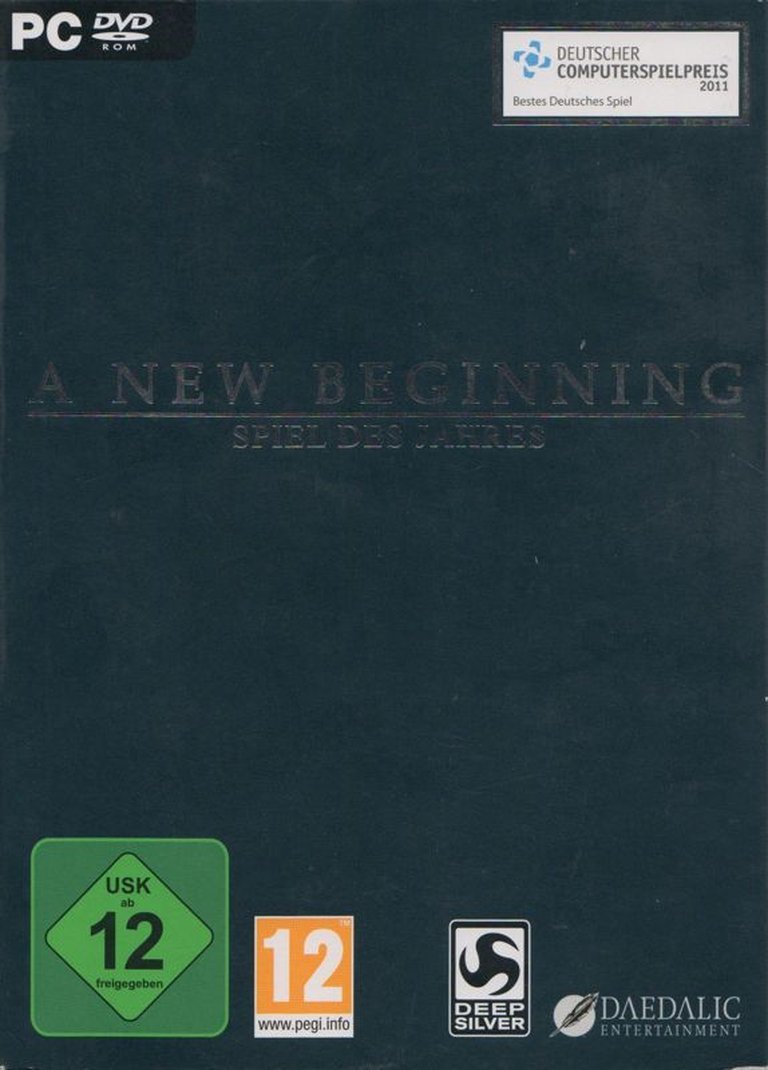
The Publishing Landscape: In Germany, it was published by Deep Silver (a Koch Media label). Internationally, the rights fell to Lace Mamba Global, a publisher that would later become infamous among indie developers for questionable practices, casting a retrospective shadow over the game’s commercial journey. The “Spiel des Jahres” edition referenced in this review’s title is not a subtitle but a specific physical release (July 2011) commemorating the game winning the prestigious German Computer Game Prize (Deutscher Computerspielpreis) for “Best German Game” and “Best Youth Game” in 2011. This edition bundled the game (in German and English) with a soundtrack CD and the making-of documentary An Inconvenient Game.
Narrative & Thematic Deep Dive: The Unreliable Apocalypse
The plot of A New Beginning is a masterclass in gradual, devastating subversion. It begins in the 26th century with a classic “after the end” tableau: humanity huddles in underground bunkers, the planet’s ozone and magnetic fields destroyed, awaiting a final solar flare. The “Phoenix Plan” is devised: time-travel “time pilots” are sent back to avert the ecological collapse. The initial jump fails catastrophically; all teams perish in 2050—a world already ravaged by superstorms, flooding, and desertification—except for the idealistic radio operator Fay and the ruthless pragmatist Salvador.
Fay’s story, relayed through extended flashbacks as she convinces retired Norwegian bio-engineer Bent Svensson to resume his work on a blue-algae biofuel, is the game’s primary vehicle. She paints a picture of a chain reaction: a nuclear reactor explosion in the Brazilian Amazon (owned by the archetypal Corrupt Corporate Executive, Inoz Indez) triggers a nuclear winter, dooming the planet by 2050. Only Bent’s clean energy can prevent this. The narrative is intricately structured across 11 asynchronous chapters, alternating between Fay’s desperate present (the 1980s/1990s, per the Wikipedia entry) and her recounted past (2050 San Francisco).
The Central Twist & Thematic Complexity: The genius—and source of much critical division—lies in the mid-to-late-game revelation from Salvador: Fay is an unreliable narrator. The true timeline is worse: the ecological collapse happened in the 26th century, not 2050. The Amazon nuclear plant is perfectly safe. The Phoenix Plan’s true goal is not to prevent a disaster, but to engineer one—to cause a catastrophic reactor meltdown in the Amazon to shock humanity into abandoning both fossil fuels and nuclear power, forcing adoption of Bent’s algae. This transforms the narrative from a straightforward “save the planet” fable into a grim parable about well-intentioned extremism. The game asks: can you justify creating a present-day apocalypse to avert a future one? It weaponizes the “green aesop,” forcing players to confront the ethical quagmire of eco-terrorism for a “greater good.”
Character Arcs: Bent Svensson is a portrait of Chronic Hero Syndrome in remission, a man broken by his own sense of global responsibility. Fay evolves from naive, empathetic rookie to a hardened, morally flexible agent of a desperate future. Their dynamic—a skeptical past and an idealistic future—drives the emotional core. Supporting characters like the slick villain Indez and the sociopathic Salvador provide clear antagonists, though the twist recasts Salvador as a brutal utilitarian and Indez as a potential scapegoat.
Dialogue & Prose: The writing, particularly in the German original, is praised for its depth and maturity. However, the English localization is a considerable weakness. Multiple sources (Alternative Magazine Online, GamingLives) note stilted dialogue, a lack of contractions, mismatched subtitles, and occasional German lines slipping through. This creates a “robotic” feel that undermines the emotional beats, especially in Fay’s voice acting, which is often cited as flat and emotionless—a fatal flaw for a character meant to be the audience’s heart.
Gameplay Mechanics & Systems: Tradition With a Verb-Wheel Twist
A New Beginning adheres to the classic point-and-click adventure formula but introduces a notable interface innovation.
Core Loop: Players alternate controlling Fay and Bent in linear chapter progression. The game is inventory-heavy: find objects, combine them, use them on the environment or NPCs to solve puzzles blocking progression. Environments are lush but often static, with hotspots meticulously (and sometimes obscurely) placed.
The “Medallion” System: Instead of the standard “Verb Coin” (Look/Take/Use/etc.), the game employs a context-sensitive wheel that appears when holding the left mouse button on a hotspot. This wheel offers specific verbs tailored to the object (e.g., “Climb” on a beam, “Flick” on a switch, “Spit on” for an adversary). This is widely praised for reducing guesswork and adding playful specificity, though in practice it often yields the same functional results as a standard verb coin. It’s a thoughtful modernization that didn’t revolutionize but did refine.
Puzzle Design: This is the game’s most polarizing element.
* Inventory Puzzles: The bulk of the game. Many are logical and integrated into the story (repairing machinery, crafting tools). However, pixel-hunting is a common frustration. Hotspots are small, and the lack of a clear visual cue (despite the spacebar “highlight all” function, which many players miss) leads to endless scrolling and cursor-dragging.
* “Set-Piece” Minigames: Several chapters feature standalone mechanical puzzles (defusing a bomb via circuit connections, managing water tank levels, powering a turbine). These are often cited as the most difficult and least intuitive parts. A mercy feature allows skipping after a few minutes, but the skip animation is a “blink-and-you-miss-it” flash-build that provides no clue for where the player went wrong, breeding frustration (GamingLives’ review captures this agony perfectly).
* Linear & Scripted: Progression is highly linear. Puzzles must be solved in a prescribed order, and the game occasionally forces specific interactions in cutscenes, limiting player agency. The narrative framing (Fay’s flashbacks) often justifies this linearity, but it can feel restrictive.
UI & Quality-of-Life: The interface is clean but suffers from era-appropriate limitations. No auto-save is a significant omission. The “journal” or quest log is absent, leaving players to remember multi-step objectives. The spacebar hotspot reveal is crucial but poorly communicated in-game. The fixed 4:3 resolution is a glaring oversight for a 2011 PC release, stretching or letterboxing on modern displays.
World-Building, Art & Sound: A Visually Arresting, Aurally Inconsistent Experience
Visual Direction: This is A New Beginning’s undisputed crown jewel. Daedalic perfected its signature style: hand-painted, detailed backgrounds with a muted, earthy palette for Bent’s挪威 fjords and 1980s locales, contrasted with the bleached, washed-out, ruined vistas of 2050 San Francisco (flooded streets, crumbling buildings). The character sprites are cel-shaded and expressive, though they suffer from pixelation when zoomed in and occasionally stiff animation cycles. The comic-panel cutscenes are inspired—partially animated storyboard sequences with dynamic panel layouts and speech bubbles, perfectly suiting the game’s narrative-as-recollection structure. They are plentiful (over an hour) and elevate the production values immensely.
Sound Design & Music: The soundtrack, composed primarily by Knights of Soundtrack (with main theme by Periscope Studios), is a standout achievement. It won the Deutscher Entwicklerpreis for Best Soundtrack in 2010. The score ranges from melancholic, piano-driven themes for Bent to tense, orchestral swells for chase sequences, to diegetic 1980s Europop/lounge music in certain scenes (like the Amazon facility). It is universally praised as epic, emotive, and perfectly attuned to the atmosphere. The sound effects are competent, though some environmental loops (like footsteps) can be jarringly repetitive or mismatched.
Voice Acting: The Achilles’ heel. German voice acting (with legends like Jürgen Holdorf as Bent) is reportedly strong, capturing the gravitas. The English dub, however, is roundly criticized as flat, robotic, and devoid of emotional nuance. Fay’s actress, in particular, fails to convey the character’s purported empathy and desperation, turning key story moments into monotone exposition. This fatally undermines the narrative’s emotional core for international audiences. Coupled with the sometimes-dodgy translation, the audio-visual dichotomy is stark: a breathtaking visual novel paired with a narratively inert auditory experience.
Reception & Legacy: A Cult Classic Mired in Controversy
Domestic (German-Speaking) Reception: A New Beginning was a darling. It swept the 2011 German Computer Game Prize, winning the top honor (“Bestes Deutsches Spiel”) and “Best Youth Game.” Critics like PC Games (84%), GameStar (84/100), and 4Players (82/100) praised its mature themes, gripping story, stunning art, and well-integrated puzzles. Adventure-Treff gave it 87%, noting it didn’t quite reach the heights of The Whispered World but was still exceptional. It was seen as a maturation of the German adventure genre, proving it could handle weighty subjects.
International Reception: The response was mixed to divided, reflected in aggregate scores: Metacritic 72/100, GameRankings 67.88%.
* Praise: Adventure Gamers (4/5) and GamingXP (85%) highlighted the absorbing story, convincing characters, inventive puzzles, and stunning artwork. The twist was noted as genuinely surprising and thought-provoking.
* Criticism: Destructoid (4/10) and Gamer.no (40%) were scathing, citing “stupid, illogical puzzles,” “moronic characters,” and “poor dialogues.” GameSpot (6.5/10) and many user reviews pointed to the abysmal English voice acting and translation as deal-breakers. The technical issues—no widescreen, buggy saves (notably a chapter 6 save failure), and crashes—were also frequently mentioned. The moral of the story was sometimes seen as heavy-handed or undermined by the twist’s logical gaps (e.g., why not prevent Chernobyl?).
* The “Spiel des Jahres” Edition: This retail special edition, with its soundtrack and documentary, was a nice collector’s item but did little to address the core issues. Its existence, however, cemented the game’s status as a significant German release of 2010/2011.
Legacy & Influence:
1. For Daedalic: It solidified their reputation as Germany’s premier adventure studio, though their later focus shifted heavily to publishing. It demonstrated a willingness to tackle complex themes, a threadcontinued in later narrative-driven titles like The Long Journey Home and State of Mind.
2. For the Genre: It stands as a benchmark for the “serious adventure.” It proved that point-and-click mechanics could serve a plot with philosophical weight and moral ambiguity. Its use of a framing narrative with an unreliable narrator was clever,尽管 execution of the twist remains debated.
3. Cultural Artifact: It is a time capsule of early-2010s environmental anxiety, predating the Greta Thunberg movement but capturing a growing mainstream concern. Its “what if” scenario—using a catastrophic event to force behavioral change—feels chillingly relevant in the era of climate tipping points.
4. Cult Following: Despite its flaws, it retains a passionate cult following who champion its story, art, and boldness. The twist is frequently discussed in adventure game circles as a memorable, if flawed, narrative gamble.
Conclusion: A Flawed, Fascinating Artifact of Ambition
A New Beginning (Spiel des Jahres) is not a forgotten gem; it is a divisive, ambitious, and deeply imperfect milestone. Its place in video game history is secured not by polish or universal acclaim, but by sheer audacity. Daedalic Entertainment dared to wed the intimate, puzzle-solving format of the point-and-click adventure with the sprawling, impersonal panic of global climate collapse, and then layered on a central ethical paradox that questions the very heroes’ motives.
Its triumphs are monumental: a visually sumptuous world, a soundtrack of cinematic breadth, a narrative structure that cleverly uses its dual protagonists, and a final act that genuinely recontextualizes everything that came before. Its failures are equally monumental: an English localization that saps the life from its characters, puzzle design that sometimes prioritizes obscurity over logic, technical myopia (no widescreen, save bugs), and pacing that sags under the weight of its own exposition.
To play A New Beginning today is to engage with a fascinating case study in localization and cultural translation. The game that won Germany’s top honors feels like a different—and lesser—experience in English. Yet, for those willing to overlook or work around its flaws (using the spacebar liberally, perhaps even subtitles over voices), it offers a rich, challenging, and surprisingly mature story. It is a testament to Daedalic’s founding belief that adventures could be more than puzzles in a fantastical setting; they could be vessels for urgent, uncomfortable questions about our collective future.
Final Verdict: A New Beginning is a flawed masterpiece. It is a 7/10 game with the soul of a 9/10 story. Its legacy is that of a brave, culturally significant work that straddled the line between artistic statement and genre convention, ultimately succeeding more in its aspirations than its execution, but succeeding nonetheless. It deserves to be remembered, studied, and—for the brave or the forgiving—played, as a pivotal, if bumpy, step in the evolution of narrative-driven games.