
- Release Year: 1998
- Platforms: Antstream, Browser, PlayStation, Windows
- Publisher: Piko Interactive LLC, Psygnosis Limited
- Developer: Psygnosis Limited
- Genre: Role-playing
- Perspective: Behind view
- Game Mode: Single-player
- Gameplay: Action RPG, Puzzle elements
- Setting: Futuristic, Sci-fi
- Average Score: 55/100
Description
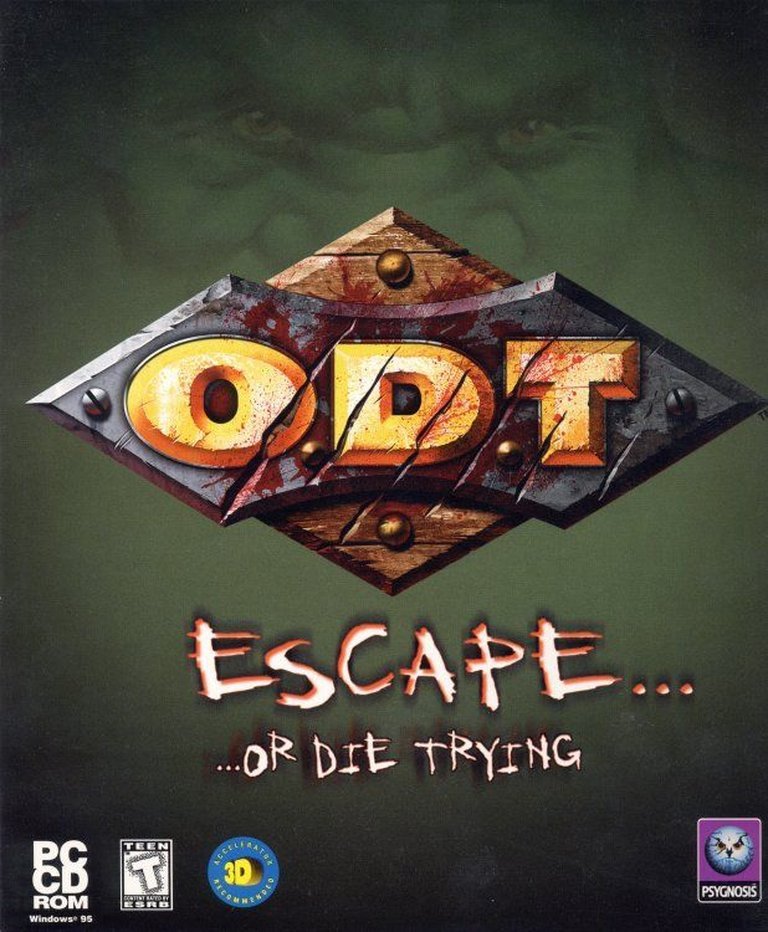
Set in a sci-fi, futuristic world, O.D.T.: Escape… or Die Trying follows the four crew members of the crashed airship Nautiflyus—Julia, Ike, Maxx, and Solaar—after Captain Lamat and the healing Green Pearl are abducted in the Forbidden Zone. As an action RPG with platforming and puzzle elements, players choose a character with unique abilities to fight enemies, earn experience for upgrades, and navigate challenges in a rescue mission to save the captain and recover the pearl.
Gameplay Videos
Where to Buy O.D.T.: Escape… or Die Trying
O.D.T.: Escape… or Die Trying Cracks & Fixes
O.D.T.: Escape… or Die Trying Reviews & Reception
ign.com (55/100): Psygnosis’ attempt at sci-fi innovation fails on nearly all fronts.
myabandonware.com : the final product is nothing short of disastrous.
O.D.T.: Escape… or Die Trying Cheats & Codes
PC
Enter text codes at the main menu or while the game is paused.
| Code | Effect |
|---|---|
| lacrimosa | Level select |
| sophia | Sophia now playable |
| karma | Karma now playable |
| xul | Full energy |
| boz | Full mana |
| jbb | Full capacity on all four weapons |
| math | Increase power slightly on all four weapons |
| grabo | Increase armor, weapon, and spirit levels slightly |
| mumu | Maximum experience |
| alex | 50 lives |
| rik | All spells |
| vince | Add one star to each acquired spell |
| cachou | Full energy, mana, experience, weapon power; 50 lives; slightly increased armor, weapon, and spirit; all spells with 4 stars |
| bar | Remove enemy life bars |
| birdy | Unknown |
| odt | Unknown |
PlayStation
Pause the game and enter button sequences for most cheats; at the main menu for character cheats.
| Code | Effect |
|---|---|
| Up, Circle, Right, Select, Square | 50 lives |
| Left, Right, Up, Down, Circle, Square | Full ammo |
| Left, Right, Left, Right, Square | Full health |
| Left, Right, Left, Right, Circle | Full mana |
| R1, R2, L2, L1 | Play as Karma |
| L1, L2, R2, R1 | Play as Sophia |
| Square, Circle, Triangle, Select, Left | Upgrade abilities |
| Triangle, Square, Circle, Triangle, Circle | Disable enemy health |
| R1,L1,R2,L2,LEFT,RIGHT,UP,DOWN | Upgrade weapon and magic |
| CIRCLE,TRIANGLE,L1,L2,R1,SELECT | Full experience |
O.D.T.: Escape… or Die Trying: A Flawed Frontier of French Steampunk Gaming
Introduction: The Allure and Agony of a Genre Hybrid
In the crowded pantheon of late-1990s action-adventure games, few titles occupy as curious a space as O.D.T.: Escape… or Die Trying. Released in 1998 by Psygnosis’s French studio (FDI), it arrived at the peak of the Tomb Raider clone boom, yet immediately positioned itself as something more idiosyncratic—a gritty, steampunk-tinged hybrid of third-person shooter, platformer, and nascent action-RPG. Its critical reception was a study in contradiction: hailed by some as an intense, atmospheric masterpiece with unparalleled depth, and dismissed by others as a clumsy, frustrating, and technically inept misfire. This review posits that O.D.T. is neither a hidden classic nor a complete disaster, but a fascinating and deeply flawed artifact of ambition. It represents a earnest, if ultimately compromised, attempt to synthesize multiple gameplay genres around a stark, Lovecraftian aesthetic, creating an experience defined by brilliant ideas perpetually at war with messy execution. Its legacy is that of a cautionary tale about the perils of overreaching on limited hardware, and a cult curio for those willing to endure its punishing systems for its singular, oppressive atmosphere.
Development History & Context: A French Studio’s “Futur-Antérieur” Vision
O.D.T. was developed by FDI, Psygnosis’s French division, a team whose core members had recently shipped Adidas Power Soccer for the PlayStation. According to producer Jean-Baptiste Bolcato in PSExtreme magazine, the studio’s guiding inspiration was not the cyberpunk-drenched sci-fi of the era, but the “‘futur-anterieur’ look and feel a la Jules Verne” found in The Chaos Engine. This “past vision of the future”—a gritty, industrial, almost dieselpunk aesthetic—was a deliberate departure from the sleek chrome of Deus Ex or the neon of Blade Runner. The team aimed for a world that felt both anachronistic and terrifyingly advanced, a surreal dimension where Victorian-esque airships collided with mutant horrors and laser weaponry.
This vision was pursued under the significant technological constraints of 1998. The game was built for both PlayStation and Windows PC, a cross-platform effort that inevitably led to compromises. The PlayStation version, while notable for being one of the few games to support the PlayStation Mouse, struggled with the console’s hardware limitations, resulting in the infamous “pop-up” of polygon walls and a short draw distance that exacerbated the game’s constant sense of falling into a black void. The PC version, while capable of smoother frame rates with 3dfx acceleration, suffered from a notorious lack of mouse support and a save system that was archaic even for its time. The development was further complicated by a cancelled Nintendo 64 port, which was reportedly completed but leaked years later, a ghostly footnote hinting at what might have been a more technically robust version on more powerful hardware.
Narrative & Thematic Deep Dive: A B-Movie Script with Philosophical Undertones
The plot of O.D.T. is pure, unadulterated B-movie pulp, delivered with a straight face that borders on the poetic. The airship Nautiflyus, carrying the “Green Pearl”—a globe-shaped artifact with healing powers—to the plague-stricken city of Calli, is diverted into the “Forbidden Zone” by a magnetic storm. The ship crashes onto the roof of a monolithic, non-Euclidean tower, Captain Lamat and the Pearl are abducted, and the four remaining crew members must descend into the tower’s nightmarish realms to rescue them. The narrative framework is simple, but its execution is steeped in a pervasive, existential dread.
- The Crew as Archetypes: The playable characters are not deep RPG personas but clear, functional archetypes whose stats reinforce their roles. Maxx Havok, the Chief Engineer, is a walking tank with high armor and weapon skill but negligible magic capability. Solaar, the Archbishop, is the inverse: a frail spellcaster whose occult prowess is matched only by his physical vulnerability, accompanied by a small bat-winged familiar that adds a layer of eerie companionship. Julia Chase, the Cartographer, and Ike Hawkins, the Strategist, are the balanced middle-ground, with Julia having a slight edge in magic. Two unlockable characters—Ike’s sister Sophia and a reformed enemy monster named Karma—offer further variance but remain within this stat-based paradigm. This design prioritizes gameplay differentiation over narrative depth; their personalities are sketched in the manual and cutscenes but rarely drive the plot.
- Themes of Cosmic Horror and Futility: The game’s true narrative strength lies in its setting and implied themes. The “Forbidden Zone” is not a jungle or a dungeon, but a flat, black void surrounding a single, impossible tower—a vision of isolation that evokes H.P. Lovecraft’s cosmic indifference. The tower’s inhabitants are not simply monsters but mutants and “Deviants,” casualties of some ancient, unspeakable experiment or war. The central MacGuffin, the Green Pearl, is less a holy grail and more a volatile, almost radioactive object whose “curing” power feels as dangerous as the plague it counters. The story becomes less about heroic rescue and more about desperate survival against a reality that is fundamentally hostile and broken. The title “Escape… or Die Trying” is not just a boast; it’s a bleak prognosis, where “trying” is the only viable option, and success is measured solely in temporary survival.
Gameplay Mechanics & Systems: A Clash of Genres in a Precarious World
O.D.T.’s core gameplay loop is a tense, methodical dance between exploration, combat, and puzzle-solving, all underpinned by a fragile sense of momentum.
- Character Progression & The RPG Lite: The game introduces a deceptively simple RPG layer. Defeating enemies yields Experience Points, which can be allocated to one of three core stats: Strength (melee damage and carrying capacity), Weapons Skill (ranged weapon damage and accuracy), and Resistance (magic defense and health). This system is barebones—there are no skills, spells learned through scrolls, or complex builds—but it has a profound impact. A high-Weapons Skill Ike can tackle gun-toting mutants from a distance, while aStrength-focused Maxx can wade into melee. This creates meaningful replayability, as each character fundamentally changes the combat calculus. Spells, found as one-time pickups or in hidden areas, are powerful but limited resources, adding a tactical layer of resource management.
- Combat & The Aiming Dilemma: The combat is the game’s most praised and criticized element. It occupies the famous “2/3 blasting, 1/3 platforming” ratio cited by reviewers. The aiming system is a clever, if imperfect, solution to the third-person shooter problem. Tapping the aim button shifts the camera into a narrow, quasi-first-person view, allowing for precise targeting of enemies on different vertical planes—a crucial feature in a game with flying foes and turrets. However, this system competes for button space on a controller already managing movement, jumping, firing primary/secondary weapons, and spell selection, leading to a cluttered, unintuitive interface that many critics called “arcade-style” in a pejorative sense.
- Platforming & The Pitfalls of Precision: The platforming is unforgiving. Levels are vast, multi-sectioned labyrinths (seven main levels with up to ten sub-sections each) filled with narrow walkways over bottomless pits. The game’s ledge-grabbing is forgiving in principle, but the camera’s tendency to swing wildly and the character’s momentum often make precise jumps a matter of luck. This is catastrophic because of the game’s draconian save system. Save points are limited to the start of a level and a few designated locations within it. A single mistimed jump means a lengthy, frustrating backtrack, eroding any sense of progress. This design choice, common in older console titles, felt archaic and cruel on PC and was a primary source of criticism.
- Puzzles & Environmental Interaction: Puzzles are predominantly switch-and-key based, requiring players to explore every nook of a section to find a keycard, fuse, or switch that opens the next area. They are integrated into the environment—sewers, reactor rooms, alien nests—but are often more about exhaustive searching than intellectual challenge. The “multi-leveled” design of the tower means backtracking is frequent, and the lack of a clear, dynamic map (a static overview is available but not实时) fosters a sense of disorientation that doubles as atmospheric immersion or frustrating confusion, depending on the player’s patience.
World-Building, Art & Sound: A Masterclass in Oppressive Atmosphere
Where O.D.T. is almost universally praised is in its cohesive, terrifying world-building. This is its undeniable, enduring strength.
- Visual Direction & Steampunk Unease: The game’s “futur-anterieur” aesthetic is brilliantly realized. The palette is dominated by rusted browns, deep blues, and sickly greens, with environments ranging from dripping sewer trenches and clanging catwalks to organic, fleshy alien chambers and sterile, crystalline control rooms. The architecture feels industrial, decrepit, and utterly alien—less Final Fantasy and more The City of Lost Children (notably, a film several team members also worked on). Character designs are inventive: the green, rifle-wielding mutants; the bulky, spider-like attack bots; the hulking, four-armed bosses. While character animation can be stilted and environments suffer from texture pop-in and a terrifying black void beyond the island’s edges, the overall mise-en-scène is powerfully unsettling. It creates a place that feels wrong, a pocket dimension of decay and violence.
- Sound Design & Ambient Dread: The sound design is a cornerstone of this atmosphere. Critics frequently highlighted its “unobtrusive ambient tracks” and exceptional use of stereo positioning. Footsteps change material based on the surface—clanking on metal, squelching in mud. Enemy growls, weapon discharges (from the meaty thump of fists to the electric crackle of the ionic gun), and the constant, low hum of the tower’s machinery create a soundscape of perpetual tension. The subtle, melancholic music that occasionally swells in moments of exploration or combat adds a layer of tragic grandeur, suggesting the tower’s history is one of immense, failed power. It’s a soundscape that doesn’t just accompany the action but defines the player’s emotional state: paranoia, weariness, and dread.
Reception & Legacy: A Polarizing Curio
Upon release, O.D.T.‘s reception was sharply divided, often along platform lines. The Windows version holds a GameRankings score of 61%, while the PlayStation version lags at 51%. This split likely stems from control preferences: the PlayStation version’s analog stick implementation was criticized as imprecise, while the PC version’s keyboard-only controls (no mouse support) were a deal-breaker for many.
- The Critic Spectrum: Reviews ranged from the hyperbolic 100% from GameGenie (“graphic splendors,” “outstanding gameplay”) to the scathing 35% from Hacker (“a poorly implemented hybrid”). The middle ground, however, identified consistent traits. Praises centered on: the unique, multi-character RPG system; the exceptional, eerie atmosphere and sound design; the ambitious scale of levels; and the satisfying weight of combat. Criticisms formed a damning litany: a “poor man’s Tomb Raider” with clumsy controls and camera (GamePro); a frustratingly obscure save system; repetitive level design; numerous graphical bugs (wall pop-up, texture tears); and a difficulty curve that felt unfair rather than challenging. IGN’s 5.5/10 review bluntly stated it “should be avoided at all costs,” while Jeuxvideo.com (a French outlet, perhaps more forgiving of its national studio) gave it a 16/20, celebrating its “French touch” and brilliant story.
- Legacy and Cult Status: O.D.T. did not spawn sequels or influence major genre trends. Its direct mechanics were too frustrating to be widely borrowed. Its legacy is that of a cult curio and a “what if” story. It is remembered for:
- Its Aesthetic Singularity: Few games from the 3D boom capture such a specific, industrial-Lovecraftian vibe. It is a definitive entry in the “weird PS1” canon.
- Its Premature Hybridization: It attempted the action-RPG fusion years before games like Deus Ex (2000) or System Shock 2 (1999) would solidify the formula, but without the narrative integration or systemic depth to make it work seamlessly.
- Its Preservation Oddities: The cancelled, complete N64 port that leaked online, the community-created HD FMV mods for modern systems, and the official 2022 re-release on Steam and GOG by Piko Interactive (with bundled fixes for modern Windows) are testaments to a small, dedicated fanbase keeping its obscure flame alive.
- A Benchmark in Frustration: It is frequently cited in retrospectives on bad controls and punishing save systems as a prime example of how not to design player progression and retention.
Conclusion: A Rugged, Unforgettable Relic
O.D.T.: Escape… or Die Trying is not a good game by conventional metrics. Its controls are awkward, its camera treacherous, its save system punitive, and its technical execution on the PlayStation particularly shaky. To play it is to constantly fight the interface as much as the mutants on the screen.
Yet, to dismiss it entirely is to ignore its remarkable achievements in world-building and genre ambition. It creates a palpable, dread-filled atmosphere that few games of its era matched. Its simple RPG progression system, for all its limitations, genuinely impacted playstyle and encouraged replay. It dared to blend frantic shooting with deliberate exploration and puzzle-solving in a framework that felt weighty and consequential.
In the history of video games, O.D.T. belongs to the category of ” Noble Failures”—projects that reach for a unique synthesis of ideas but are grounded by the technical and design limitations of their time. It is a fascinating footnote in the lineage of the action-adventure genre, a French counterpoint to the British polish of Tomb Raider and the American complexity of Deus Ex. It is a game more studied than recommended, more appreciated for its audacious vision and creepy ambience than for its moment-to-moment play. For the patient historian willing to overlook its myriad flaws, O.D.T. offers a stark, unforgettable journey into a dark tower where the true horror is not the monsters around every corner, but the imminent, sudden yank of the pit beneath your feet. It is a game that truly embodies its title: you will struggle, you will die repeatedly, and you may ultimately escape… but you will not soon forget the trying.