
- Release Year: 2018
- Platforms: Android, iPad, iPhone, Macintosh, Nintendo Switch, Windows, Xbox One
- Publisher: Noodlecake Studios Inc., Wild Rooster
- Developer: Wild Rooster
- Genre: Action
- Perspective: Side view
- Game Mode: Single-player
- Gameplay: Digging, Platforming, Roguelike
- Setting: Fantasy
- Average Score: 72/100
Description
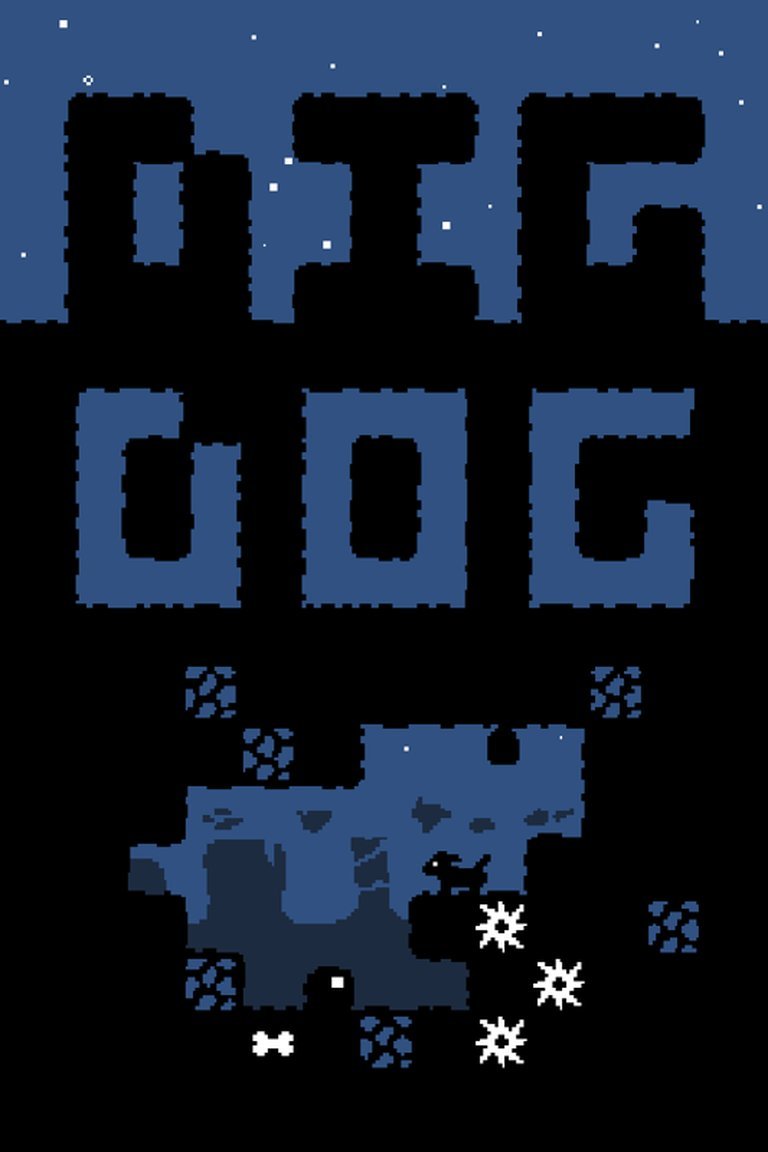
Dig Dog is a 2D side-scrolling platformer set in a fantasy world where players control a dog digging through underground layers to collect bones and avoid enemies. With roguelike elements and arcade-style gameplay, it offers quick, challenging sessions that are accessible to all skill levels and perfect for relaxed play.
Gameplay Videos
Where to Buy Dig Dog
PC
Dig Dog Reviews & Reception
metacritic.com (80/100): Dig Dog is a pleasing game. The gameplay is quick but fun and increasingly challenging. This is a mindless game to play when you’re looking for something relaxing or don’t want to commit to a heavy story.
metacritic.com (75/100): While the creation of Dig Dog is a true underdog tale, the game stands on its own four feet – wagging tail and all. It’s highly accessible to players of all skill ranges, but offers a challenging sandbox to play in. Overall, if you are looking for a classic arcade-style digger with a fun ambiance, Dig Dog is a very, very good boy.
metacritic.com (75/100): Dig Dog is effective in how straightforward it is. You’re a dog. You dig. Go get those bones and survive. Part of me wishes the experience were smoother and more polished, but I also appreciate how raw Dig Dog feels.
metacritic.com (60/100): If you’re the kind of gamer who enjoys getting high scores in unique arcade experiences then you should give Dig Dog a try.
metacritic.com (60/100): It’s far from perfect by any stretch of the imagination, but for what it is there’s definitely plenty of addictive gameplay here if your willing to put the effort in.
monstercritic.com (80/100): Dig Dog is a pleasing game. The gameplay is quick but fun and increasingly challenging. This is a mindless game to play when you’re looking for something relaxing or don’t want to commit to a heavy story.
monstercritic.com (80/100): A fun game to play in your odd downtime moments when you haven’t got the opening to sink into a much larger game. Comes with plenty of challenge in the main game, but also has a more relaxing version when you’re just wanting to chill.
monstercritic.com (75/100): It’s messiness is more endearing because of the killer hook, distinctive art, and memorable soundtrack. This might not be a long-lasting game, but it doesn’t need to be. It’s just a doggy digging.
monstercritic.com (60/100): If you’re the kind of gamer who enjoys getting high scores in unique arcade experiences then you should give Dig Dog a try.
opencritic.com (55/100): Dig Dog will entertain you a couple of hours along some platformer levels in a Rogue-like style 8bits game. You will have to guide a little dog who is looking for the final treasure: a bone, which is at the bottom of the level. Avoiding different enemies, our dog will have to dig a lot in order to achieve this purpose. Perfect for children or just in case you don’t want to spend a lot of time in front of the tv.
opencritic.com (80/100): Dig Dog is a pleasing game. The gameplay is quick but fun and increasingly challenging. This is a mindless game to play when you’re looking for something relaxing or don’t want to commit to a heavy story.
opencritic.com (75/100): While the creation of Dig Dog is a true underdog tale, the game stands on its own four feet – wagging tail and all. It’s highly accessible to players of all skill ranges, but offers a challenging sandbox to play in. Overall, if you are looking for a classic arcade-style digger with a fun ambiance, Dig Dog is a very, very good boy.
opencritic.com : Don’t expect anything that will wow you, but for less than half a pint of beer, Dig Dog is a game that will keep you busy for an hour or so.
opencritic.com (80/100): A fun game to play in your odd downtime moments when you haven’t got the opening to sink into a much larger game. Comes with plenty of challenge in the main game, but also has a more relaxing version when you’re just wanting to chill.
opencritic.com (75/100): It’s messiness is more endearing because of the killer hook, distinctive art, and memorable soundtrack. This might not be a long-lasting game, but it doesn’t need to be. It’s just a doggy digging.
opencritic.com : If you’re the kind of gamer who enjoys getting high scores in unique arcade experiences then you should give Dig Dog a try.
opencritic.com (65/100): You’ll play as the title dog and your objective is always to find your bone within the level…
gamegrin.com (80/100): Overall Dig Dog is a fun “10-minute” game. Hop on, play it for a bit and hop off again. Something fun to play for the downtime you have between other games. Truly though, I think where Dig Dog will hopefully succeed, is with the speed-running community. It’s a clever short game, with plenty of routes that could lead to times getting faster and faster.
Dig Dog: An Underdog’s Triumph
Introduction: The Bark That Roared
In the vast, often-overlooked corners of digital storefronts lies a game that embodies a powerful, simple truth: a compelling hook, executed with heart and ingenuity, can transcend its modest budget and diminutive scope. Dig Dog is not a titan of industry, nor a critical darling that swept the awards circuit. Instead, it is a fiercely independent, pioneering project that stands as a testament to the resilience of creative passion. Released in 2018 by the one-man studio Wild Rooster, its premise is ruthlessly efficient: you are a dog, you dig, you seek a bone. Yet, beneath this minimalist surface churns a surprisingly deep roguelike platformer with a distinctive aesthetic and a gamefeel that demands tactical consideration. More than its gameplay, however, Dig Dog is historically significant as the first game its creator, Rusty Moyher, programmed and illustrated entirely without using his hands, a feat born from a debilitating Repetitive Strain Injury (RSI). This review will argue that Dig Dog is a landmark of accessible game development and a brilliantly focused design exercise, whose legacy is twofold: as a charming, challenging indie title and as a beacon for adaptive technology in a creator’s toolkit.
1. Development History & Context: Forging a Path Without Hands
The story of Dig Dog is inseparable from the story of its creator, Rusty Moyher. A lifelong game enthusiast who taught himself through library books on HyperCard, Moyher finally entered the indie scene around 2011, quitting his day job to develop games like Box Cat. His work consistently channels “an adoration for the old,” not as cloying nostalgia, but as a foundational design philosophy of simplicity and immediacy.
The crucible for Dig Dog‘s unique development was the 2012-2014 “Retro Game Crunch” project, where Moyher, Matt Grimm (composer), and Shaun Inman aimed to make six games in six months. The intense, repetitive workload exacerbated Moyher’s pre-existing wrist vulnerabilities, leading to a severe RSI diagnosis by the third game. Facing financial stress, project delays, and physical pain, he was forced to innovate or abandon his craft. His solution was a gradual, experimental shift to voice coding and head-tracking.
The technical stack was a cobbled-together marvel. For coding, he used DragonFly, a speech recognition add-on for the Nuance Dragon engine, pairing it with a custom, condensed vocabulary (e.g., “rack” for a right bracket, “lack” for a left bracket) to dictate Python code efficiently. For art and UI work, he employed a SmartNav 4 infrared camera mounted on his monitor, tracking a reflective dot on his glasses or hat to move the cursor—a physically taxing method he later improved upon with a Tobii eye-tracker. The only manual work was essential playtesting with a controller for precision. Thus, Dig Dog, begun in summer 2016, was conceived as a “voice-first” project, a deliberate challenge to perfect these adaptive tools for his entire future workflow. Its selection for the 2017 Fantastic Arcade Official Selection provided crucial validation before its multi-platform launch in February 2018 (Xbox One, PC, Mac, iOS). The Nintendo Switch port in April 2019 added unlockable color palettes, cementing its status as a cross-platform cult title.
2. Narrative & Thematic Deep Dive: Less Story, More Principle
Dig Dog presents a narrative stripped to its absolute skeleton, a conscious design choice that aligns with its arcade roots and minimalist ethos. The plot is relayed in the developer’s notes and title screen: a dog seeks a bone. There are no cutscenes, no dialogue from the protagonist, and no named characters beyond the enigmatic “strange creatures” populating the worlds. This absence is not a failing but a thematic statement. The game is about action and principle.
The core theme is persistent, iterative pursuit. The dog’s quest for the bone mirrors the player’s quest for mastery. Each run (in Bone Hunt mode) is a fresh attempt against a procedurally generated gauntlet. The narrative is written in the player’s actions: the desperate tunnel towards the exit, the calculated risk to dispatch an enemy for coins, the split-second decision to dash over a pit. The “stranger creatures” are not given lore; their behavior is their character—the bouncing red orb, the floating eye, the spiked beetle—each a simple but lethal puzzle piece.
A secondary, profound theme is accessibility and adaptation, though it exists outside the game fiction. The very act of playing Dig Dog engages with the reality of its creation. Knowing the developer coded it hands-free imbues the experience with a quiet sense of triumph. The simple controls (three inputs) and the forgiving, instant-restart penalty system can be seen as an extension of this philosophy: a game designed to be entered with minimal friction, respecting the player’s time and potential limitations. The lore is the game’s existence itself—a testament to “if you have the desire, you can find a way.”
3. Gameplay Mechanics & Systems: The Art of the Dig
Dig Dog’s genius lies in distilling the roguelike-platformer formula to its essentials and building a robust, tactical core from a single verb: Digging.
- Core Loop & The Dig Mechanic: The player controls a dog navigating a single-screen-wide, multi-screen-tall level. The objective is always to reach the bone at the bottom. The entire world is destructible terrain, created in a silhouette style with a bright background. Digging is not just movement; it is level creation. You carve your own path, which immediately creates tactical dilemmas: dig straight down for speed (and risk hitting a hazard or enemy from below), tunnel horizontally to bypass threats, or create vertical shafts for safe passage. This mechanic is profoundly spatial, turning each level into a 3D puzzle in a 2D plane.
- Controls & Combat: Using a minimalist scheme (joystick + one button), the button toggles between Dig (holding) and Jump/Dash (tapping). A third action, a “bark/bite,” is noted in some reviews as seemingly cosmetic, a charming but unclear detail. Combat is rudimentary: jump on enemy heads to stomp them. A crucial advanced technique, as noted by Moyher, is the “fast stomp”—landing on an enemy with significant downward momentum—which creates horizontal sparks. These sparks are a brilliant emergent mechanic: they can clear enemies or destructible terrain ahead but can also ricochet back and kill the dog if used recklessly in tight spaces. This turns a simple stomp into a high-risk tool.
- Progression & Systems (Bone Hunt Mode): This is the primary roguelike mode across four worlds of increasing difficulty. Progression is not about permanent upgrades between lives but about resource management within a run. Coins are dropped by enemies and chests and can be spent at intermittent shops on upgrades like extra health, a higher jump, or a dash length increase. The critical, roguelike tension is: spend coins now for immediate survival, or hoard them for a potential high score or later, tougher shops? Death is permanent, resetting the run. Checkpoints do not exist.
- Free Dig Mode: This is the “zen mode.” It removes game overs and shop pressure, offering infinite, ever-so-slightly-challenging levels. It serves as a pressure-free sandbox to practice digging routes, experiment with the spark mechanic, and enjoy the cathartic, destructive core loop. Progress is saved, allowing for endless, low-stakes digging.
- Flaws & Friction: Reviews consistently note a slight “roughness.” The lack of tutorial clarity on mechanics like the bark or the precise effects of some shop items is a minor but notable omission. The difficulty curve can feel steep and occasionally “unfair” due to the procedural generation sometimes creating lethal claustrophobic situations. However, most critics agree this “messiness” is part of the charm, a raw, arcade-grade challenge that rewards skill over memorization.
4. World-Building, Art & Sound: A Silhouette of Style
Dig Dog’s aesthetic is a masterclass in cohesive, retro-inspired design that maximizes contrast and readability.
- Visual Design: The game uses a silhouette style with a fixed, bright background (often a gradient sky). The foreground elements—the dog, enemies, terrain, treasures—are all dark, solid shapes. This is not a limitation but a brilliant readability tool. Threats are instantly visible against the light background. The destructible terrain, when dug away, reveals the bright background, creating a satisfying visual “pop.” The pixel art is chunky, expressive, and charmingly crude. The dog’s animations—a wagging tail when stationary, a curious head turn—add immense personality with minimal frames. The four worlds ( grassy start, caves, desert, hellish finale) are differentiated primarily through palette swaps and new enemy types, a clever way to recycle assets while maintaining visual interest.
- Sound Design: The audio, by Matt Grimm, is a “thumpin’ 8-bit soundtrack” that perfectly complements the action. It is melodic, energetic, and loop-based, driving the pace without becoming grating. Sound effects are similarly crisp and retro: the chunk of digging, the springy boing of a jump, the satisfying crunch of collecting a bone. The audio is functional and stylish, never overwhelming the gameplay tension.
- Atmosphere: The combination creates a unique vibe: playfully macabre. You are a cheerful dog digging through increasingly hazardous, often grotesque environments filled with spiked hazards and monstrous creatures. It’s cute and brutal in equal measure, reminiscent of 8-bit classics like Alley Cat (as noted by Bobby Jack’s review) in its silhouette-and-high-contrast look. The world feels dangerous yet welcoming, a sandbox of destruction where the primary tool is your own paws.
5. Reception & Legacy: The Good Boy Assessment
Dig Dog was met with a consistently positive, if not spectacular, critical reception. Aggregate scores hover around 71-76% on MobyGames, Metacritic, and OpenCritic. Reviewers universally praised its addictive core loop, charming style, and excellent value (often priced at $0.79-$3.99). Common descriptors were “pleasing,” “charming,” “relaxing yet challenging,” and a “mindless game” perfect for short sessions. Criticisms centered on a perceived lack of polish, minimal tutorial guidance, and potential for repetitiveness over long periods—standard critiques for tight, arcade-style indies.
Its commercial performance is less documented but its persistent presence on Steam (with a “Mostly Positive” rating from hundreds of user reviews years later) and multiple platform ports suggest a slow-burn success, likely bolstered by its low price and Switch release.
Legacy exists on two fronts:
1. Design Legacy: Dig Dog is a notable entry in the “environment-destroying roguelike” subgenre, alongside titles like SteamWorld Dig and Downwell. It distinguishes itself by making digging the entire gameplay, not a secondary mechanic. Its focus on player-forged paths and risk/reward within a single-screen layout offers a purer, more tactical take than the broader Metroidvania diggers. It’s been cited as a “thoughtfully simplified take on Spelunky‘s roguelike-platformer majesty.”
2. Historical & Cultural Legacy: This is where Dig Dog truly carves its niche. It is frequently cited in articles and discussions about accessible game development. Moyher’s candid documentation of his voice-coding workflow (detailed in the VG247/Ars Technica pieces) provides a practical roadmap for developers with physical disabilities. It stands as a powerful counter-narrative to the myth of the solo dev typing endlessly with ten fingers, proving that with adaptive tools and unwavering drive, the barrier to entry can be lowered. It joins the ranks of games like Canabalt (made with one hand) as milestones in inclusive creation.
6. Conclusion: A Bone Well-Earned
Dig Dog is not the most polished, lengthy, or groundbreaking game in the indie canon. Its narrative is nonexistent, its systems are simple, and its challenge can be abrupt. Yet, it succeeds—and endures—on the strength of its singular, laser-focused vision. The joy of carving your own path, the tension of managing a single fragile health pool, the charm of its shadowy, pixelated world, and the sheer satisfaction of a perfect, spark-clearing run coalesce into an experience that is greater than the sum of its parts.
More importantly, Dig Dog is a landmark. It is a monument to Rusty Moyher’s determination to “make and share things” against significant physical adversity. It demonstrates that accessibility is not just for players but for creators, and that innovation in development tools can come from necessity and personal adaptation. For the price of a coffee, you get a genuinely fun, replayable arcade roguelike. But in supporting Dig Dog, you also champion a story of resilience that resonates far beyond its digital borders. In the end, Dig Dog is a very, very good boy—and a profoundly important one.
Final Score: 8/10 – A charming, challenging, and historically significant indie gem. Its minor roughness is outweighed by its tight design, palpable personality, and the inspiring story of its creation. Essential for fans of arcade roguelikes and a must-study case for anyone interested in the future of inclusive game development.