
- Release Year: 2022
- Platforms: Windows
- Publisher: Do Games Limited
- Developer: Do Games Limited
- Genre: Adventure
- Perspective: 1st-person
- Game Mode: Single-player
- Gameplay: Hidden object, Puzzle elements
- Setting: Fantasy
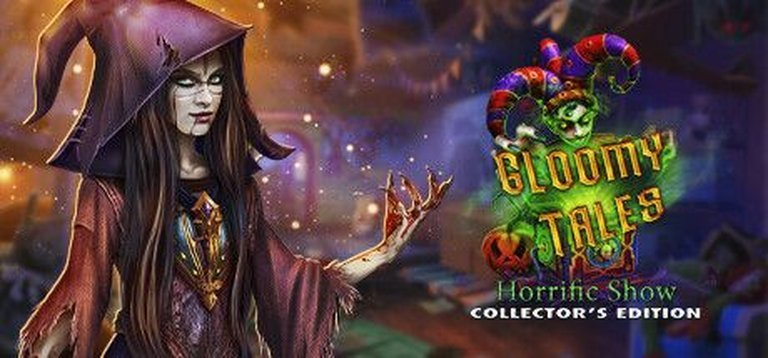
Description
Gloomy Tales: Horrific Show (Collector’s Edition) is a fantasy adventure game set in a magical traveling circus, where players engage in hidden object puzzles and exploration to solve a mysterious disappearance and protect their sister from malevolent forces. With a first-person, point-and-click interface, the game offers a story-rich experience in a hand-drawn, atmospheric environment, enhanced by the Collector’s Edition’s extra content.
Where to Buy Gloomy Tales: Horrific Show (Collector’s Edition)
Gloomy Tales: Horrific Show (Collector’s Edition) Guides & Walkthroughs
Gloomy Tales: Horrific Show (Collector’s Edition): A Forgotten Corner of the Casual Horror Pantheon
Introduction: The Allure and Obscurity of the Hidden Object Horror
In the vast, overcrowded ecosystem of digital storefronts, where thousands of new titles vying for attention each year, some games are designed to be landmarks, others to be fleeting sensations. Then there are the workhorses: the reliable, formulaic, and numerous entries in genres that operate on a different economic and design plane. Gloomy Tales: Horrific Show (Collector’s Edition), released by the prolific Bulgarian studio Do Games Limited in October 2022, is a quintessential example of the latter. It is a game that exists not to redefine its genre, but to perfectly满足 its core audience’s expectations within the well-worn confines of the hidden object puzzle adventure (HOPA). This review will argue that while Horrific Show offers negligible innovation and is historically insignificant as a standalone artifact, it serves as a vital, if unspectacular, data point in understanding the modern casual gaming landscape—a landscape built on series-driven production, low technical barriers, and the relentless pursuit of a comforting, cyclical gameplay loop. Its legacy is not one of critical acclaim or cultural impact, but of industrial persistence.
Development History & Context: The Do Games assembly line
Do Games Limited, operating under various other monikers like Domini Games and GameHouse Studios, is a titan of the casual and mid-core market, particularly on PC and mobile platforms. With a back catalog stretching back over a decade, they have perfected a development pipeline focused on volume, genre consistency, and efficient asset reuse. The Gloomy Tales series itself, of which Horrific Show is an early entry (preceded by titles like Cavemen Tales and followed by One-Way Ticket and Hotel Frightsylvania), represents a thematic branding shift from their earlier Mystery Tales series, likely an attempt to carve out a niche in the Halloween/limited-time horror seasonal market.
The technological context is telling. The game’s system requirements (Windows 7/8/10, 1-2 GHz processor, 1-2 GB RAM, DirectX 9) place it squarely in the era of accessible, low-fidelity development. It targets integrated graphics and decade-old hardware, ensuring maximum compatibility for its demographic: older PC users and casual players who may not have gaming rigs. The “Fixed / flip-screen” visual perspective and “Hand-drawn” user tag, as cataloged on MobyGames and Steam, point to a 2D, pre-rendered or digitally painted art style—cost-effective to produce and easy to scale across resolutions. This is not a game pushing engines like Unity or Unreal to their limits; it is a product built on a stable, proprietary or licensed casual game engine (likely something akin to the Adventure Game Studio or a custom Do Games framework), optimized for rapid asset insertion.
The 2022 release placed it in a post-pandemic market where casual gaming on PC (via Steam, GOG, and their own portals) was booming, but also facing saturation. The “Collector’s Edition” model is the industry standard for HOPAs: it bundles the base game with a bonus chapter, collectibles (circus coupons), extra puzzles, and achievement hunting. This model transforms a $4.79 experience (its frequent Steam sale price) into a perceived $7.99 value, encouraging completionism in a genre where players often “consume and discard” titles quickly. Do Games’ output is less about singular artistic vision and more about maintaining a steady stream of recognizable products to satisfy a loyal, subscription-based audience (through services like GameHouse and Big Fish Games).
Narrative & Thematic Deep Dive: A Circus of Clichés
The plot, as distilled from the Steam store description and MobyGames blurb, is a masterclass in economical, trope-driven storytelling:
The Catalyst: A traveling circus arrives in Seattle for Halloween. The protagonist’s sister, Annabelle, is eager to see the “real zombies and monsters” performing.
The Inciting Incident: During a disappearing act, Annabelle volunteers on stage. The circus tent catches fire. In the chaos, she vanishes.
The Descent: The protagonist, trapped in the burning tent, escapes and begins searching for Annabelle, only to be deliberately impeded by the sinister circus owner.
The Revelation: The search leads into a “world of nightmares,” implying a supernatural or psychological distortion of reality.
The Stakes: The sister must be saved by “defeating monsters and finding hidden artifacts.”
This narrative skeleton is fleshed out minimally through text-based exposition and brief character interactions. There is no evidence of voice acting depth or complex character arcs. The circus owner is a mustache-twirling antagonist; Annabelle is a pure damsel-in-distress motivation. The “world of nightmares” is a device to justify the game’s visual aesthetic—a collision of festive circus motifs (colorful tents, props, posters) with horror tropes (zombies, monsters, dark, twisted environments). The thematic core is a simple, effective one for its audience: familial love tested by supernatural adversity, with a heavy dose of Halloween spirit.
The “Bonus Chapter,” a standard Collector’s Edition feature, introduces a parallel-world threat to the hometown, a common trope in the series that expands the lore without substantial connection to the main plot. It serves primarily as an additional gameplay container rather than a narrative deepening. The story’s function is purely utilitarian: to justify the sequence of hidden object scenes (a burning tent, a nightmare circus backlot, a monster-infested big top) and puzzle environments. Its lack of ambition is not a flaw within its genre context; it is a design prerequisite, allowing players to focus on the core mechanics without narrative distraction.
Gameplay Mechanics & Systems: The HOPA Blueprint Executed
Gloomy Tales: Horrific Show is a pure, unadulterated Hidden Object Puzzle Adventure. Its gameplay loop is rigidly defined and executed with competent professionalism:
1. Core Loop: The player navigates a series of static, beautifully illustrated 2D scenes (the “worlds”). Each scene contains dozens of items from a list. The player must find and click these items. This is the primary activity, satisfying a basic cognitive itch of pattern recognition and visual search.
2. Puzzle Integration: Finding hidden objects often yields inventory items used to solve puzzles within the scene or in adjacent areas. These puzzles are standard HOPA fare: tile-matching (“Match 3” as tagged on Steam), sliders, mechanical assembly (find a key to open a box), and object-use puzzles (use the found hammer to break a crate). The “intriguing puzzles and mini-games” mentioned in the description are, by genre standards, straightforward and rarely opaque, ensuring a smooth, frustration-free experience.
3. Progression & Collectibles: Progression is linear and scene-based. To advance, players must complete a certain number of hidden object searches and puzzles per area. The “circus coupons” serve as an optional collectible system. Scattered throughout scenes, they allow purchase of “props for your own show” in a separate, trivial cosmetic or collection interface. This is a classic “collectathon” mechanic to encourage thorough exploration and replayability of scenes, extending playtime without adding complexity.
4. Interface & UX: The “Point and select” interface is the genre standard. The cursor changes to indicate interactable hotspots. Inventory is typically a accessible tray. UI is clean, with objectives clearly listed. The “First-person” perspective is a misnomer in a traditional sense; it means the player views the scene as if standing in it, not as an omniscient observer, but movement is restricted to clicking to transition between fixed camera angles (the “Fixed / flip-screen” perspective). This design prevents motion sickness and simplifies asset creation.
5. Innovation or Flaws? There is no meaningful innovation here. The systems are a carbon copy of hundreds of other HOPAs from developers like Artifex Mundi, Brave Giant, and indeed, Do Games’ own extensive library. The “flaws” are inherent to the genre: the gameplay is inherently repetitive, the puzzles are simple, and the narrative is an afterthought. For its target audience, these are not flaws but features—predictable, relaxing, and devoid of penalty or pressure. The mixed Steam reception (43% positive from 16 reviews) likely stems from players outside this core audience expecting more interaction or depth, or from performance issues on “newer Windows 11 systems” as warned on the GameHouse page—a common problem with older, less-optimized casual game engines.
World-Building, Art & Sound: A Charming, Safe Horror Aesthetic
This is where the game likely invests most of its creative capital, as is typical for HOPAs. The “Hand-drawn” and “Colorful” tags are accurate. The art direction creates a specific dichotomy: the vibrant, almost whimsical aesthetic of a classic circus (bright reds, yellows, striped tents) contrasted with a darker, “nightmare” palette (muted purples, greens, shadows, grotesque monster designs). The “Atmospheric” tag is earned through meticulous scene composition—smoke, lighting effects (the burning tent), and clutter that tells a micro-story in each static image.
The “world of nightmares” is not a survival horror landscape but a themed playground. Monsters are cartoonish rather than terrifying (zombies with exaggerated features, shadow creatures). This aligns with the “Family Friendly” tag, targeting a broad age range (older children to adults) who enjoy spooky but not traumatizing themes. The sound design, while not detailed in sources, would follow the formula: a light, mysterious musical score punctuated by ominous tones during object searches, simple sound effects for interactions (clinks, creaks, monster growls), and potentially a narrated story text (the “Narration” tag).
The setting—a traveling circus—is a PERFECT thematic fit for the HOPA format. Circus environments are inherently dense with objects: props, costumes, trunks, food stalls, cages, and backstage clutter. This provides a logically rich and visually varied playground for hidden object scenes. The transition from “real” circus to “nightmare” circus allows for creative liberty in placing fantastical objects (monster eyes, cursed tickets, magical artefacts) without breaking the scene’s internal logic.
Reception & Legacy: The Quiet Hum of the Assembly Line
At launch, Gloomy Tales: Horrific Show was a non-event in the mainstream gaming press. No major outlets covered it. Its reception is confined to its storefront pages and the aggregate of its genre’s community. The Steam review score is “Mixed” (7 positive, 9 negative as of data collection), a common score for niche HOPAs. Positive reviews will praise its relaxing gameplay, nice art, and appropriate difficulty. Negative reviews will likely critique its simplicity, short length, or perceived lack of “game” beyond object hunting.
Its commercial performance is not public, but its inclusion in multiple bundles (Halloween Mysteries, Gloomy Tales Deluxe Edition) and its persistent low-price availability indicate it met the low-risk, high-volume sales targets of its publisher. It is a product that recoups its modest development costs through bundle sales and regional pricing (notably on GOG and regional Steam storefronts).
Its legacy is intra-genre and industrial:
1. Series Proliferation: It established the thematic template for subsequent Gloomy Tales games (circus, parallel worlds, monsters-as-entertainment). Hotel Frightsylvania and One-Way Ticket follow the same structural and narrative blueprint.
2. Genre Archetype: It represents the late-2020s evolution of the HOPA: visually polished, thematically cohesive, packed with bonus content, and marketed as a complete ” Collector’s Edition” experience from day one. It is a refinement, not an evolution, of a formula solidified in the late 2000s/early 2010s.
3. Preservation Question: Its presence on GoG’s “Dreamlist” and MobyGames entry signals a growing, if slow, academic and archival interest in documenting the vast output of the casual game sector. Games like this are the invisible majority of digital game sales, yet they are almost entirely absent from historical discourse. Cataloging them is the first step to understanding the full tapestry of the medium.
Conclusion: A Competent Artifact in an Overlooked Ecosystem
Gloomy Tales: Horrific Show (Collector’s Edition) is not a game that belongs in conversations about narrative mastery, mechanical innovation, or artistic boundary-pushing. Judged by the standards of “core” gaming, it is lightweight, repetitive, and simplistic. To judge it thus, however, is to fundamentally misunderstand its purpose and its audience.
It is a expertly crafted piece of functional entertainment within its specific niche. It delivers a coherent, Halloween-appropriate theme, a substantial collection of hidden object scenes, a suite of accessible puzzles, and a bonus chapter—all at a price point that feels like a fair transaction for hours of quiet, methodical play. Its development history reveals a studio operating at peak efficiency in a stable market segment. Its mixed reception highlights the cultural divide between genres.
Its ultimate place in video game history is as a representative specimen. It is a clear, modern example of the hidden object puzzle adventure in its matured, corporate form. For scholars of casual game design, it is a textbook case of genre conventions. For archivists, it is a data point in the massive, undocumented output of the 2020s. For the player seeking a specific, calming type of engagement, it is a perfectly adequate and charming—if entirely forgettable—way to spend an evening. Its valor lies not in greatness, but in its quiet, efficient embodiment of a enduring and economically vital genre. It is not a hidden gem; it is a perfectly visible, polished, and functional cog in a machine that hums along, largely unnoticed, but never stops.