
- Release Year: 2007
- Platforms: Windows
- Genre: Adventure
- Perspective: 3rd-person (Other)
- Game Mode: Single-player
- Gameplay: Click-and-point, Puzzle
- Setting: Family
Description
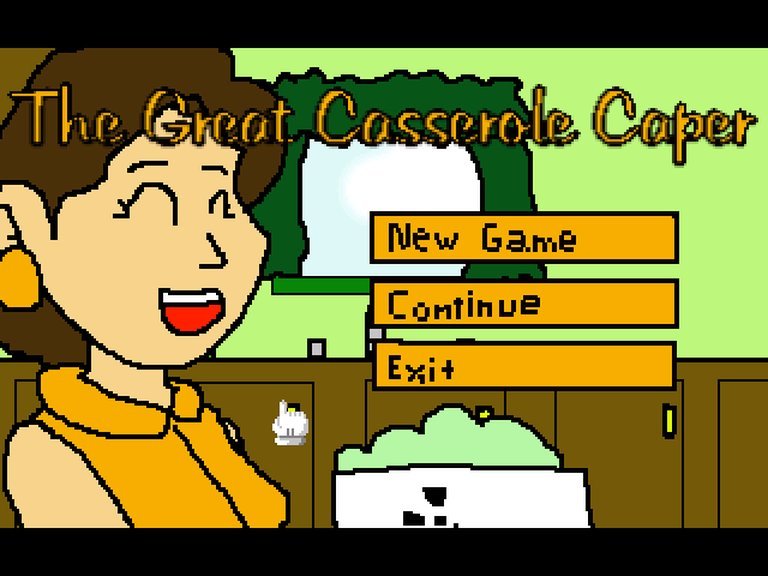
The Great Casserole Caper is a free 2D point-and-click adventure game set in a contemporary family Easter dinner. Players take on the role of Jeffrey McCracken, a young boy who must sabotage his aunt’s mysterious Casserole-O-Matic machine after discovering it produces toxic food, all while evading his aggressive uncles who are determined to catch him. The game incorporates puzzle-solving and inventory management, built with Adventure Game Studio.
The Great Casserole Caper Free Download
The Great Casserole Caper Reviews & Reception
adventuregamestudio.co.uk : This was a really great game, it was funny and was a lot of fun to play, i recommend it.
The Great Casserole Caper: An Obscure Artifact of Amateur Adventure Game Genius
Introduction: A Dish Best Served Weird
In the vast, often-forgotten archives ofPC gaming, where countless freeware and shareware titles flicker like half-remembered dreams, there exists a peculiar and pungent gem: The Great Casserole Caper. Released in the summer of 2007, this point-and-click adventure game is not a commercial blockbuster nor a critically lauded indie darling. Instead, it is a pure, unfiltered expression of the do-it-yourself spirit that flourished in the mid-2000s, powered by the democratizing engine of Adventure Game Studio (AGS). Created by a lone developer under the pseudonym “nick.keane” for the AGS community under the banner “Stunning Interactive,” the game is a surreal, grotesque, and hilarious satire of family dysfunction and holiday horror. This review posits that The Great Casserole Caper is a significant cultural artifact—not for its polish or widespread influence, but as a potent case study in grassroots game development, a showcase of AGS’s creative potential, and a wildly original narrative that embraces absurdity with a传染性的 fervor. It stands as a testament to the idea that a compelling vision, executed with passionate idiosyncrasy, can carve out a permanent, if niche, place in gaming history.
Development History & Context: The AGS Ecosystem and the Rise of the Amateur Auteur
To understand The Great Casserole Caper, one must first understand the ecosystem that birthed it: the Adventure Game Studio community. In the late 1990s and 2000s, AGS emerged as the premier tool for aspiring designers to create LucasArts- and Sierra-style graphic adventures without needing a programming team or a budget. It was a community-driven project that fostered a unique culture of sharing assets, scripts, and tutorials. By 2007, AGS had produced a string of professional-quality titles like Ben Jordan: Paranormal Investigator and The Misadventures of P.B. Winterbottom, proving the engine’s capability.
Into this fertile ground stepped “nick.keane,” later identified in credits as the sole creator responsible for story, graphics, music, and scripting. The game’s development was a classic AGS success story: a solo passion project built in an accessible engine, shared freely with a dedicated online community. The constraints were those of the era and the tool: a fixed 320×200 resolution with 16-bit color, a scripting language (AGS Script) that was powerful but required a steep learning curve, and entirely self-produced pixel art and MIDI music. These technical limitations did not stifle creativity; they seemed to fuel it, forcing a focus on strong writing, memorable visual gags, and puzzles rooted in a twisted logic rather than graphical fidelity.
The gaming landscape of 2007 was dominated by the seventh generation of consoles and the rising tide of digital distribution. For the adventure genre, it was a period of quiet resurgence after the 1990s collapse. The Great Casserole Caper arrived not as a competitor to Sam & Max or The Walking Dead, but as a love letter to the older point-and-click format, infused with internet-age absurdist humor. Its release as freeware via the official AGS website and its subsequent preservation on platforms like the Internet Archive cemented its status as a monument to the “share your creation” ethos that defined that corner of the industry.
Narrative & Thematic Deep Dive: A Symphony of Surreal Dysfunction
The plot of The Great Casserole Caper is deceptively simple: a boy must sabotage a malevolent kitchen appliance at his aunt’s Easter dinner. Yet, the execution is where the game’s true narrative brilliance lies. The story, as outlined in the AGS description, is a masterclass in escalating absurdity. Protagonist Jeffrey McCracken is not a brave hero but a reluctant, whiny child, a choice that immediately grounds the game in a relatable, if unflattering, perspective. His nemesis is not a dark lord but family: the seemingly innocent Aunt Edna and the terrifying Uncle Rigatoni, whose very name evokes a cartoonish, food-based menace.
Thematic depth emerges from this bizarre setup. The Casserole-O-Matic is more than a MacGuffin; it is a symbol of soulless, industrialized domesticity and the hidden toxicity beneath the facade of familial tradition and holiday cheer. The machine’s “toxic” output literalizes the poisonous dynamics of the McCracken clan. Jeffrey’s mission becomes an act of subterfuge against the very institutions of family and ritual.
The supporting cast is a rogues’ gallery of grotesque caricatures, each representing a different facet of dysfunctional family archetypes:
* Uncle Rigatoni: The hyper-masculine, violent patriarch, a “testosterone-fueled” threat whose uncles “want to beat the crap out of you.”
* The Obese Uncle with an IQ of 16: A figure of gluttonous stupidity, embodying mindless consumption.
* The “Sickeningly Sweet” Cousin: An embodiment of cloying, insincere affection, a sugar-coated menace.
* Grandpa the Wannabe Rap Idol: A generation lost in delusional self-aggrandizement, providing moments of surreal comedy.
The dialogue and writing, as noted by player “jkohen,” are a double-edged sword. They are undeniably creative and often hilarious in their sheer audacity (“sadistic device fouler than anyone alive could comprehend”), but they sometimes lack the character-establishing depth that would make players care about Jeffrey beyond his immediate predicament. The protagonist’s whining, as jkohen observes, can grate, which is perhaps a deliberate choice—Jeffrey is meant to be an irritating, every-kid thrust into an insane situation. The game’s true narrative success is in world-building this specific, over-the-top family and its insane holiday scenario, creating an atmosphere where the next room might contain a macaroni-based character or a turkey harness, as praised by user “tinkerer.” It’s a world where the logic is familial chaos.
Gameplay Mechanics & Systems: Inventory Shenanigans and Puzzle Logic
As a 2D click-and-point adventure, The Great Casserole Caper adheres closely to the genre’s classic template while injecting its own chaotic spirit. Core loops involve exploring the multiple screens of the McCracken house (exterior, living room, kitchen, etc.), examining scenes, conversing with the bizarre family members, collecting items into an inventory, and using/combining them to solve puzzles and progress.
The inventory system is straightforward but functional, displayed at the bottom of the screen. The game supports both mouse and keyboard, though the mouse-driven interface is the primary intended control method. The puzzle design is the game’s most discussed and divisive aspect. Reviewers note that puzzles can be “pretty weird” and sometimes “don’t make sense at all,” leading to moments where players “strayed from one place to another wondering what you were supposed to do.” This is the inherent risk of an adventure game built on surreal, family-centric logic. A solution involving a “turkey harness” or interacting with a sentient macaroni character exists within the game’s internal, absurdist rule set, which may not align with a player’s conventional logic. For some, this is a charming, creative challenge (“Some really nice ideas here”); for others, it’s a frustrating, opaque barrier.
The game’s length is noted as “Medium Length” on AGS, and user “jkohen” confirms it is “pretty long and varied,” suggesting a substantial number of screens and puzzle chains. However, the “grand end sequence” is implied to be truncated, with tinkerer speculating the developer “ran out of time.” This points to a common trait in ambitious AGS projects: a brilliant, sprawling middle section that can’t quite stick the landing due to scope or resource constraints. The game over condition—being caught by an uncle who wants to “beat the crap out of you”—is a simple, stark failure state that reinforces the constant, low-grade threat of the family, blending puzzle-solving with stealth/evasion tension.
World-Building, Art & Sound: The Charm of the Low-Res Liminal Space
Visually, The Great Casserole Caper is a product of its engine and era. The 320×200 resolution and 16-bit color palette create a charmingly chunky, pixelated aesthetic. The art, all created by nick.keane, is competent and expressive within these limits. Character sprites are simple but distinct, conveying their exaggerated personalities—the rotund uncle, thezigzag-haired grandpa, the innocent Jeffrey. The backgrounds, depicting the messy, lived-in McCracken house, are filled with details that sell the dysfunctional atmosphere: overflowing trash, strange decorations, the ominous Casserole-O-Matic itself. The art style doesn’t aim for realism; it aims for caricature, and it succeeds.
The sound design and music are equally lo-fi but effective. Comprising likely self-produced MIDI tracks, the score is jaunty, eerie, or comically dramatic, perfectly underscoring the game’s tonal shifts from slapstick to slight horror. The sound effects are minimal but functional, providing auditory feedback for actions. Together, the visuals and audio create a cohesive, if crude, universe that feels intentionally stylized rather than technically limited. This “liminal space” of early-millennium amateur AGS art has a strong nostalgic appeal for genre veterans and an undeniable quirky charm for newcomers.
The atmosphere is a unique blend: the cozy, investigate-everything vibe of a classic adventure game is constantly undercut by the pervasive sense of dread and absurdity emanating from the NPCs and environment. You are not exploring a haunted castle but a suburban home that feels profoundly wrong. This dissonance is the game’s greatest atmospheric achievement.
Reception & Legacy: A Cult Classic in the Making
The Great Casserole Caper exists almost entirely outside the traditional critical and commercial canon. It has no MobyScore and only a handful of player reviews on aggregators like MobyGames and the AGS forums. Its reception was quiet, confined to the AGS community itself. The available user feedback is positive but measured: “This was a really great game, it was funny and was a lot of fun to play” (MadEvie), balanced by critiques of puzzle opacity and character relatability.
Its legacy is not one of mainstream influence but of preservation and community esteem. Its inclusion on the Internet Archive and the Adventure Game Database ensures its survival as part of the digital heritage of independent adventure games. The fact that a user from the French AGS forum sought to translate it in 2009 indicates it had a small, international audience within the niche AGS sphere. Furthermore, its existence spawned a literal sequel: the blog post for The Great Casserole Caper…EXTREME! confirms a comic book continuation, extending the McCracken family’s saga into another medium. This is the hallmark of a true cult property—a world deemed worthy of expansion by its creator and fans.
In the grand tapestry of video game history, its influence is subtle. It exemplifies the power of accessible tools (AGS) to enable singular creative voices. It shares DNA with other offbeat, family-horror comedies like Psychonauts (in spirit) and the cult classic Day of the Tentacle (in its absurdist puzzle logic). Its legacy is that of a perfectly preserved time capsule of a specific moment in indie game development: when a passionate individual could create and distribute a complete, weird, and personal game to a global audience with virtually no barrier to entry.
Conclusion: A Deliciously Strange Relic
The Great Casserole Caper is not a masterpiece by conventional metrics. Its narrative, while original, can feel emotionally thin. Its puzzles, while creative, can frustrate. Its production value is that of a bedroom project. Yet, to dismiss it on these grounds is to misunderstand its fundamental purpose and achievement. It is a game that screams its creator’s personality from every pixel and line of dialogue. It is a concentrated dose of surreal, familial satire wrapped in the comforting, clickable shell of a classic adventure game.
Its place in history is secure as a paragon of the amateur AGS movement. It demonstrates that a compelling core concept—”What if your family’s Easter dinner was run by a toxic cooking machine and your uncles wanted to beat you up?”—paired with dedicated execution within a community-focused engine, can result in a memorable and enduring experience. It is a game remembered not for its polish, but for its pungent, unforgettable flavor. For historians of the indie scene, it is essential study: a reminder that behind every major studio release lies a sprawling universe of homemade, heartfelt, and gloriously weird creations like this one, waiting in the digital archives for the next curious player to click on. It may not be the best story ever told in a game, as lists on sites like Den of Geek celebrate, but it is certainly one of the most uniquely and defiantly itself.