
- Release Year: 2007
- Platforms: Android, iPad, iPhone, Windows
- Publisher: ak tronic Software & Services GmbH, BC Soft Games, G5 Entertainment AB, Merscom LLC, S.A.D. Software Vertriebs- und Produktions GmbH
- Developer: BC Soft Games
- Genre: Adventure
- Perspective: 1st-person
- Game Mode: Single-player
- Gameplay: Hidden object, Mini-games, Puzzle elements, Spell casting
- Setting: Fantasy
- Average Score: 67/100
Description
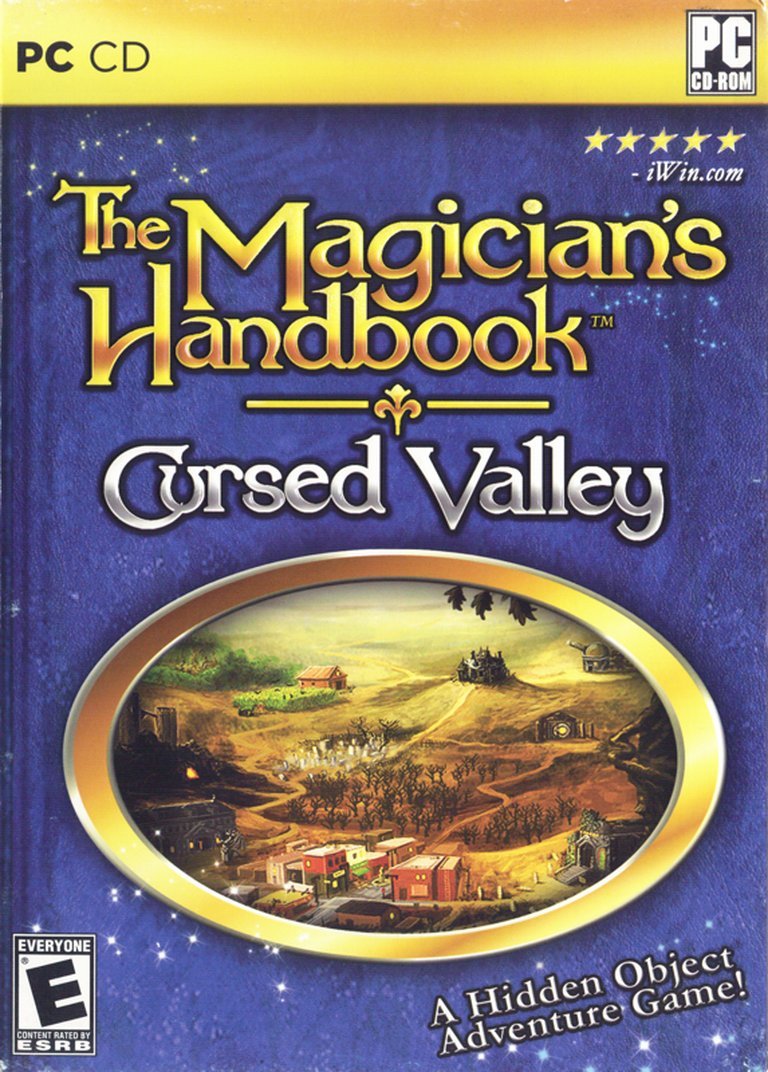
The Magician’s Handbook: Cursed Valley is a fantasy hidden object adventure where an apprentice magician must lift an evil spell haunting a cursed valley by using spells from a magical handbook. Players explore hand-painted backgrounds across thirteen chapters, finding hidden items with a wand cursor, managing time limits, and utilizing spells like Reveal and Repel, while engaging in mini-games such as potion mixing and magical chants to progress through mystical locations.
Gameplay Videos
The Magician’s Handbook: Cursed Valley Free Download
The Magician’s Handbook: Cursed Valley Guides & Walkthroughs
The Magician’s Handbook: Cursed Valley Reviews & Reception
metacritic.com (71.67/100): It’s all fine but nothing more than average.
gamezebo.com : Unfortunately, Cursed Valley wastes your good graces by hiding many of its objects too well.
The Magician’s Handbook: Cursed Valley: A Spellbook of Missed Opportunities
In the bustling marketplace of mid-2000s casual games, the hidden object genre was a dominant force, a comforting and accessible digital hearthside for millions. Within this crowded field, The Magician’s Handbook: Cursed Valley (2007) emerged not with a revolutionary shout, but with a whispered promise of arcane mystery and handcrafted beauty. Developed by the obscure BC Soft Games and helmed by a single visionary, Bryce Carroll, the game sought to weave a cohesive fantasy narrative into the then-standard formula of finding disparate objects on static screens. This review will argue that while Cursed Valley is a game of considerable charm and atmospheric ambition, its ultimate legacy is that of a flawed artifact—a title whose innovative ideas and artistic heart are consistently undermined by frustrating design choices and a fundamental misunderstanding of player comfort, leaving it a fascinating “what-if” rather than a cornerstone of the genre.
1. Introduction: The Allure of the Arcane
At a time when hidden object games (HOGs) often felt like assembly-line productions—packing lists of idle trinkets into generic, photorealistic scenes—The Magician’s Handbook: Cursed Valley presented a tantalizing alternative. Its premise was pure,pulp-inflected fantasy: an apprentice wizard, having bought a dubious “mail-order spellbook” from a late-night infomercial, must travel to a blighted land to lift an ancient curse by finding enchanted objects. This framing, blending mundane modern humor with classic sword-and-sorcery lore, immediately set it apart. The game’s thesis, then, is its core mechanical gimmick: the act of searching is not merely a task, but a magical ritual. The objects you find are spell components, and your success directly empowers your wizard, creating a meta-narrative of progression that the genre rarely attempted. This review will examine how this vision was realized—and often compromised—across its narrative, systems, and presentation.
2. Development History & Context: One Man’s Wizard’s Tower
The Magician’s Handbook is theproduct of a micro-studio operating at the very edge of the industry’s雷达 (radar). The credits, painstakingly listed on MobyGames, reveal a project led almost entirely by Bryce Carroll (Producer, Lead Programmer, Concept, Design). Art was outsourced to entities like “Arsorson Studios” and “Talking Donkey Production,” with sound from dedicated audio houses like SoundRangers. This structure was typical of the era’s casual game development: a central creative driving force coordinating a patchwork of specialized freelancers.
The game was built using PopCap’s framework, a significant clue. PopCap Games (Bejeweled, Peggle) was the gold standard for polished, accessible casual mechanics. By licensing their engine, BC Soft Games signaled an ambition for mainstream appeal and technical stability, but also a constraint: the game’s architecture was likely designed for simplicity and rapid prototyping, not for the nuanced interaction or high-fidelity visuals the team perhaps desired. This technical bedrock explains the game’s functional, if unspectacular, UI and its reliance on a static-screen format.
Crucially, Cursed Valley arrived in 2007, at the absolute zenith of the downloadable hidden object boom. Publishers like Big Fish Games and G5 Entertainment (who would later publish mobile ports) were saturating the market. To stand out, a game needed either a killer license (like Nancy Drew or Mystery Case Files) or a unique hook. Cursed Handbook chose the latter, betting on its thematic integration and hand-painted art. However, as noted by critics like GameZebo and 148apps, this proved insufficient to overcome the sheer volume of competition, with many players feeling a profound sense of deja vu (“the formula… is starting to get a bit tired”).
3. Narrative & Thematic Deep Dive: A Tale of Two Wizards and One Infomercial
The game’s story is its most clever and consistently praised element, a framework that elevates the object-finding from chore to lore. The narrative, pieced together from the game’s chapter transitions and the detailed walkthrough from Casual Game Guides, unfolds as a classic morality tale.
- The Premise: You are an everyman, bored at your “day job,” who succumbs to a cheesy infomercial for the Magician’s Handbook. This immediately establishes a tone of self-aware, lighthearted humor—the fantasy is purchased, not innate. The price point (“$19.95”) is even joked about, rooting the epic quest in commercial reality.
- The Core Conflict: The valley’s curse stems from a fallen student of a benevolent “Great Magician.” Spurned and embittered (the walkthrough humorously notes “a gallon of ice cream and a lifetime movie didn’t help him”), this “Dark Wizard” unleashes a series of escalating curses: animating books and trees, poisoning treasure, summoning a dragon. Each chapter corresponds to learning a spell that counters one of his actions, turning your progress into a direct counter-offensive.
- Thematic Layers: The story explores themes of resentment, the responsible use of power, and redemption through knowledge. The Dark Wizard’s flaws are petty jealousy and a desire for domination. The Wise Wizard’s responses are clever, non-violant counters (e.g., teaching people to command the animated books to “scram” Mary Poppins-style). The final confrontation involves the Dark Wizard’s overreaching with “dark rune stones,” a classic fantasy trope about power consuming its user. The narrative’s strength is its escalation and cause-effect structure. You aren’t just finding items; you’re learning why the valley is cursed and how each spell you earn fits into the magical duel.
- Limitations: The delivery is almost entirely textual, relegated to chapter intro/outro screens and item names. There are no voice-overs or significant character interactions beyond the implied duel. The “humor” noted by The A.V. Club is largely confined to the initial premise and some whimsical item names (spells with “Harry Potter-esque” titles), but it rarely deepens. It’s a solid, functional B-plot that serves the gameplay, but rarely transcends it.
4. Gameplay Mechanics & Systems: Spells and Frustration
This is where the game’s ambition most visibly stumbles and innovates in equal measure.
- Core Loop: Standard HOG fare: a static, cluttered scene, a list of 10-15 items to find within a time limit, using a wand cursor. The primary innovation is the spell system integrated into the search.
- Reveal Spell (The Hint System): Instead of a generic sparkle, it’s a magical “eye” on your crystal ball that precisely highlights one object. Its scarcity (starting at 2 per chapter, earnable via good grades) is a brilliant design choice, making hints a precious strategic resource rather than a crutch.
- Repel Spell: This is a genuinely unique mechanic. It banishes “distractions”—flying books, skittering spiders, glowing orbs—that clutter the scene and obscure items. It also illuminates pitch-black areas (like the Dungeon). This creates a dynamic tension: do you use your limited Repel cast to clear the visual noise, or save it for the next dark room? It directly ties a game ability to environmental storytelling (the curse’s “darkness”).
- Progression & Grading: After each chapter’s 2-3 locations, you’re graded (A+ to F). Speed and minimal hint use improve your grade. A better grade increases your starting Reveal spells for the next chapter. This creates a meta-game of efficiency that skilled players can exploit, rewarding mastery. However, the grading also exacerbates frustration; a single missed item due to poor visibility can tank your grade, feeling profoundly unfair.
- The Mini-Games: These are the game’s most divisive element. They break the monotony but are critically flawed.
- Potion Mixing (Match-3): A grid of ingredient tiles requires you to draw lines through 3+ matching items to fill a potion jar. It’s simple, mindless, and as GameZebo noted, “the mini-games lack magic.” It’s functional filler.
- Magical Chant (Word Assembly): Word fragments of varying font, size, and color float around the screen. You must select them in order to spell a phrase at the bottom. The walkthrough compares it to “poetry magnets,” which is apt. It’s more engaging than match-3 but suffers from extreme repetition (you’ll play it 13 times). Its difficulty arises not from puzzle logic, but from visual clutter and the fragments’ movement, making it more of a frantic hidden object challenge in itself. As 148apps stated, “nothing makes it stand out… not even the attractive hand-painted backgrounds,” and these mini-games are a prime example.
- Collectibles & Secrets: The game includes two layers of optional collection: 36 Magician’s Coins (unlock cosmetic secrets like a pink wand) and Hidden Handprints (recharge your Repel spell). These encourage exploration and replay, a nice touch for completionists, though their extreme obscurity (some only visible in later chapters) can feel punitive rather than rewarding.
- Critical Flaws – The Visibility Crisis: This is the game’s Achilles’ heel, consistently cited across all reviews.
- Poor Object Design & Scaling: As GameVortex brutally noted, items “are often nowhere near the size they should be” and “obscured in complete darkness.” Objects blend into backgrounds due to overly similar color palettes or are rendered as indistinguishable “smudges.” This isn’t about clever hiding; it’s about poor visual communication.
- Non-Randomization: GameZebo correctly identified that “the lack of item randomization allows you to memorize where things are.” This destroys replay value and makes the “leveling up” by finding extra items trivial on repeat visits, undermining the core challenge.
- Aggressive Distractions: While the Repel spell concept is smart, its implementation is often cruel. The “distractions” (loud sounds, frenetic animations) as per GameVortex can be “straight up aggravating,” and the Repel’s long recharge time forces you to endure them, making some scenes actively unpleasant.
5. World-Building, Art & Sound: The Hand-Painted Mirage
Here lies the game’s greatest strength and one of its most poignant failures.
- Visual Direction & Art: The game’s signature is its hand-painted backgrounds. This was a deliberate, risky choice in an era increasingly favoring photorealistic stock photos. The result, when viewed in stills, is lovely: there’s a warm, storybook-gothic quality to the Cemetery, Wizard’s Lab, Haunted House, and Creatures of Magic Museum. The art direction evokes a cohesive, magical world that feels designed, not just scanned. The A.V. Club subtly praised this “attractive hand-painted backgrounds.”
- The Fatal Flaw: Interaction & Clarity. The hand-painted style, however, is catastrophically ill-suited to the hidden object mechanic. Photorealistic photos provide natural texture and shadow that can hide objects plausibly. Hand-painted scenes, with their often uniform brushstrokes and limited texture detail, make it impossible to distinguish a “hidden” object from a background element unless it is starkly different in color or form. As Adventurespiele succinctly stated in German: “the hidden object scenes… are displayed quite blurry.” The artist’s beautiful composition works against the player’s eyes. Scale issues in the HD ports (GameVortex) magnified this problem, making some items microscopic.
- Sound Design: The approach is functional. Peter King’s in-game music is described as “angenehm und passend” (pleasant and appropriate) by Adventurespiele, providing a low-key, mysterious atmosphere. Sound effects for spells and interactions are clear. However, the “distractions” sound effects are widely panned as annoying and immersion-breaking, serving only to frustrate rather than enhance the cursed atmosphere.
6. Reception & Legacy: A Niche Curio
- Critical Reception at Launch: The game’s Metacritic/Moby average of 61% reflects its deeply split nature.
- Positives focused on the charming premise, hand-painted art, and the clever Repel/Reveal spell integration (The A.V. Club’s 75%).
- Negatives were almost universally about frustrating object clarity, repetitive mini-games, and overall lack of innovation beyond the skin-deep theme (GameZebo’s 50%, Adventurespiele’s 40%).
The iPhone/iPad ports (published by G5 Entertainment in 2012) received a slightly higher average (~72%), possibly due to a more casual audience accustomed to touch-screen fumbling or a slightly adjusted difficulty, but the core criticisms remained unchanged.
- Commercial Performance & Legacy: As a shareware title sold via download and CD-ROM, it likely found a modest audience among hidden object completists but was utterly overshadowed by giants like Mystery Case Files or Drawn series. Its most significant legacy is its direct sequel, The Magician’s Handbook II: BlackLore (2009), developed by a largely same team (carrolls and Jaeks). This sequel suggests a small, dedicated fanbase or a publisher willing to bet on the formula again, but it did not break through.
- Influence: The game had no discernible influence on the broader industry. Its spell-integration concept was not adopted by major HOG franchises. It remains a curio—a game that tried, and failed, to meaningfully weave narrative into its mechanics beyond surface dressing. Its place in history is as a well-intentioned, artistically distinct but fundamentally flawed entry in the casual game boom, emblematic of the struggles small studios faced in a genre increasingly dominated by production value and brand recognition.
7. Conclusion: The Unbroken Curse of Clarity
The Magician’s Handbook: Cursed Valley is a game of profound contrasts. It possesses a thematic coherence most HOGs lack, framing every click as a step in a magical education. Its hand-painted world offers a unique, warm aesthetic in a genre of cold digital photography. The Repel spell is a genuinely interesting mechanic that interacts with the environment.
Yet, these strengths are systematically dismantled by its core technical failure: the inability to clearly present the objects players are meant to find. No amount of narrative charm can compensate for squinting at a blob that might be a “candlestick” or a “mushroom” because the artist’s style and the game’s scaling erased defining details. The grading system, which rewards speed and penalizes hint use, becomes a punishment for the player’s eyes, not their skill. The mini-games, while breaking monotony, are forgettable chores.
Verdict: 6/10 – A competent, charming, and ultimately frustrating footnote. For the historian, Cursed Valley is a vital case study in how artistic vision can be sabotaged by fundamental UX and clarity failures. For the player, it is a lesson in patience—a game whose magical world is constantly at war with its own obscure execution. It did not break the curse of its valley, and it did not break the mold of its genre. Instead, it remains a beautifully bound but infuriatingly cryptic spellbook, its most potent incantations lost in a fog of poor visibility.