
- Release Year: 2017
- Platforms: Android, iPad, iPhone, Linux, Macintosh, Nintendo Switch, PlayStation 4, Windows, Xbox One
- Publisher: H2 Interactive Co., Ltd., Headup Games GmbH & Co. KG, Kalypso Media Digital Ltd., Kalypso Media Group GmbH
- Developer: Studio Fizbin GmbH
- Genre: Adventure
- Perspective: Third-person
- Game Mode: Single-player
- Gameplay: Inventory management, Point-and-click, Puzzle
- Setting: Fantasy
- Average Score: 78/100
Description
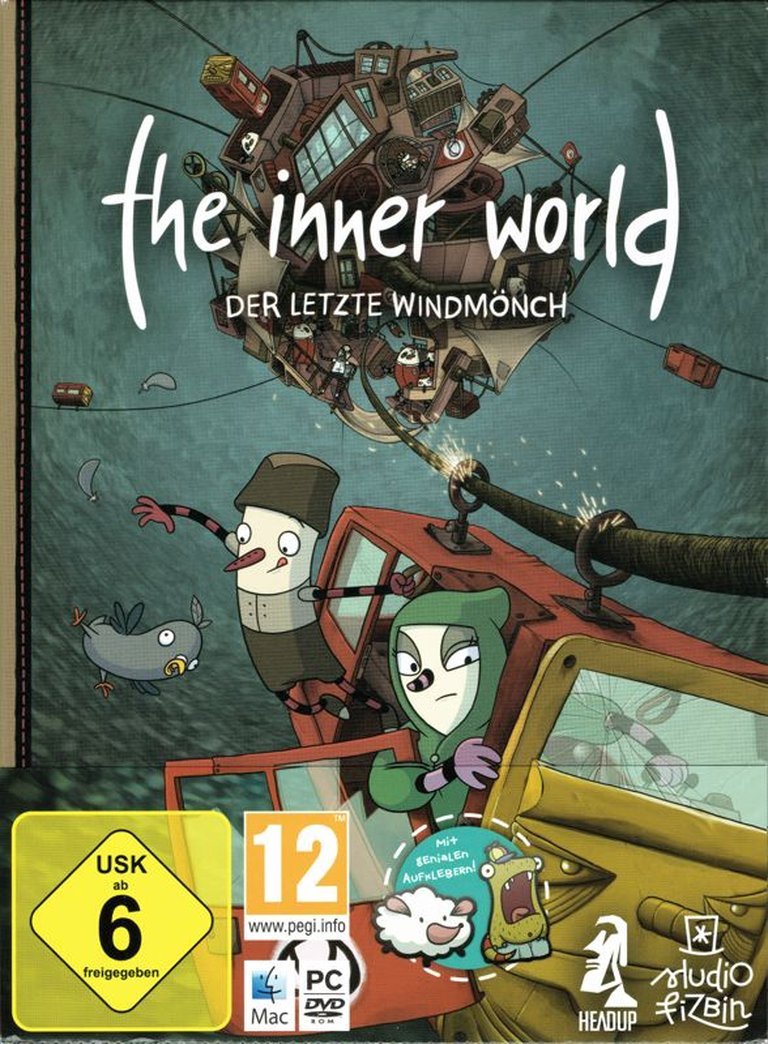
The Inner World: The Last Wind Monk is the humorous sequel to the point-and-click adventure The Inner World, set in the fantasy world of Asposia. Three years after the first game, the hero Robert awakens from petrification to find the realm under the control of Emil, who seeks to resurrect the villainous wind monk Conroy and exterminate the flute noses. Players switch between Robert, his pigeon companion Peck, and the rebellious Laura to solve puzzles, explore a bizarre setting, and navigate a comedic yet tense storyline with shared inventory and intuitive controls.
Gameplay Videos
Where to Buy The Inner World: The Last Wind Monk
The Inner World: The Last Wind Monk Cracks & Fixes
The Inner World: The Last Wind Monk Guides & Walkthroughs
The Inner World: The Last Wind Monk Reviews & Reception
opencritic.com (77/100): For the most part, The Inner World – The Last Wind Monk makes a strong case that point-and-click adventures still have a lot to offer in modern gaming.
gamewatcher.com : This charming adventure doesn’t just tell a pretty good story.
videochums.com : It’s essentially an extension of The Inner World’s story with just as much charm and satisfying logic puzzles.
metacritic.com (79/100): It has everything a good point-and-click should have from meaningful world engagement and enjoyable dialogue to good, old-fashioned, item-heavy puzzle solving.
The Inner World: The Last Wind Monk: Review
Introduction: A Whimsical World Confronts Its Shadows
In an era where the legacy of the point-and-click adventure genre often seems confined to nostalgic retrospectives or the output of a few dedicated studios, The Inner World: The Last Wind Monk arrives as a potent reminder of the form’s enduring vitality. Released in 2017 by the German indie studio Studio Fizbin, this sequel to the 2013 delight The Inner World does more than simply revisit its charming, subterranean universe of Asposia. It propels its protagonists—and its narrative—into murkier thematic waters, confronting bigotry, fascist propaganda, and the fragility of hard-won peace with a surprising frankness, all while maintaining the series’ signature absurdist humor and visual inventiveness. This review will argue that The Last Wind Monk is a pivotal and ambitious entry in the modern adventure canon: a game that successfully expands its predecessor’s mechanics and world-building while taking significant, sometimes uneasy, tonal risks. Its legacy is that of a title that proved the genre could grapple with weighty sociopolitical allegory without sacrificing its core appeal, even if the balance it strikes is not always perfectly executed.
Development History & Context: Building on a Solid Foundation
Studio Fizbin, founded in Ludwigsburg and Berlin, emerged from the German indie collective Saftladen with a clear mission: to craft story-driven games featuring unique characters and worlds. Their debut, The Inner World (2013), was a critical success, praised for its hand-drawn aesthetic, comedic writing, and inventive puzzles. For the sequel, the team retained its core creative leadership, including Game Director Sebastian Mittag, Author Anika Soisson, and Art Director Tim Gaedke, ensuring a consistent vision. The game was developed in Unity, a pragmatic choice for an indie team aiming for multi-platform deployment (Windows, macOS, Linux, PlayStation 4, Xbox One, iOS, Android, Nintendo Switch), with FMOD handling its expressive sound design.
The sequel arrived in 2017, a period of renewed but niche interest for point-and-click adventures. Studios like Daedalic Entertainment and Pendulo Studios were keeping the tradition alive, but the genre was no longer mainstream. The Last Wind Monk benefited from this environment, offering a polished, accessible experience that felt both retro and contemporary. Its development was characterized by a focus on expanding gameplay systems (notably the seamless character-switching) and deepening the lore of Asposia, while leveraging the technical flexibility of Unity to reach a wide audience across PC and consoles. The involvement of publishers Headup Games and Kalypso Media provided crucial distribution and marketing muscle, ensuring the game reached beyond its initial German-speaking critical stronghold.
Narrative & Thematic Deep Dive: From Whimsy to Widespread Persecution
The narrative of The Last Wind Monk is a direct continuation, set three years after Robert, the flute-nosed heir, defeated the tyrant Conroy. However, the victory is swiftly undercut: Robert, in a moment of post-adventure anxiety, has accidentally petrified himself. In his absence, a new villain, Emil, has arisen. A former trader, Emil is a master of propaganda, having convinced the populace of Asposia that the flute-nose dynasty were collaborators with dark forces and that Conroy was a martyr who sacrificed himself to save the world. The central conflict thus shifts from a singular villain to a systemic persecution. Emil’s regime actively hunts flute noses, throwing them into the wind fountains—a clear, chilling analogue for fascist purges and state-sanctioned genocide.
This is where the game’s thematic ambition becomes most evident. As Adventure Gamers noted, the sequel features a “darker and more sinister tone” and a “World War II ambiance,” moving beyond the existential threat of suffocation in the first game to a narrative of racist scapegoating and totalitarianism. The citizens of Asposia are no longer passive victims; they are complicit, turned into a “mindless mob willing to aid a villain in mass extermination.” This allegory is handled with a degree of subtlety that sparked critical debate. German outlet GameStar praised the game for providing a “familienfreundliche Art einen guten ersten Kontakt mit den schwierigen Themen Hass, Ausgrenzung und Faschismus” (family-friendly first contact with difficult themes of hate, exclusion, and fascism). Yet Adventure Gamers and Hooked Gamers found the shift jarring, suggesting it “leaves a little of [the original’s] charm behind” and makes the world feel less appealing.
The protagonist, Robert, is deliberately ill-suited to this harsh new world. His defining trait is naive timidity, a direct result of his abusive upbringing by Conroy. His journey is one of reluctantly stepping into a leadership role he never wanted, constantly haunted by Conroy’s voice in his head—a clever device that externalizes his internalized trauma and provides ongoing, caustic comic relief. This is contrasted by the forceful Laura, the rebel who fights back, and the flightless but fiercely loyal pigeon Peck. Their trio dynamic is central to the story, with the new character Mama Dola serving as a mysterious guide whose knowledge of Robert’s destiny adds a layer of mythological intrigue.
The dialogue and character writing remain a high point. The humor is derived from the bizarre logic of Asposia (a land of “roly-poly” people, “tumble mice,” and “gorfs”) and the clash between Robert’s meekness and Laura’s aggression. As 4Players.de observed, the authors have developed a “gutes Gespür für Situationskomik” (good sense of situational comedy). The challenge for the narrative is balancing this lightweight humor with the grim backdrop of political oppression. Mostly, it succeeds by leaning into absurdity even in dark situations (e.g., helping a “Bingo-Pony” with self-esteem issues in a prison camp), but the tonal whiplash is a persistent feature, not a bug, of the experience.
Gameplay Mechanics & Systems: Expansion and Refinement
At its core, The Last Wind Monk adheres to the classic point-and-click adventure template: players explore 2D environments, collect items, combine them, and engage in dialogue to solve puzzles and progress. Where the sequel innovates is in its multi-character system. The ability to seamlessly switch between Robert, Laura, and Peck—either within a shared scene or in parallel locations via a simple inventory bar click—fundamentally alters puzzle design and pacing. Each character possesses a unique ability: Robert plays wind songs on his flute-nose (now simplified to icon selection, a welcome change from the first game’s manual input), Laura provides brute strength, and Peck can fly to inaccessible areas. This system encourages players to think laterally about obstacles, considering how each character’s physical and social attributes can interact with the environment and NPCs.
The puzzle design is generally lauded for its creativity and challenge. Gameplay (Benelux) called the puzzles “knifflig” (tricky), and 4Players.de highlighted the pleasure of “das Inventar vollzustopfen, abstruse Kombinationen auszuprobieren” (stuffing the inventory, trying out bizarre combinations). The puzzles are often multi-step and require careful observation of the game’s quirky logic. However, this is also a major point of contention. Adventure Gamers noted that some puzzles sacrifice “sense at the altar of perceived difficulty,” citing a specific prison rat puzzle that remains confusing even with the solution. TheSixthAxis was more damning, calling puzzle solutions “convoluted” and a source of frustration.
This leads to the game’s most praised feature: its comprehensive hint system. Accessed via the menu, it provides tiered assistance. The first hint might be a vague nudge, subsequent ones add clarity, and the final hint is a step-by-step walkthrough. Crucially, this system is optional and spoiler-free in its implementation, allowing players to self-select their difficulty. As GameWatcher ( TJ Denzer) stated, it is “hands-down the best hint system implementation in any game I’ve ever played,” effectively making the game accessible to both hardcore puzzle solvers and story-focused players. This philosophy—removing frustration without removing agency—is a significant evolution in adventure game design.
The interface remains standard point-and-click, with a highlighted hotspot system (hold mouse button) to eliminate pixel hunts. On consoles, however, this control scheme proves “cumbersome,” as Video Chums noted, requiring players to navigate a cursor with a joystick—a clear port of a PC-native design. This discrepancy highlights the game’s hybrid identity: designed for mouse and keyboard but adapted for gamepads, with mixed results.
World-Building, Art & Sound: The Charms of Asposia
The world of Asposia is the game’s undeniable visual and auditory anchor. The art direction is a masterclass in stylized, hand-drawn 2D animation, evoking European animated films with its fluid movements and expressive character design. The locations are wildly imaginative: from the topsy-turvy Asposia Central airport to the grim Shovel Mountains prison and the eerie Tumble Mouse Factory. The environments are dense with detail and personality, though Adventure Gamers correctly observed a “level of bleakness” with “red-sigiled banners and barbed-wire chain link fences,” visually reinforcing the game’s darker political narrative.
The character animation, while generally charming, is identified by several reviewers as a weakness. GBG_Jason pointed out “generic talking cycles” and moments where animations look “lazy” or “awkward,” especially during non-interactive cutscenes. This occasional stiffness slightly undermines the otherwise lively world, creating a minor disconnect between the excellent voice acting and the visual performance.
The voice work is a significant improvement over the first game, according to most critics. The core cast returns, with Robert’s nasally, anxious voice and Laura’s confident, sometimes harsh tone perfectly characterizing their relationship. The inclusion of Conroy’s ghostly voice in Robert’s head is a standout narrative and comedic device. However, Adventure Gamers noted a mismatch with Mama Dola’s “smooth-as-silk voice” coming from her “grizzled and wrinkly face,” a minor but noticeable casting flaw.
The sound design and music utilize FMOD to create a warm, cartoony score that complements the whimsy. While effective, Adventure Gamers felt it lacked “memorable tracks” beyond the themes from the first game. The audio, overall, supports the game’s dual nature: it can underscore a silly moment with a jaunty tune or a tense one with a somber refrain, though it rarely transcends functional support to become iconic.
Reception & Legacy: A Sequel That Divides and Defines
Upon release in October 2017, The Last Wind Monk received generally favorable reviews, aggregating to a Metascore of 79 and MobyGames’ 76% from critics. Steam user reviews are “Very Positive” at ~89% (from over 500 reviews), indicating strong player satisfaction. German publications were particularly effusive: GameStar (84%) and PC Games (83%) hailed it as a heartfelt, expertly written sequel that successfully tackles heavy themes with humor. International critics were more measured, averaging around 77% on Windows, with Adventure Gamers’ 70% review becoming a touchstone for those who felt the tonal shift was a misstep.
The central critical debate revolves around its tonal ambition. Is the Nazi allegory handled with enough sophistication for a “family-friendly” game, or is it uncomfortably glib? GameStar saw it as an effective, gentle introduction to tough topics; Adventure Gamers saw it as a “grimmer, more oppressive mood” that undermined the original’s charm. This discussion is itself a testament to the game’s willingness to engage with complexity.
Commercially, the game found a solid niche. Its presence on GOG.com and Steam (often on sale for $1.99) and its multi-platform release (including a well-received Nintendo Switch port with touch controls, as praised by Nintendo Life) ensured a broad reach. With ~33,500 units sold (per Raijin.gg data) and consistent wishlisting, it has achieved a healthy, if not blockbuster, commercial performance for an indie adventure.
Its legacy is twofold:
1. As a Series Pillar: It cemented The Inner World as one of the most significant German adventure game series of the 2010s, with a distinct identity separate from giants like Daedalic.
2. As a Genre Example: It demonstrated that modern point-and-clicks could incorporate sophisticated hint systems and multi-character mechanics to enhance accessibility and puzzle depth without dumbing down the core experience. Its thematic blend of absurdist comedy and political commentary, while controversial, opened a door for adventures to be more narratively daring.
Conclusion: A Flawed but Essential Journey
The Inner World: The Last Wind Monk is not a perfect sequel. Its occasional animation stiffness, its sometimes obtuse puzzle logic, and its persistently uneasy tonal balance will be points of friction for some players. For others, these very elements—the willingness to be politically resonant, to challenge the player’s logic, to place cute characters in genuinely dark circumstances—are precisely what elevate it above mere comfort food.
It is a game that dares to make its silly world matter. By framing its conflict around propaganda, persecution, and the corrosive nature of fear, it transcends the typical “save the kingdom” plot to comment on real-world historical and contemporary evils. It does so with a heart full of humor, a head full of clever puzzles, and a hint system that represents a milestone in player-friendly design. While it may not capture the unadulterated, effortless charm of its predecessor, its ambition, its emotional weight, and its mechanical refinements make it the more substantial and historically significant entry.
Final Verdict: The Inner World: The Last Wind Monk is an essential play for fans of narrative-driven games and a case study in how a genre can evolve. It is a bold, imperfect, and ultimately beloved sequel that uses the language of cartoon comedy to ask serious questions about complicity, leadership, and resistance. In the canon of modern adventure games, it stands not just as a worthy successor, but as a brave and influential milestone.