
- Release Year: 2020
- Platforms: Windows
- Publisher: smatrade GmbH
- Genre: Compilation
Description
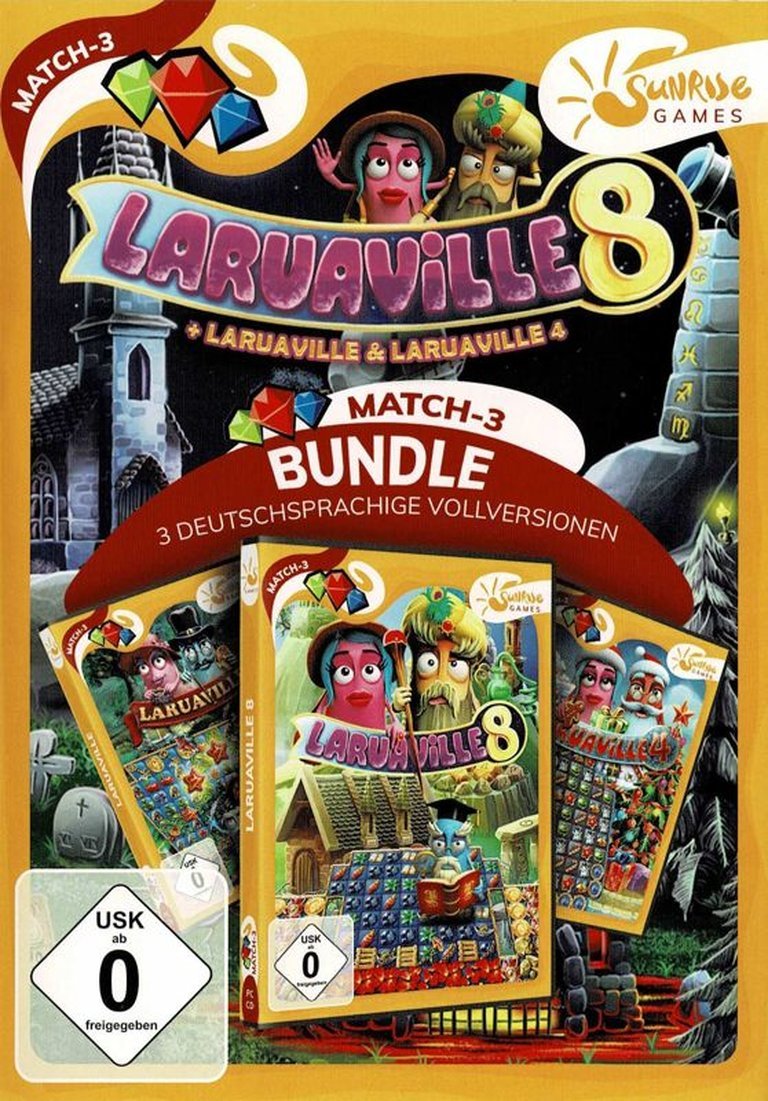
Laruaville 8 + Laruaville & Laruaville 4 is a retail compilation that bundles three titles from the Laruaville series: the original Laruaville, Laruaville 4, and Laruaville 8. These casual games feature a mix of gameplay styles including match-3 puzzles, hidden object challenges, and resource management, all set in vibrant, animated village environments designed for relaxing play.
Laruaville 8 + Laruaville & Laruaville 4 Reviews & Reception
gamefools.com : As with all the Laruaville games, I love that there are different themes and things to build. Although the elements of each game are similar, I never get bored with them.
Laruaville 8 + Laruaville & Laruaville 4: A Alchemical Anthology of Casual Gaming’s Quiet Corners
Introduction: The Ghost in the Machine of the Match-3 Genre
In the vast, ever-expanding museum of video game history, there exist entire wings dedicated to the titans—the Zeldas, the Civs, the GTAs. Yet, just as significant for understanding the medium’s full tapestry are the quiet, persistent hums of the casual gaming scene. This is the realm of the daily puzzle, the soothing click of tiles, the satisfying pop of matched gems, a world built on accessibility, repetition, and comfort. Within this world, one enduring spectral series has quietly churned out entries for nearly two decades: Laruaville. The compilation “Laruaville 8 + Laruaville & Laruaville 4”—a title that itself feels like a bureaucratic footnote—is not a landmark release. It is not a trendsetter. Instead, it is a perfectly preserved time capsule, a bundle representing the sturdy, unflashy, and phenomenally durable core of the “Match-3 + Build” casual template. This review argues that the value of this compilation lies not in groundbreaking innovation but in its masterful, if modest, execution of a proven formula, and in its role as a tangible artifact of a specific, long-lived design philosophy that has quietly entertained millions.
Development History & Context: The Steady Pulse of the Casual Market
The provided sources point to a clear, if opaque, development lineage. The primary studio credited across platforms is LGT SIA, a Latvian developer (inferred from the “SIA” suffix, denoting a limited liability company in Latvia). The publisher for this specific 2020 compilation is smatrade GmbH, a German company known for distributing budget and classic software. This immediately situates the product within the European budget retail market—the kind of compilation disc you might find in a supermarket software aisle or a discount bin, targeting an older, less digitally-native demographic.
Laruaville 8 itself, as listed on Steam and other storefronts, had a staggered release. While the MobyGames entry for the compilation cites 2020, the standalone Laruaville 8 is shown on Steam as released in October 2023 and on NSWTL.INFO as having a PC release date of February 20, 2019. This discrepancy highlights the messy, region-specific, and often re-packaged nature of budget casual game distribution. Games were frequently released in various “Deluxe” editions, bundles, and compilations years apart, catering to different retail cycles and digital storefronts.
The technological context is one of deliberate, conservative design. System requirements from the Steam page (Windows XP/Vista/8/10/11, 1.6 Ghz processor, 8GB RAM, DirectX8) are extraordinarily low, ensuring the game runs on anything from a decade-old office PC to a modern budget laptop. This is not a tech showcase; it is a digital appliance. The gaming landscape in which these titles thrive is the post-Bejeweled, post-Farm Frenzy era of the late 2000s and 2010s, where the “Match-3 + Resource Management” hybrid became the gold standard for casual play. Laruaville found its niche in this crowded field by leaning into a quirky, ghostly theme and a consistent, incremental release schedule.
Narrative & Thematic Deep Dive: Ghosts, Gold, and the Alchemical Dream
While narrative is rarely the primary draw in such games, the Laruaville series establishes a persistent, charmingly simple lore. The core premise, as consistently stated across the GameFools, Steam, and RAWG descriptions, is that the player assists a group of friendly, puzzle-solving ghosts. These are not terrifying specters but helpful, slightly mischievous spirits with a collective goal. In Laruaville 8, that goal is explicitly the “ancient art of alchemy”—the mystical transformation of base matter into gold.
The narrative framework is a thin but effective veneer. The ghosts “claim to be” experts, suggesting a lighthearted, comedic tone where their efforts are earnest but fraught with humorous mishaps. The journey is framed as an “enchanting adventure” of “mastering the elements.” Thematically, the game touches on transformation and creation. The match-3 mechanic of turning “piles of rocks into mountains of gold” is a literalization of alchemical philosophy. The town-building component adds a layer of community and restoration; you are not just making gold for its own sake, but presumably building or aiding a ghostly settlement. The inclusion of “Black Coins” in the bonus levels introduces a thematic element of temptation and risk—the very pursuit of gold (or points) can lead to failure if you grasp at the wrong thing.
Compared to more narrative-heavy casual games like the Mystery Case Files series, Laruaville‘s story is purely functional. There are no voiced characters, no complex dialogue trees, and no plot twists. The story exists to provide a skin for the gameplay loop: “We are ghosts. We want gold. We need your matching skills. Here is a town to build.” It is a narrative of pure, unadulterated gameplay justification, which is precisely what its audience expects and desires.
Gameplay Mechanics & Systems: The Evolution of a Template
This is where the compilation’s true substance lies. The bundle contains three specific iterations of the formula—Laruaville 1 (implied by “Laruaville”), 4, and 8—representing different points in the series’ refinement. The core loop described for Laruaville 8 is the culmination of this evolution:
- Match-3 Puzzles: The foundational mechanic. Players swap adjacent tiles on a grid to create matches of three or more identical symbols (likely gems, stones, or alchemical ingredients). The objective varies per level: clear a certain number of specific tiles, reach a target score, clear “sand” or “ice” coverings, etc.
- City-Builder/Resource Manager: Success in match-3 levels earns resources (gold, wood, stone, etc.). These resources are then used on a separate town map to construct buildings and decorative elements, progressively “building the town” and often unlocking new puzzle areas or bonuses.
- Diversified Minigames: Laruaville 8 explicitly lists “skippable Mahjong, Solitaire levels, Spot the Difference games, and Hidden Object scenes.” This is a critical evolution. By the 8th main entry, the developers recognized potential fatigue in a pure match-3 regimen. The integration of other casual puzzle genres—even if skippable—broadens the gameplay palette and caters to fans of adjacent sub-genres. This transforms the game from a single-system workout into a “greatest hits” compilation of casual mechanics.
- Progression & Replayability: The town-building acts as a metagame, providing a visual sense of accomplishment and a reason to tackle more puzzles. The mention of “40 bonus levels” and two distinct sets of optional challenges (AI head-to-head matches and the “avoid Black Coins” constraint) demonstrates a focus on extending playtime for dedicated players. The “Black Coins” mechanic is a notable innovation, introducing a high-risk, aversion-based challenge within the standard matching framework.
Flaws & Innovations: The sources do not provide direct criticism, but the nature of the genre implies potential issues: potential grind in later levels, reliance on random number generation that can frustrate, and a UI that may feel dated. The “skippable” nature of the non-match-3 minigames is itself an innovation—a voluntary difficulty or novelty shift, respecting the player’s preferred playstyle. The series’ longevity (spanning at least 17 main entries as seen on GameHouse) is its own testament to a reliably satisfying, if iterative, gameplay loop.
World-Building, Art & Sound: Cute, Cartoon, and Consistently Cheerful
The visual and auditory identity is consistently described across storefronts using the same tags: 2D, Cartoon, Cute, Family Friendly, Mystery. This paints a clear picture. The art style is non-photorealistic, relying on bright, saturated colors, simple character designs (the ghosts are likely round, fluffy, and expressive), and clean, readable board layouts. The setting is a whimsical, probably European-inspired ghost village, with alchemical labs and quirky architecture.
The atmosphere is one of low-stakes, cozy mystery. The “Mystery” tag suggests perhaps some light exploration or narrative breadcrumbs in the town-building phase, but the primary mood is cheerful and relaxed. Sound design, while not detailed, would logically feature upbeat, melodic music and pleasant, crisp sound effects for matches, building, and item collection—all designed to be soothing rather than adrenaline-pumping. This aesthetic is timeless for the genre; it avoids trends that would date the game, aiming instead for a style that feels perpetually “cute” and inoffensive. It is the visual equivalent of a warm blanket.
Reception & Legacy: The Unseen Giant
Here, the source material is painfully silent. MobyGames lists no critic or user reviews for this specific compilation. The Steam page has only 1 user review (which is not visible without logging in, but the summary shows it as “Positive”). GameFools provides a single quoted testimonial praising the series’ variety and consistent appeal. This absence of critical discourse is, in itself, the story.
The Laruaville series represents the “long tail” of casual gaming. It is not reviewed by mainstream outlets, nor does it generate forum flame wars. Its “reception” is measured in steady, quiet sales, likely through bundles like this one, on digital storefronts like Big Fish Games, GameHouse, and Steam, and through subscription services like GameFools On Demand. Its legacy is not one of critical acclaim but of cultural persistence and commercial viability. It has survived over 15 years and 17 main entries because it reliably delivers a specific experience to a specific audience.
Its influence is indirect. It did not invent the Match-3 + Build genre (that credit belongs to games like Diner Dash and early Jewel Quest), but it has helped solidify and polish that template. By consistently adding minor innovations (the minigame variety, specific bonus modes), it contributes to the genre’s slow accretion of features. It stands as a testament to the power of a “good enough” idea executed with reliable consistency, year after year.
Conclusion: A Solid, Unassuming Artifact
“Laruaville 8 + Laruaville & Laruaville 4” is not a game to analyze for its revolutionary mechanics or its profound storytelling. It is, however, an exceptional case study in genre archaeology. This compilation offers a direct, playable through-line from an earlier iteration of the Match-3 + City Builder formula (Laruaville 4) to its morefeature-rich late-stage version (Laruaville 8), with the series’ origin point (Laruaville) completing the trilogy.
For the historian, it demonstrates the incremental, risk-averse design evolution of the casual sector. For the player, it represents hundreds of hours of mindfully engaging, stress-free puzzle gameplay wrapped in a consistently cute and cheerful package. Its place in video game history is not on a pedestal, but firmly entrenched in the sprawling, popular foundation of casual gaming—a quiet, ghostly guardian of the match-3 throne, proving that in an industry obsessed with the new, there is immense and lasting power in the perfected, familiar, and comforting.
Final Verdict: A niche but perfectly executed anthology for connoisseurs of the casual puzzle genre, offering a clear window into the steady, reliable design philosophy that has kept the “match-3 and build” formula alive and well for two decades. Its historical value lies in its unassuming persistence.