
- Release Year: 2001
- Platforms: PlayStation, Windows
- Publisher: Cenega Poland Sp. z o.o., ITE Media ApS (Interactive Television Entertainment)
- Developer: ITE Media ApS (Interactive Television Entertainment)
- Genre: Action
- Perspective: Behind view
- Game Mode: Single-player
- Gameplay: Collection, Combat, Platforming
- Setting: Fantasy
Description
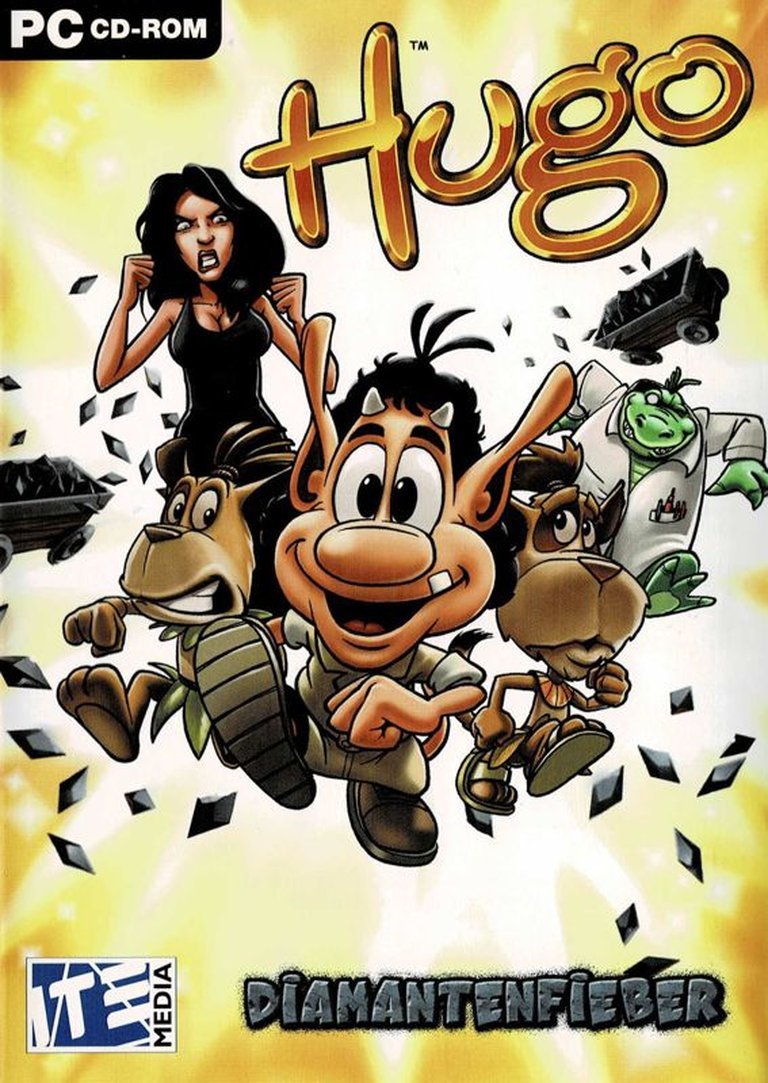
Hugo: Black Diamond Fever is a 3D platform game where players control Hugo the TV troll to save the enslaved Kikurians on Volcano island from the evil witch Scylla and her ally Don Croco. Scylla is forcing the Kikurians to mine black diamonds for a supreme evil formula, and Hugo must navigate the fantasy setting, defeat enemies with his tail, free captives, and collect diamonds to thwart her plans. Aimed at younger audiences, the game features accessible gameplay, cute graphics, and a vibrant world filled with jungle animals and crocodiles.
Gameplay Videos
Where to Buy Hugo: Black Diamond Fever
PC
Hugo: Black Diamond Fever Free Download
Hugo: Black Diamond Fever Cracks & Fixes
Hugo: Black Diamond Fever Cheats & Codes
Game Boy Color
| Code | Effect |
|---|---|
| 006-4BA-19E | Infinite Lives |
| 006-359-3BE | Infinite Time |
| UPUPDOWNDOWN | Get unlimited lives. |
| BLACKDIAMOND | Unlock black diamond collection mode on all levels. |
PC
| Code | Effect |
|---|---|
| 313323111134 | Unlock Old Kiku Trail |
| 143221231142 | Unlock Diamond Cavern |
| 423211131134 | Unlock Supply Line |
| 343123113234 | Unlock Oil Rig |
| 223121134212 | Unlock Diamond Factory |
| 343211114323 | Unlock Melt Down |
| 243113133324 | Unlock The Getaway |
Playstation
Select ‘Enter Level Code’ from main menu and enter one of the codes below.
| Code | Effect |
|---|---|
| O O X X X X X Triangle Triangle Triangle X Square | Unlock Level 2 (Old Kiku Trail) |
| Triangle Triangle O Square Triangle Triangle X Triangle Triangle Triangle Square O | Unlock Level 3 (Diamond Cavern) |
| Square Square O Square Triangle Triangle Triangle Triangle Triangle Triangle Triangle Square | Unlock Level 4 (Supply Line) |
| Triangle O O Triangle Square Square Square Triangle Triangle Square Square Square | Unlock Level 5 (Oil Rig) |
| O Square X O Square X O Square O X X O | Unlock Level 6 (Diamond Factory) |
| Triangle Square O Square Triangle X O Square O X X O | Unlock Level 7 (Melt Down) |
| O O Square Square Triangle Triangle Square Triangle Square Square O Square | Unlock Level 8 (The Getaway) |
Hugo: Black Diamond Fever: A Relic of the European Mascot Platformer Era
Introduction
In the crowded turn-of-the-millennium landscape of 3D platformers, where Italian plumbers and eastern marsupials reigned supreme, a small Danish troll named Hugo carved out a surprising niche. Hugo: Black Diamond Fever, released in 2001 by ITE Media, stands not as a landmark of the genre, but as a fascinating, deeply regional artifact—a game that embodies the ambitions, limitations, and cultural specificity of Europe’s answer to the console-driven platformer boom. As a direct sequel to Hugo: Quest for the Sunstones, it refines its predecessor’s formula while stumbling into many of the same pitfalls. This review argues that Black Diamond Fever is a critical case study in licensed game development: a competent but unremarkable technical achievement whose primary legacy is as a nostalgic touchstone for a generation of Scandinavian and Central European children, and as a stark example of how local production values and audience expectations could diverge wildly from the critical mainstream.
Development History & Context
The Hugo Phenomenon: To understand Black Diamond Fever, one must first understand its progenitor. Hugo originated as the star of the Danish game show Skærmtrolden Hugo (The Screen Troll Hugo), which aired from 1990. The show featured a live presenter interacting with a cartoon troll via a “magic” telephone, making choices that affected Hugo’s adventures in a cartoon world. This television heritage is the game’s foundational DNA. ITE Media (Interactive Television Entertainment), the developer and publisher, was intrinsically linked to the show’s production company, creating a vertically integrated franchise. By 2001, the Hugo video game series was a well-established, multi-platform franchise in Northern and Eastern Europe, with a reputation for simple, accessible games for young children.
Sequels and Iteration: Black Diamond Fever was the second 3D platformer in the series, following Quest for the Sunstones (2000). The development team, led by Head of Production & Development Lars Rikart Jensen and Lead Concept/Designer Kim Krogh, was largely a returning crew. The credits list 56 individuals for the Windows/PS1 version, a significant team for the era, suggesting a serious investment. However, this was still a fraction of the resources allocated to A-list platformers from Naughty Dog or Rare. The technological constraints were those of the early PS1/Windows 98 era: limited 3D rendering power, rudimentary camera systems, and a reliance on colorful, low-polygon character models to mask technical shortcomings.
A Crowded Marketplace: The game’s release coincided with the twilight of the mascot platformer’s golden age. Crash Bandicoot, Spyro, and Banjo-Kazooie had set a high bar for polish, camera control, and inventive level design. Black Diamond Fever entered this arena not as a innovator, but as a follower, openly modeled on the “Croc” or “Crash” template, as noted by Wikipedia and multiple critics. Its primary competition wasn’t Jak & Daxter, but rather other budget-priced, licensed European titles.
Narrative & Thematic Deep Dive
Plot Mechanics: The narrative is pure serialized cartoon fodder. Hugo’s arch-nemesis, the witch Scylla, seeks the rare black diamonds of Jungle Island to brew a “supreme evil” potion. She has enslaved the indigenous Kikurians (a primitive, humanoid tribe) and forced them to mine under the guard of her henchman, Don Croco, and his crocodile pirates. The inciting incident is a literal “damsel in distress” letter from the imprisoned Kikurian elder (referred to as “King Kikurian” in some sources), delivered by Hugo’s friend Fernando. Hugo’s mission is threefold: 1) Free all enslaved Kikurians, 2) Sabotage the diamond processing operation by stopping a mine conveyor belt and closing an oil pipeline, and 3) Rescue the elder and escape the collapsing factory before Scylla completes her potion.
Character & Worldview: The characters are archetypal and lack depth. Hugo is the generic, good-hearted hero. Scylla is the cackling, power-hungry villain. Don Croco is the bombastic, subordinate brute. The Kikurians are passive victims awaiting liberation. This simplicity is by design for a child audience. The plot’s environmental subtext—stopping industrial exploitation (mines, pipelines) of a natural resource (black diamonds) on a native island—is present but superficial, serving only to frame the action rather than explore any meaningful commentary on colonialism or ecology.
Localization Nuances: An intriguing detail from the French version (Hugo: Le Maudit Diamant Noir) specifies that Scylla’s ultimate goal is to “summon a great demon.” This adds a slight cosmic horror layer absent from the more generic “supreme evil” of other versions, hinting at how regional translators might subtly emphasize different mythical elements to suit local tastes.
Gameplay Mechanics & Systems
The 3D Core Loop (PC/PlayStation): The gameplay is a by-the-numbers 3D platformer. Hugo navigates linear, corridor-like levels with a fixed camera angle (often a significant flaw). His primary tool is a tail-whip, requiring two hits to defeat most enemies (jungle animals, crocodile pirates). The core objectives are:
1. Exploration & Collection: Gather red diamonds scattered throughout the level.
2. Rescue:Locate and free imprisoned Kikurians, who are usually found in cages or behind simple puzzles.
3. Boss/Objective: At the end of most levels, confront a simple boss or activate a switch (like stopping the conveyor belt) to progress the narrative.
Innovation (?) and Flaws: The game attempted a slight systemic twist: some enemies, if defeated before collecting all red diamonds, would only yield coins or power-ups, not the coveted black diamonds. This created a minor risk-reward dynamic—rushing into combat could be wasteful. However, the design was not balanced to make this engaging; it was mostly a source of frustration. The most universally criticized mechanic, cited by PC Games and PC Action, was the “unglücklich gewählte Kameraperspektive” (unhappily chosen camera perspective). The fixed or sluggish camera frequently obscured platforms and enemies, leading to cheap falls and repeated attempts, fundamentally undermining the platforming challenge.
The 2D Divergence (Game Boy Color/Mobile): significantly, the handheld versions are entirely different games. As noted on MobyGames, they are 2D platformers in the style of Bomb Jack or Donkey Kong. Hugo navigates single-screen stages with ladders, must collect all red diamonds to unlock black diamonds from enemies, and operates under a strict time limit that turns enemies aggressive if expired. This represents a far more focused, arcade-style experience, arguably better suited to the GBC’s hardware and the casual play session. Its higher critic score (71% on Moby for GBC vs. 46% aggregate for 3D versions) suggests this adaptation, while simpler, may have been more successfully executed for its target hardware and audience.
World-Building, Art & Sound
Visual Style: The game presents a vibrant, cartoonish fantasy world. The “Jungle Island” setting is rendered with lush (if simplistic) textures, bright greens, browns, and volcanic reds. Character models are low-polygon but animated with a surprising amount of squash-and-stretch, giving Hugo a bouncy, exaggerated feel. The art direction successfully mimics the aesthetic of the original TV show’s animation, creating a sense of continuity for fans. However, compared to contemporaries like Crash Bandicoot, the environments are generic and lack dynamic lighting or intricate detail.
Sound Design: The soundtrack, composed by David Filskov, Christian S. Jensen, and Asbjørn Andersen, is appropriately jaunty and adventurous, utilizing MIDI instrumentation typical of the era. Sound effects are cartoony and functional—the crack of the tail whip, the clink of diamonds, the gibberish of the Kikurians. It lacks the iconic punch of a Koji Kondo or Grant Kirkhope score but serves its purpose of creating a lighthearted, non-threatening atmosphere.
Atmosphere & Cohesion: The world-building is purely surface-level. The “Volcano Island” is a themed playground (jungle paths, mine shafts, factory interiors) rather than a lived-in space. The enslaved Kikurians are visually identical and lack any cultural depth. The atmosphere is one of playful danger, never approaching genuine menace, which aligns perfectly with its E-rated (USK 0) audience.
Reception & Legacy
Critical Dissection: Critically, the game was savaged in core gaming press, particularly in Germany and the UK, while receiving a lukewarm, even positive, reception in its native Denmark and some other European territories.
* German Press: PC Games (48%), PC Action (42%), big.N (31% for GBC), and GBX (30% for GBC) were harsh, focusing on the “odegradliche” (boring) gameplay, camera issues, and perceived technological obsolescence.
* UK/Czech Press: Official UK PlayStation Magazine and Oficiální český PlayStation Magazín both gave it 3/10, calling it a “dull ‘Crash Bandicoot’ clone without charm.”
* Danish Outlier: Gamesector.dk awarded it 7/10 for PC and 8/10 for PS1, explicitly praising its lower difficulty compared to Quest for the Sunstones and its suitability for its core 6-12 year-old demographic.
* Russian Press: The Absolute Games review is a notorious piece of vitriolic satire, giving it 3/10 and dismissing its “obsolete technology.”
This schism reveals the game’s central identity crisis: it was made for a specific, young, European audience, but reviewed by a generalist, core-gamer-focused press that judged it against the cream of the global platformer crop.
Commercial Performance & Legacy: Concrete sales figures are unavailable. Its inclusion in the 2007 compilation Dětský svět (Children’s World) in the Czech Republic points to a sustained, if modest, commercial life in regional markets. Within the Hugo franchise, it is a transitional title. It refined the 3D approach before the series would pivot again with Hugo: The Evil Mirror (2002), which introduced more combat and RPG elements. Its legacy is primarily:
1. A Regional Staple: For many in Scandinavia, Poland, Germany, and Russia, it is a remembered piece of childhood, part of the broader Hugo multimedia phenomenon.
2. A Technological Bridge: It represents the last gasp of the PS1-era, fixed-camera 3D platformer before that design philosophy was largely abandoned.
3. A Cautionary Tale: It exemplifies the risks of porting a locally-focused, licensed children’s game into a competitive global market without addressing core gameplay and Camera design fundamentals expected by the wider press.
Conclusion
Hugo: Black Diamond Fever is not a lost classic. It is, by most objective standards outside its target demographic, a flawed and derivative game. Its camera system is a persistent source of frustration, its level design is linear and uninspired, and its narrative is negligible. Yet, to dismiss it entirely is to miss its cultural and historical significance. It is a pristine artifact of a specific moment in European game development: a studio leveraging a beloved local television property into the global 3D platformer trend with earnest competence but insufficient resources or design expertise to compete at the highest level.
Its value today lies in academia and curation. It is a perfect subject for studying regional game industries, the economics of licensing, and the evolution of children’s game design. It demonstrates how a game can be critically panned yet commercially viable within a protected ecosystem. In the vast canon of platformers, Hugo: Black Diamond Fever occupies a place of earnest mediocrity—a game that knew its audience and served them adequately, even as it failed to resonate beyond its borders. It is a testament to the fact that not all important games are great games, and that the history of the medium is written not only in masterpieces, but in the honest, if bumpy, attempts to bring a local icon to a new dimension.