
- Release Year: 2005
- Platforms: Macintosh, Windows
- Publisher: Konami Corporation, United Nations World Food Programme
- Developer: Deepend, Playerthree Limited
- Genre: Educational, Simulation
- Perspective: Top-down
- Game Mode: Single-player
- Gameplay: Business simulation, Managerial
- Setting: Civil war, Famine, Island nation
Description
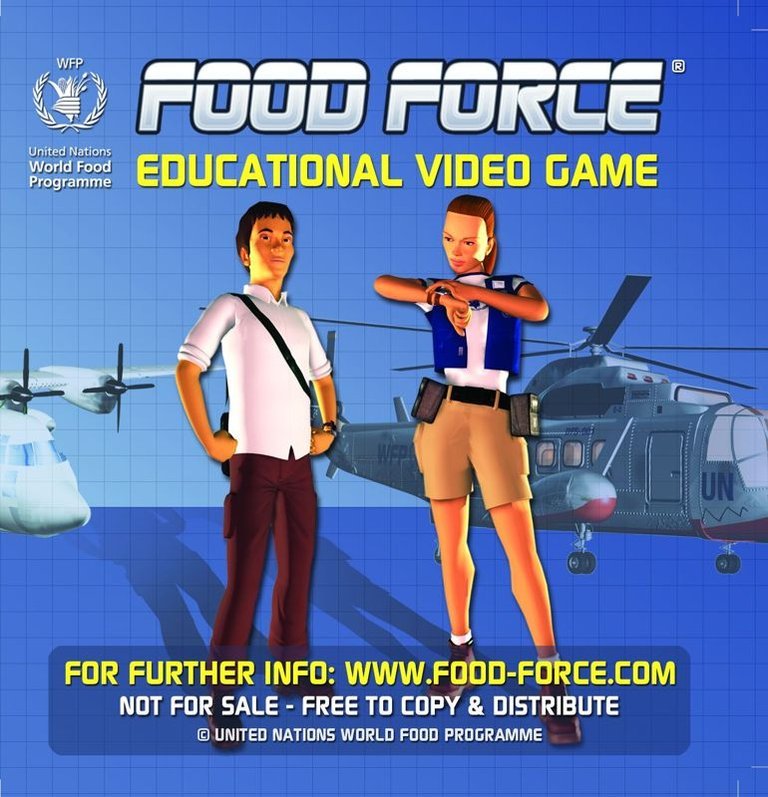
Food Force is an educational simulation game developed by Playerthree Limited for the United Nations World Food Programme. Set in the famine-stricken and war-torn island nation of Sheylan, players engage in six missions that mirror real-world humanitarian aid, including aerial scouting, creating nutritious food packages, air-dropping supplies, international procurement and shipping, navigating truck convoys through hazards, and distributing food to promote health, schooling, and infrastructure restoration.
Gameplay Videos
Where to Buy Food Force
PC
Food Force Free Download
PC
Food Force Reviews & Reception
openthefuture.com : the reviews of Food Force have been surprisingly good.
blog.acton.org : The overall goal of the WFP in fighting hunger is a noble one.
Food Force: The UN’s Pioneering Foray into Humanitarian Gaming
Introduction: A Noble Experiment in Interactive Empathy
In the mid-2000s, the video game industry was a landscape dominated by escalating graphical fidelity, increasingly complex narratives, and a persistent cultural critique linking interactive entertainment to violence and societal decay. Against this backdrop, an improbable actor entered the arena: the United Nations World Food Programme (WFP). In April 2005, it released Food Force, a free, educational “serious game” tasked with a monumental goal—making the abstract, global crisis of hunger tangible and actionable for a generation of young gamers. The very concept invited skepticism. Could an institution synonymous with bureaucracy and dire reporting craft a gameplay experience that was not only informative but genuinely engaging? Synthesizing its development history, mechanics, and reception reveals Food Force as a fascinating, flawed, and ultimately pioneering artifact. It stands as a landmark attempt to weaponize the interactive medium for humanitarian awareness, succeeding more as a bold proof-of-concept and a conversation starter than as a timeless classic, but its legacy in legitimizing “games for change” is undeniable.
Development History & Context: A Tight Deadline and a Tight Budget
Food Force was born not from a commercial imperative but from a humanitarian and communicative one. Its origins are poignant: the initial concept was proposed by Italian WFP field worker Paola Biocca, who died in the line of duty in Kosovo in 1999. The game is dedicated to her memory, a detail that imbues the project with a solemn, personal purpose from the outset. The vision was clear: to create an engaging digital experience that could “target future decision makers” and pull young people “into the discussion of world hunger,” a crisis where, as noted in a 2005 Game Developer article, a child dies every five seconds.
The execution was a study in constrained creativity. The WFP, acutely aware that funds must serve direct aid first, operated on a shoestring budget. As Justin Roche, the WFP’s program manager, stated in the Serious Games Summit 2005 coverage, the project was amortized over 2.5–3 years, with only about $5,000 initially spent on gaming consulting. The final cost was approximately $475,000—a fraction of a mainstream AAA title’s budget. This necessitated a lean development model reliant on pro bono partnership. The technical execution was handed to two European studios: the British Playerthree Limited and the Italian company Deepend. They built the game using Macromedia Director, a versatile but aging tool popular for its cross-platform capabilities and ability to integrate video (via QuickTime), 3D graphics, and interactive elements. This choice reflected both budget constraints (leveraging existing, licensable technology) and the design need to mix cinematic footage—real-world images of hunger—with playable 3D simulations.
The 2005 gaming landscape was one of transition. Serious games were a nascent niche, with titles like SimCity and A Force More Powerful serving as benchmarks. The WFP’s entry was uniquely positioned: it had the gravitas of a UN agency and a distribution model (free download, encouraged CD-burning) that prioritized reach over profit. The involvement of publisher Konami Corporation (listed on the title screen and credited with facilitating Japanese localization) hinted at a desire for industry credibility, though the core project remained firmly in the humanitarian, not commercial, sphere.
Narrative & Thematic Deep Dive: The Crisis of Sheylan
Food Force constructs its educational narrative around a fictionalized but archetypal setting: the island nation of Sheylan in the Indian Ocean, suffering from drought and civil war. This creative decision is critical. By inventing Sheylan, the game avoids direct, potentially politically charged references to real, ongoing crises, while still capturing their essential dynamics. The player is not an abstract entity but a “rookie” who joins a crack team of UN experts: a nutritionist, a logistics officer, a pilot, an appeals officer, and a food purchasing director. This framing immediately establishes a hierarchy of expertise and positions the player as a learner within a professional context.
The narrative is delivered through a series of six linearly progressing missions, each serving as a chapter in the story of emergency relief and long-term recovery:
- Air Surveillance: The player pilots a helicopter, scanning a 3D map to locate clusters of needy citizens. The theme here is assessment and reconnaissance—the first, data-gathering step of any humanitarian operation.
- Energy Pacs: This mission moves to a screen where the player must formulate a daily food ration. They must balance five ingredients (rice, cooking oil, beans, sugar, salt) within a devastatingly tight budget of 30 cents per person per day. This introduces the core, grinding tension of humanitarian logistics: maximal nutritional impact under minimal financial constraint. The underlying theme is nutritional science and economic triage.
- Food Drop: The player becomes an aerial loader, guiding pallets out of a cargo plane’s bay. The key mechanic is compensating for wind direction, which shifts before each drop. This simulates the precision and danger of airdrops, teaching that relief is not a simple “drop and hope” affair but a calculated operation subject to environmental chaos.
- Locate and Dispatch: This is a complex global logistics puzzle. The player acts as a dispatcher, matching incoming food donations (from specific countries, with specific contents) to Sheylan’s monthly needs, using a world map with shipping lanes. The theme expands to international coordination, supply chain management, and the politics of aid (donations may not match needs).
- Food Run: The tone shifts to tension and danger. The player leads a ground convoy of trucks along a winding road, encountering landmines, roadblocks, and rebel fighters. This embodies the physical peril and security challenges of overland aid delivery in conflict zones.
- Future Farming: The final, most ambitious mission is a long-term development simulation. Over a timescale of 10 years, the player allocates a resource of “Food Resource Units” to investments like nutrition training, schooling, “food for work” programs, and HIV/AIDS treatment. The stated goal is to make a village self-sufficient. This mission is the narrative and thematic climax, arguing that humanitarianism’s ultimate aim is its own obsolescence.
The dialogue, delivered with competent but unspectacular voice acting (Kerry Shale as the narrator/Carlos, among others), is functional and expositional. It rarely rises to dramatic heights but effectively conveys procedural information and the team’s camaraderie. The overarching themes are consistent and powerful: systemic problem-solving, the dignity of recipients, the multifaceted nature of aid (immediate relief vs. long-term development), and the constant negotiation between ideal outcomes and harsh practical limits. The game’s dedication to Paola Biocca serves as a silent, grounding motif—this is not an abstraction, but the work of real people who risk everything.
Gameplay Mechanics & Systems: Arcade Urgency vs. Strategic Depth
Food Force is structured as a mini-game compilation, a series of discrete challenges that together form the relief operation. The core design philosophy prioritizes “twitch” elements and time pressure to simulate the “race against the clock” inherent in humanitarian crises. This is both its most engaging and most divisive feature.
- Air Surveillance: A simple top-down scrolling shooter analogue. The player flies a helicopter, using a spotlight to “identify” (click on) refugee icons. It’s a test of scanning speed and hand-eye coordination, introducing the map of Sheylan.
- Energy Pacs: The most strategically interesting mini-game. Players drag sliders to set the weight of each food component. A nutritive value meter and a cost meter provide feedback. Success requires balancing calories, protein, and micronutrients against the 30-cent ceiling. Critics like Tech with Kids praised this as a genuine lesson in the economics of nutrition, though others, like Toolness, noted poor instruction could leave players guessing.
- Food Drop: An arcade-style aiming game. The player must judge wind speed/direction (displayed as an arrow) to drop pallets onto a moving target zone. The wind mechanic is the key challenge, requiring prediction rather than simple point-and-click. Its win condition is accuracy under pressure, simulating the narrow margin for error in real airdrops.
- Locate and Dispatch: A logistics management puzzle. A world map shows arriving shipments (color-coded by country) and monthly need graphs for Sheylan. The player must drag donation icons to matching need bars before time runs out. It teaches resource matching and temporal planning, though it abstracts the immense political complexities of real-world donation logistics.
- Food Run: A vehicular action/avoidance game. The convoy auto-scrolls forward; the player must brake or accelerate to avoid obstacles (landmines) and shoot or evade rebel ambushes. This is pure tension, injecting the threat of violence into the supply chain. Its connection to educational themes is tenuous, relying on atmosphere.
- Future Farming: The unique systems simulation. A village is divided into sectors (Health, Education, etc.). The player allocates a fixed pool of “Food Resource Units” over a decade. The interface is opaque; as Toolness observed, the interrelations between sectors are poorly explained, making it feel like blind allocation. However, it attempts a systems-thinking approach—showing that investment in one area (health) can benefit others (school attendance).
UI and Presentation: The interface is functional, using clear icons and gauges, but can feel clunky, particularly in the food drop and convoy missions where precision is required. The high score system for each mission, with online leaderboards (now defunct), encouraged replayability through competition, a clever engagement hook for its target audience.
The Fundamental Tension: The game’s design embodies a core conflict in serious games: educational pacing versus game pacing. As Curly’s World of Freeware and Abandonia Reloaded noted, the挑战 (challenge) is accessible and the presentation “cool.” Yet, as the critical review from Toolness passionately argued, the pervasive time limits often work against learning. In the “Energy Pacs” mission, the narrator’s explanations overlap with the countdown, forcing the player to juggle comprehension and stress. The best edutainment integrates learning into the core mechanic; Food Force frequently places learning outside the urgent action, treating it as a lecture to be endured between tasks. This is its most significant design flaw.
World-Building, Art & Sound: Bridging Fiction and Reality
The aesthetic of Food Force is a product of its engine and budget. Using Macromedia Director, it creates a mixed-media experience:
- Visuals: The game employs low-polygon 3D models with a bright, almost cartoonish color palette for vehicles, environments, and UI elements. This style sacrifices realism for legibility and broad appeal, aligning with its 8-13 year-old target demographic. The fictional island of Sheylan features generic tropical landscapes—beaches, jungles, small villages. More impactful are the FMV (Full-Motion Video) sequences interspersed between missions. Using QuickTime, these integrate real, documentary-style footage of famine-stricken regions, empty warehouses, and WFP workers. This juxtaposition of playable 3D “game” world with “real” documentary footage is the art’s masterstroke. It constantly reminds the player that Sheylan is a metaphor for actual places, grounding the arcade action in sober reality. As Jamais Cascio on WorldChanging observed, this use of “full screen video” was a strength.
- Sound Design: The soundtrack is minimal, atmospheric electronic music that does not intrude. Sound effects for helicopter blades, truck engines, and drops are serviceable. The voice acting (Kerry Shale, Kenny Andrews, etc.) is clear and professional, delivering scripted lines with appropriate gravity, though lines can be repetitive across mission retries.
- Atmosphere: The game’s atmosphere is a calculated blend. The missions have an urgent, sometimes thrilling arcade feel (especially “Food Run”), but this is perpetually undercut by the weighty subject matter presented in the mission briefings and video segments. This creates a unique cognitive dissonance: you are playing a high-score chase that is simultaneously about life-and-death logistics. It’s less immersive than SimCity or Civilization, but its purpose is not to create a living world, but to create a symbolic, pedagogical space where systems can be manipulated without real-world consequence.
Reception & Legacy: A Smash Hit in the “Serious” Arena
The critical and commercial reception of Food Force was a surprise to its creators and the industry. Within six weeks of its April 2005 release, it had registered over 1 million players. By its first anniversary, the WFP proudly announced it had reached nearly 4 million players worldwide, spanning nearly 200 countries. This organic, viral spread—driven by free distribution, school adoption, and media coverage—was a monumental success for a non-profit’s first foray into gaming.
Critical Reviews were remarkably positive for an educational title. The aggregate score on early aggregators was 88%. Tech with Kids gave it a perfect score, lauding its ability to make kids “feel as if they are a part of the team who saved Sheylan.” Abandonia Reloaded (a site known for its hardcore gaming audience) called it “the best coffee-break game I’ve ever seen,” praising its “cool graphics” and “brilliant gameplay,” and declaring it suitable “for all ages.” The more measured Curly’s World of Freeware scored it 67%, acknowledging its entertainment value and informative content but noting it occasionally “skirt[s] thorny issues” of bureaucratic failure. The critical consensus validated the WFP’s thesis: you could make a serious-game game, not just a gamified lesson.
Legacy and Influence:
Food Force‘s legacy is multifaceted:
1. Benchmark for Serious Games: It became, as the WFP itself stated, “the benchmark in the burgeoning ‘serious games’ niche.” It proved that a non-profit with a serious message could produce a game with mainstream appeal and massive reach. Industry publications like Game Developer covered its development, legitimizing the model.
2. Institutional Proof-of-Concept: Its success directly led to the WFP pursuing a sequel, Food Force 2, released in 2009. Significantly, Food Force 2 was developed as free software (GPLv3) in Python, making it truly open-source and cross-platform (including the One Laptop Per Child’s XO). This shift reflected lessons learned: community-driven localization and development could extend a game’s lifespan and impact far beyond the initial commercial release.
3. Localization as a Model: The original game was translated into multiple languages (Japanese, Italian, Polish, etc.) through partnerships with gaming and government entities (Konami, Ubisoft, ECHO). This showed a scalable model for internationalizing a humanitarian message.
4. A Cautionary Tale on Sustainability: For all its success, the original Food Force is now an abandonware title. Its official website (food-force.com) and download links are defunct, a victim of the waning support cycle for a 2005 freeware title. It survives only through mirrors and archives like the Internet Archive and MyAbandonware. This highlights the critical challenge for serious games: long-term maintenance, compatibility with new OSes, and curatorial support. The open-source Food Force 2 attempts to solve this problem, but the original’s fragility is a case study in digital preservation for socially-conscious games.
5. Cultural Footprint: It inspired analyses in academic journals, was used in classrooms with provided lesson plans, and became a touchstone example in discussions about “games for change.” Its core analogy—using a game to simulate bureaucratic and logistical processes—remains influential.
Conclusion: A Flawed but Essential Pioneer
Food Force is not a game remembered for its deep, emergent gameplay or its stunning visuals. By modern standards, its mini-games are simplistic, its AI non-existent, and its systems shallow. Its most innovative mission, “Future Farming,” fails to provide a clear conceptual model, leaving players to guess at causal relationships. Its reliance on timed sequences often undermines its educational goals, creating stress where contemplation is needed.
Yet, to judge it solely on these metrics is to miss its historic achievement. Food Force succeeded in its primary mission: it made global hunger feel immediate, understandable, and solvable to millions of children. It translated the dense, policy-driven work of the WFP into a series of visceral challenges: the tension of the airdrop, the puzzle of the ration, the peril of the convoy. It used the language of play—scores, retries, mastery—to teach the language of humanitarianism: logistics, nutrition, development.
It stands as a pioneering artifact of the serious games movement, demonstrating that a game’s topic need not be fantasy or violence to be engaging. It showed the power of free distribution and viral marketing for a cause. Its success spawned an open-source sequel and influenced how NGOs approach digital advocacy.
In the canon of video game history, Food Force occupies a unique niche. It is not a masterpiece of design like SimCity 2000 (which it apes in its final mission) or a cultural phenomenon like Minecraft. Instead, it is a noble, pragmatic, and remarkably effective tool—a product of its technological moment, bounded by its budget, but animated by a profound humanitarian purpose. Its flaws are instructive, highlighting the pitfalls of forcing educational content into arcade formats. Its triumphs are enduring, proving that games can be a powerful medium for empathy and systems literacy. For anyone studying the evolution of games beyond entertainment, Food Force is an essential, if dated, case study: the story of how the United Nations tried to save the world, one high-score run at a time.