
- Release Year: 2023
- Platforms: Windows
- Publisher: Luminous Games
- Developer: Luminous Games
- Genre: Action, Adventure, Role-playing (RPG)
- Perspective: Behind view
- Gameplay: Action RPG, Open World, Sandbox
- Setting: Fantasy
Description
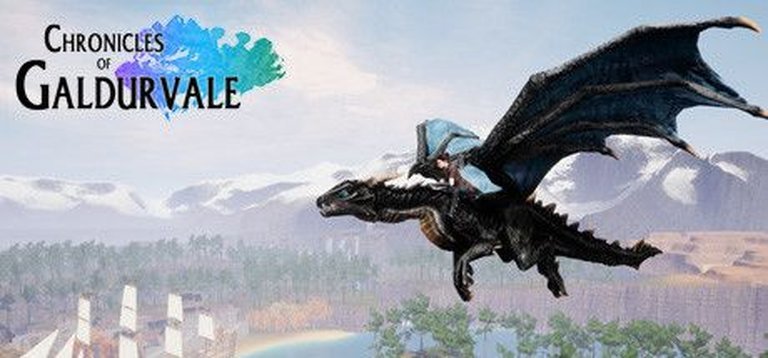
Chronicles of Galdurvale is an action-adventure RPG set in a fantasy open world where players control Amelia Moonglow, a skilled huntress who rides a dragon to explore Galdurvale, craft items, collect weapons, and battle challenging bosses. Her quest is to gather five sacred stones and reunite with her mother in the Sky World.
Gameplay Videos
Where to Buy Chronicles of Galdurvale
Chronicles of Galdurvale: The Indie Dragon Rider’s Tumultuous Flight
Introduction: A Skyward Dream Forged in Adversity
In the sprawling canon of modern action-adventure RPGs, few titles have been born from such a visibly turbulent and personal journey as Chronicles of Galdurvale. Emerging from the digital ether in May 2023 after a lengthy Early Access period, this game represents not just a fantasy quest for its protagonist, Amelia Moonglow, but also a testament to the relentless perseverance of its sole creator. eschewing the glossy production values of AAA studios, Chronicles of Galdurvale presents itself as a passionate, if rough-hewn, invitation to soar on dragonback through a stylized open world. This review will argue that the game’s true significance lies less in its mechanical execution and more in its role as a raw, unfiltered chronicle of indie development struggle—a “game jam” ethos scaled to an open world—whose value is found in the tenacity of its creation as much as in the content of its final form.
Development History & Context: The Lone Wolf, The Pack, and The Phoenix
The story of Chronicles of Galdurvale is inextricably linked to the story of its developer, Luminous Games, and specifically its driving force, HikaruYugi (as identified in the GameHypes update). The development narrative, as pieced together from the official dev post, is one of dramatic iteration and against-all-odds survival.
The project began in 2018 as a solo endeavor, born from a deliberate choice of a “low poly art style” due to the creator’s self-professed lack of artistic skill. This first iteration, complete with a playable demo in just three months, was scrapped entirely after a friend saw potential and joined the project. This partnership accelerated development, leading to a shift to a “realistic art style” and several public showcases at New Zealand gaming events like Armageddon. However, this period of collaboration quickly soured. Creative disputes over the story, exacerbated by the hiring of a writer, led to a breakdown in trust. The partner treated the project as a hobby, while the founder viewed it as a business. This conflict forced the founder to reclaim the project solo, but he returned to a development nightmare: the current world design was “very demanding in terms of hardware,” causing severe FPS drops.
This led to the second monumental pivot: the scrapping of the entire game world again to create “COG v2.0″—the “semi-realistic” art style seen in the final product. This version was more performant but arrived just as the developer’s personal finances were exhausted, forcing a move to a smaller home. The project’s salvation came from two unexpected quarters: the unwavering support of a small group of Kickstarter backers (despite the campaign’s failure) and, crucially, the Epic MegaGrants. This award provided the lifeline needed to hire a professional writer from Australia and push toward completion. The final stretch was a exercise in scaled-back ambition, focusing on finishing a coherent, if smaller, game.
Technologically, Chronicles of Galdurvale was built with Unreal Engine 4 and utilizes the PhysX physics engine, standard tools for an indie project of its scope in the early 2020s. Its context within the 2021-2023 indie landscape is that of a “kitchen sink” open-world action-RPG, attempting to synthesize crafting, exploration, aerial combat, and boss fights—mechanics popularized by giants like The Legend of Zelda: Breath of the Wild and The Witcher 3—but with a fraction of the resources.
Narrative & Thematic Deep Dive: A Quest of Maternal Longing and Elemental mastery
The narrative of Chronicles of Galdurvale is presented through the store blurb and Metacritic summary as a classic high-fantasy framework with a personal core. The protagonist, Amelia Moonglow, is a “skilled huntress” on a dual quest: to collect the five sacred stones (elemental crystals) and to reunite with her mother in the Sky World. This immediately establishes a narrative bifurcation—the external, world-saving task and the internal, emotionally fraught personal journey.
Thematically, the story explores legacy and rediscovery. The “Sky World” is described as the home of the “Dragon Riders of old,” suggesting Amelia is not just reclaiming a family member but also a lost heritage and a connection to a mythical past. Her role as a huntress grounded in the “Middleland” below, who must master elements to ascend, positions her as a bridge between earthly skill and celestial magic. The “mystical armband” mentioned in the Kotaku summary is her key to harnessing these elements.
However, the narrative execution, based on available sources, is likely sparse. The Steam description emphasizes “cunning environmental puzzles” and “uncover[ing] ageless secrets,” but no specific plot details, character names beyond Amelia and her mother, or thematic depth are provided in the source material. The community discussions hint at quests (e.g., a “Potion quest”) and characters (a loud goblin named “Gung”), suggesting a quest-driven structure with light NPC interaction. The failure of the first writer and the late hiring of a second implies narrative may have been a secondary concern to gameplay systems, or that it underwent significant reworking. The story, therefore, functions primarily as a scaffold for gameplay—a McGuffin (the stones) and emotional motivation (the mother) to propel the player through the game’s activities.
Gameplay Mechanics & Systems: The Promise of Flight and the Grind of Crafting
The core gameplay loop of Chronicles of Galdurvale is clearly articulated in its promotional material and community feedback: explore, craft, fight, repeat.
-
Dragon Riding (The Flagship Mechanic): This is the game’s unique selling point and the centerpiece of its identity. Players control Amelia, who rides a dragon. This allows for “soar[ing] through the skies,” accessing “otherwise unreachable areas,” and engaging in “thrilling aerial combat” using the dragon’s “powerful fireball.” The sensation is marketed as “exhilarating,” with an emphasis on verticality and perspective. This mechanic aims to merge traversal and combat seamlessly, a feature reminiscent of games like Dragon’s Dogma (with its Pawn-riding) or Skies of Arcadia, but in an open-world context.
-
Crafting & Resource Gathering: A significant portion of gameplay involves “gather[ing] resources like herbs” and “hunt[ing] down animals” to “craft powerful arrows and useful items.” This introduces a survival-crafting element, encouraging exploration of the diverse environments of Galdurvale. The community feedback confirms this loop, with one user noting the crafting of “Fire Arrows” and their potential overpowered nature (“223Hps off” a scorpion).
-
Combat & Progression: Ground combat appears to be real-time and action-oriented, with a focus on “learn[ing] new combat techniques and observing opponents.” Weapon acquisition comes primarily from “collect[ing] weapons dropped by the enemies,” suggesting a loot-based or pick-up system rather than deep weapon customization. Boss fights are highlighted as challenges against unique foes like “giants and ancient machines,” implying varied combat puzzles or patterns.
-
Open World & Activities: The world is a “sandbox / open world” (MobyGames) filled with “dangerous bandit gangs who have set up camps throughout Galdurvale.” These function as likely mini-dungeons or strongholds. Environmental puzzles are mentioned, aligning with the “cunning” puzzles in the Metacritic summary.
Critical Flaws & Player Feedback: The Steam Community discussions reveal several systemic issues:
* Balance Problems: Fire arrows were reported as “way too overpowered” in the demo, indicating a lack of combat tuning.
* Technical & Design Issues: Numerous posts report bugs (“Bug!!!”, “EA-Quest Failure?”, “Mouse moving by itself”). One persistent complaint was the lack of controller support (“this game needs controller support !”), a significant omission for an action-adventure game.
* Asset Criticism: A striking community comment in Polish (“zbyt duzo gotowych assetow”) translates to “too many ready-made assets, it looks ugly, fix it.” This is a devastating critique from a player perspective, suggesting the game’s visual identity may feel generic or haphazardly assembled from store-bought assets, undermining the intended “semi-realistic” style.
* Quest Design: Specific quests like the “Potion quest” and “Aconites” (likely a crafting ingredient) are subjects of discussion, hinting at potentially obscure or buggy quest progression.
World-Building, Art & Sound: A Vast, Variable, and Problematic Landscape
The world of Galdurvale is described as a “mysterious” and “vast open world” with geography ranging from the “Middleland” to the floating “Sky World.” This verticality is the game’s defining spatial feature. The art style’s evolution—from low poly to realistic to “semi-realistic”—is itself a key part of the game’s identity, but the community’s “too many ready-made assets” critique suggests this final style may not have been cohesively realized, potentially resulting in a visually inconsistent experience.
The soundscape is virtually undocumented in the sources. There is no mention of a composer or notable soundtrack. The only specific audio feedback is the complaint about an NPC named “Gung” the goblin being “very very loud compared to Amelia,” pointing to inconsistent audio mixing. This lack of information suggests a functional, rather than memorable, auditory experience.
The atmosphere is built on the fundamental thrill of flight and the allure of discovery. The promise is one of serene exploration punctuated by the danger of bandit camps and boss encounters, aiming for a “Relaxing” tag alongside “Combat” and “Family Friendly.” Whether this tonal balance succeeds is questionable given the reported difficulty spikes and bugs.
Reception & Legacy: A Cult Curiosity with a Troubled Birth
Chronicles of Galdurvale has no Metascore on Metacritic (listed as “tbd” with no critic reviews). Its commercial and critical reception is minimal and polarizing.
- Commercial Performance: Sold for a budget price of $7.79/€7.79 on Steam. It was an Epic MegaGrants recipient and featured in several indie showcases (NZGDC, Armageddon), indicating some early institutional recognition. However, a failed Kickstarter campaign suggests difficulty in generating wider public funding or interest pre-launch.
- Player Reception: As of the last data pull, it holds a Steam Player Score of 71/100 from 7 reviews (5 positive, 2 negative). This is a very small sample size, indicative of a niche audience. The positive reviews likely celebrate the core fantasy and the developer’s perseverance. The negative reviews almost certainly cite the bugs, asset criticism, and feature gaps (like controller support).
- Legacy and Influence: The game has no discernible influence on the industry. Its legacy is currently confined to being a case study in solo/indie resilience. It exemplifies the “never give up” narrative, having survived partnership breakdowns, complete art style overhauls, financial destitution, and a failed crowdfunding campaign. It is a game that exists against formidable odds. Its influence may be inspirational for other small developers facing similar existential hurdles, demonstrating that a project can be completed through sheer will and strategic use of grants, even if the result is imperfect.
Conclusion: A Flawed Pearl from the Depths of Indie Struggle
Chronicles of Galdurvale is not a great game by conventional metrics. Its world likely feels cobbled together, its combat balance is suspect, its quests may be buggy, and its story is paper-thin. The community’s harsh assessment of its visual assets is particularly damning for a game whose primary draw is exploring a beautiful fantasy world.
Yet, to judge it solely on these flaws is to miss the point. It is a monument to completion. It is the physical manifestation of a developer’s vision clawed back from the jaws of collapse twice over. The exhilarating promise of dragon flight—the one universally acclaimed feature—feels almost miraculous given the context of its creation. It is a game for a specific kind of player: one willing to overlook jank for a unique aerial fantasy, and one who deeply values the human story behind the code.
In the grand tapestry of video game history, Chronicles of Galdurvale will not be remembered for its innovations or its polish. It will be remembered, if at all, as a “cult artifact of development adversity.” It stands as a raw, unvarnished look at what one person (with intermittent help) can actually build with Unreal Engine 4, a budget under $10, and an indomitable will. Its final verdict is not “must-play” but “must-be-acknowledged.” It is a flawed, fascinating, and ultimately human-sized achievement in a landscape of corporate behemoths, proving that the journey of creation can be as compelling as the destination—even if that destination is a rocky, asset-stuffed sky world filled with overpowered fire arrows and loud goblins.