
- Release Year: 2009
- Platforms: Windows
- Publisher: UIG Entertainment GmbH
- Genre: Puzzle
- Perspective: 1st-person / Top-down
- Gameplay: Word construction
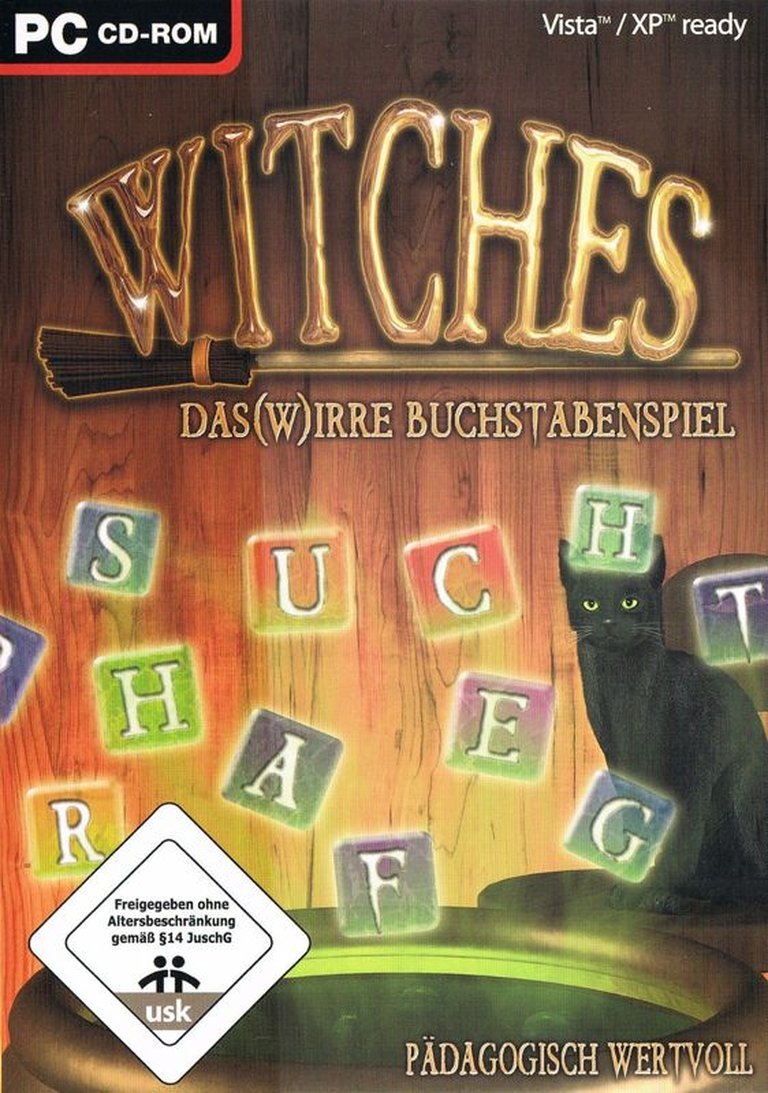
Description
Witches: Das (W)irre Buchstabenspiel is a puzzle video game centered on word construction, where players connect letters on a board to form valid words in any direction, similar to Scrabble. By scoring points for each word, players progress through endless, randomly generated levels, offering a perpetually challenging and replayable experience on Windows platforms.
Witches: Das (W)irre Buchstabenspiel Cheats & Codes
Witches 1.2 PC
Open Witches1.2.exe go to load game
| Code | Effect |
|---|---|
| Beginning | Unlocks Level 1: Beginning |
| Alessandria | Unlocks Level 2: Alessandria |
| Antigone | Unlocks Level 3: Antigone |
| Agathon | Unlocks Level 4: Agathon |
| Cervia | Unlocks Level 5: Cervia |
| Cavalcanti | Unlocks Level 6: Cavalcanti |
| Alagna | Unlocks Level 7: Alagna |
| Barbarossa | Unlocks Level 8: Barbarossa |
| Calboli | Unlocks Level 9: Calboli |
| Falterona | Unlocks Level 10: Falterona |
| Antiphon | Unlocks Level 11: Antiphon |
| Alberti | Unlocks Level 12: Alberti |
| Alcmaeom | Unlocks Level 13: Alcmaeom |
| Beatrice | Unlocks Level 14: Beatrice |
| Cimabue | Unlocks Level 15: Cimabue |
| Alagia | Unlocks Level 16: Alagia |
| Ahasuerous | Unlocks Level 17: Ahasuerous |
| carsar | Unlocks Level 18: carsar |
| Aglauos | Unlocks Level 19: Aglauos |
| Arachne | Unlocks Level 20: Arachne |
| briareus | Unlocks Level 21: briareus |
| bohemia | Unlocks Level 22: bohemia |
| farinata | Unlocks Level 23: farinata |
| anastagi | Unlocks Level 24: anastagi |
| barbagia | Unlocks Level 25: barbagia |
| cytharaea | Unlocks Level 26: cytharaea |
| angelico | Unlocks Level 27: angelico |
| spider | Unlocks Final Level (Level 28) |
Witches: Das (W)irre Buchstabenspiel: Review
Introduction: The Silent Spell of an Obscure Title
In the vast digital archives of gaming history, countless titles exist as mere spectral entries—a name, a platform, a genre tag—with no critical analysis, no player memories, and no cultural footprint to speak of. Witches: Das (W)irre Buchstabenspiel (translated roughly as “Witches: The Crazy Letter Game”) is the very archetype of such a phantom. Released for Windows in 2009 by the German publisher UIG Entertainment GmbH, this title presents itself on the surface as a straightforward, family-friendly word puzzle game in the vein of Scrabble. Yet, its near-total absence from discourse, its complete lack of reviews or credits on major databases, and its extremely limited commercial footprint position it not as a forgotten gem, but as a fascinating case study in ephemeral game production. This review will argue that Witches is historically significant not for its gameplay—which appears conventional to the point of anonymity—but for what its obscurity reveals about the late-2000s German budget software market, the challenges of preserving digital culture for non-English “shovelware,” and the sheer volume of games that exist only as catalog numbers and unopened boxes on reseller sites.
Development History & Context: A Product of the German “Bargain Bin” Pipeline
The Studio and Publisher: UIG Entertainment
The publisher, UIG Entertainment GmbH, provides the first crucial piece of context. UIG was a prolific German publisher known primarily for producing low-cost, often licensed or concept-driven games for the PC and, later, mobile platforms. Their catalog was extensive but notoriously inconsistent, targeting the “breitbandig” (broad) casual and children’s market with titles based on popular TV shows, simple puzzles, and activity compilations. They operated on a model of high-volume, low-budget releases, frequently selling through discount retailers, supermarket media sections, and mail-order catalogues. The development studio behind Witches is not credited, suggesting it was either an internal “studio” (a common practice for such publishers) or, more likely, a contract developed by a small, anonymous team, possibly outside Germany, for a quick turnaround.
The 2009 Landscape: Casual’s Peak and the Budget PC Niche
2009 was a pivotal year. The Western casual market was dominated by PopCap Games (Bejeweled, Plants vs. Zombies) and the emergent Facebook/social game boom. Meanwhile, the Nintendo DS was in its prime, churning out both acclaimed titles and a torrent of cheap, stylus-based puzzle games. The PC, however, still had a robust market for budget “tainment” discs—collections of simple games sold in colorful boxes at newsstands and electronics stores for under €10. These were not expected to be journalistic darlings; they were expected to be purchased by grandparents for grandchildren, or by consumers seeking a trivial distraction. Witches fits squarely into this last category. Its USK rating of 0 (“ohne Altersbeschränkung,” or no age restriction) confirms its positioning as a game for young children and families.
Technological Constraints and Vision
Technologically, the game is a black box. No credits exist to analyze. The MobyGames specs list “Fixed / flip-screen” visuals and support for keyboard/mouse, hallmarks of simple 2D DirectX or early XNA projects. The “perspective” is listed as both 1st-person and top-down, an immediate red flag for confusion or error—possibly indicating a UI view that felt immersive (like looking down at a board) while the board itself was a traditional top-down grid. The “infinite levels” claim from the description points to a basic procedural generation algorithm for letter tiles and board layouts, a common cost-saving measure to avoid designing hundreds of static boards. The “vision” was likely not artistic but commercial: to take a proven mechanic (word construction), apply a mildly thematic wrapper (“witches”), and ship it with minimal risk.
Narrative & Thematic Deep Dive: The Absence of Story
Here, the review must confront a fundamental void. There is no narrative. The title, Witches: Das (W)irre Buchstabenspiel, is purely decorative. The “(W)irre” pun (“irre” meaning “crazy” or “mad” in German, with the “W” from “Witches” incorporated) is a piece of linguistic playfulness, but it is not integrated into any story. There are no characters, no plot, no dialogue, and no themes beyond the elementary educational concept of forming words. This is not a game like the contemporaneous A Witch’s Tale (a completely unrelated Nintendo DS RPG) that uses witchcraft as a narrative engine. For Witches, the “witch” branding is likely a superficial marketing tactic to appeal to a demographic interested in magic and fantasy, divorced from any deeper mechanics or lore. This thematic emptiness is, in itself, a critical statement: it represents a segment of the industry where theme is a skin, not a skeleton.
Gameplay Mechanics & Systems: The Scrabble Scaffolding
Based solely on the MobyGames description, the core loop is starkly simple:
1. Core Action: Form English (or possibly German, given the title) words by connecting letter tiles on a grid, “in any direction,” as in Scrabble or Boggle.
2. Progression: Score points. Upon reaching a point threshold, the current level ends.
3. System: A new level is “generated,” implying an endless, non-sequential mode. There is no campaign, no unlockable content, no branching paths. The game is an infinite score-attack sandbox.
4. Inferred Mechanics: Likely features include standard Scrabble bonus squares (double/triple letter/word scores), a tile bag/rack system, and perhaps a time limit or move limit per level to increase challenge. The mention of “word construction” suggests players must spell sequentially connected letters, not just find words in a jumble (which would be Boggle-style). The “any direction” implies orthogonal and diagonal connections are valid.
Analysis of Systems:
* Innovation: None. The game is a direct mechanical clone. Its only potential innovation is the “infinite generated levels” aspect, which in practice would mean a simple algorithm randomizing tile placement on a fixed board size and populating bonus squares. This is a feature of convenience, not depth.
* Flaws (Inferred): Without tutorials, hint systems, or validation against a comprehensive dictionary, the player experience would be fraught with frustration (“Is ‘QI’ a valid word?”). The lack of any progression narrative or unlockables would make the endless mode feel hollow quickly. The “first-person” perspective listed is almost certainly a mislabeling or refers to a camera angle that makes the player feel “over” the board; it does not imply an immersive 3D world.
* UI/HUD: Presumably minimal: a score display, current tile rack, and perhaps a progress bar toward the level goal. Given the publisher’s profile, it was likely functional but aesthetically generic, using standard Windows UI elements and basic bitmapped fonts.
World-Building, Art & Sound: The Unseen Aesthetic
No screenshots, no credits, no composer listings. This is the greatest loss to historiography. We can only extrapolate from the publisher’s typical output and the year.
* Visual Direction: Likely 2D, pre-rendered or simple vector graphics. The board might have a “wooden” or “parchment” texture. Letters were probably standard, clear fonts. Any “witch” theme would be confined to the title screen and perhaps background images of cartoonish cauldrons, stars, or broomsticks—generic clip-art style. The “(W)irre” in the title suggests a font that playfully highlights the “W.” Given the “Fixed / flip-screen” visual spec, there were likely no animations; board states changed statically.
* Atmosphere: Non-existent. This is a abstract puzzle game. Any atmosphere would be the quiet, contemplative (or anxious) focus of a word game, broken by perhaps a cheerful,合成 MIDI soundtrack for children.
* Sound Design: Would consist of:
* A short, looping title screen melody, likely upbeat and magical (harps, celesta, simple orchestral hits).
* Sting sounds for placing tiles, completing a word, and level completion (positive chimes).
* A generic “error” buzz for invalid words.
The quality would be typical of low-budget PC games: adequate, immediately forgettable, sourced from cheap stock music libraries or composed by an unknown sound designer.
The true tragedy is that we cannot see the specific, likely kitschy, German-language interpretation of the “witch” aesthetic they chose. It is a lost piece of regional graphic design.
Reception & Legacy: A Ghost in the Machine
Commercial & Critical Reception at Launch
Witches appears to have been completely ignored by the professional gaming press. It received zero reviews on MobyGames, no Metacritic entry, and no coverage in German print magazines like PC Games or GameStar beyond likely small, paid advertisements. Its commercial performance is opaque but can be inferred:
1. Distribution: It was sold in physical boxes in German-speaking countries (Germany, Austria, Switzerland), as evidenced by eBay listings showing new, sealed copies with EAN numbers.
2. Sales Volume: The publisher’s model suggests modest sales—likely in the low thousands—moving through discount channels. Its presence on eBay today, selling for €3-5, indicates it was not a collector’s item but common enough to be periodically liquidated from store stocks.
3. Player Reception: A complete vacuum. No user reviews, no forum posts, no archived mentions. It was consumed silently by its target audience (children, casual players) and discarded.
Evolution of Reputation and Influence
The game has no reputation to evolve. It is the definition of a “non-entity” in gaming history. It has zero influence on subsequent games. It did not innovate, it was not acclaimed, and it was not even notorious for being bad. It simply was for a brief commercial moment and then vanished.
* As a Historical Artifact: Its value is sociological. It exemplifies the “long tail” of low-quality, regionally-specific software that comprised a significant portion of retail shelf space in the 2000s. These are the games that fill the gap between AAA blockbusters and indie darlings—the “shovelware” that funded smaller publishers.
* Preservation Challenges: Its obscurity makes it a prime candidate for loss. With no digital distribution (no Steam, no GOG), no patches, and no community, the only surviving copies are likely physical discs deteriorating in attics and the occasional eBay sale. The source code is presumably lost. It is a digital artifact at extreme risk of total extinction, a silent testament to the impermanence of the vast majority of software history.
The “A Witch’s Tale” Confusion
A significant source of potential confusion is the 2009 Nintendo DS game A Witch’s Tale (developed by Hit Maker, published by NIS America). This was a reviewed, notable, if poorly-received, action-RPG with a strong witch theme and a Nightmare Before Christmas-esque art style. Searches for “Witches 2009 game” can conflate the two. This review must explicitly separate them: Witches: Das (W)irre Buchstabenspiel is a German PC word puzzle with no narrative or connection to the DS title beyond a coincidental thematic keyword and release year. The DS game has a Metacritic score (50/100) and documented reviews; the PC game has none.
Conclusion: A Footnote, Not a Story
Witches: Das (W)irre Buchstabenspiel cannot be judged by traditional standards of artistry, innovation, or fun because it operates outside those paradigms. It was not designed to be remembered; it was designed to be sold. Its thesis is one of pure economic utility: identify a simple, evergreen game mechanic (word puzzles), apply a cheaply produced thematic skin (“witches”), and distribute it through non-traditional retail channels to an audience with low critical expectations.
As a historical object, it is a perfect specimen of the “Bargain Bin Casual” genre of late-2000s PC gaming. Its complete lack of narrative, its derivative mechanics, its anonymous development, and its total absence from critical discourse tell us more about the commercial landscape of German gaming than any number of review scores could. It highlights the vast, uncounted majority of games that slip through the cracks of history—the software equivalent of blank prescription pads or generic cereal boxes. It is not a bad game; it is, in the truest sense, a non-game in terms of cultural impact. Its place in video game history is as a silent, sturdy brick in the immense, crumbling wall of commercial ephemera, a reminder that for every Portal or Disco Elysium, there are thousands of Witches: products with no ambition beyond the point of sale, and with no legacy beyond a forgotten EAN number and a dusty jewel case on a reseller’s shelf. Its ultimate verdict is one of profound, almost philosophical, insignificance.