
- Release Year: 2001
- Platforms: Android, iPad, iPhone, Macintosh, Windows
- Publisher: Eon Digital Entertainment, Kavcom Ltd, Kingstill International Software Services Ltd., Rebellion Developments Ltd., SCi Games Ltd., Sold Out Sales & Marketing Ltd.
- Developer: Bitmap Brothers, The
- Genre: Strategy, Tactics
- Perspective: Diagonal-down
- Game Mode: LAN, Online PVP, Single-player
- Gameplay: Arcade, Base building, Real-time strategy, Resource Management, Territory control, Unit control
- Setting: Futuristic, Sci-fi
- Average Score: 67/100
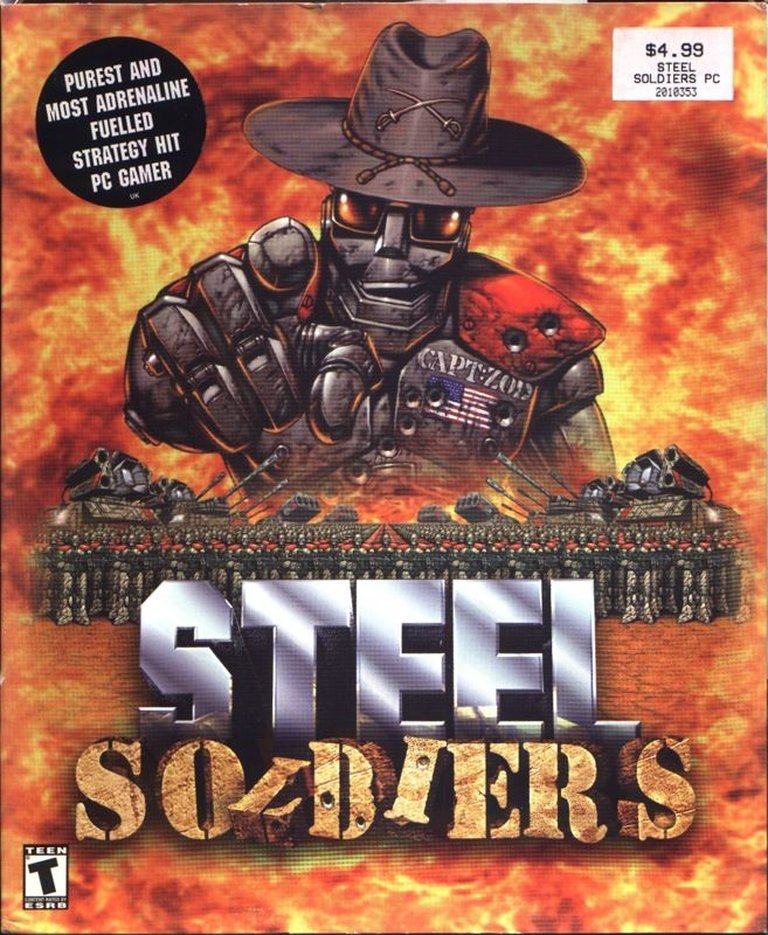
Description
Z: Steel Soldiers is a real-time strategy game with an arcade focus, set 500 years after the original Z in a futuristic sci-fi universe where an incident breaks an uneasy cease-fire between TransGlobal Industries and MegaCom Corporation, reigniting galactic war. Players compete across six distinct worlds—from deserts to forests—by capturing territories with varying Xenonite resource yields and strategic advantages, controlling up to 30 land, naval, and air units in a true 3D environment featuring realistic shadows, weather, and day-night cycles, all within a plot-driven narrative of intrigue and adaptive AI.
Gameplay Videos
Z: Steel Soldiers Free Download
Z: Steel Soldiers Patches & Updates
Z: Steel Soldiers Reviews & Reception
metacritic.com (88/100): A combat intensive 3D RTS that plays fast and smart, with clever AI and an engaging story propelled campaign.
metacritic.com (78/100): Some of the ideas in this game are really good, it’s just too bad that the execution of said ideas wasn’t a little better and a little more time had been put into creating factions with differences (both sides use the same units).
metacritic.com (71/100): The control mechanism and its efficient usage present the thin line between victory and failure. In this respect, Z: Steel Soldiers is both very well conceived, and extremely demanding in hardware.
metacritic.com (70/100): While Steel Soldiers has its strengths, the outdated play mechanics and buggy code may frustrate players rather than satisfy them.
metacritic.com (68/100): If you want the emphasis in real-time strategy to be on “strategy” over “real-time,” you’ll probably want to look elsewhere. As an old-fashioned and predictable RTS, Steel Soldiers succeeds, but as anything more, it merely scrapes by.
metacritic.com (50/100): The addictive qualities of “Z” are still there, but the passing years have made the underlying gameplay of Steel Soldiers boring, old and passé.
metacritic.com (40/100): Most gamers won’t be able to think straight, let alone execute the tons of mouse clicks necessary to keep from being overwhelmed.
ign.com (78/100): Takes the core structure of the original title, Z, and immerses you into an arcade-strategy title where the emphasis is on real-time combat.
Z: Steel Soldiers Cheats & Codes
PC
Cheats are applied by editing game files (using a hex editor for save files or a text editor for configuration files) or via an in-game button sequence.
| Code | Effect |
|---|---|
| 00247449 | Grants 1,000,000 credits when all three occurrences of the original 10,000 credit value (00401C46) are replaced in the save file. |
| 80 96 98 4A | Grants 5,000,000 credits when all three occurrences of the original 10,000 credit value (00401C46) are replaced in the save file. |
| 210614544 | Unlocks all levels when the current level number in the playername.zcm file is changed to this value. |
| Hold Shift and repeatedly click on an immobile target while the shockwave unit charges | Fires multiple energy blasts rapidly (only works on unpatched game in single-player mode). |
Z: Steel Soldiers: A Fusillade of Frustration and Fun – A Definitive Historical Review
Introduction: The Last Gasp of the Arcade RTS?
In the crowded arena of early-2000s real-time strategy (RTS), where StarCraft’s meteoric rise defined esports and Command & Conquer perfected the formula, the Bitmap Brothers’ Z: Steel Soldiers arrived not with a whisper, but with the chaotic, explosive charge of a squad of rogue robots. Released in 2001 as the sequel to their cult 1996 hit Z, Steel Soldiers (the North American title) was a deliberate pivot: a full-throttle, “arcade strategy” experience that sought to divorce itself from the meticulous economic micromanagement dominating the genre. Its thesis was bold—victory is measured in captured territory, not harvested resources, and every engagement should be a visceral, immediate decision. Yet, for all its ambition and technological prowess, the game became a fascinating case study in how brilliant concepts can be undermined by stubborn execution flaws. This review will argue that Z: Steel Soldiers is a critical failure and a commercial curios, yet a profoundly important technological stepping stone for its developer and a poignant, if flawed, monument to a specific, action-oriented design philosophy that never quite found its audience.
Development History & Context: From 2D Maverick to 3D Contender
The Bitmap Brothers were no strangers to innovation. By the late 1990s, they had built a reputation on genre-defying titles like Speedball 2 and The Chaos Engine, with Z (1996) standing out as a quirky, humor-infused RTS that stripped away resource gathering for pure territorial conquest. After a lengthy hiatus from major PC releases, the studio, under Managing Director Mike Montgomery and Lead Designer Jamie Barber, announced Z2 (later Z: Steel Soldiers) in August 2000, having secured the rights from former publisher GT Interactive.
The development context is crucial. The team was operating in a landscape dominated by Blizzard’s StarCraft (1998) and Westwood’s Command & Conquer series, where base-building, tech trees, and balanced economies were sacrosanct. Steel Soldiers was a conscious rebellion against this. As stated in the official press release and echoed by GameSpot’s preview, the goal was an “accessible strategy game combined with the immediacy of an arcade title.” This meant a from-the-ground-up 3D engine—a massive technical undertaking for a team known for 2D sprites—and a ruleset designed for rapid-fire gameplay. The delay from a planned late February 2001 release to June was attributed by the developers to these “substantial improvements,” primarily the leap to a fully 3D world with real-time shadows, reflections, and terrain deformation (tracks in soft soil, dust clouds). The technological leap was significant; this was the Bitmap Brothers’ first true 3D game, and it served as a foundational engine for their later, better-known World War II: Frontline Command (2001).
However, the era’s technological constraints were evident. The game demanded a “moderately fast or recently purchased computer,” with high graphical detail threatening frame rates on lower-end Pentium II systems. It famously lacked compatibility with Windows Vista years later, a symptom of its era-specific coding. The publishing journey was also rocky, involving multiple entities like Eon Digital Entertainment, SCi Games, and Sold Out Sales & Marketing, hinting at uncertain commercial faith.
Narrative & Thematic Deep Dive: Intrigue in a World of Tin
Where the original Z was a near-silent, cartoonish conflict between two robot armies for vaguely defined reasons, Steel Soldiers is a verbose, plot-driven campaign. Written by Martin Pond—a veteran of narrative-driven games like Medievil and Imperium Galactica 2—the story is a significant departure, aiming for “intrigue and conspiracy” in a post-509-year-war setting.
The premise is straightforward: a fragile peace brokered by Commander Keeler (MegaCom, red) and Commander Rieman (TransGlobal, blue) is shattered on the contested world of Rigal. The protagonist is the demoted Captain Zod (formerly Commander Zod from the first game), conducting rogue patrols in the demilitarized zone. The inciting incident—the shooting down of a transport by scouts Brad and Clarke—unveils the shadowy “Omega” conspiracy. The narrative unfolds through “luscious cut scenes” produced by AudioMotion, which were widely praised by critics (GameSpy, GameSpot) for their “caustic and witty” humor, good voice acting, and ability to propel the plot.
Thematically, the story grapples with blind obedience versus rogue initiative (Zod’s insubordination), corporate militarism, and the fragility of peace. However, the execution is uneven. The plot’s twists are often telegraphed, and the dialogue oscillates between sharp satire and groan-inducing puns. The introduction of “Hero” units—characters with unique visuals and roles (like the Sniper or the Tough)—adds flavor but often felt like window dressing for missions that boiled down to “destroy every enemy unit on the board,” as Game Over Online noted. The narrative’s greatest strength is its sheer presence; it commits to being a story-driven experience in a genre often reliant on mission briefings, making the campaign feel more coherent than its predecessor’s abstract battles. Yet, it never fully escapes a sense of predictability, and the final act’s reliance on a classic “stop the doomsday weapon” trope (Omega) underscores a reliance on familiar sci-fi tropes.
Gameplay Mechanics & Systems: The Beautiful, Broken Blitzkrieg
Z: Steel Soldiers is defined by one核心 (core) mechanical pillar: Territory is Everything. Buildings can only be constructed on owned land, captured by moving a unit onto a flag. Each flagged sector (1-5) generates “Credits” (replacing Xenonite mining) based on its number, creating an immediate strategic calculus: high-value resource territories versus strategically superior terrain (e.g., high ground for defense). This is a brilliant, pressure-cooker system that forces constant expansion and makes every inch of the 3D map a contested prize. It perfectly embodies the “arcade strategy” ethos—no safe economic backlines to build up; the war is won or lost at the front.
However, this elegant core is encased in a body of significant flaws.
-
The “Blitzkrieg” Mandate: The game demands relentless aggression. There is no traditional resource gathering; income is purely territory-based. This creates a frantic, almost overwhelming pace, praised by PC Action (Germany) for being “viel zu hektisch” (far too hectic) and rewarding fast, decisive strikes. But it also leads to a repetitive “destroy all enemies” loop, as GameSpot observed. The AI is hyper-aggressive, constantly expanding and probing, making defensive missions a desperate,动态 (dynamic) struggle.
-
Unit & Force Design: The roster of ~30 units (land, air, naval) is diverse and thematically sound, from hulking Toughs with missile launchers to nimble Snipers. New elite infantry (Technician, Spy, Explosives Expert) add interesting tactical options—planting viruses, stealing buildings—though these abilities were often situational. The biggest change from Z is the diminished role of the individual robot pilot; the focus is now on platoons and vehicle columns, a shift that disappointed purists (Mouse n Joypad).
-
The User Interface (UI) Abyss: This is the game’s most notorious failing. Multiple reviews (Eurogamer, PC Games Germany, Mouse n Joypad) crucified the UI as “clumsy,” “sludgy,” and “awkward.” Selecting and managing large groups of units was imprecise. The lack of standard RTS QoL features—a game-speed toggle (GameStar), clear unit pathing indicators, responsive command queues—meant victories often felt earned through battling the interface as much as the enemy. The “thin line between victory and failure” (ActionTrip) was frequently blunted by unresponsive controls and units disobeying orders, a source of legendary frustration.
-
AI: A Double-Edged Sword: The AI was cited as a “strong attribute” (PC Zone) and “clever” (GameSpy), capable of passive turtling or aggressive scouting/manufacturing based on difficulty. It made for a formidable opponent. Yet, this sophistication exposed other flaws: unit pathfinding was erratic, with squadrons ignoring enemies to chase a single jeep (PC Games Germany), and defensive AI could be simultaneously brilliant and idiotic, making the game feel “unfair” rather than challenging.
-
Mission Design & Structure: The campaign spans 30 missions across six distinct worlds (desert, forest, volcanic, ice, archipelago, wasteland), each with unique environmental hazards and wildlife. Objectives vary—capture shipyards, rescue personnel, timed EVACs—but a lack of diversity emerged. Too many missions resolve to “annihilate the enemy base,” undermining the territorial mechanics’ potential. The free-form Skirmish mode (20+ maps) and 2-8 player multiplayer (LAN/Internet) were robust additions, offering customizable conditions (timed, resource-based, objective-based) that extended replay value, albeit hampered by the same UI issues.
World-Building, Art & Sound: A 3D Vision Ahead of Its Time
Technologically, Steel Soldiers was a landmark for the Bitmap Brothers. The transition to true 3D was not an afterthought; the engine was built to showcase it. The landscapes are rendered with a “humorous comic book style” that blends cartoonish unit designs with surprisingly realistic terrain. Details like real-time shadows, reflections on water, weather effects (rain, fog), and a dynamic day-night cycle were impressive for 2001. Units kick up dust on desert worlds and leave tracks in mud, grounding the sci-fi armies in a tactile, physical world. The six biomes are genuinely distinct, offering not just visual variety but strategic considerations—canyons in canyons, archipelagos requiring naval units.
The sound design, led by Head of Sound Chris Maule, was a mixed bag. The ambient sounds and weapon effects were praised for their effectiveness (PC Zone’s “good use of ambient sounds”). The in-game music was designed to “heighten intensity,” often driving the fast pace. However, the sound effects and overall audio palette were frequently criticized as “generic” (GameSpot), lacking the iconic punch of, say, StarCraft’s unit voices. The cutscenes, however, were a high point, with sharp animation and voice acting that sold the game’s offbeat tone.
Reception & Legacy: A Cult Classic That Never Was
Upon release in mid-2001, Z: Steel Soldiers received mixed or average reviews, with a Metacritic score of 70/100 (based on 26 critic reviews) and a MobyGames aggregate of 72%. The critical split was stark:
- The Champions (88% – 84%): GameSpy (88%) hailed it as a “combat intensive 3D RTS that plays fast and smart, with clever AI and an engaging story propelled campaign.” PC Gamer Brasil (89%) and Power Unlimited (84%) praised its action focus and longevity, with the latter comparing it favorably to Emperor: Battle for Dune. PC Zone’s iconic 90% and “Classic Award” celebrated the AI, sound, and map design.
- The Critics (40% – 60%): Computer Gaming World (40%) and All Game Guide (40%) dismissed it as a “must-pass,” citing unbearable UI, lack of diversity, and a requirement for excessive, frantic micromanagement. Next Generation (60%) called it a “boisterous melee… but you’ve seen much of it elsewhere.” GameSpot (68%) concluded it was “predictable” and that players often feel “like you’re trying to beat the game design instead of a wily opponent.”
The consensus painted a picture: a game with a revolutionary core idea (territory-centric, arcade-paced 3D RTS) and a stunning technical engine, brought down by a clumsy interface, inconsistent AI, and a failure to offer enough distinct strategic depth to stand out from contemporaries like Ground Control (2000) or Warzone 2100 (1999). The humor, while appreciated by some, was seen as “old-school” and not enough to carry the experience.
Commercially and culturally, its impact was minimal. It never approached the popularity of Warcraft II or Command & Conquer. It received “only one gaming magazine award” (presumably the PC Zone Classic Award) and quickly faded from the zeitgeist. Its legacy is twofold:
- As a Technological Stepping Stone: The 3D engine and design lessons directly fed into the more polished and better-received World War II: Frontline Command (2001). For the Bitmap Brothers, it was a necessary, if imperfect, evolution.
- As a “What If” Artifact: It remains a fascinating “alternate path” for the RTS genre—one where the genre’s relentless economizing was rejected for pure battlefield conquest and speed. Its influence is subtle, seen in later “arcade strategy” titles like the Company of Heroes spin-offs orcertain mobile RTS, but it left no direct progeny.
Its 2014-2015 mobile ports (Android/iOS) by TickTock Games/Kavcom, with “reworked art and controls,” suggest a recognition of its dormant potential, but these were niche releases for retro enthusiasts.
Conclusion: A Flawed Masterpiece of Misplaced Ambition
Z: Steel Soldiers is not a great game by conventional metrics. Its user interface is amasterclass in frustration, its AI behavior is erratic, and its campaign, while narratively ambitious, fails to consistently leverage its unique territory system. It was rightfully criticized for offering “nothing new” in an imagination-saturated genre.
Yet, to dismiss it entirely is to miss its audacious spirit. Its core mechanic—a map that is both a battlefield and a resource-grid—is elegantly brutal. The feeling of pressing forward, securing a high-ground sector with a “1” flag while your enemy bleeds for a “5” in a valley, is a uniquely tense strategic gambit. The 3D world, for all its polygonal roughness, was a technical marvel for its team and a genuine attempt to make terrain a tactical character.
The game’s ultimate verdict is that of a splendid failure. It aimed to reinvent the RTS wheel but couldn’t grind the axle smooth. Its legacy is not in games that copied it, but in its testament to the Bitmap Brothers’ restless creativity. It stands as a curious, deeply flawed monument to a direction the genre could have taken—a blistering, territory-driven, arcade-sense strategy game buried under a keyboard of clumsy commands. For historians, it is an essential study in how a singular, brilliant vision can be compromised by the grind of implementation. For players, it remains a punishing, rewarding, and utterly unique experience that demands patience to see past its myriad scars to the innovative heart beneath. It is, in the end, a game worth studying, if not always worth playing.