
- Release Year: 2002
- Platforms: Windows
- Publisher: 07th Expansion
- Developer: 07th Expansion
- Genre: Adventure
- Perspective: 1st-person
- Game Mode: Single-player
- Gameplay: Visual novel
- Setting: Contemporary
Description
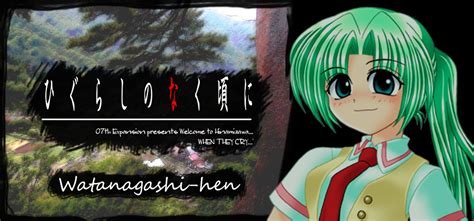
Higurashi no Naku Koro ni: Watanagashi-hen is a visual novel compilation that includes the Onikakushi-hen and Watanagashi-hen arcs from the Higurashi: When They Cry series. Set in the remote village of Hinamizawa during the 1980s, it follows Keiichi Maebara, a teenage boy who moves to the village and forms close friendships with a group of schoolgirls. After Keiichi and others break an old taboo, the village is consumed by horrific and mysterious events. The game is a kinetic visual novel with no branching paths, where players progress by reading text and unlock optional ‘TIPS’ bonus scenes after completing each chapter.
Gameplay Videos
Higurashi no Naku Koro ni: Watanagashi-hen Mods
Higurashi no Naku Koro ni: Watanagashi-hen: The Unraveling of Hinamizawa
Introduction: The Calm Before the Storm
To understand Higurashi no Naku Koro ni: Watanagashi-hen, one must first understand its context: it is the second chapter in a revolutionary narrative experiment that would come to define an era of Japanese horror. Released on December 29, 2002, by the doujin circle 07th Expansion, this “sound novel” (a term the creator, Ryukishi07, prefers over “visual novel”) is not merely a sequel but a pivotal escalation. Where Onikakushi-hen established the idyllic facade of Hinamizawa and the first wave of paranoia, Watanagashi-hen systematically demolishes the foundations of trust, introducing the twin pillars of the series’ enduring mythology: the Sonozaki family’s horrific secrets and the profound, terrifying unreliability of perception itself. My thesis is this: Watanagashi-hen is the arc where Higurashi transitions from a clever mystery into a masterclass in psychological horror and nonlinear storytelling. It weaponizes its kinetic, choice-less format to trap the player in a protagonist’s deteriorating mindset, using its supplemental “TIPS” system not as an afterthought, but as an essential, meta-textual key to a truth that the main narrative itself is desperate to conceal.
Development History & Context: The Doujin Revolution
The story of Watanagashi-hen is inextricably linked to the humble, almost mythic origins of its creator. 07th Expansion was not a studio but a small doujin circle, with Ryukishi07 as the virtually sole auteur—handling scenario, character art (under the pseudonym ”Kurosaki”), direction, and production. The game was built on the NScripter engine, a popular tool for doujin visual novels that emphasized text presentation and static imagery over flashy animation. This constraint became a virtue: the limited sprite work and photographic backgrounds (taken by Ryukishi07, his brother, and a colleague) created a uniquely uncanny, hyperreal yet distinctly low-fidelity representation of 1983 rural Japan.
Ryukishi07’s vision was a conscious reaction against the tear-jerking “nakige” (crying game) trend popularized by Key (Kanon, Air). As he stated in 2004, he wanted to “scare the player” instead, but in a way that felt connected to Key’s mastery of emotional manipulation—creating a “contrast between a fun, ordinary life, and something terrifying and out of the ordinary.” His influences were darker: the complex, puzzle-box mysteries of Seishi Yokomizo (creator of the Kosuke Kindaichi series) informed the structure of overlapping stories where truth is assembled from fragments. The initial plan was for a single game, but the story ballooned, leading to the “question arc”/”answer arc” division that would become the franchise’s backbone.
The release was a典型 doujin operation: sold at Comiket 63 in December 2002, with an initial print run of 50 copies. Its success was grassroots and viral. As Ryukishi07 later reminisced, they even shipped extra copies under the guise of a “mistaken order” to solicit feedback. Word-of-mouth on Japanese textboards like 2channel was explosive. This organic, community-driven hype was crucial. The game’s niche status as a PC-only doujin title meant its early acclaim was pure, unadulterated by corporate marketing, built entirely on the strength of its narrative ingenuity. The technological constraints of the era—basic sprites, looping background music, a text-only interface—forced a focus on writing and sound design that would ultimately become its greatest strength.
Narrative & Thematic Deep Dive: A Hall of Mirrors
Watanagashi-hen represents a quantum leap in narrative complexity from its predecessor. The plot, from the perspective of Keiichi Maebara, is a meticulously crafted descent into confusion and dread. The inciting incident—Keiichi’s insensitive remark about Mion being a “tomboy” and his subsequent, prolonged misunderstanding of Shion as Mion—is not just character development; it is the narrative engine of the arc’s central theme: the catastrophe of miscommunication and the fragility of identity.
The plot mechanics are deceptively simple:
1. The Festival & The Transgression: The Watanagashi Festival proceeds. Keiichi, Shion, Tomitake, and Takano break the taboo by entering the Saiguden (ritual storehouse), discovering its gruesome inventory of torture devices.
2. The Dual Deaths: Tomitake and Takano are found dead on the night of the festival—a deviation from the “one dies, one disappears” pattern. This signals a catastrophic escalation.
3. The Paranoia Spiral: Villagers begin to vanish. Keiichi, through nightly phone calls with “Shion” (who is actually Mion in disguise, believing she is Shion), receives cryptic warnings. The core mystery for the player becomes: Who is who? What is real?
4. Confrontation and Revelation: Keiichi and Rena, spurred by detective Ooishi, confront Mion at the Sonozaki estate. In a stunning monologue, Mion confesses to the murders, reveals the hidden torture chamber, and the “truth” that Shion is alive and suffering. This is the arc’s climactic, gut-punching revelation: the seemingly gentle, club-leading Mion is a confessed killer, while the shy, girlish Shion is the traumatized victim.
5. The Cycle Continues: The arc ends not with resolution, but with a deeper plunge into horror. Keiichi is stabbed by an undead-appearing Mion, hallucinates her return, and dies. The final image is one of utter defeat.
Themes are woven into every scene:
* Duality and Split Identities: The Mion/Shion dynamic is the arc’s heart. It explores how societal roles (heir vs. outcast, leader vs. follower) can fracture a single person. The “demon-possessed” villagers folklore mirrors this psychological splitting. The ultimate twist—that Mion was impersonating Shion—retroactively makes every prior interaction a lie, forcing a devastating reevaluation of the entire story.
* The Rot Beneath the Surface: Hinamizawa’s picturesque community is a veneer over endemic abuse (Satoko’s uncle), yakuza influence (Sonozaki family), and ritualized violence (the Saiguden). The festival itself, a purification ritual, is built on a foundation of historical atrocity.
* Unreliable Narration as a Gameplay Mechanic: This is Higurashi‘s genius. The first-person narration from Keiichi’s perspective is actively deceptive, not just biased. The game rewards (and requires) the player to distrust the main text. This is where the TIPS system becomes fundamental. These optional, database-style entries—accessed after chapter completion—provide cold facts, medical reports, folklore definitions, and police logs that contradict or contextualize Keiichi’s panicked, flawed account. One TIP might define “Hinamizawa Syndrome” as a psychosomatic disease, another might list Satoshi’s disappearance as a missing persons case. They are fragments of an “objective” reality the player must assemble, creating a participatory, detective-like experience despite the lack of traditional gameplay choices.
* The Inescapable Past: The arc’s poem, attributed to the enigmatic Frederica Bernkastel, speaks of a “desert” of thirst—a metaphor for the characters’ desperate, cyclical search for truth in a reality that withholds it. The past, both personal (Shion’s trauma) and collective (the village’s history), is an inescapable, predatory force.
Gameplay Mechanics & Systems: The Power of Stillness
Watanagashi-hen is a kinetic visual novel. There are no branching paths, no choices to make. The player’s sole interactive function is to advance text (click, scroll, or auto-play). This design is often mislabeled as “passive,” but in Higurashi, it is a deliberate, claustrophobic narrative strategy. The player is not a decision-maker but a prisoner of the protagonist’s perspective.
Core Loop: Read text -> advance -> encounter static sprite against photographic background -> occasional sound cue or BGM change -> repeat. Interspersed are “intermissions” where the player can save and access the TIPS database. This rhythm is hypnotic and oppressive, mimicking the inescapable progression of a nightmare.
Systems & Innovations:
* The TIPS Database: This is the game’s most critical “system.” It functions as an alternative narrative channel. Entries are often written in a clinical, detached tone (medical reports, police files, dictionary definitions) that starkly contrasts with Keiichi’s emotional, confused narration. It encourages a dual-reading: what is happening on screen versus what actually happened. It turns the player into an investigator, cross-referencing the story text with the TIPS to spot contradictions and build a truer picture. This was revolutionary for its time and directly inspired later mystery visual novels.
* Sprite & Background Usage: The static 2D sprites (drawn by Ryukishi07) are simple but expressive. The use of photographic backgrounds (real locations in Shirakawa, Gifu) grounds the supernatural horror in a tangible reality, making the intrusion of the uncanny more potent. The limited animation—a character’s sprite changing to a “shocked” or “angry” expression—carries immense weight due to its sparing use.
* Sound Design as Narrative: The sound novel moniker is apt. The soundtrack, composed by Kusanagi Kouji and others, is minimal and atmospheric. The omnipresent sound of cicadas (higurashi) is not just ambience; it is an aural symbol of the oppressive, inescapable summer and the village’s collective madness. Silence is used masterfully, broken by sudden, jarring sound effects (a door slamming, a metallic clang in the Saiguden) that trigger visceral jump-scares despite the static visuals.
Flaws are inherent to the format: The lack of player agency can feel stifling to those expecting interactive mystery. The text-only delivery means all emotional weight rests on the writing. For non-Japanese readers (prior to official translations), reliance on fan patches added a barrier. However, these “flaws” are integral to the experience—the passivity is the point, forcing immersion in Keiichi’s helpless terror.
World-Building, Art & Sound: The Architecture of Dread
Hinamizawa, 1983: The setting is not just a backdrop but a character. A remote village in the Japanese countryside, ostensibly in Gifu Prefecture, it operates on feudal-like family structures (the Three Families: Sonozaki, Kimiyoshi, Furude) and ancient, bloody traditions. The Watanagashi Festival—a “cotton-drifting” purification ritual—is the arc’s central macabre irony: a festival celebrating cleansing is the catalyst for the year’s bloodshed. The village’s physical spaces are loaded: the Saiguden (torture chamber/storehouse) is the literal and metaphorical heart of darkness; the Sonozaki estate is a fortress of yakuza power and hidden horrors; the Furude Shrine holds the tragic history of Oyashiro-sama.
Visual Direction: The aesthetic is “low-resolution horror.” The character sprites are charming, even moe—Rena’s wide-eyed smile, Mion’s confident grin. This cuteness is the Trojan Horse. When those same sprites depict rage, madness, orblank-eyed emptiness, the dissonance is terrifying. The photographic backgrounds are often serene (sunny village streets, peaceful forests), which makes the moments of violence and discovery within them feel like a violation of reality itself. The color palette is summer-saturated—greens, blues, bright sunlight—which ironically heightens the sense of wrongness. Darkness is reserved for the Saiguden and torture chamber, visually coding them as “other.”
Sound as Atmosphere: Kenji Kawai’s famous compositions for the later anime are not in the original PC game. The original PC soundscape relies on:
1. Field Recordings: The drone of cicadas, crickets, wind. This natural soundscape becomes oppressive, a constant reminder of the village’s watchful nature.
2. Minimalist BGM: Simple, looping melodies that shift from cheerful (club scenes) to hauntingly melancholic (Rika’s shrine maiden ceremony) to outright terrifying (the “Oni” or “Hanyuu” motifs).
3. Sparse, Effective SFX: A knife being drawn, a body thudding into a well, a glass shattering. These sounds carry catastrophic weight because they break the relative auditory monotony.
The combination creates a soundscape that feels both mundane and menacing, a perfect analog to the plot’s central tension.
Reception & Legacy: From Doujin to Phenomenon
Watanagashi-hen‘s reception must be viewed in stages.
Initial Japanese Reception (2002-2007): As the second part of the first Higurashi boxed set (which included Onikakushi-hen), it contributed to a slow-burn success. By 2006, the entire Higurashi series had sold over 100,000 copies in Japan—a staggering figure for a doujin title, matching the feat of Tsukihime. By August 2007, with the live-action film adaptation announced, sales had surpassed 500,000 copies. The PlayStation 2 port, Higurashi no Naku Koro ni Matsuri (which included Watanagashi-hen), sold 140,397 copies by October 2007. The enhanced Matsuri: Kakera Asobi version added further content. Famitsu awarded the PS2 version a total score of 31/40. The series was voted the 10th most interesting bishōjo game by Dengeki G’s Magazine readers in 2007. Critics praised its “incredibly eerie” writing and “skillful story weaving.”
Western Reception (2009-Present): MangaGamer’s official English release (December 2009) introduced the arc to a global audience. Reviews were strongly positive. Hardcore Gamer called the writing “amazingly effective” and stated “few video games make it anywhere near the skillful story weaving present within the Higurashi series.” APGNation praised the “excellent writing and music.” The reception highlighted the pain of waiting for the answer arcs (Kai), but the standalone power of the “question arcs” to horrify and captivate was universally acknowledged.
Legacy and Influence:
* Defining the “Question Arc” Structure: Watanagashi-hen perfected the formula: a self-contained, brutally grim reality cycle that ends with more questions than answers, its truth to be partially revealed in a subsequent “answer arc” (Meakashi-hen in this case). This fractal storytelling became a blueprint.
* The TIPS System’s Progeny: The concept of an in-game database that tells a parallel, “more true” story influenced countless later visual novels and narrative games seeking to convey complex lore or unreliable perspectives.
* The “Cute Girls Do Horrible Things” Trope: The juxtaposition of moe aesthetics with extreme violence and psychological degradation, while not invented by Higurashi, was crystallized and massively popularized by this arc’s portrayal of Mion’s descent and Shion’s fate. It directly impacted the aesthetics of later horror series.
* Mainstreaming Doujin Game Culture: Its success proved that doujin (fan-made) games could achieve blockbuster status and spawn multimedia franchises (manga, anime, live-action films, dramas, stage plays). It paved the way for other doujin successes.
* Cultural Footprint: The 2006 anime adaptation (covering Watanagashi-hen) was a breakout hit in the West, often being many viewers’ first exposure to horror anime. The arc’s imagery—the Saiguden, the well, Mion’s final grin—are iconic within the fandom. The franchise’s total media sales (games, manga) exceed 10 million copies.
* Industry Recognition: Its DNA is evident in later horror games relying on psychological tension and community folklore (e.g., Silent Hill series, with which it shares thematic DNA). In 2025, it was revealed that Ryukishi07 was brought in to write for Silent Hill f, with Konami stating he “could really understand the essence of Japanese horror”—a testament to Higurashi‘s, and by extension Watanagashi-hen‘s, foundational influence.
Conclusion: A Cornerstone of Interactive Horror
Higurashi no Naku Koro ni: Watanagashi-hen is not a perfect game by conventional metrics. Its interface is archaic, its visuals are dated by modern standards, and its core interactivity is minimal. Yet, to judge it on those terms is to miss its monumental achievement. It is a literary horror experience that uses the interactive medium not for player agency, but for immersive perspective. It locks you into the confused, terrified mind of Keiichi Maebara and uses the TIPS system to make you, the player, complicit in the act of piecing together a truth the protagonist is psychologically incapable of seeing.
This arc is where the series’ soul is laid bare: the horror is not in jumpscares, but in the slow, crushing realization that your friends, your community, your very senses cannot be trusted. The twin Sonozaki sisters become enduring archetypes of fractured identity and repressed trauma. The village of Hinamizawa transforms from a quirky setting into a pressure cooker of generational sin.
In the canon of video game history, Watanagashi-hen secures its place as a pioneering work of psychological horror and nonlinear narrative. It demonstrated that a game could be a “sound novel” first, using every tool of the medium—text, sound, static image, and supplementary data—to construct a labyrinth of dread. It inspired a generation of creators and proved that profound, community-driven storytelling could emerge from the doujin underground to captivate the world. It is, without exaggeration, one of the most important and influential horror narratives ever committed to the interactive medium. Its power to unsettle, to provoke, and to demand active intellectual participation from its audience remains undimmed, a chilling testament to the enduring nightmare of the cotton-drifting festival.