
- Release Year: 2010
- Platforms: Windows, Xbox 360
- Publisher: Akella, JoWooD Productions Software AG
- Genre: Special edition
- Average Score: 69/100
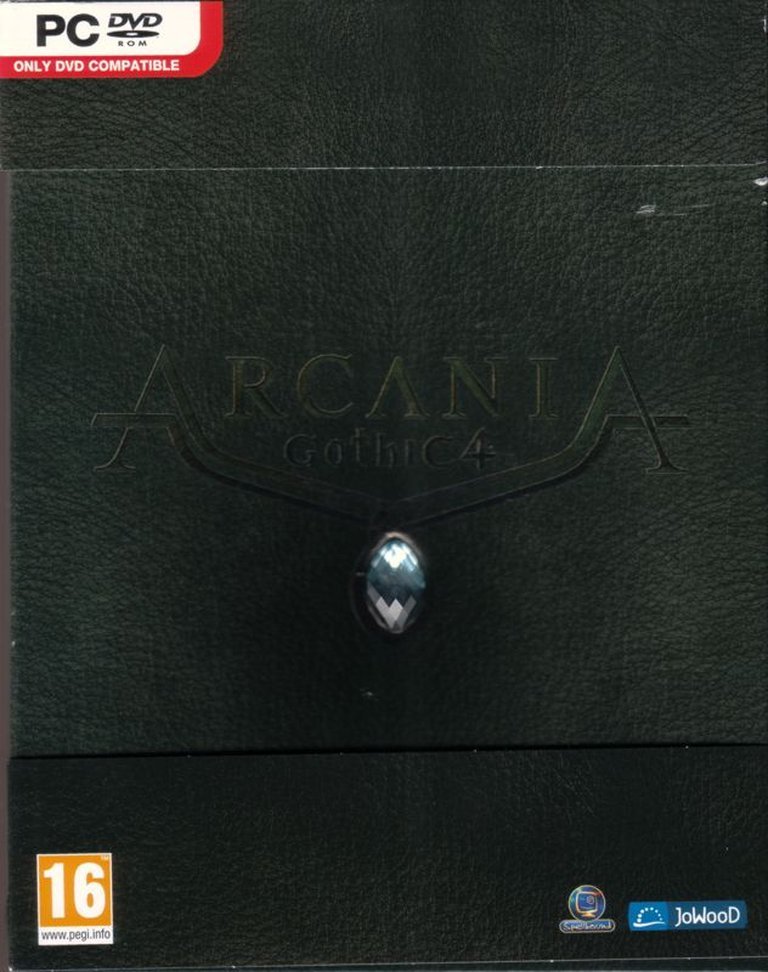
Description
Arcania: Gothic 4 is an action role-playing game set in the Southern Seas on the idyllic isle of Feshyr. The protagonist returns from an adventure to discover his village destroyed by aggressors bearing an eagle emblem, sparking a quest for revenge that uncovers a lurking supernatural evil and ties his fate to a mysterious woman and an ancient artifact from a forgotten past.
ArcaniA: Gothic 4 (Collector’s Edition) Patches & Updates
ArcaniA: Gothic 4 (Collector’s Edition) Mods
ArcaniA: Gothic 4 (Collector’s Edition) Guides & Walkthroughs
ArcaniA: Gothic 4 (Collector’s Edition) Reviews & Reception
ign.com : the lack of polish ultimately holds Arcania: Gothic IV back.
metacritic.com (63/100): Arcania is a good but not excellent RPG, that tries to continue the legendary Gothic-franchise.
pcgamer.com (76/100): A shallow but entertaining adventure. The world is wonderful to explore, but a lack of depth keeps this from achieving greatness.
ArcaniA: Gothic 4 (Collector’s Edition): A Franchise at a Crossroads
Introduction: The Weight of a Legacy
To understand ArcaniA: Gothic 4 is to understand a moment of profound crisis for one of PC gaming’s most beloved RPG franchises. By 2010, the Gothic series was a cornerstone of German-developed role-playing, renowned for its uncompromising open worlds, systemic depth, and notoriously steep learning curves. Piranha Bytes’ original trilogy had cultished a fiercely dedicated, if sometimes frustrated, fanbase that cherished its immersive sim-like freedom. The arrival of ArcaniA, developed not by the series’ creators but by Spellbound Entertainment under publisher JoWooD, was therefore met with a mixture of cautious optimism and deep suspicion. Heralded as a “back-to-basics” approach, it instead represented a dramatic pivot toward accessibility and mainstream console action-RPG design. This Collector’s Edition review examines not just the game in its leather-bound case, but a pivotal, contentious artifact: the title that temporarily severed a sacred developer-publisher-fan covenant and forced the Gothic universe to reckon with its identity. My thesis is clear: ArcaniA: Gothic 4 is a technically competent, visually pleasing, but fundamentally hollow experience. Its greatest failure is not in its execution, but in its philosophical abandonment of the very principles—player agency, systemic complexity, and organic discovery—that defined the series’ legacy, replacing them with a linear, fetch-quest-driven template that feels more like a budget action-RPG than a successor to Gothic 3.
Development History & Context: A New Hand at the Helm
The genesis of ArcaniA is a story of corporate turmoil, shifting rights, and a desperate attempt to mainstream a niche franchise.
The Studio Shift: The most seismic change was the handover from Piranha Bytes to Spellbound Entertainment. The provided trivia from MobyGames and Gothic Wiki reveals a contentious background: after the technically troubled launch of Gothic 3, negotiations between Piranha Bytes and JoWooD broke down. JoWooD instituted a “developer casting,” where potential studios had to produce a demo on their own time to secure the contract. Spellbound won, but the original vision—reportedly a bridge to a new series—was altered. An external investor’s producer later took control, fundamentally changing the game from an open-world RPG to a linear experience, leading to the multiple name changes and the eventual, reluctant use of the “Gothic 4” subtitle. As one JoWooD community manager infamously stated, many in the company would have “rather cut their own wrist than calling the game Gothic 4.”
The Naming Odyssey: The title’s evolution is a direct reflection of this internal strife and marketing anxiety:
* August 2007: Announced as Gothic 4: Genesis.
* April 2008: Changed to Gothic 4: Arcania.
* September 2008: Further mutated into ArcaniA: A Gothic Tale, a move explicitly aimed at giving the franchise a “fresh start” in North America where it had limited traction.
* March 2010: Officially settled on ArcaniA: Gothic 4 for all regions, a confusing compromise that pleased neither fans nor marketers.
Technology & Constraints: Spellbound utilized Trinigy’s Vision Engine 7, with some features from Engine 8, and NVIDIA PhysX for physics. This was a capable, multi-platform middleware choice, allowing for the game’s surprisingly good graphics and smooth streaming world (with few load screens). However, this technical proficiency could not compensate for the creative constraints: a tighter budget, a smaller team than Piranha Bytes’ later efforts, and a mandated design philosophy that prioritized accessibility over depth. The result was a game that looked and ran well for its time but felt architecturally and mechanically thin.
The 2010 RPG Landscape: ArcaniA launched in October 2010, sandwiched between landmark titles like The Elder Scrolls V: Skyrim (November 2011) and Dragon Age: Origins (2009). It competed against the open-world grandeur of Bethesda and the narrative depth of BioWare. Its decision to streamline and linearize placed it in a no-man’s-land: not deep enough for hardcore RPG fans, not polished or innovative enough to stand out in a crowded action-RPG space. It was a product of its publisher’s risk-averse commercial ambitions, aiming to be “the most successful title from the Gothic series, and one of the best RPGs of 2010,” a goal that spectacularly backfired.
Narrative & Thematic Deep Dive: A Story of Missed Connections
The narrative of ArcaniA is where the disconnection from the Gothic legacy is most painfully evident.
Plot Structure: Set a decade after Gothic 3, the game follows a new, nameless shepherd protagonist on the island of Feshyr. After his village is destroyed and his pregnant fiancée, Ivy, is killed by soldiers bearing the eagle banner of King Rhobar III (the former player character from the original trilogy), he embarks on a quest for revenge. This personal vengeance plot quickly escalates into a battle against a demonic force, Krushak (the final boss of Gothic 1), who has possessed the now-corrupted King Rhobar III. The hero must find the “Divine Anvil,” retrieve a special amulet, and exorcise the demon with help from a “beautiful, mysterious lady” and a renegade general, Drurhang.
Thematic Emptiness: The story is a by-the-numbers fantasy revenge tale, devoid of the moral ambiguity, faction politics, and philosophical quandaries that defined the original trilogy. The theme of a hero becoming a tyrant (Rhobar’s fall) is potent but utterly unexplored from the player’s perspective—we only see the aftermath. The new hero has no predefined personality, and the script offers no meaningful choices. Contrast this with Gothic 2‘s nuanced exploration of power and loyalty or Gothic 3‘s sprawling political landscape; ArcaniA‘s world feels stage-set, not lived-in.
Characters & Dialogue: The cast is a mix of shallow new faces and disingenuous cameos. The return of Diego (a fan-favorite from the original games) is a transparent attempt to placate fans but feels like a hollow Easter egg. He has no meaningful relationship with the new protagonist. Voice acting, as unanimously panned in reviews (Eurogamer, IGN, The Final Dungeon), ranges from “acceptable” to “laughably awful,” marred by poor translation and wooden delivery. Dialogue is functional, serving only to deliver fetch quests. The “named character” interaction system—where only characters with names have unique dialogue—further sterilizes the world, making every other NPC a repetitive, dismissible automaton.
Canonicity & Fan Reaction: Crucially, the Gothiccreative team at Piranha Bytes has explicitly stated that the events of ArcaniA are not canon. The later removal of “Gothic 4” from the title by Nordic Games (2014) and the erasure of series connections from marketing cement this schism. For fans, the narrative is not a continuation but an imposter, a story that borrows names and a villain but understands none of the soul of the original saga.
Gameplay Mechanics & Systems: The Great Simplification
ArcaniA‘s most significant and damning changes are mechanical. It represents a conscious truncation of RPG systems in favor of a more “accessible” action-RPG model.
Combat: The combat is fast, responsive, and action-oriented, a clear evolution from Gothic 3‘s clunkier system. The PC version uses a two-button mouse scheme: left-click for attacks, right-click to block or dodge-roll. Enemy attacks are telegraphed by a violet aura, encouraging tactical rolling over blocking. Spells (Fire, Lightning, Ice) are cast via hotkeys and are upgradable through a skill tree. While functional and satisfying on a moment-to-moment basis—with satisfying physics sending enemies flying—the system lacks depth. Combos are simple, and the lack of stamina management or complex attack patterns makes encounters repetitive. The expansion Fall of Setarrif later added the ability to play as series veterans like Gorn or Diego, a nod to fans that felt too little, too late.
Character Progression: The skill tree system is severely limited compared to the stat-based, teacher-dependent progression of earlier games. There are three primary paths: Combat, Archery, and Magic. Each has a handful of upgrades (e.g., “Sword Mastery I, II, III”). There are no classes, no stat requirements for weapons or armor, and no in-game teachers. All progression is via skill points earned on level-up (3 per level). This “all-weapons-accessible” design removes the sense of specialization and accomplishment. A strength-focused warrior can effectively use a high-level bow if he invests a few points, breaking class identity. The system encourages a “jack-of-all-trades” build that neuters the RPG fantasy.
Quest Design & World Structure: This is the engine of the game’s tedium. The world of Argaan is not open-world but a series of large, connected zones. Once you leave a zone, you cannot return. The main quest line is exquisitely linear, and side quests are almost exclusively “fetch quests” of the most mundane variety: retrieve Boar Hearts, gather Nuts, find a depressed friend’s lost necklace (itself part of a nested fetch chain). As The Final Dungeon’s review scaldingly notes, quests are “fetch quests within fetch quests.” There is no morality system, no consequence for theft (you can loot entire shops in front of NPCs), and no faction alignment. The world exists solely to service a checklist.
Inventory & Crafting: The inventory has no capacity limit. Combined with ubiquitous loot and the ability to steal freely, this breaks any sense of resource management. Crafting and alchemy are simplified: gather abundant plants and minerals found everywhere, and use menus to create potions or upgrade gear. The abundance of materials makes these systems trivial and devalues crafted items against random loot drops, which are often level-scaled and superior.
World-Building, Art & Sound: A Beautiful Shell
Where ArcaniA most successfully mimics its predecessors is in its presentation.
Visuals & Engine: Powered by the Vision Engine 7, the game’s graphics were praised at launch. The world is saturated and detailed, with excellent draw distance, competent character animation (including satisfying hit reactions), and well-rendered environments—from swampy towns to mountainous interiors. The streaming world with minimal load screens was a technical achievement. However, flaws were apparent: texture pop-in, vegetation that disappears at close range (a visibility hack), and a startling lack of NPC variety. Reviews repeatedly note the heavy recycling of a handful of human models, making towns feel populated by clones. The art direction is generic high-fantasy, lacking the gritty, distinct identity of Piranha Bytes’ work.
Sound & Music: The soundtrack is a competent, orchestral fantasy score that fits the genre but is instantly forgettable. Sound design is effective in wilderness areas—waterfalls, wind, creature cries—but environmental audio had a noted tendency to cut in and out, particularly on console versions. The voice acting, as previously noted, is the major sore point, a combination of poor casting, direction, and localization that undermines any narrative gravitas.
Atmosphere vs. Immersion: The world is beautiful to look at and traverse, but it is not immersive. The constant glowing quest items, floating exclamation points, bull’s-eye minimap markers for every objective, and the sheer volume of collectibles turn exploration into a chore of icon-watching. The “obviousness” criticized by The Final Dungeon is antithetical to the atmospheric discovery of the original Gothic, where getting lost and dying was part of the learning process.
Reception & Legacy: A Critical and Fan Disconnect
ArcaniA‘s reception is a study in divergent perspectives and lasting repercussions.
Critical Reception (Metacritic):
* PC: 63/100 (Mixed or Average)
* Xbox 360: 64/100 (Mixed or Average)
* PS3/PS4 (Complete Tale): 42/100 (Generally Unfavorable)
The spread is telling. The PC version was seen as the superior, more polished experience. The later console ports suffered more from control and UI compromises.
Critic Consensus: Reviews consistently highlighted a schism:
* Praised: Graphics, technical stability (few bugs), accessible combat system, enjoyable loot-driven exploration for casual players.
* Panned: Gutting of classic Gothic systems (no open world, no factions, no complex crafting/teachers), horrendous voice acting, repetitive fetch-quest design, lack of player agency, shallow story, and failure to understand the series’ appeal.
* GameSpot‘s verdict became iconic: “Arcania has been dumbed down into a generic action role-playing game, so it isn’t a Gothic game in anything but its subtitle.”
* IGN offered a more positive take, calling it a “loot-heavy dungeon crawling experience that doesn’t tax your skills,” recommending it for leisure play.
* PC Gamer (UK) scored it 76%, praising its “comforting sense of rhythm” and gorgeous world while acknowledging its lack of depth.
* Eurogamer was scathing (4/10), calling it a “mundane, rote, disappointingly shallow RPG.”
* The Final Dungeon delivered a blistering 6/10, dissecting its fetch-quest obsession and thematic vacuity.
Commercial Performance & Aftermath: Despite the critical drubbing, ArcaniA reportedly sold 200,000 units in Europe by October 2010—solid, but not the breakout hit JoWooD hoped for. The planned “several add-ons” materialized only as the 2011 expansion, Fall of Setarrif. The “Complete Tale” editions in 2013 (PS3, X360, PS4) were largely ignored, receiving even worse reviews.
Long-Term Legacy:
1. Canonical Schism: The game is now functionally a side-story or apocryphal entry. Piranha Bytes’ return to the franchise (with the Gothic Remake announced for 2026) deliberately ignores ArcaniA. Nordic Games’ (now THQ Nordic) removal of the “Gothic 4” subtitle in 2014 was an admission of its toxic brand association.
2. The “Risen” Path: The failure of ArcaniA to satisfy core fans indirectly validated Piranha Bytes’ own post-Gothic 3 direction. Their 2009 game Risen and its sequels were explicitly positioned as spiritual successors—more streamlined than classic Gothic but retaining open-world exploration, systemic depth, and meaningful choices. ArcaniA proved that removing the series’ signature complexity was the wrong path.
3. A Cautionary Tale: In game development history, ArcaniA stands as a classic case of publisher-imposed design for marketability overriding core identity. It demonstrates the danger of moving a niche, beloved series “out of its comfort zone” without understanding what made it beloved. It is frequently cited in discussions about franchise mismanagement.
4. Collector’s Edition Context: The 2010 Collector’s Edition—with its leather case, 3D crystal, art book, storybook (The Cleaved Maiden), soundtrack, and map—is now a curious artifact. Its physical extravagance contrasts sharply with the game’s digital emptiness. It represents the commercial confidence JoWooD had before release, a confidence utterly evaporated by post-launch reality. For collectors, it’s a piece of Gothic history; for historians, it’s a symbol of the era’s misguided premium packaging for subpar titles.
Conclusion: A Hollow Crown
ArcaniA: Gothic 4 is not a bad game in the absolute sense. On PC, it is a technically sound, occasionally fun, and visually attractive action-RPG that could satisfy a player with no connection to the Gothic name or expectations. Its combat is responsive, its world is pretty, and its loot is plentiful. For a weekend hack-and-slash, it has merit.
But as a Gothic game, it is a catastrophic failure. It systematically dismantles the architectural pillars of the series: the ruthless, unguided open world; the systemic, non-quest-driven interactions; the profound sense of player consequence; the intricate, teacher-based progression; and the immersive, often hostile, atmosphere. It replaces them with a guided, fetch-quest corridor populated by generic NPCs, accessible to anyone with a mouse and keyboard, and utterly devoid of the soul, challenge, and emergent storytelling that earned the series its hallowed reputation.
The Collector’s Edition itself becomes a bitter irony: beautiful packaging for a barren product. It commemorates a moment when a publisher’s desire to cash in on a legendary name led to a profound misreading of that legend’s appeal. ArcaniA: Gothic 4 did not kill the Gothic series—THQ Nordic’s ongoing remake efforts prove its enduring value—but it did force it into a decade-long coma of canonicity debates and brand rehabilitation. It is the black sheep of the family, the awkward cousin everyone acknowledges but hopes to forget. In the pantheon of RPG history, its place is not as a successor, but as a salutary lesson: a franchise’s identity is its most precious asset, and to simplify it for mass appeal is not to broaden its appeal, but to dissolve its very essence. For better or worse, ArcaniA ensured that the true spirit of Gothic would have to be reclaimed, not continued.