
- Release Year: 2006
- Platforms: Windows
- Publisher: dtp young entertainment GmbH & Co. KG
- Developer: Radon Labs GmbH
- Genre: Simulation
- Perspective: 1st-person
- Game Mode: Single-player
- Gameplay: Animal treatment, Horse riding, Veterinary care
- Setting: Veterinary clinic
Description
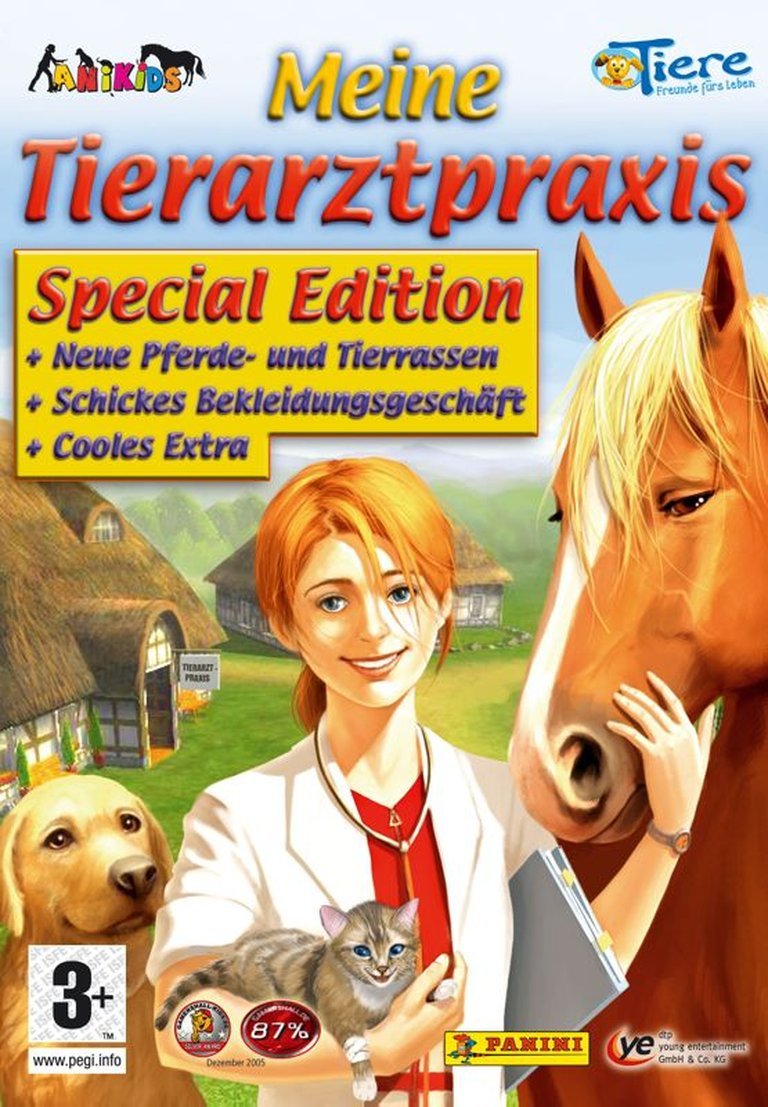
Meine Tierarztpraxis (Special Edition) is a veterinary simulation game where players step into the role of an aspiring veterinarian. This enhanced edition features 20% more content than the original, including a wider variety of animal species to treat (from birds like cockatoos to small mammals like hamsters), the ability to go horse riding, and guided ‘horse whispering’ lessons with the renowned German expert Andrea Kutsch. With its educational materials and in-game shop bonuses, the core goal is to learn and succeed in a professional veterinary practice, all from a first-person perspective on a Windows PC.
Meine Tierarztpraxis (Special Edition) Reviews & Reception
retro-replay.com : the gameplay loop balances fun mechanics with surprisingly authentic professional insights.
Meine Tierarztpraxis (Special Edition): Review
Introduction: A Prescription for Niche Nostalgia
In the vast museum of video game history, certain titles reside not in the marble halls of canonical masterpieces but in the dedicated, warmly lit wings of cultural specificity and vocational daydreaming. Meine Tierarztpraxis (Special Edition), known in English-speaking territories as Paws & Claws: Pet Vet (Special Edition), is one such title. Released in 2006 for Windows by German studios Radon Labs and publisher dtp young entertainment, it represents a pivotal, if under-documented, moment in the “edutainment” and life-simulation genres. It is a game that asked a very specific question of its primarily juvenile audience: “What if you could run your own veterinary clinic?” This review will argue that Meine Tierarztpraxis (Special Edition) is a fascinating case study in localized game design, serving as a bridge between pure play and professional inspiration. Its legacy is not one of critical acclaim or commercial blockbuster status, but of quiet cultural impact within its target demographic, a meticulously crafted toolkit for empathy, responsibility, and the gentle art of animal husbandry disguised as a game. It stands as a testament to the power of niche development, where a deep understanding of a target audience’s interests (in this case, German children’s fascination with animals, particularly horses) can produce a experience more personally resonant than any globally-targeted blockbuster.
Development History & Context: The German Edutainment Engine
The game emerges from a specific technological and cultural ecosystem. The primary developer, Radon Labs GmbH, was a Berlin-based studio with a distinct technical pedigree. They were the creators of the Nebula Device, a powerful and flexible 3D engine used in several notable German RPGs like The Dark Eye: Drakensang. This technical expertise is crucial to understanding Meine Tierarztpraxis. While the game’s visuals are described as “charming” and “cartoonish” rather than cutting-edge, its use of a full 3D environment—a first-person perspective within a complete veterinary clinic and surrounding world—was a significant step above the 2D sprite- or slide-based interfaces common in contemporary children’s educational software. The engine allowed for detailed animal models, a navigable space, and a sense of immersion that simpler titles could not achieve.
The publisher, dtp young entertainment GmbH & Co. KG, was the youth-focused division of dtp entertainment AG, a powerhouse in the German “kinder- und jugendsoftware” (children’s and youth software) market. Dtp’s business model was built on licensed properties (like Bibi Blocksberg and Benjamin Blümchen), original edutainment series, and localized versions of international hits. Meine Tierarztpraxis falls into the latter category, but with a critical twist: it was an original German concept later rebranded for the US market as the Paws & Claws series. This localization strategy—creating a game with core German appeal (the “horse whisperer” Andrea Kutsch is a key selling point) and then adapting it for an international audience—was common for dtp and reveals the game’s dual identity.
The year 2006 sat at an interesting crossroads for simulation games. The juggernaut The Sims 2 (2004) had perfected the “life simulation” template, but its complexity and sometimes mature themes made it unsuitable for the youngest players. Meanwhile, the “VeggieTales” and “Barbie” pockets of the market were often simplistic activity packs. Meine Tierarztpraxis carved a middle path: it adopted the build-and-manage loop of The Sims—upgrading a clinic, managing finances, expanding services—but applied it to a single, child-friendly profession. Its technological constraints were those of the mid-2000s PC: CD-ROM media (listed as such on MobyGames), a requirement for keyboard and mouse, and a 425MB installation footprint for the Mac version, which was sizable for the time. The PEGI 3 rating and the “ab acht Jahren” (from age 8) target, noted in the Mac Life review, defined every design decision, from the intuitive, icon-driven UI to the absence of any punitive failure states. It was a game designed not to frustrate, but to empower.
Narrative & Thematic Deep Dive: The Heart of the Healing
While structurally a simulation, Meine Tierarztpraxis (Special Edition) weaves a deliberate, if thin, narrative fabric to provide context and motivation. The player is not an anonymous cursor but a freshly graduated veterinarian taking over a modest, newly opened clinic. This foundational premise—of youthful ambition and professional beginnings—is the game’s primary narrative engine. The world is populated by a cast of quirky, personable clients (as described in the Retro Replay review), each with distinct personalities and animal care dilemmas. Treating a nervous parakeet or a farmer’s prized horse isn’t just a gameplay task; it’s a small story of trust and recovery. The “side stories” that unlock as client loyalty builds—like the parakeet regaining its song—give emotional weight to the diagnostic and treatment mini-games, transforming them from chores into meaningful interactions.
The most significant narrative and thematic addition in the Special Edition is the integration of Andrea Kutsch, a famous real-world German “horse whisperer.” Her role transcends mere branding; she functions as an in-game mentor and quest-giver. The progression system for equine care is narrativized through her guidance. Players don’t simply unlock a stable; they “prove themselves” to her, earning consultations that escalate in difficulty. Her dialogue sequences, described as “charming” and offering “anecdotes from her real-life practice,” do two things: they lend authenticity and educational weight to the horse-whispering mechanics, and they embed the player within a professional community. The fantasy is no longer just “I run a clinic,” but “I am being trained by a renowned expert.” The ultimate narrative milestone is “mastering horse whispering” and earning her trust, a classic hero’s journey arc condensed into veterinary terms.
Underlying themes are clear and purposeful:
1. Responsibility & Care: The core loop of feeding, medicating, and monitoring patients reinforces a gentle ethic of stewardship. The ability to board animals for intensive care (“für einige Tage bei dir aufnimmst” as per the Application Systems description) introduces the concept of long-term commitment.
2. Professional Growth & Learning: The game explicitly ties progression to education. The “additional education material for learning the veterinary profession” mentioned in the MobyGames description is woven into the shop system—buying a new diagnostic tool comes with an explanation of its real-world use. The path from treating rabbits to performing complex equine respiratory therapies is framed as a curriculum.
3. Entrepreneurial Spirit: Managing clinic finances, taking loans from the in-game bank, and deciding whether to reinvest profits into new facilities (stalls, therapy houses) introduces basic business management in a safe, sandboxed environment.
The narrative is deliberately lightweight to avoid impeding gameplay, but its consistent presence provides just enough “why” to make the “what” of the simulation compelling. It’s the story of becoming, not of saving the world.
Gameplay Mechanics & Systems: The Diagnostic Loop
At its mechanical heart, Meine Tierarztpraxis is a task-based simulation built on a core diagnosis-treatment-reward loop. The first-person perspective is key: the player physically walks around their clinic, approaches the examination table, and interacts directly with animal patients using the mouse. This creates a tangible sense of presence missing from top-down management sims.
1. The Diagnostic Interface: As per the Retro Replay review, this is the primary gameplay frame. When an animal is placed on the table, a clear UI presents checklists and options: visual inspection, stethoscope, thermometer, X-ray, etc. This is not a complex minigame but a guided procedural process. The player selects the appropriate tool from a radial or menu-based interface, performs the action via a simple click-and-hold or quick-time-event-lite interaction, and receives a diagnosis. The learning curve is gentle, teaching players (especially children) the sequence of a basic veterinary exam.
2. Treatment Mini-Games: Here the “20% more game content” and “new mini-games” cited in the Special Edition blurb come into play. After diagnosis, treatment is often a short, discrete minigame. Examples include:
* Administering Medicine: Precise mouse movement to guide a syringe or pill to the correct location on the animal’s body.
* Bandaging Wounds: A simple drag-and-drop or click-sequence to apply a bandage neatly.
* Grooming: Brushing or cleaning the animal model, with tactile feedback as the fur/feathers “ripples” (as noted in the graphics review).
These minigames are brief and repeatable but provide a satisfying kinetic break from the menu-driven diagnosis. They inject “action” into the sim, ensuring the player is constantly doing rather than just selecting.
3. Clinic Management & Economy: This layer operates on a broader timescale. Money earned from successful treatments is spent in the shop system (expanded in the Special Edition). Purchases fall into categories:
* Medical Supplies: Restocking inventory of medicines, serums, bandages. Running out halts treatment, creating a resource management challenge.
* Clinic Upgrades: New examination tables, diagnostic machines (X-ray), which unlock more complex treatments for new animal species.
* Facility Construction: Building specialized enclosures (stalls for horses, aviaries for birds) and decorative items. This is the build phase of the sim, governed by available space and funds.
* Educational Materials: Literally, product descriptions that explain veterinary principles, fulfilling the educational mandate.
The loan system from the in-game bank adds a layer of financial risk/reward, a sophisticated feature for a children’s game.
4. Horse Riding & Whispering (The Pivotal Expansion): This is the Special Edition’s flagship feature, directly tied to the Andrea Kutsch license. It’s a dual-purpose system:
* Equestrian Care: Treating horses requires the previously constructed stable and therapy house. Diagnosing and treating equine-specific ailments (hoof care, respiratory issues) uses the core diagnostic loop but with higher stakes.
* Riding Minigame: “Horse riding” is described as an “intuitive” diversion. It likely involves guiding a horse along predefined trails (to the city, forest, beach) in a simplified, on-rails or lightly controlled experience. This serves two purposes: it’s a recreational break from clinic work (addressing the “time to yourself” mentioned in the German descriptions), and it’s a practical application of the “horse whispering” skills. The act of riding itself may be tied to building the trust/relationship stat with the horse, making it mechanically relevant.
This system elegantly combines a major gameplay expansion (new species, new building type) with a narrative justification (learning from the master) and a thematic one (the holistic care of large animals).
5. Progression & Unlocks: The game is structured around unlocking new animal species and facilities. Starting with rabbits, birds, and cats, players progressively gain access to dogs and, finally, horses. Each new species requires specific diagnostic tools and enclosures, creating a satisfying techtree-like progression. The narrative of “becoming the best veterinarian” is directly mapped onto this mechanical expansion of one’s capabilities and clinic footprint.
Flaws & Innovations: The innovation lies in its seamless, child-appropriate integration of vocational concepts into a playful loop. The flaws are inherent to its design philosophy. Tasks can become repetitive (as the Mac Life review notes), as the diagnostic process, while varying by animal, follows a familiar pattern. The economic simulation is shallow (prices are static, no market fluctuations). Its greatest strength—accessibility—is also its potential weakness for older players, who may find the lack of systemic depth (“ultra-realism”) a limitation. However, for its intended audience, this is a feature, not a bug.
World-Building, Art & Sound: A Pastel-Clad Professional Sphere
The game’s world is a stylized, idyllic German countryside fused with a bright, welcoming clinic interior. The visual philosophy is one of “comfortable realism.”
- Environment & Layout: The clinic is a fully navigable 3D space. The base game’s rooms are enhanced in the Special Edition with “more varied decor: potted plants, educational posters and animated client NPCs waiting in comfortable benches.” This attention to environmental storytelling makes the clinic feel lived-in. The exterior features new stable scenes with “well-worn wooden beams, hay bales and water troughs,” creating a tactile, rustic contrast to the clinical indoors. The four riding trails (city, countryside, forest, beach) expand the world beyond the workplace, reinforcing the “life” aspect of the simulation.
- Character & Animal Design: The animal models are the centerpiece. The Retro Replay review is precise: “fluffy hamster fur ripples realistically when petted, while cockatoo feathers glimmer under clinic lights.” This suggests a level of normal map-based detail and shader work that was impressive for a mid-2000s children’s title. The design balances cartoonish expressiveness (large eyes, simplified forms for readability) with textural authenticity (fur, feathers, coats). This duality is key to its appeal: cute enough to endear, detailed enough to feel “real” to a child.
- User Interface: The UI is a masterclass in clarity and intuition, a necessity for its PEGI 3 rating. “Cleanly designed with intuitive icons and tooltips,” it uses “pop-up windows [with] step-by-step instructions in a legible font.” The interface is diegetic in feel—it exists within the game world as part of the clinic’s computer system—but remains a HUD. The color palette is **bright and inviting,” using greens, blues, and whites to evoke cleanliness and calm, essential for a hospital setting aimed at easing anxiety.
- Sound Design: Informational sources are silent on specifics, which is telling. For a game of this scope and budget, the sound design was likely functional: ambient clinic sounds ( murmured voices, animal noises), pleasant interface clicks, and perhaps light, melodic background music. The absence of criticism in reviews suggests it was competent and non-intrusive, fulfilling its role without distraction. The focus was unequivocally on the visual and interactive experience.
The cumulative effect is a world that feels both professionally competent and emotionally safe. It presents veterinary medicine not as a gruesome or high-stakes profession (though ailments are serious within the game’s logic), but as a clean, organized, and rewarding act of care.
Reception & Legacy: A Quiet Success in the Edutainment Pasture
Critical reception, as documented on MobyGames and aggregators, is essentially non-existent in the hardcore gaming press. The “Critic Reviews” section is empty, and player reviews are absent. This is the first and most glaring piece of evidence for its niche status. However, a single professional review from Mac Life (a German Mac-focused magazine) provides a valuable snapshot. Their assessment is mixed but fair:
- Praise: It correctly identifies the game as “für die Kleinen” (for the little ones), lauding its simple, intuitive controls, clear menu structures, and its skill-building aspects (mouse/keyboard use, money management). The Mac-specific port’s ease of installation is noted positively.
- Criticism: The core gameplay loop is deemed “auf Dauer eintöniger Spielablauf” (repetitive gameplay in the long run). The reviewer crucially states: “Das eigentliche Heilen der Tiere macht aber nur einen kleinen Teil des Spiels aus” (The actual healing of the animals makes up only a small part of the game). The larger focus is on clinic management and financial oversight.
- Verdict: A score of 2.7/5 (“befriedigend” – satisfactory). The conclusion is definitive: “Jugendliche und Erwachsene werden hingegen unterfordert” (Teenagers and adults will be under-challenged). It is recommended solely for its target audience of animal-loving children up to about age 12.
Commercially, its success is implied by its series longevity. It was followed by Paws & Claws: Pet Vet 2 – Healing Hands (2007) and several other titles in the Meine Tierarztpraxis and related Meine Tierpension (My Pet Hotel) series. The fact that the original 2005/2006 game was ported to GBA and DS (by Independent Arts Software) and included in multiple 3-in-1 box sets (as per the Horse Game Database) indicates strong, consistent sales in the German-speaking budget and children’s markets. The US rebranding as Paws & Claws under THQ/ValuSoft further confirms a perceived, if modest, international market.
Its legacy is threefold:
1. In the Edutainment Genre: It stands as a high-water mark for serious vocational simulation for children. Unlike abstract math or reading games, it offered a concrete, respected profession (veterinarian) and simulated it with a degree of procedural authenticity. It treated its young audience’s aspirations with respect.
2. In the German Games Industry: It is a prime example of the “Kinder- und Jugendssoftware” sector, a robust and culturally distinct market that flourished alongside but separate from the mainstream German PC gaming scene (dominated by genres like strategy and hardcore RPGs with Drakensang). Studios like Radon Labs and dtp young built sustainable businesses on this niche.
3. As a Cultural Artifact: For a generation of German and European children in the late 2000s, this game likely served as a * digital dollhouse for professional ambition*. The specific inclusion of a German celebrity (Andrea Kutsch) rooted it firmly in a local cultural context, something lost in the generic international rebranding.
Its influence on broader game design is minimal, as it operated in an isolated ecosystem. However, it can be seen as a precursor to the more sophisticated “job simulator” trend (like Surgeon Simulator or PowerWash Simulator), sharing the core appeal of performing a specialized, often mundane, real-world task in a gameified space—but for a vastly different, younger audience.
Conclusion: A Competent Prescription, Not a Panacea
Meine Tierarztpraxis (Special Edition) is not a hidden gem waiting for rediscovery by hardcore gamers. By any mainstream metric—graphical fidelity, narrative complexity, systemic depth—it is a simple, even simplistic, title. Its “Special Edition” enhancements (20% more content, horse riding) were meaningful additions within its own context but would be negligible in a modern review.
And yet, to dismiss it is to misunderstand its purpose and its achievement. Within the tight constraints of its audience, its platform, and its educational brief, it is an exceptionally well-executed product. It understands that for an 8-year-old, the joy is not in economic optimization but in the tactile act of bandaging a hamster’s paw and seeing it scamper away healed. It understands that “educational” does not mean “dry” but can be embedded in the fantasy itself—learning about anatomy because your in-game mentor, based on a real expert, explains it. It successfully translates a childhood dream (“I want to be a vet when I grow up”) into a playable, rewarding, and safe interactive experience.
Historically, its importance lies in its proof of concept for a specific type of simulation: one that prioritizes empathetic engagement over complex systems, and professional aspiration over power fantasy. It is a relic of a more compartmentalized game industry, where a title could be a roaring success in the German toy aisle and a complete unknown on Steam. Meine Tierarztpraxis (Special Edition) does not demand to be preserved in the canon of great art, but it deserves to be remembered as a conscientious, competent, and culturally significant piece of work. It is, in the best sense, a perfectly adequate game that knew exactly what it was, who it was for, and how to make them feel like the world’s best veterinarian. Its final verdict is not one of awe, but of a warm, professional respect for a job well done in its designated field.
Final Score: N/A (As a title outside standard critical frameworks, it is best evaluated on its own terms: a successful, engaging, and educational tool for its target audience.)