
- Release Year: 2011
- Platforms: Windows
- Publisher: 1C-SoftClub, Rainbow S.p.A.
- Developer: PIPE studio
- Genre: Action, Adventure, Educational
- Perspective: Side view
- Game Mode: Single-player
- Gameplay: Clothing Selection, Hairstyling, Makeup
- Setting: Fantasy
- Average Score: 83/100
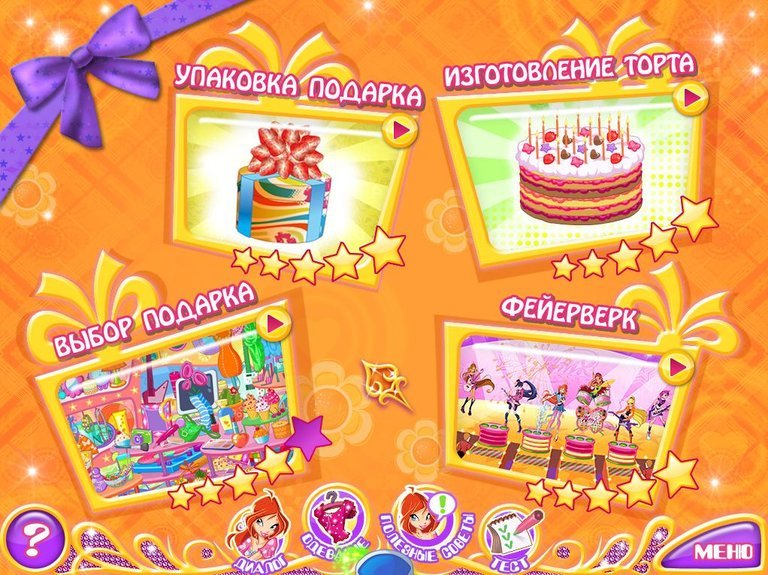
Description
Winx Club: Den rozhdeniya Blum is an educational action-adventure game set in the fantasy realm of Magix, specifically at the Alfea School of Magic. Players assist the Winx fairies in organizing a special birthday celebration for Bloom, the club’s founder, by engaging in activities that teach preschool-aged children about beauty, fashion, and makeup through interactive gameplay.
Winx Club: Den rozhdeniya Blum Reviews & Reception
metacritic.com (83/100): Great game, thanks developers for awesome expirienc.
Winx Club: Den rozhdeniya Blum: A Forgotten Artifact in a Magical Empire
Introduction: The Birthday of an Obscure Fairy
In the sprawling multimedia empire of Winx Club—a franchise that has morphed from a niche Italian cartoon into a global phenomenon spanning television, comics, toys, and dozens of video games—there exist curious tributaries of adaptation that feel both entirely predictable and bizarrely specific. Winx Club: Den rozhdeniya Blum (translated from Russian as “Winx Club: Bloom’s Birthday”) is one such tributary. Released exclusively for Windows in March 2011 by the Russian publisher 1C-SoftClub and Italian rights-holder Rainbow S.p.A., and developed by the little-known PIPE studio, this title represents a fascinating, albeit invisible, intersection of licensed game development, regional market targeting, and the earliest, most literal interpretation of “edutainment” within a franchise built on empowerment and transformation. This review posits that Den rozhdeniya Blum is not a failed action-adventure or a lackluster RPG, but rather a starkly focused, prescriptive, and historically significant beauty simulation aimed at preschoolers, whose existence reveals more about the commercial mechanics of children’s licensing in the early 2010s than its own paltry gameplay. Its legacy is one of profound obscurity and a perfect case study in how a powerful brand can be flattened into a single, simplistic activity for its youngest fans.
Development History & Context: A Studio, a License, and a Niche
The development context of Den rozhdeniya Blum is a puzzle with most pieces missing. The developer, PIPE studio, leaves virtually no digital footprint. No portfolio, no credited staff on major databases beyond this title and a handful of other obscure Russian-localized games (Winx Club: Vecherinka, Winx Club: Volshebnye tantsy—all released in a clustered 2011-2012 window). This suggests a small, likely outsourcing studio in Eastern Europe, adept at rapidly producing licensed software for a local market under the umbrella of a major international licensor.
Rainbow S.p.A., the creator of Winx Club, was at this time aggressively expanding its brand through a “360-degree” strategy, licensing its characters for products across dozens of categories. The 2011 period was deep into the show’s third and fourth seasons, where Bloom’s narrative arc was centered on her Sirenix quest and familial reconciliation (as extensively detailed in the provided source material from the Winx Wiki). Yet, this game ignores that action-packed narrative entirely. Instead, it taps into a different, enduring aspect of the franchise: its core identity as a series about friendship, self-discovery, and personal style.
The technological and gaming landscape of 2011 is crucial. The casual and “girls’ games” market was transitioning from PC CD-ROMs to web and mobile apps. However, in regions like Russia and parts of Eastern Europe, the PC (often running Windows XP) remained the dominant platform for children’s software, distributed on physical discs in toy stores or bundled with magazines. The “Educational” and “Pre-school / toddler” tags on MobyGames are not mere descriptors; they are survival instructions. This was a game designed to be purchased by parents, not demanded by kids who saw ads on Nickelodeon. Its perspective—”Side view”—and genres—”Action, Adventure, Educational”—are likely generic defaults on the submission form, masking a reality of point-and-click interactions and dress-up mechanics. The game’s existence is a direct product of a licensing model where a studio is given a brand, a target age (4-7), and a mandate (“beauty secrets”), and is then contractually obliged to produce a product, however thin.
Narrative & Thematic Deep Dive: A Plot of Pure Prescription
If one expects a narrative echoing the epic Secret of the Lost Kingdom movie or the season-long Sirenix quest, Den rozhdeniya Blum offers a profound shock. There is no Valtor, no Trix, no Dragon Flame crisis. The story, as described in the MobyGames blurb, is a single, stripped-down sentence: “The Winx fairies have decided to throw a party for Bloom… You will learn how to properly choose clothing items and arrange hairstyles. Also learn the secrets of makeup.”
This is not an adaptation of an episode or movie; it is the thematic distillation of the franchise’s aesthetic core into a functional task list. The “plot” is merely a narrative wrapper for a series of beauty tutorials. The player’s role is not to battle or discover, but to assist. The setting—the “land of Magix and the school of magic Alfea”—is not a place of adventure but a backdrop, a branded container for the activities. Bloom herself does not share “secrets of beauty” as a magical ability; she is recast as a brand ambassador for a proto-influencer lifestyle. The underlying theme shifts from the series’ central “finding your inner magic and strength” to a more conventional, and for this franchise, atypical, message: “True magic is in looking your best for your friends.”
This represents a significant, if commercially logical, narrowing of the Winx brand. While the series consistently celebrated makeovers and transformations (each new fairy form is a radical visual shift), those transformations were metaphors for internal growth and mastering one’s power. Here, the transformation is literal, surface-level, and devoid of struggle. It is beauty as an endpoint, not a journey. The only “villain” is a poorly planned party, and the only quest is to achieve aesthetic perfection. For a child steeped in the lore of Bloom’s traumatic past, lost kingdom, and cosmic dragon powers, this must have felt like a profound dissonance—a game that uses the character’s name and setting while hollowing out her entire narrative purpose.
Gameplay Mechanics & Systems: The Beauty Salon as Dungeon Crawler
Deconstructing the gameplay of Den rozhdeniya Blum requires reading between the lines of its description and genre标签. It is almost certainly a point-and-click adventure game with minigame elements, built around a central hub (likely Alfea or Magix City). The core gameplay loop is not combat or exploration, but completion of beauty-related tasks:
- Character Creator: The GamePressure description mentions “the ability to create a new sorceress and then determine her appearance.” This is likely the game’s central “progression” system. Players start by designing an original fairy OC (Original Character), choosing from presets—a significant draw for the target demographic. This OC then serves as the player’s avatar throughout the party-preparation process.
- Station-Based Minigames: The “secrets of beauty” are broken into discrete stations:
- Clothing Selection: A drag-and-drop interface where players match tops, bottoms, accessories, and shoes from a limited wardrobe to achieve a “perfect” Bloom-themed outfit. Success may be judged by a vague “style points” meter or simply by completing the set.
- Hairstyling: An interactive tool where players use mouse or keyboard controls to select a style, apply tools (brush, straightener, etc.), and perhaps add accessories like hair clips or flowers. This simulates the tactile process of hairstyling in a simplified, failure-proof way.
- Makeup Application: Another precision-based minigame. Players would apply foundation, blush, eyeshadow, and lipstick in a specific order, using tools that mimic real-world application (brushes, sponges). The “secret” here is likely the order of application or color matching.
- Exploration & Item Collection: To “visit the land of Magix,” the player probably moves their OC between static screens (Alfea courtyard, library, a boutique) to find items needed for the beauty stations (a special hair serum in the forest, a rare makeup palette from a shopkeeper). This provides a thin veneer of “adventure.”
- The Ultimate Goal: Assemble the “perfect” birthday look for Bloom herself, using the skills learned. The “party” is likely a final, cheerful cinematic where the created OC and the canon Winx fairies celebrate.
Innovative or Flawed Systems: There is no innovation here. The systems are derivative of a dozen 芭比 and Dress-Up games from the era. Its “flaw” is its utter lack of integration with the Winx lore’s actual mechanics. There is no spellcasting tied to confidence, no Charmix earned through kindness, no Believix gained from belief. The only “system” is a series of aesthetic checklists. The UI is likely abright, pink-and-purple-heavy interface with large, clear buttons for young children. The most significant “flaw” from a critical perspective is its complete abandonment of the franchise’s own core narrative themes, reducing one of television’s most powerful female heroines to a passive birthday girl awaiting a makeover.
World-Building, Art & Sound: A Licensed Facade
The game’s world is not built; it is licensed. The art direction does not create a new vision of Magix; it replicates, at best, the visual style of the Winx Club TV series circa Season 3/4 (the “2D” animation style before the later 3D/CGI shift). Screenshots would show flat, brightly colored backgrounds of Alfea’s pink-and-white spires and simple character models with the show’s distinctive large eyes and fashion-forward outfits. The “fantasy setting” is purely cosmetic. The magical dimension is just a themed wallpaper.
The sound design is almost certainly lifted from the series’ stock library: cheerful, melodic background music (likely from the Italian score, given Rainbow’s involvement), sound effects for magic (but used here for makeup “puffs” or clothing “snaps”), and perhaps a few voice lines in Russian from the local TV dub actors reprising their roles as the Winx. The atmosphere is one of perpetual, undemanding celebration. There is no mystery, no lurking danger, no awe. The “magic” is confined to the sparkle effects on a new dress or a successfully applied eyeshadow.
This aesthetic serves the game’s purpose: to make the child feel they are operating within the real Winx Club world, but a version of it that is safe, controlled, and focused on social approval (having the “best” birthday look). It is a world stripped of conflict and consequence, perfectly calibrated for its preschool/toddler “Educational” rating.
Reception & Legacy: The Echo of Silence
Critical and commercial reception for Den rozhdeniya Blum is a void. The MobyGames entry shows zero critic reviews and, at the time of writing, the user review section is also empty, a testament to its complete obscurity even within niche retro gaming circles. It is not listed on major Western review aggregators like Metacritic (the linked Metacritic page is for a completely different Winx Club game by Konami from 2006, a third-person shooter—a bizarre contrast highlighting the franchise’s genre schizophrenia).
Its commercial success can only be inferred from its distribution model. Published by 1C-SoftClub, a powerhouse in Russian/CIS software distribution, it was likely a modest success in its targeted market—sold in newsstands and toy stores alongside Winx DVDs and dolls. It would have been a forgotten purchase within a year, its playtime measured in hours, not the “400 hours” ironically claimed in one of the unrelated Metacritic user reviews for a different game.
Its legacy is purely industrial:
1. A Template for Brand Flattening: It stands as an extreme example of how a complex narrative franchise can be reductively mined for a single, surface-level activity to exploit a younger demographic segment.
2. A Regional Artifact: It highlights the fragmented nature of licensed game development, where a major Italian IP could spawn a Russian-exclusive beauty sim, while Western audiences got action games from Konami. It is a ghost in the machine of the global Winx game library.
3. A Contrast to the Series’ Ethos: For historians and fans, it serves as a curious counterpoint. It proves that even at the height of Bloom’s narrative power—as the Keeper of the Dragon Flame, a princess restoring her kingdom—the most bankable “gameplay” associated with her character could be reduced to selecting a party dress. It underscores the tension between narrative empowerment and commercial simplification in girls’ media.
4. Preservation Failure: Its current state—nearly no online footprint, no playable version on abandonware sites, no video playthroughs—marks it as critically endangered. It is a piece of media so disposable that not even its niche audience has preserved it, a fate sealed by its own lack of substantial content.
Conclusion: A Birthday Present Never Given
Winx Club: Den rozhdeniya Blum is not a bad game in the traditional sense; it is a non-game in the context of its own franchise. It is a branded app before apps, a dress-up box with a license sticker. Its historical value lies entirely in its existence as a data point. It tells us that in 2011, the economic logic of the Winx Club machine was so potent that it could justify the production of a Windows executable whose sole purpose was to guide preschoolers through a virtual beauty regimen, using the names and faces of characters whose true stories revolved around cosmic battles and familial legacy.
To play it would be to engage with the hollowed-out iconography of a more ambitious series. It represents the ultimate commercialization of Bloom’s “birthday”—not her literal birth in a destroyed kingdom, but the birthday of her as a brand identity: a beautiful, friendly, unthreatening figure for the very youngest consumers. Its verdict is one of utter historical insignificance as a game, but profound significance as a cultural artifact. It is the birthday party no one remembers, for a character everyone knows, a silent monument to the most literal and forgettable interpretation of “magic.” In the vast, chaotic, and often glorious Winx Club gaming canon—which includes competent action RPGs and awkward shooters—Den rozhdeniya Blum occupies the uniquely sad niche of being completely irrelevant to anyone, including its own intended audience, the moment the disc was ejected. It is the game that asks you to prepare for a party, but has no party to offer.