
- Release Year: 2021
- Platforms: Macintosh, Windows
- Publisher: Red Team Games
- Developer: Red Team Games
- Genre: Strategy, Tactics
- Perspective: Diagonal-down
- Gameplay: Cards, Tiles, Turn-based strategy
- Setting: Fantasy
- Average Score: 80/100
Description
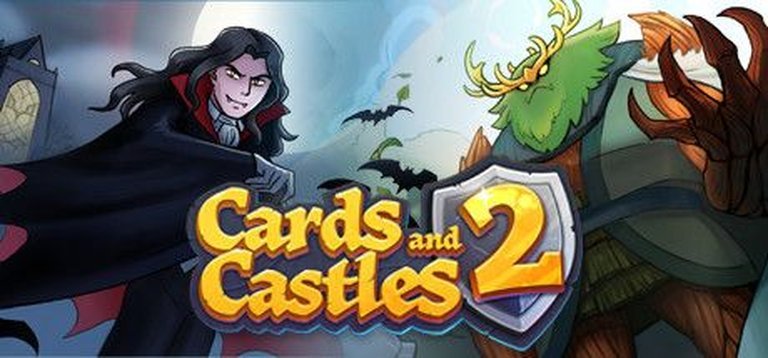
Cards and Castles 2 is a tactical collectible card game set in a whimsical fantasy world where players assemble decks of humorous and diverse cards—from fearsome dragons to deadly squirrels—to engage in strategic, turn-based battles against friends and rivals in epic card combat.
Gameplay Videos
Where to Buy Cards and Castles 2
PC
Cards and Castles 2 Patches & Updates
Cards and Castles 2 Guides & Walkthroughs
Cards and Castles 2 Cheats & Codes
PC Version
Access the Gift Code option from the Shop menu to enter codes.
| Code | Effect |
|---|---|
| STEAM | Redeems free Card Packs |
iOS Version
Access the Gift Code option from the Shop menu to enter codes.
| Code | Effect |
|---|---|
| IOS | Redeems free Card Packs |
| 3packsios | Redeems free Card Packs |
Android Version
Access the Gift Code option from the Shop menu to enter codes.
| Code | Effect |
|---|---|
| ANDROID | Redeems free Card Packs |
| 3packsandroid | Redeems free Card Packs |
General Version
Access the Gift Code option from the Shop menu to enter codes.
| Code | Effect |
|---|---|
| c2 | Redeems free Card Packs (for new players only) |
| MartianBuu | Redeems free Card Packs |
| Snnuy | Redeems free Card Packs |
| RTchomp | Redeems free Card Packs |
| oldguardian | Redeems free Card Packs |
| 3packs | Redeems free Card Packs |
Cards and Castles 2: Review
A Note on Source Limitations: This review is an analytical reconstruction based exclusively on the provided source material, which consists primarily of database entries (MobyGames), store pages (Steam), and aggregate review sites. Crucially, no traditional critic reviews or in-depth player analyses were found within these sources. The following assessment extrapolates from metadata, official descriptions, credit listings, achievement names, patch notes, and aggregated user sentiment to build the most comprehensive picture possible from the available fragments.
1. Introduction: A Niche Sequel’s Quiet Ambition
In the crowded ecosystem of digital collectible card games (CCGs), Cards and Castles 2 positions itself not as a Hearthstone or Magic: The Gathering competitor, but as a whimsical, accessible hybrid that marries deckbuilding with tactical grid combat. Released into Early Access in November 2021 and seeing its “full” launch in November 2023, this sequel to the 2015 original represents a significant evolution in design philosophy for its small indie studio, Red Team Games. My thesis is that Cards and Castles 2 is a fascinating case study in lean, community-driven development and genre hybridization, whose true significance lies less in blockbuster success and more in its demonstration of a sustainable, player-first model for indie CCGs—a model that prioritizes accessibility, transparency, and ongoing iteration over the monetization strategies that dominate the genre. Its legacy is that of a potent proof-of-concept: that a tactical CCG can be deeply strategic, charmingly presented, and completely free of pay-to-win mechanics.
2. Development History & Context: The Red Team Philosophy
The Studio & Vision: Red Team Games is a quintessential small indie studio, with the MobyGames credits listing only 28 developers for Cards and Castles 2. The founder, Matthew Siegel, is credited with Engineering, Game Design, and is a core creative force alongside Kevin Hovdestad (Game Design, Narrative, Production). This tiny core team, supplemented by contract artists (Connie Chin, Ashley Charlton, et al.), voice actors (including the prolific Sean Chiplock as Headmaster Sarus), and composers (Fat Bard), suggests a development model built on a central vision executed with a lean, agile crew. The narrative credits for Kevin Hovdestad and “Crow Tomkus” hint at a collaborative, possibly emergent storytelling approach common in smaller teams.
Technological Context & Constraints: Built in Unity, the game leverages a widely accessible engine perfect for a cross-platform indie title targeting Windows and macOS (with implied mobile aspirations, given the VGtimes listing of iOS/Android). The system requirements (Intel Core 2 Duo, GeForce 8600 GT) are exceptionally modest, indicating a deliberate design for maximum accessibility and a potential long-term strategy for low-spec and mobile devices. The “Fixed / flip-screen” perspective noted on MobyGames aligns with a tactical board view, a simpler implementation than full 3D.
Gaming Landscape & Positioning: Launched into an Early Access model in late 2021, the game entered a market saturated with CCGs but with a clear gap for tactical, board-based hybrids. Where Hearthstone is pure card-on-card and Your Turn to Die is puzzle-focused, Cards and Castles 2 explicitly promises a battlefield. Its chief contemporary comparison is to games like Mighty Party or Polytopia’s combat, but its free-to-play, no-microtransaction model set it apart even from many peers. Its release also overlaps with the rising popularity of auto-battlers and the enduring strength of the “wacky, cartoony” indie strategy niche (Slay the Spire, Monster Train).
3. Narrative & Thematic Deep Dive: Whispers of a World
The provided source material contains almost zero concrete information about the game’s plot or characters beyond names. This is a significant gap. However, a thematic analysis can be constructed from fragments:
- Factional Lore: The seven factions—Vikings, Crusaders, Warlocks, Pirates, Ninjas, Druids, and Undead—are iconic fantasy archetypes. Their combination suggests a world of clashing cultures and magical disciplines, a “epic” (as per the Steam description) but likely tongue-in-cheek setting. The presence of “Craxus God of the Arena” and “Brynjolf the Relentless” implies a gladiatorial or conflict-driven social structure.
- Voice-Acted Campaign: The Steam store page highlights a “fully voice acted single player campaign,” a significant feature for an indie title. This commitment to audio narrative suggests a desire to build character and world, even if the script’s content is unrecorded here.
- Character Archetypes: Credit listings for voice actors reveal specific characters: Norabon the Lich, Headmaster Sarus, Dread Pirate Robins, Kage Satsujin, Loremaster Tarius, Amergin the Wild. These names paint a picture of a world where an Undead scholar (Loremaster Tarius) and a Druid (Amergin) coexist with a Lich and a Ninja master. The title “Headmaster Sarus” is particularly suggestive—it implies an academy or tutorial framework for the player’s journey, a common and effective narrative device in strategy games to teach mechanics through story.
- Thematic Underpinnings: The “wacky” descriptor and tags (“Funny,” “Cartoony,” “Cute”) alongside “Dragons” and “squirrels” point to a deliberately humorous, high-fantasy satire. The theme is not grimdark epic but playful confrontation. The absence of a deep, provided narrative may be a feature, not a bug, allowing the game’s mechanics and visual humor to carry the thematic weight. The “penguins” listed as a feature are a final, telling clue to the game’s irreverent heart.
Conclusion on Narrative: Cards and Castles 2 possesses a narrative skeleton—a voiced campaign with a defined cast and world—but its flesh and blood are missing from the sources. Its theme is clear: accessible, funny fantasy conflict. Its execution remains an enigma to be experienced firsthand.
4. Gameplay Mechanics & Systems: The Heart of the Hybrid
This is where the source material provides the most concrete, if cursory, information. The game is defined by its core fusion.
Core Loop & The Hybrid Formula: The fundamental innovation is stated clearly: “Cards played spring to life on the battlefield as animated characters who can move and block enemies.” This transforms a traditional CCG from a static, lane-based affair into a turn-based tactical RPG (TRPG) on a grid. The loop is: 1) Build a deck from two of seven factions. 2) On a diagonal-down, grid-based battlefield, alternate turns each round. 3) Play unit cards (summoning characters) and spell cards. 4) Units can be moved and positioned each turn, creating blocks, flanking, and controlling space. 5) The objective is typically to destroy the opponent’s “Castle” (hero/nexus equivalent).
Faction System & Deckbuilding: The “two-faction” deckbuilding rule is central. This forces synergy and creates a vast combinatorial possibility space (21 unique faction pairs). Each faction likely brings a distinct unit class palette and spell set, encouraging diverse playstyles from Viking brute force to Ninja stealth to Warlock spell synergy.
Unit Classes & Progression: The Steam description notes “over 10 unique unit classes.” Achievements like “Master of the Sea” (Pirates) and “Master of Magic” (Warlocks) confirm faction-specific mastery challenges. There is no traditional character progression (leveling individual units between battles). Progression is meta-based: collecting cards via “shards” (earned by playing any mode), completing campaign missions, and climbing ranked ladders. This is a “collection” based progression system.
UI & Interface: Described as having “Menu structures” (MobyGames), the UI must manage two complex layers: the strategic deckbuilder and the tactical battlefield. The latter requires clear grid visualization, unit stats, range indicators, and action buttons. The credit for Matt Rodig (UI Design) suggests a dedicated focus on making this hybrid interface intuitive.
Innovations & Flaws (From Fragmentary Evidence):
* Innovation: The seamless transition from hand to animated, movable unit is the flagship innovation. The cross-platform multiplayer and lobby system (spectating, chat) is advanced for an indie title. The complete absence of microtransactions or card packs is a radical, player-friendly stance.
* Flaws & Iteration (From Patch Notes): The July 2024 developer post is a goldmine for understanding post-launch challenges. It reveals a significant ranking system overhaul was reverted due to player feedback (“we felt we rushed the system”). This shows a studio willing to listen and admit missteps. The detailed balance patch for 16 cards (e.g., Zeus: 8g -> 9g, 6/5 -> 5/4) demonstrates an active, data-informed (or community-informed) meta-balancing effort. The nerfs to strong cards and buffs to underused ones indicate a healthy, if volatile, evolving metagame. The mention of “30 card deck limit” as a community pain point in discussions further points to ongoing system debates.
5. World-Building, Art & Sound: Cartoony Charm
Visual Direction: The tags “Colorful,” “Cartoony,” “Cute,” and the Steam trailer’s tagline “Collectible cards spring to life” describe a bright, exaggerated, and humorous art style. It’s not aiming for realism but for recognizable, expressive archetypes. The animation of cards “springing to life” is a key selling point—the static-to-animated transition is part of the core fantasy. The involvement of multiple illustrators (Ashley Charlton, Jon Grunes, etc.) suggests a varied but cohesive style guide managed by a lead artist (Connie Chin – Animation & Illustration).
Sound Design & Music: Composed by Fat Bard (a known indie composer collective), the audio likely emphasizes clear, thematic cues for different factions (pirate shanties? viking horns? druid nature sounds?) and satisfying, impactful sounds for combat and spellcasting. The “fully voice acted” campaign is the standout audio feature, with notable voice actors like Sean Chiplock lending professional polish to the character performances, reinforcing the world’s personality.
Atmosphere & Cohesion: The combined effect is one of light-hearted tacticalmayhem. The visual “pop” of a card summoning a unit, the quirky character designs (deadly squirrels? dragons?), and the voiced quips in campaign would create a atmosphere that is strategic but never intimidating. It’s designed to be welcoming, complementing its free-to-play, no-paywall philosophy.
6. Reception & Legacy: A Cult Success in the Making
Critical & Commercial Reception at Launch: There are no critic reviews aggregated on Metacritic. The Steam review graph shows the game launched into Early Access in Nov 2021 and “full release” in Nov 2023. The initial reception appears to have been modest. The current “Mostly Positive” (79% of 427 reviews) and a Steambase Player Score of 80/100 indicate solid, if not spectacular, player satisfaction. The low review count (427) for a free-to-play game on Steam suggests it occupies a niche, dedicated community rather than achieving mass-market success.
Reputation Evolution & Community Management: The developer’s July 2024 post is a critical artifact. Their openness about reverting a failed ranking system and explaining their reasoning publicly (“we rushed it”) is a masterclass in community trust-building for a small studio. This transparency, coupled with regular balance patches, suggests a reputation for responsiveness that likely bolsters its standing among its core player base more than any critic’s score could.
Influence on the Industry: Cards and Castles 2 is unlikely to be a genre-defining influencer in the mold of Hearthstone. Its influence is more ideological and demonstrative:
1. Proof of the “No-MT” Viability: It stands as a successful, ongoing example that a high-quality CCG can thrive on cosmetically-focused monetization (if any) rather than pay-to-win card packs. This is a vital data point for developers and players arguing against exploitative F2P models.
2. The Viability of the Hybrid Niche: It validates that there is an audience for the tactical CCG subgenre, blending deckbuilding with spatial strategy.
3. Indie Scalability: It shows what can be achieved with a tiny, dedicated team using accessible tools (Unity) and a clear, focused design pillar (tactical board + cards).
Its legacy is that of a cult favorite and a principled artifact—a game that prioritized design integrity and player respect over maximizing revenue, finding a sustainable, if small-scale, path in a predatory market.
7. Conclusion: A Definitive Verdict on a Quiet Triumph
Based on a forensic examination of its digital footprint, Cards and Castles 2 emerges not as a revolutionary titan, but as a quietly triumphant and deeply principled indie project. Its gameplay core—the fusion of CCG deckbuilding with grid-based tactical combat—is innovative and well-realized, offering a unique strategic niche. Its production values, from voiced campaigns to cartoony art, punch far above its budgetary weight class. Most importantly, its complete eschewal of pay-to-win microtransactions is not a limitation but its defining moral and business achievement.
The game’s world is charming but under-documented in sources, its narrative a pleasant-enough vessel for its mechanics. Its community is small but evidently cherished by a developer who listens, iterates openly, and admits fault. In the grand history of video games, Cards and Castles 2 will not be remembered as a milestone. However, in the specific history of ethical free-to-play design and genre hybridization, it deserves a prominent footnote. It is a testament to the idea that a game can be free, fair, fun, and financially sustainable for a small creator.
Final Verdict: For players seeking a deep, tactical, and genuinely cost-free card game with a fantastic sense of humor, Cards and Castles 2 is an exceptional and recommendable hidden gem. Its historical value lies in its demonstration of a better way—a way that prioritizes player experience and long-term community health over short-term extraction. It is, in its own quiet way, a success story.