
- Release Year: 2004
- Platforms: Windows
- Publisher: Her Interactive, Inc., Micro Application, S.A., Noviy Disk
- Developer: Her Interactive, Inc.
- Genre: Adventure
- Perspective: First-person
- Game Mode: Single-player
- Gameplay: Point-and-click, Puzzle
- Setting: Ranch, Western
- Average Score: 78/100
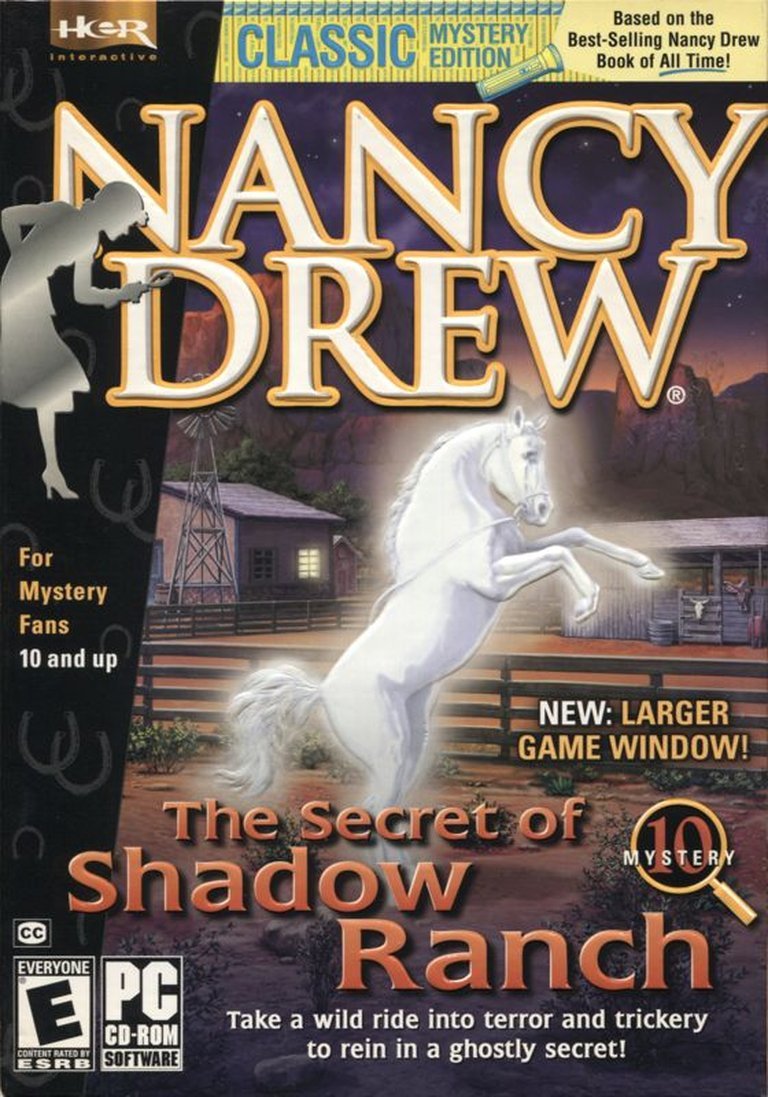
Description
Nancy Drew: The Secret of Shadow Ranch is a point-and-click adventure game where the iconic teenage detective’s vacation at a western-style ranch turns into a perilous mystery after encountering the ghost of the former owner. Players must explore the ranch, solve puzzles, interact with characters, and collect items to unravel a vengeful plot, all based on the best-selling Nancy Drew book of the same name.
Gameplay Videos
Where to Buy Nancy Drew: The Secret of Shadow Ranch
PC
Nancy Drew: The Secret of Shadow Ranch Guides & Walkthroughs
Nancy Drew: The Secret of Shadow Ranch Reviews & Reception
community.herinteractive.com (90/100): This entry has a lot going for it, but the plot is, in my opinion, probably its most impressive asset.
metacritic.com (68/100): The best in children’s games always tries to meld education with fun, and this game does that superbly, with a smooth integration of factoids about various things coupled with critical thinking activities and a fun adventure.
store.steampowered.com (68/100): A wonderful mystery for the whole family! The best in children’s games always tries to meld education with fun, and this game does that superbly, with a smooth integration of factoids about various things coupled with critical thinking activities and a fun adventure.
Nancy Drew: The Secret of Shadow Ranch: A Definitive Historical Analysis
Introduction: A Western Turn for a Timeless Detective
In the pantheon of adventure gaming, few series have sustained a legacy as quietly profound as Her Interactive’s Nancy Drew point-and-click mysteries. By 2004, the franchise had already established a reliable formula: first-person detective work, puzzle-centric progression, and a wholesome, family-friendly ethos. Yet with its tenth installment, The Secret of Shadow Ranch, the series took a decisive leap forward—both technologically and narratively. Loosely adapted from the 1931 novel The Secret at Shadow Ranch (the best-selling Nancy Drew book of all time), this entry transcends its literary source to weave a new, richer tapestry of mystery, history, and atmosphere. Set against the stark beauty of an Arizona dude ranch, the game marries a classic ghost story with a complex scavenger-hunt narrative, creating what is widely regarded as a pinnacle of the series. This review argues that Shadow Ranch represents not merely a high watermark for Her Interactive’s technical and narrative ambitions, but a crystallization of the Nancy Drew adventure game’s core identity: intelligent, immersive, and deeply respectful of its audience’s capacity for deduction and emotional engagement.
Development History & Context: Forging a New Frontier
Studio Vision and The “Classic Mystery” Brand
Her Interactive, under the leadership of President & CEO Megan Gaiser and Creative Director Max Holechek, had by 2004 perfected a sustainable model for episodic Nancy Drew adventures. Shadow Ranch was explicitly marketed as a “Classic Mystery Edition,” a label signifying its basis on the most iconic book in the series. This was a strategic move to leverage literary nostalgia while asserting the game’s standalone merit. Director of Product Development Jennifer Beers and Script Writer/Producer Anne Collins-Ludwick spearheaded a narrative that respectfully diverged from the novel’s plot, using its core premise—a ranch, a phantom horse, a hidden treasure—as a springboard for an original story deeply entangled with local history.
Technological Evolution and Constraints
The game was built on Her Interactive’s proprietary engine, a significant upgrade from previous titles. Most visibly, this manifested in a larger game window and a redesigned, tabbed interface at the bottom of the screen (featuring inventory, journal, and the now-iconic cell phone). This UI overhaul was the first since the series’ 1998 debut, addressing a long-standing critique about cramped visuals. However, this progress came with steep new system requirements: a 400MHz Pentium II, 64MB RAM, and a 16MB 3D accelerator. While modest by today’s standards, this nearly doubled the hardware demands of earlier games, pricing out some older PCs but pushing the series into a more visually competent era. The trade-off was a game with richer environments, more detailed character models, and smoother animations, even if the graphics remained firmly in the pre-rendered 2.5D style of its peers.
The 2004 Gaming Landscape
Release in August 2004 placed Shadow Ranch in a competitive adventure market. It followed the well-received Danger on Deception Island (2003) and preceded the equally acclaimed Curse of Blackmoor Manor (2004). The point-and-click genre was in a transitional phase, with traditional inventory-based puzzles sharing space with narrative-driven experiments. Her Interactive’s steadfast commitment to pure, logic-based adventure—eschewing action, timed sequences, or violent conflict—positioned it as a bastion of “thinking” games in an industry gradually leaning toward action and open-world design. Its ESRB “E for Everyone” rating, with descriptors for “moments of mild violence and peril,” clearly targeted a family audience, a niche few other major adventure franchises (like the later Professor Layton series) would occupy so consistently.
Narrative & Thematic Deep Dive: The Ghosts of Shadow Mountain
Plot Architecture: A Dual-Timeline Masterstroke
The brilliance of Shadow Ranch’s plot lies in its seamless, almost imperceptible, interweaving of two mysteries: Nancy’s present-day investigation and the 1880s tragedy of outlaw Dirk Valentine and Sheriff’s daughter Frances Humber. The present-day frame is elegantly simple: Nancy arrives at a remote Arizona ranch for a vacation with friends Bess and George, only to find their aunt and uncle hospitalized and the ranch plagued by the “phantom horse” of local legend—a glowing white steed whose appearances precede accidents. The investigation unfolds over three days, structured around Nancy’s dual role as guest (helping with ranch chores) and detective.
The historical mystery is revealed not through dry exposition, but as the active, emotional engine of the present-day case. Clues—a trunk lock combination based on a wedding date, a petroglyph map, fragmented journal entries—piece together a gothic romance: Dirk, awaiting execution, hid a treasure (a chest of solid gold hearts) for Frances, leaving puzzles across the landscape. Frances, heartbroken and alienated, never found it. The thematic core is the enduring weight of legacy and unresolved love. The “curse” is not supernatural, but a man-made manipulation of this tragic story for material gain. The resolution is twofold: the capture of the saboteur (ranch hand Shorty Thurmond, seeking the treasure he wrongly believed was on the ranch), and the poignant, posthumous fulfillment of Dirk and Frances’s story when Nancy recovers the treasure and, in a final act of narrative grace, returns Frances’s locket to the Humber family via the sheriff.
Character Study: Ensemble Depth and Missed Opportunities
Thesuspects are archetypal yet layered, each with a plausible motive tied to the land or the treasure lore.
* Shorty Thurmond (The Cook): His motive—get-rich-quick schemes—is openly admitted, making him a charming, talkative red herring for much of the game. His betrayal is shocking precisely because his comic-relief persona masks a desperate, opportunistic greed.
* Dave Gregory (The Foreman): The romantic, polite foil to Tex. His connection is familial: his great-aunt was a cousin to Frances Humber. His motive is one of inheritance and historical curiosity, arguably the most sympathetic. His awkward, genuine affection for Nancy provides rare character warmth.
* Tex Britten (The Wrangler): The gruff, traditional cowboy. His motive is concealed: his sister was fired by the Rawleys, and he is secretly in a relationship with Mary Yazzie, who wants the ranch land. His gruffness softens subtly, revealing a man of principle and hidden loyalty.
* Mary Yazzie (The Gift Shop Owner): The critical weak link. Her motive (acquiring ranch land for petrified wood or other reasons) is clear, but she remains frustratingly passive. Her secret romance with Tex is underdeveloped, and her character feels detached from the core historical mystery, serving mainly as an exposition source for local and Native American history. She is the series’ first significant “false protagonist” suspect, yet her narrative function is primarily informational, a flaw noted by several contemporary reviews.
The phone contacts—Bess, George, Frank, Joe, the Rawleys, Sheriff Hernandez, and the romance novelist Charleena Purcell—are vital narrative arteries. Bess and George’s Stranded-at-the-airport subplot is not filler; it provides crucial research assistance (George identifying bead patterns, Bess finding information on crackers) and reinforces the girls’ loyalty and detective skills. Frank and Joe’s comic subplot about tracking a missing laptop offers levity and demonstrates their continued camaraderie with Nancy.
Dialogue and Thematic Resonance
Dialogue is functional and often educational, delivering facts about horse breeds, Arizona geology, petroglyphs, and colonial-era crackers. This “edutainment” is woven into the mystery’s fabric (e.g., learning horse anatomy to pass Tex’s quiz). The underlying themes—the veneer of myth versus human machination, the persistence of the past in the present, and the idea of treasure as emotional value (Frances’s locket, the gold hearts) versus monetary wealth—are handled with a subtlety uncommon in children’s media. The game posits that the true “treasure” is understanding and closure, a mature beat for a title rated “Everyone.”
Gameplay Mechanics & Systems: Chores, Puzzles, and the Cell Phone Revolution
Core Loop and Structure
Gameplay is a balanced triad: Exploration (riding Bob to new locations via a map screen), Tasks (ranch chores), and Puzzle-Solving (logical and item-based challenges). This structure creates a natural ebb and flow. Days begin with a phone call from Aunt Bet, then open-ended exploration. The three-day timeline is cleverly used: Night 1 features the cookout and pump house explosion, forcing a morning investigation; Night 2 sees Nancy’s gloves glowing with phosphorescent powder, a key narrative device that happens organically; the climax occurs on Day 3.
The Chore System: Immersion or Monotony?
A defining and controversial feature is the integration of repetitive ranch tasks: harvesting specific vegetables, collecting eggs, building a fire, feeding livestock according to a precise ration schedule, baking a cake with precise measurements, barrel racing, and roping practice. These serve three purposes:
1. Immersion: They make Nancy’s extended stay at the ranch feel tangible and grounded.
2. Pacing: They break up intense investigative periods with varied activity.
3. Skill Reinforcement: Tasks like vegetable identification (via the in-game cell phone web search) and horse feeding teach real-world knowledge.
Critically, these are a point of division. Reviews like Just Adventure condemned them as “monotonous,” while others (GameBoomers) saw them as integral to the “well-rounded, well crafted family fun.” The chores are arguably the least “gamey” element, relying on execution over deduction. However, their repetition (vegetables and eggs are picked twice) is a structural weakness, feeling like padding in a game that otherwise rewards observation.
Puzzle Design: Logical, Layered, and Occasionally Frustrating
The main puzzle line is a masterclass in cascading clue integration. It begins with unlocking trunks (using dates from historical records), progresses to decoding messages (a simple letter-number substitution), and culminates in a multi-stage treasure hunt involving tuning forks, petroglyph maps, and a final maze inside cliff dwellings. This “scavenger hunt” is the game’s spine, and its strength is in requiring the player to connect disparate clues learned over time (e.g., the initials “FH” on a tuning fork set lead to Frances Humber).
Standalone puzzles vary in quality:
* Excellent: The trunk lock combination (12-position clock dial), the tuning fork box puzzle (deducing correct placements by testing letter depressions), the “Run for Cover” grid game (a clever, logic-based pathfinding puzzle).
* Functional: The pocket watch puzzles (randomized number depressions), the jewelry sorting puzzle at Mary’s.
* Weak: The “Zebra Rock” magnet puzzle can be opaque due to hidden pathways; the final maze is a source of widespread frustration due to its confusing layout and random key placements, requiring brute-force backtracking.
The UI Revolution: The Cell Phone and Journal
Shadow Ranch’s most significant mechanical innovation is the expanded, tabbed interface. The cell phone is transformative. It replaces static books with a dynamic research tool: web searches for vegetable identification, horse anatomy, and brand meanings; a directory for contacts; and a camera for examining items (like the pocket watch). This makes Nancy feel like a modern detective and streamlines information access. The journal automatically logs key plot points and conversations, a crucial aid given the game’s dense historical detail. The inventory is now a large, scrollable toolbox, a vast improvement over the cramped earlier iterations. The only UI flaw is the two-step process for some inventory interactions (e.g., selecting an item, then selecting a “use” function), a minor friction point.
Difficulty Modes: Senior vs. Junior
The dual difficulty system primarily affects puzzle hints and complexity. Junior Detective provides a task list in the journal and simplifies puzzles (e.g., fewer pieces in the egg basket repair, simpler maze layouts). Senior Detective removes the task list, requiring the player to track chores independently, and presents more complex puzzles. Crucially, as with all Nancy Drew games, the plot remains identical. This was a forward-thinking accessibility feature, allowing younger or less experienced players to enjoy the narrative without being blocked by logic hurdles.
World-Building, Art & Sound: The Ranch as Character
Visual Design and Atmosphere
The art direction, led by Art Director Sheila Caillier, is a triumph of cohesive environmental storytelling. The Arizona desert is rendered in warm, sandy palettes with striking red rock formations (Cougar Bend). The Shadow Ranch house is a standout: a rustic, multi-room hacienda with clay tile floors, wooden beams, a stone fireplace, and Southwestern textiles. Every room is packed with period-appropriate clutter—books on horses, recipe boxes, old letters—making the space feel lived-in and historically layered. The ghost town of Dry Creek is a masterpiece of atmospheric dread. Its dilapidated buildings—the jail, the saloon (Cappy’s), the bank—are rendered with haunting detail, the silence broken only by wind and creaking wood. This location, in particular, leverages its desolation to generate genuine suspense, a rarity in the series.
Character models, while still using pre-rendered sprites, show marked improvement in expressiveness and detail. Tex’s craggy face and Dave’s earnest eyes convey personality effectively within the technical limits. The animation, especially for horse riding and riding crops, is fluid for the era.
Sound Design and Score
Composer Kevin Manthei delivers what many fans consider the series’ best soundtrack. The score masterfully blends ambient desert winds, tense minor-key melodies for investigative moments, and upbeat, harmonica-and-accordion-driven themes for ranch life, creating an authentic “Western” feel that never feels cliché. The sound effects are crisp: the crunch of gravel underfoot, the whinny of horses, the crackle of the campfire. Voice acting, a perennial strength for Her Interactive, is exceptional here. Lani Minella’s Nancy is confidently intelligent without being abrasive. Special praise goes to Gary Hoffman (Tex/Sheriff/Dirk) and Stephen Hando (Dave) for bringing gravitas and nuance to their roles. Jonah Von Spreecken’s loquacious Shorty is perfectly cast as the gossipy cook.
The Phone as a World-Building Tool
The in-game cell phone does more than advance puzzles; it roots the game in a believable 2004. Searching for “Kelleher crackers” or “Nez Perce Appaloosas” on a simulated web browser (with period-appropriate search results) makes the research feel active and rewarding, a clever analogue to modern smartphone use that avoids breaking the 2004 setting’s realism.
Reception & Legacy: A Benchmark Achieved
Critical Reception
Reviews at launch were strongly positive, with an average critic score of 76% based on 11 ratings, significantly higher than some preceding titles like The Final Scene or Secrets Can Kill. Edutaining Kids gave a perfect 100%, praising its atmosphere (though noting it was “less moody” than predecessors) and satisfying challenge. GameZone (90%) hailed it as “a wonderful mystery for the whole family,” lauding its educational integration. Quandary (80%) called it “the biggest and, arguably, one of the best yet,” highlighting the improved UI and tougher puzzles.
The criticisms were specific and consistent. Adventure Gamers (60%) felt it “lacks a certain surprise factor” compared to benchmarks like Danger on Deception Island and found the plot “flat.” Just Adventure (50%) delivered a scathing takedown of the puzzle design, particularly the maze, calling it “shameful” and un-recommendable. The consensus was that while the setting and story were top-tier, some puzzle implementations were flawed and chores could be tedious.
Commercial Performance and Franchise Impact
By August 2006, the PC version had sold between 100,000 and 300,000 units in the US. In the context of Her Interactive’s total sales of 2.1 million copies for the series by that date, Shadow Ranch was a significant contributor. Edge magazine famously cited the entire Nancy Drew series as a “powerful franchise” in its 2006 “Top 100 PC Games of the 21st Century” list, with Shadow Ranch’s commercial and critical success a key data point.
Legacy and Influence
1. Technical Template: The new UI (larger window, tabbed interface, robust cell phone) became the standard for all subsequent Her Interactive adventures for over a decade, until the shift to 3D in Midnight in Salem (2019).
2. Narrative Ambition: It demonstrated that the series could handle a dual-timeline, emotionally complex mystery with genuine historical weight. This raised the narrative bar for future entries, which increasingly wove past and present stories together (e.g., The Creature of Kapu Cave, The White Wolf of Icicle Creek).
3. Brand Expansion: Its success as a “Classic Mystery” cemented the viability of re-interpreting the classic books with new plots, a strategy used for Secret of the Old Clock (2005) and others.
4. Mobile Precursor: The 2011 mobile adaptation, Nancy Drew Mobile Mysteries: Shadow Ranch, was an early experiment in transmedia, blending the game’s assets with the original novel’s text into an interactive book app. This foreshadowed later