
- Release Year: 2003
- Platforms: GameCube, PlayStation 2, Windows, Xbox
- Publisher: Electronic Arts, Inc.
- Developer: Electronic Arts Canada
- Genre: Sports
- Perspective: 3rd-person
- Game Mode: Online PVP, Single-player
- Gameplay: AI, Ball Physics, Freestyle, Off-the-ball control, Team Management
- Setting: Real-world
- Average Score: 90/100
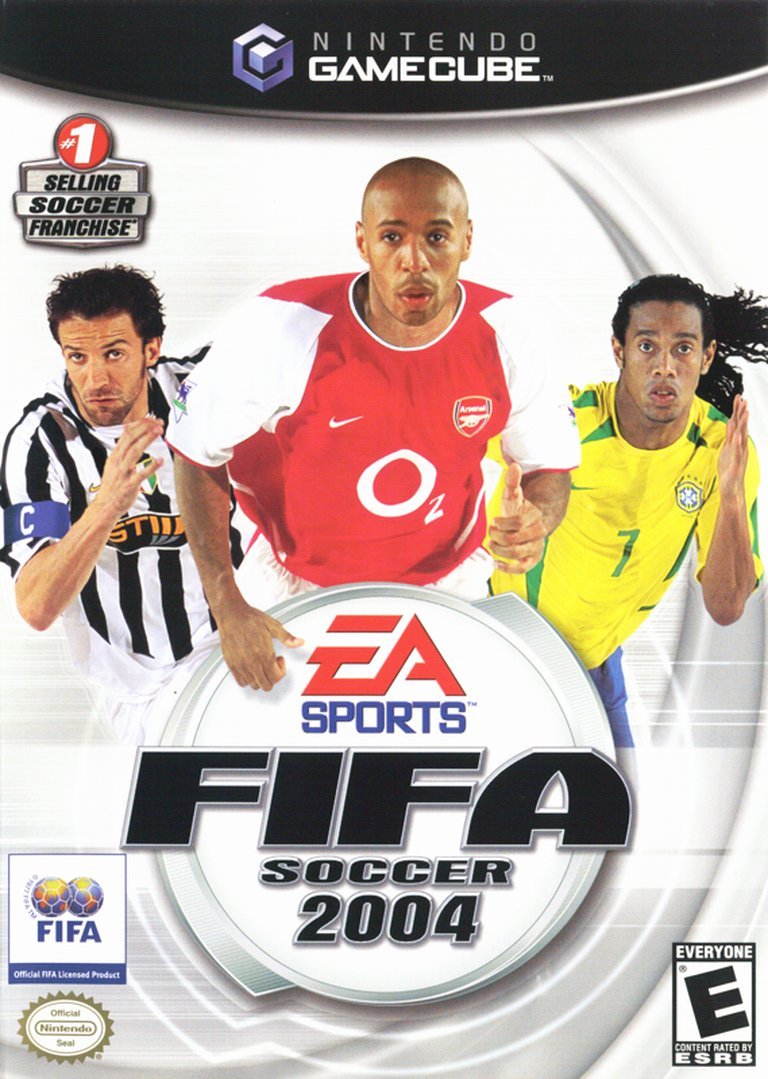
Description
FIFA Soccer 2004 is a comprehensive soccer simulation game featuring eighteen licensed leagues, thirty-five national teams, and over ten thousand real players. Players can engage in single matches, tournaments, or an in-depth career mode that involves managing team budgets, negotiating contracts, and promoting or demoting players to achieve success over multiple seasons. The game introduces Freestyle gameplay using the right analog stick for advanced skills like bicycle kicks and precise passing, and integrates with EA Sports Bio on consoles for cross-title progression and rewards.
Gameplay Videos
FIFA Soccer 2004 Free Download
PlayStation 2
FIFA Soccer 2004 Mods
FIFA Soccer 2004 Reviews & Reception
metacritic.com (100/100): Not to be outdone by “Winning Evening 6,” EA Sports has pulled out all the stops and created a soccer game that is second to none.
imdb.com (80/100): FIFA 2004 has left a significant mark on the history of football simulators.
FIFA Soccer 2004 Cheats & Codes
GBA
| Code | Effect |
|---|---|
| 00006496 000A | Master Code |
| 100207CE 0007 | Master Code |
| 96647CCA7721 | Master Code |
| D604755EF318 | Infinite Sprint |
| 436A3BFC5800 | Player 1 Can’t Score |
| 036A3BF45840 | Player 1 Starts With 5 Goals |
| 476ABBDE5A00 | Player 2 Can’t Score |
PlayStation (Classic-Cheats)
| Code | Effect |
|---|---|
| 24D1A6AA 9676C509 | (Must Be On For “Scores 5 Per Goal” Cheats) |
| 24D3A6A8 16748529 | (Must Be On For “Scores 5 Per Goal” Cheats) |
| 2452B628 5E74C510 | (Must Be On For “Scores 5 Per Goal” Cheats) |
| 24D3B628 1654C538 | (Must Be On For “Scores 5 Per Goal” Cheats) |
| 24D2A6A8 0676C58A | (Must Be On For “Scores 5 Per Goal” Cheats) |
| 2450B688 9274C5A9 | (Must Be On For “Scores 5 Per Goal” Cheats) |
| 2450B688 1274C599 | (Must Be On For “Scores 5 Per Goal” Cheats) |
| 2451B62E 9B6E8DB8 | (Must Be On For “Scores 5 Per Goal” Cheats) |
| 24D2B488 1256C509 | (Must Be On For “Scores 5 Per Goal” Cheats) |
| 24D1B568 10F64778 | (Must Be On For “Scores 5 Per Goal” Cheats) |
| 0410B628 1674C508 | Player 1 Scores 5 Per Goal |
| 0410B628 1674E508 | Player 2 Scores 5 Per Goal |
| 249101B0 10BCCEE1 | Start Career With 64000 Points |
| 249031A0 1534D13B | Disable Career Spending |
| 248030AC 1CBC9183 | Disable Career Spending |
| D4C01A77 9F38DE46 | Reset Clock (Hold Select & Press L2) |
| 24D03468 36F04598 | Reset Clock (Hold Select & Press L2) |
| D4C01A67 9F389E46 | End Half (Hold Select + Press R2) |
| 24D03478 36F00598 | End Half (Hold Select + Press R2) |
| 254F68D6 CB8B8AB7 | Max Bio Points (This Game) |
| 24D3BE88 1F4E8108 | (Must Be On For “Increase Team Score” Cheats) |
| 2450B6A2 17748129 | (Must Be On For “Increase Team Score” Cheats) |
| 24D3BE88 1F4E8119 | (Must Be On For “Increase Team Score” Cheats) |
| 24D3BE88 9F4E8138 | (Must Be On For “Increase Team Score” Cheats) |
| 24C0B6AE 1E7C8181 | (Must Be On For “Increase Team Score” Cheats) |
| 24D3BE88 9F4E81A9 | (Must Be On For “Increase Team Score” Cheats) |
| 24D1A6AA 9666C199 | (Must Be On For “Increase Team Score” Cheats) |
| 24D2B6A0 9657C1B9 | (Must Be On For “Increase Team Score” Cheats) |
| 24D2B4A4 1657C109 | (Must Be On For “Increase Team Score” Cheats) |
| 2440BC36 166E8822 | (Must Be On For “Increase Team Score” Cheats) |
| 24911168 30765314 | (Must Be On For “Increase Team Score” Cheats) |
| 254F6BD6 CB0B8A97 | Max Bio Points (All Games) |
| D4C01A77 9E389E46 | Increase Home Team Score (Hold Select & Press L1) |
| 2453B6A8 1665C129 | Increase Home Team Score (Hold Select & Press L1) |
| D4C01A77 9F389E4E | Increase Away Team Score (Hold Select & Press R1) |
| 2453B6A8 1665C189 | Increase Away Team Score (Hold Select & Press R1) |
PS2
| Code | Effect |
|---|---|
| FA7A006E 32974EF1 | Code Breaker Version 1-5 Enable Code (Must Be On) |
| 9A5C35CD 188369F2 | Code Breaker Version 6+ Enable Code (Must Be On) |
| 2A2B7BEA 0000???? | Home Team Score Modifier |
| 2A177BEA 0000???? | Away Team Score Modifier |
| 2AEB3EA9 24030000 | All Goal’s Score For Home Team |
| 2AEB3EA9 24030004 | All Goal’s Score For Away Team |
| 1A22C884 000000?? | Goal’s Score Modifier |
| 2A472D76 00000000 | Infinite Budget Points Usage |
| DA840103 B2A35D4D | Away Team Start With Score Modifier |
| 2A177BEA 0000???? | Away Team Start With Score Modifier |
| DA880103 B2AF5D4D | Home Team Start With Score Modifier |
| 2A2B7BEA 0000???? | Home Team Start With Score Modifier |
| 2AACC91F 3463E0FF | Max Budget Remaining |
| 2AA8C91F ACE30028 | Max Budget Remaining |
| 2A94C91F 03E00008 | Max Budget Remaining |
| 2A90C91F AD030010 | Max Budget Remaining |
| 2A532D62 0C030088 | Max Budget Remaining |
| 2A5F2D62 3C0305F5 | Max Budget Remaining |
| DA261254 B20E4519 | P1 Press L1+L2 For More Time |
| 1AF10590 00000000 | P1 Press L1+L2 For More Time |
| DA261254 B20E4019 | P1 Press R1+R2 To End Half |
| 1AF10590 00000170 | P1 Press R1+R2 To End Half |
| DA261255 B20E4518 | P2 Press L1+L2 For More Time |
| 1AF10590 00000000 | P2 Press L1+L2 For More Time |
| DA261255 B20E4018 | P2 Press R1+R2 To End Half |
| 1AF10590 00000170 | P2 Press R1+R2 To End Half |
| DA261256 B20E451B | P3 Press L1+L2 For More Time |
| 1AF10590 00000000 | P3 Press L1+L2 For More Time |
| DA261256 B20E401B | P3 Press R1+R2 To End Half |
| 1AF10590 00000170 | P3 Press R1+R2 To End Half |
| DA261257 B20E451A | P4 Press L1+L2 For More Time |
| 1AF10590 00000000 | P4 Press L1+L2 For More Time |
| DA261257 B20E401A | P4 Press R1+R2 To End Half |
| 1AF10590 00000170 | P4 Press R1+R2 To End Half |
| DA261250 B20E451D | P5 Press L1+L2 For More Time |
| 1AF10590 00000000 | P5 Press L1+L2 For More Time |
| DA261250 B20E401D | P5 Press R1+R2 To End Half |
| 1AF10590 00000170 | P5 Press R1+R2 To End Half |
| DA261251 B20E451C | P6 Press L1+L2 For More Time |
| 1AF10590 00000000 | P6 Press L1+L2 For More Time |
| DA261251 B20E401C | P6 Press R1+R2 To End Half |
| 1AF10590 00000170 | P6 Press R1+R2 To End Half |
| DA261252 B20E451F | P7 Press L1+L2 For More Time |
| 1AF10590 00000000 | P7 Press L1+L2 For More Time |
| DA261252 B20E401F | P7 Press R1+R2 To End Half |
| 1AF10590 00000170 | P7 Press R1+R2 To End Half |
| DA261253 B20E451E | P8 Press L1+L2 For More Time |
| 1AF10590 00000000 | P8 Press L1+L2 For More Time |
| DA261253 B20E401E | P8 Press R1+R2 To End Half |
| 1AF10590 00000170 | P8 Press R1+R2 To End Half |
FIFA Soccer 2004: The Pivot Point – A Comprehensive Historical Review
Introduction: The Beautiful Game, Rebalanced
In the annals of sports video games, few franchises carry the weight of expectation quite like EA Sports’ FIFA. By 2003, the series was a global institution, yet it faced an existential crisis: a decade of dominance was being challenged by Konami’s Pro Evolution Soccer (PES), a rival lauded for its purer, more tactile simulation of football. Released in October 2003 with the tagline “Create Brilliance,” FIFA Soccer 2004 (known as FIFA Football 2004 in Europe) was not merely an annual roster update. It was EA’s comprehensive, high-stakes response—a deliberate tactical retreat from arcade flair toward a more considered, realistic, and ultimately deeply influential simulation. This review argues that FIFA 2004 represents the series’ most significant and necessary evolutionary step, a game that consciously traded some of its historic accessibility for depth, atmosphere, and strategic complexity, successfully closing the gap with its rival and redefining the baseline for all subsequent football simulations. Its legacy is not in perfecting a formula, but in courageously rebuilding one.
1. Development History & Context: The Pressure Cooker of 2003
Studio & Vision: Developed by the veteran team at EA Canada, the studio behind the series since its inception, FIFA 2004 was produced under the executive leadership of Rory Armes. The development philosophy was clearly one of reactive innovation. The undeniable critical darling of 2003 was Winning Eleven 6 / Pro Evolution Soccer 3, which had captured the hearts of European critics and hardcore fans with its superior ball physics, player momentum, and passing intelligence. EA’s response was not to superficially copy PES, but to identify and shore up its own weaknesses while introducing new, systemic features that pushed the series forward on its own terms.
Technological Constraints & The 6th/7th Gen Transition: The game launched across a crowded field: PlayStation 2, Xbox, GameCube, Windows PC, PlayStation 1, Game Boy Advance, and N-Gage. This multi-platform mandate meant the core engine had to scale. While the PS2, Xbox, and GameCube versions shared the flagship “next-gen” features (most notably the “Off the Ball” control), the PS1 version was a starkly different, stripped-down product with none of these innovations, as noted in its MobyGames description. The era was defined by the burgeoning potential of online console play (PS2’s online adapter) and the refinement of 3D animation pipelines. EA leveraged this to push player likenesses and stadium atmospherics, areas where they had always held an advantage in licensing and presentation.
The Gaming Landscape: The 2003 sports gaming landscape was a duel. On one side, EA’s Madden NFL 2004 and NBA Live 2004 dominated their American sports with a blend of flash and franchise depth. On the other, Konami’s PES3 had achieved the unthinkable: dethroning FIFA in the eyes of the most discerning critics. FIFA 2004 landed in this crossfire, tasked with defending its title as the world’s best-selling football game while proving its simulation credentials were now as valid as its commercial might.
2. Narrative & Thematic Deep Dive: Simulating the Drama of “The Beautiful Game”
FIFA 2004, as a pure sports simulation, possesses no traditional plot or scripted characters. Its “narrative” is emergent, generated by the player through the Career Mode and the match engine itself. This is where the game’s thematic heart—“Create Brilliance”—is fully realized.
- The Career Mode as a Narrative Engine: For the first time in the series, the Career Mode was a truly engaging, multi-season journey. The inclusion of secondary divisions (e.g., England’s Coca-Cola League One/Two) was revolutionary. It allowed players to script their own underdog story, taking a lowly club from obscurity, battling for promotion, managing budgets, negotiating contracts, and developing youth. This wasn’t just a menu; it was a sandbox for footballing narratives. The theme here is one of progression and legacy, echoing the real-world dreams of managers and club owners. The mode’s depth, while still nascent compared to dedicated management sims, provided a persistent world where results had consequence.
- Matchday as Theater: The narrative of each 90-minute match is one of tactical struggle and spontaneous creation. The new “Off the Ball” control system was a direct narrative enhancer. By allowing players to control a secondary receiver while the ball-carrier was still moving, it enabled the scripting of complex attacking moves—a one-two pass, a curved run behind the defense—that felt deliberate and intelligent, rather than relying on AI whims. This shifted the game’s storytelling from “wonder goals from nowhere” to “well-worked team moves,” aligning more closely with the thematic ideal of collective brilliance.
- Atmosphere as Characterization: The game’s world—its stadiums, crowds, and commentary—acts as a silent protagonist. The use of real stadiums (with licensing from architects like Jean-Pierre Buffi and Roger Taillibert) and dynamic day/night cycles creates distinct personalities for each venue. The deafening, authentic crowd chants, the specific visual flair of the San Siro or Old Trafford, and the authoritative commentary of John Motson and Ally McCoist all work to situate the player within the grand theater of world football. The emotion isn’t scripted; it’s environmental.
3. Gameplay Mechanics & Systems: The Crucible of Change
This is the core of FIFA 2004‘s revolution. The foundational gameplay loop—control, pass, shoot—was being fundamentally altered.
- The “Off the Ball” (Freestyle) Control System: The headline innovation. By pressing and holding the right analog stick, players could switch control to any teammate off the ball. This was not a gimmick; it was a paradigm shift in tactical control. It allowed pre-emptive movement into space, better positioning for crosses and set-pieces, and the ability to orchestrate attacks without constantly switching to the ball-carrier. Reviews were divided: GameStar (Germany) noted a steep learning curve (“die famose Fingerakrobatik“), but celebrated the resultant “fantastic Spielzüge” (moves). IGN and GameSpot acknowledged it made the game more realistic but less immediately accessible. The flaw was its implementation: the AI teammates sometimes failed to react appropriately, and the manual control could feel disconnected from the main action.
- Ball Physics & “Dribbling”: The ball was now a more independent, weighty object. This improved realism in long passes and shots but created a noted flaw in close control. Multiple reviews (PC Action (Germany), 4Players.de) lamented that receivers often “stood still” instead of moving toward the ball, and that dribbling past a defender remained awkward. The game moved from a “super arcade” feel (JeuxVideoPC.com) to something “stiffer” and more simulation-oriented, but the dribbling mechanic hadn’t yet achieved the fluidity of PES3.
- The Career Mode Ecosystem: More than just a franchise mode, it was a complete club simulation loop. Transfers were now based on player form and scouting. Budgets had to be managed. Player development (promotion/demotion) and contract renegotiation added a layer of strategic depth previously unseen in the series. GamePro noted it was “in-depth,” though some (PC Gamer) felt its impact on match outcomes was minimal, making it a “nice addition” rather than a core feature. The Football Fusion feature, linking with Total Club Manager 2004, was a brilliant, forward-thinking idea that allowed management decisions to be tested on the pitch, though it remained a niche connectivity experiment.
- Set-Pieces & Special Moves: The game introduced more dynamic corner and free-kick routines. The famed “screamer” from distance was a powerful, if sometimes overpowered, tool, as noted in user reviews on IMDb. Bicycle kicks and other acrobatic moves added visual spice.
- UI & Presentation: The EA Sports Bio system, linking progress across Madden 2004 and NBA Live 2004, was a novel cross-franchise engagement tool. The menus were slick, licensed, and TV-style, but some (Jeuxvideo.com) found them confusing. The progressive scan support on GameCube and Xbox was a technical high-water mark for console sports visuals of the era.
4. World-Building, Art & Sound: The Unassailable Fortress
If FIFA 2004 stumbled slightly on the pitch, it conquered the presentation entirely. This was EA’s traditional home-field advantage, and they expanded it decisively.
- Visuals & Player Models: The player models were significantly more detailed and facially recognizable than in FIFA 2003. Animations for running, shooting, and celebrating were fluid and, for the time, exceptionally realistic. The stadiums were the star—recreated with architectural accuracy, filled with thousands of individually rendered fans who reacted to the match’s ebb and flow. The dynamic time-of-day system meant playing under the Friday night floodlights of a European ground felt utterly distinct from a Sunday afternoon kick-off. However, as Computer Bild Spiele (GameCube) pointed out, the GameCube’s hardware struggled with the distant camera view, causing player models to “blur into unrecognizability.”
- Soundscape: This was a masterpiece of sports game audio. John Motson’s iconic, gravel-voiced commentary (paired with Ally McCoist) provided a layer of instant legitimacy and broadcasting heritage. The sound design was immersive: the crunch of tackles, the roar of the crowd swelling for a counter-attack, the specific chants of clubs like Werder Bremen (64 Power). The soundtrack, featuring indie and pop tracks like Kings of Leon’s “Red Morning Light,” was contemporary and energetic, framing the game in a modern, youthful context.
- Licensing: The Ultimate Power: FIFA 2004‘s world was built on a monumental licensing advantage. With over 10,000 players, 18+ leagues (including all three English Football League divisions), and 35+ national teams, it offered an authenticity PES3 simply could not match. For the global football fan, this was the game’s killer app. As Games TM conceded, “EA holds all the aces… off the pitch.”
5. Reception & Legacy: The Bridge to the Modern Era
Critical Reception at Launch: Metacritic and GameRankings scores ranged from the low 70s (N-Gage) to mid-80s (PS2, Xbox, GameCube), solidifying its status as a “generally favorable” title. The critical consensus was remarkably consistent: FIFA 2004 was a massive, necessary improvement over 2003, but still didn’t eclipse PES3 in pure gameplay feel.
- The “Closing the Gap” Narrative: Publications like Official UK PlayStation 2 Magazine declared, “PES keeps its nose ahead, but this is the best FIFA title ever.” Eurogamer perfectly captured the tension: “FIFA completely kicks PES’ arse all over the park” in terms of peripheral features (licenses, online, presentation), but “we just don’t enjoy playing FIFA as much as we do PES3.” This was the central critique: the on-pitch gameplay still lacked the seamless physics and player intelligence of its rival.
- Praises: The “Off the Ball” system was widely seen as a bold, successful step forward. The Career Mode’s depth and the secondary divisions were huge wins for solo players. The graphics, sound, and licensing were universally lauded as best-in-class. The addition of online play on PS2 was a landmark.
- Criticisms: The ball physics and dribbling were still problematic. The new control scheme had a steep learning curve. Some felt the game was too “sticky” or “stroev” (clunky), lacking the fluid “Spielfluss” (flow) of PES. The PS2 version’s occasional frame rate drops (4Players.de) were a technical blemish.
Commercial Success & Industry Impact: The game was a major commercial hit. The PS2 version earned an ELSPA “Double Platinum” award for over 600,000 UK sales alone. Its success demonstrated that EA could innovate aggressively and retain its mass-market audience. Its legacy is profound:
- The “Off the Ball” Standard: This feature became a permanent, foundational pillar of the FIFA series, evolving into the sophisticated “Team Play” and tactical instructions of today. It forced the entire sports game genre to consider off-ball movement as a core control layer.
- Career Mode Blueprint: The multi-division, manager-integrated career mode set the template for the next decade. It directly evolved into the “Be a Pro” and “Career Mode” experiences that became staples.
- Presentation as Packaging: It cemented the formula of hyper-realistic stadiums, licensed commentary, and authentic soundscapes as non-negotiable for a premium sports title.
- The Persistent Rivalry: FIFA 2004 marked the moment EA fully engaged in the “arms race” with Konami. For the next half-decade, the yearly one-upmanship between FIFA and PES drove unprecedented innovation in gameplay systems, physics, and presentation.
- Cross-Franchise Synergy: The EA Sports Bio and Football Fusion experiments, while not directly continued, presaged the modern era of “live services,” companion apps, and interconnected gaming ecosystems.
6. Conclusion: A Flawed Masterpiece, A Necessary Pivot
FIFA Soccer 2004 cannot be judged in a vacuum. To evaluate it as simply “the best football game of 2003” is to miss its historical significance. It is, instead, the most important transitional entry in the series’ history. It is the game that said, “We hear you,” to the critics demanding more realism, and “We see you,” to the fans craving deeper experiences.
Its flaws are clear in a modern context: the dribbling is laborious, the ball sometimes defies physics, and the “Off the Ball” system can feel like operating two separate games. Yet, within its 2003 context, these were the necessary growing pains of evolution. It sacrificed some of its historic, pick-up-and-play joy to build a deeper, more rewarding, and more authentic strategic foundation.
The verdict is this: FIFA 2004 is not the pinnacle of the series, but it is the crucial bridge to the pinnacle. It was the title that successfully married EA’s unparalleled licensing and presentation power with a genuine, meaningful attempt at simulation-level gameplay depth. It closed the credibility gap with PES and set the stage for the FIFA titles of the late 2000s and 2010s that would eventually reclaim the absolute critical crown. For any historian of the genre, FIFA 2004 stands as a bold, imperfect, and ultimately triumphant statement of intent—the moment EA Sports decided to stop just making the world’s most popular football game and started trying to make the world’s best. In doing so, it achieved a brilliance all its own.
Final Score: 8.5/10
Historical Rating:★★★★★ (5/5) – The Essential Evolutionary Pivot